Description
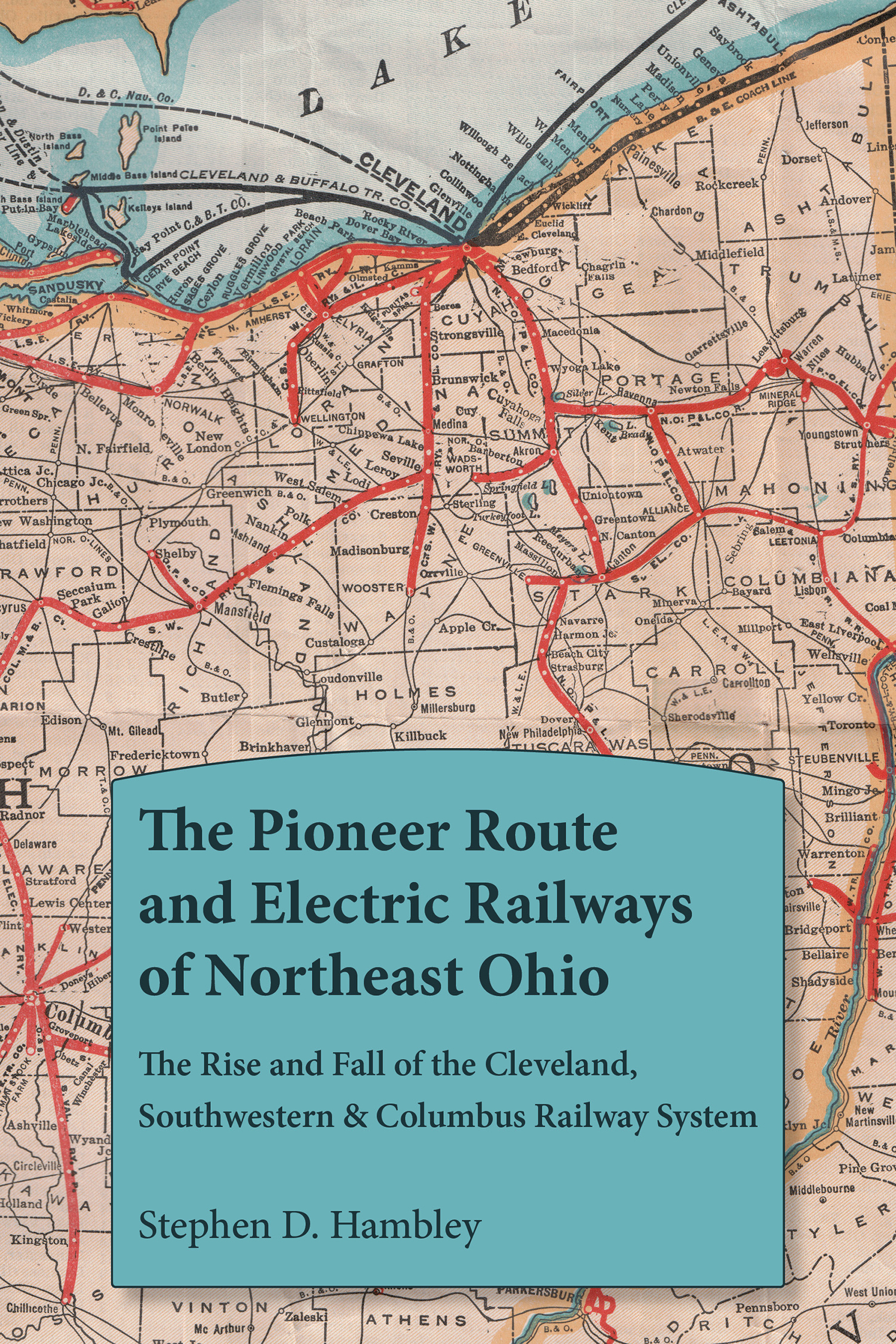
The Pioneer Route and Electric Railways of Northeast Ohio presents mass transit in the nineteenth- and twentieth-century urban United States from a business history perspective. Starting in the 1890s, a revolution in transportation—interurbans—emerged from Ohio’s largest cities and, within a single decade, extended throughout the surrounding countryside. These systems of interconnecting electric railways were made possible by a favorable political and business culture and fed by an insatiable demand. Driven by a growing population and the desire for efficient transportation services, nascent business organizations acquired the cash, approval of local governments, and essential support of the incipient electrical goods manufacturing industry. In all of this, Ohio would be the leader. Ohio’s people, businesses, and resources cultivated the emergence of the electric railway industry to a scale unsurpassed elsewhere in the US.
The rise and fall of one of its’ largest systems, the Cleveland, Southwestern & Columbus Railway, demonstrates how this marvel of transportation engineering and business acumen developed in Ohio and the effect it had on the Cleveland metropolitan region. Known originally as the Pioneer Route, the Cleveland, Southwestern & Columbus Railway was constructed by a group of investors, bankers, promoters, and industrialists. The CS&C is an ideal example of how an interurban led the way to the development of a modern rural infrastructure in the region.
About the author
Stephen D. Hambley has been an elected official for over thirty years, serving as a Medina County Commissioner, a Brunswick City Councilman, and as a member of the Ohio House of Representatives. He earned a PhD in history from The University of Akron, where he was twice awarded a Martin Scholarship. For over twenty years, he taught history, political science, and urban studies at Lorain County Community College, The University of Akron, Cleveland State University, and Lakeland Community College. He is the author of Historic Tales of Medina County, Ohio.
Praise for The Pioneer Route and Electric Railways of Northeast Ohio
I find that most books about former railroad and interurban lines fall into three categories. The first are picture books, with pictures, captions and little other text. The second are history books, where the author has done some research and tells where and when the line ran and what kind of rail cars were used. The third are books where the author has taken a much deeper look into the workings of the line. The Pioneer Route and Electric Railways of Northeast Ohio falls into all three of these groups. Stephen Hambley has done a thorough business analysis of the Cleveland, Southwestern and Columbus Railway (The Pioneer Route) and compared it to the industry as a whole. The basic history of the line is told, and the line’s successes and failures are explored. The book is punctuated with photos gleaned from many sources. This is a must-read for everyone with an interest in Northeast Ohio’s early rail transportation.
—Walt Stoner, president, Northern Ohio Railway Museum
Stephen Hambley provides a welcome, granular account of one of the most significant interurban railways in the state with the most developed interurban system. In so doing, The Pioneer Route and Electric Railways of Northeast Ohio provides fresh insights on how interurbans developed; how they blurred urban-rural boundaries by stitching together cities, towns, villages, and farms socially, culturally, and economically; and why, despite a drumbeat of sometimes surprising innovations, this novel transportation service ultimately declined as rapidly as it had risen. With a constant eye toward national context, Hambley illuminates what was a signal contributor to regional development.
—J. Mark Souther, professor of history, Cleveland State University and author of Believing in Cleveland: Managing Decline in “The Best Location in the Nation”