On the way to Agra, we stopped at Fatepur Sikri, a ghost city with palaces and a mosque that were abandoned over 400 years ago after the people living there suffered from water shortages. The mosque is actually still used for worship. At its prime, this city was larger than London and was constructed by Akbar the Great, regarded as the greatest of the Mughals.
All of the structures we saw were intricately detailed and made out of red sandstone. At one time the designs included precious stones and gold, but this was plundered long ago. Some of my favorite highlights of this site were…
- The white marble courtyard had a life size parchisi court with a place in the middle for the king to sit; he would use his concubines as pawns.
- The Diwan-i-Am (Hall of Public Audience) is where Akbar dispensed justice when citizens would present their cases to him.
- Akbar was known for his respect of other religions. He counted Christians and Hindus among his many wives and several of the pillars at this site have images of different religions on them.
- Close by, there is a monument called Hiran Minar, made to honor elephants killed in battle, stone tusks point out of the tall pillar.
Later this day we toured Agra Fort, on the bank of the Yamuna river, which was also begun by Akbar in 1565. His subsequent generations added to this structure, some using intricately detailed white marble and colorful inlaid, painstakingly carved stones. It was originally made as a military fort, but later upgraded to a palace. It also served as a prison for Shah Jahan when his youngest son seized the throne after Shah Jahan made his older brother king.
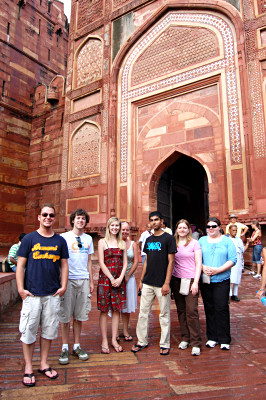
When it was upgraded to a palace it was decorated with gold and precious stones, but these were plundered over the years by the Marathas, Jats, Nadir Shah and finally the British. Some of my favorite spots included…
- The Shish Mahal (Mirror Palace) has every wall inlaid with mirrors of varying sizes. It is said that a single lamp would illuminate all of the mirrors when properly placed.
- Musamman Burj and Khas Mahal is a white-marble octagonal tower where Shah Jahan was imprisoned during the last eight years of his life. He could only look at the shrine to his deceased wife (Taj Mahal) using a mirror from this place as his site was failing at the time.
- The king’s bathtub (Hauz-i-Jehangir) is in front of the palace, it stands about 10 feet tall with little steps on the side to climb up; it was carved from one piece of stone.
So far India has been so increadible; elephants around every corner, snake charmers, intricate decorations (even trucks on the highway) – it’s saturated with colorful art and culture.