Categories
Copyright

Members of Congress the Latest to Question ALI’s Restatement of Copyright

the word "copyright" typed on a typewriterAs copyright wonks are surely aware, the American Law Institute (ALI) has been busy with its first foray into restating a body of federal statutory law, the Restatement of Copyright. Restatements have traditionally covered state common-law topics, such as employment, property, trusts, and torts, which are primarily governed by some combination of state statutory and judge-made law. Sometimes a federal statute plays a significant, though partial, role in a Restatement, as with the Foreign Sovereign Immunities Act in the Restatement (Fourth) of Foreign Relations. But never before has ALI produced a Restatement of a coherent and comprehensive federal statutory scheme—a fact that has diverse commentators scratching their heads.

Since its inception, many have expressed doubts about the Restatement of Copyright project. The U.S. Copyright Office, U.S. Patent and Trademark Office, American Bar Association IP Section, industry groups, judges, academics, and many others have communicated serious concerns that this Restatement will do more harm than good, yet ALI seems dead set on seeing it through. The latest to question the propriety of this project are Members of Congress who voiced concerns in a letter sent to ALI earlier this week. In the letter, Senator Thom Tillis and Representatives Ben Cline, Ted Deutch, Martha Roby, and Harley Rouda point out that in over 100 years of existence the ALI has never drafted a Restatement on law that is almost exclusively governed by federal statutes. The Members of Congress are primarily concerned with how the Restatement “attempts to diminish the importance of the statutory text or legislative history relating to that text” and replace it with “novel interpretations.”

The congressional letter has been well-received by the copyright community. Yesterday, AAP CEO and President Maria Pallante commended the Members of Congress for their “strong leadership” and called the Restatement of Copyright “a back door effort to circumvent the authority of Congress and undermine the copyright system that fuels our creative economy.” Copyright Alliance CEO Keith Kupferschmid applauded the Members of Congress for “voicing their concerns” and called on ALI to “address these and the many other significant and very real concerns that have been raised by the Senator and Representatives and many others who have spoken up.” And CreativeFuture complimented the insights of the Members of Congress while condemning this Restatement as being “driven by those who want to rewrite the law, which isn’t their job.”

Though certainly venerable, the Restatements over the last century have not been immune to attacks of perceived bias. Law review articles for years have made these claims (for example, see here, here, and here). The late Antonin Scalia highlighted such concerns in his acerbic dissent in Kansas v. Nebraska, when he stated in 2015 that “modern Restatements . . . are of questionable value, and must be used with caution” since “the Restatements’ authors have abandoned the mission of describing the law, and have chosen instead to set forth their aspirations for what the law ought to be.” Justice Scalia warned that “it cannot safely be assumed, without further inquiry, that a Restatement provision describes rather than revises current law.”

Unfortunately, ALI’s current Restatement of Copyright project suffers from the very problems that Justice Scalia described. The Reporter and other supporters have expressly stated that they view this Restatement as a chance to change the law—not simply to restate it. To that end, this Restatement literally rewrites the Copyright Act by paraphrasing the statutes rather than quoting them directly when presenting the supposed black-letter law. This will only lead to confusion as the proffered black-letter law is not the same as the actual law that must be applied by the courts.

A Restatement Or A Principles Project?

I participated in a panel discussion on this Restatement last year at the Fordham IP Conference, and I was genuinely surprised by how many of my fellow panelists were skeptical of the notion that we should have another copyright reference such as ALI’s Restatement of Copyright. My own view is that there’s plenty of room for more copyright treatises, but this particular project should be abandoned given the decision to recast the statutory text rather than to simply quote and interpret it. Other panelists were not nearly as positive. For example, Professor Justin Hughes of Loyola Law School offered his insights into what is really driving this project:

There is a very simple calculus of what is going on; that is, that Copyleft academics have felt themselves locked out of policymaking; have felt themselves ignored by the courts, rightly or wrongly; and are looking for a major lever. If you are not willing to do what is necessary to get legislation passed in Washington in IP — and it is not fun and it is ugly — so much the easier if you can just write black-letter law in a book with some other professors.

In fact, the Restatement of Copyright project originated as an ALI Principles project as part of a copyright reform initiative. In a letter to ALI in late 2013, Berkeley Law’s Professor Pamela Samuelson suggested that ALI “should undertake a copyright reform project” to “aid additional reform efforts” in copyright law. Her idea was that ALI would provide judges and lawyers with a set of “normative underpinnings” that they could use in practice to shape copyright law without statutory amendment. In particular, Prof. Samuelson cited “a dozen examples of common law copyright issues on which courts have been at odds that an ALI project might usefully address” that she had outlined in an article calling for copyright reform. These included digital first sale, statutory damages, conceptual separability, secondary liability, and whether fair use is a right. The letter stressed that ALI was “the institute most capable of taking on such a significant law reform project that would bring greater normative clarity, predictability, and balance to U.S. copyright law.”

Critically, in both the letter and article, Prof. Samuelson proposed that ALI undertake a Principles project—not a Restatement. The two serve different purposes and audiences. According to ALI’s Style Manual, “Restatements are primarily addressed to courts,” while “Principles are primarily addressed to legislatures, administrative agencies, or private actors.” Each “seeks to clarify and synthesize” a particular field of law; however, only Restatements are intended to “reflect the law as it presently stands or might appropriately be stated by a court.” Principles projects, by contrast, are “generally written as recommendations to particular institutions (e.g., legislatures, corporations).”

Nevertheless, ALI authorized the project as a Restatement even though its official Reporter also made clear in a letter to ALI that he envisioned a reform effort: Given the “bad state” of things, there “seemed to be a perfect environment for a deep reevaluation of copyright law.” Because this “has not happened. . . . it falls to the federal courts” to fix things since “Congress is unlikely to proceed any time soon with copyright reform.” Accordingly, the Reporter clearly intended a Principles project and not a true Restatement.

The Reporter also appears to hold a narrow and controversial view of copyright’s constitutional purpose, asserting that the Constitution “sets out an explicitly utilitarian rationale.” But, in Eldred v. Ashcroft the Supreme Court stated that copyright serves both public and private ends. The Court held that rewarding authors and promoting progress are “complementary”—and “not mutually exclusive”—“ends” since “copyright law serves public ends by providing individuals with an incentive to pursue private ones.” The Supreme Court reiterated its holistic approach more recently in Kirstaeng v. Wiley, where it unanimously noted that one of the “well settled” objectives of the Copyright Act is “rewarding authors’ creations.” By contrast, the Reporter appears willing to write authors’ rights out of the constitutional bargain—an approach again better suited for a normative Principles project and not a Restatement accurately describing the current state of the law.

Why Paraphrase When You Can Quote?

ALI’s Style Manual explains that each Restatement section is broken into three parts: (1) black-letter provision, which states the rule of law; (2) Comment, which explicates, analyzes, and illustrates the black-letter rule; and (3) Reporter’s Notes, which explain the sources provided and their place within the current law. Since earlier Restatements dealt with common-law issues, the black-letter provisions at the beginning of each section provided a coherent synthesis of the various sources of law. Copyright law, by contrast, already has a coherent body of black-letter law—the statutory provisions of the Copyright Act itself. The Style Manual provides that “Restatements are expected to aspire toward the precision of statutory language,” but such aspirations are unnecessary here since the precise statutory language already exists.

Nevertheless, the Restatement of Copyright project has approached the copyright field like it was any other, and the drafts of the Restatement to date show that the black-letter provisions are paraphrases of the underlying statutes and not the statutes themselves. It seems obvious that any attempt to restate the copyright statutes in different terms will lead to unnecessary confusion, but this is, for the time being, the route that has been chosen. The problem, of course, is that courts first and foremost must interpret and apply the words of the statute. Any deviation from the statutory language in the Restatement’s black-letter provisions will only give courts more work to do as they attempt to reconcile Congress’s actual black-letter law with ALI’s gloss upon it. This is a recipe for confusion, not clarity. Indeed, ALI has received numerous comments challenging this unique format.

For example, the U.S. Copyright Office submitted a letter to ALI in 2015 questioning the “nature and goals” of ALI’s undertaking and pointing out the obvious fact that “there can be no more accurate statement of the law than the law itself.” The Copyright Office noted that the Restatement’s black-letter provisions materially departed from Congress’s enactments and that “the accompanying discussion and illustrations evince selective and particularized views that do not present a balanced interpretation of the statute.” The Copyright Office accused ALI of treating “singular judicial decisions” as “well-established rules” while ignoring “contrary precedent,” and, after listing several specific examples, it suggested that “the Restatement project appears to run the risk of creating a pseudo-version of the Copyright Act that is inconsistent with the law as Congress enacted it.”

Similar views were expressed by the Register of Copyrights just last year. Register Karyn Temple concluded that “the project is a misguided one” since “an extensive body of positive copyright law already exists.” She pointed out the futility of restating “a body of positive federal law,” noting that there “can be no more accurate statement of the law than the words that Congress has enacted in the Copyright Act and those that the Copyright Office has adopted in its regulations.” Register Temple admonished ALI for “tinkering with complex statutory and regulatory provisions” given that it “will lead to confusion and misinterpretation” and “will inevitably alter sense and meaning.” She then suggested that ALI “reconsider the project as a whole” as “the attorney or judge who relies on it will often be misled.”

The Director of the U.S. Patent and Trademark Office, Andrei Iancu, submitted a comparable letter in late 2018, but unfortunately it’s not publicly available. In the letter, Director Iancu suggested “adapting the typical Restatement format to accommodate the specific characteristics of the Copyright Act.” Specifically, he noted that “the detailed, prescriptive provisions of the Copyright have historically been considered ‘black letter’ law,” and he argued that the “attempt to rephrase them . . . can only lead to ambiguity and contradiction” as “the meaning of the statute will be clouded or altered.” Director Iancu predicted “that the copyright Restatement project as currently conceived will create more confusion than enlightenment,” and he urged ALI to quote the statutory law itself as the black-letter statement of the law.

Likewise, Columbia Law’s Professor Jane Ginsburg sent a letter to ALI in 2015. Prof. Ginsburg called the Restatement “a fundamentally aspirational endeavor” that “gives the impression of a shadow copyright act,” and she questioned whether the project should even proceed under the guise of a Restatement instead of a Principles project. Over the past several years, many others have filed critical comments as well, including the Authors Guild and the New York City Bar. Indeed, comments have even been submitted by prominent figures such as Judge Pierre Leval of the Second Circuit and Judge Margaret McKeown of the Ninth Circuit. Unfortunately, however, most of the comments that have been filed are not readily available online at this time. Perhaps most revealing of what seems to be an underlying bias in those leading the project, I have yet to see a commentator suggest that the Restatement gets something wrong in a way that would actually benefit copyright owners. The “mistakes” all cut the other way.

As a closing thought, I’ll note that this project appears to create a Catch-22 for ALI. If the goal is to “reform” copyright law, then the Restatement will not accurately reflect the law and thus will be of little use to the courts—its intended audience. On the other hand, if the Restatement instead accurately captures the current state of the law, then the Restatement will do very little to move the reformatory needle. Behind all this might be a gambit that the Restatement is perceived to be an accurate reflection of the law, such that it’s followed, while in fact expressing a version of the law that is not actually true, but rather “aspirational” as Prof. Ginsburg said. In this way, the existing statutes could effectively be changed by the courts—at least in how they interpret and apply it. That’s a narrow needle to thread, and it’s hard to see how it could be done. I think ALI could create a useful secondary source for copyright law, but the reality is that this Restatement has been designed from the beginning to change the law—not merely to restate it.

Categories
Copyright

The CASE Act: Why Creators Need a Small Claims Tribunal


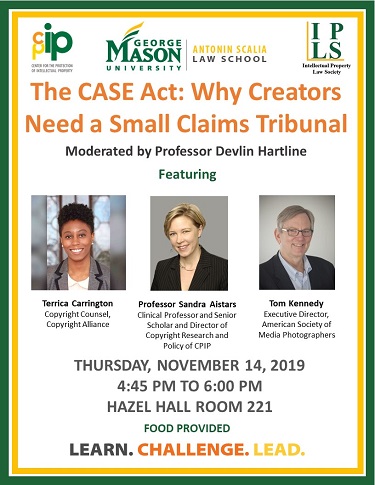
The Center for the Protection of Intellectual Property (CPIP) and the Intellectual Property Law Society (IPLS) at Antonin Scalia Law School, George Mason University, invite you to a panel discussion on the CASE Act.

2019 CASE Act panel flyer
Click on image for full-size PDF flyer.

The CASE Act: Why Creators Need a Small Claims Tribunal

Thursday
November 14, 2019
4:45 – 6:00 PM

Antonin Scalia Law School
George Mason University
3301 Fairfax Drive
Hazel Hall, Room 221
Arlington, Virginia

The event is free and open to the public. Please register in advance by emailing Kristina Pietro at kpietro@gmu.edu by 5:00 PM on Monday, November 11. Food will be provided.


EVENT DESCRIPTION

The Copyright Alternative Small-Claims Enforcement Act (CASE Act) would create a tribunal within the U.S. Copyright Office to hear small copyright claims. The federal courts have exclusive jurisdiction over copyright cases, and the cost of bringing a federal lawsuit makes it difficult for many individuals or small businesses to sue for copyright infringement. The CASE Act would provide a cheaper and simpler alternative to resolve such claims, allowing copyright owners to sue without the need to hire an attorney. The bill would also create a cost-effective way for users of copyrighted works to fight back when challenged if they believe their use is noninfringing.

The CASE Act has broad bipartisan support, and it was passed by the House in a sweeping 410-6 vote on October 22, 2019. The bill heads next to the Senate, where two Senators have placed a hold on the bill that will make it more difficult to pass. While many artist advocacy groups, such as Copyright Alliance, American Society of Media Photographers, and Authors Guild, have applauded the CASE Act’s provision of remedies for disenfranchised copyright owners, other groups, such as Electronic Frontier Foundation, Re:Create Coalition, and Public Knowledge, have condemned the bill as an assault on civil liberties that will potentially bankrupt average Americans.

This panel features three leading experts who have each played an important role in advocating for the CASE Act. They will discuss the substance and history of the CASE Act, its prospect for being passed by the Senate, and what it means for individuals and small businesses who have welcomed the meaningful copyright protection that the bill would provide.


EVENT AGENDA

4:45 – 5:00 PM Welcome Reception

5:00 – 6:00 PM Panel Discussion

  • Prof. Sandra Aistars, Antonin Scalia Law School, George Mason University, Director of Copyright Research and Policy & Senior Scholar, Center for the Protection of Intellectual Property
  • Terrica Carrington, Copyright Counsel, Copyright Alliance
  • Tom Kennedy, Executive Director, American Society of Media Photographers
  • Moderator: Prof. Devlin Hartline, Antonin Scalia Law School, George Mason University, Director of Communications, Center for the Protection of Intellectual Property

Categories
Copyright

Publishers v. Audible: An Army of Red Herrings

a gavel lying on a desk in front of booksAudible has now filed its response to the publishers’ request for a preliminary injunction—twice. It filed the exact same brief to argue that it shouldn’t be preliminarily enjoined (Dkt. 34) and to argue that the complaint should be dismissed for failure to state a claim (Dkt. 41). Unfortunately for Audible, the repetition of fallacious arguments doesn’t make them true. You may have heard that a group of geese is a “gaggle” and that a group of crows is a “murder.” Groups of animals are often known by somewhat peculiar collective nouns. Perhaps less well-known is that a group of herrings—those foraging fish that favor shallow, temperate seas—is called an “army.” Audible’s response includes so many irrelevant distractions that it can accurately be described as an army of red herrings.

Audible argues that this should be a contract dispute, not a copyright case, and that Captions is nevertheless fair use—no matter who is doing the copying. Indeed, the one thing that Audible apparently wants to avoid discussing in detail is the one thing that I find interesting in this case, namely, who directly causes the various prima facie infringements of the publishers’ rights to occur. Audible’s response makes clear that it would rather jump straight to the fair use analysis without first analyzing exactly who is causing what to occur. But that fair use analysis only makes sense if we know who is doing the copying. The factors would be applied differently to Amazon, Audible, or its users, and Audible’s response elides such distinctions even though they are crucial.

In my last post about this case, I discussed how Audible was likely to cite cases such as Sony and Cablevision in arguing that it doesn’t make the copy, the user does, and that’s fair use. Remarkably, Audible does suggest that the user makes the copy, but it relegates this claim to the preliminary, factual background section of the brief—it’s not actually part of its main argument section. But this does give us some idea of what Audible will argue once it’s forced to clarify its theory of the case. Perhaps most interesting of all, Audible explains how the third-party Amazon Transcribe feature operates within Captions, and it’s less favorable to Audible than I had originally suggested.

Audible explicitly states that “a listener generates Audible Captions.” So that tells us who Audible thinks is doing the copying—and it’s not Audible. There are no citations to any case law, and there’s no explanation of why it’s the user doing the copying. Just the ipse dixit that it’s so. Audible then explains that the transcriptions are not, as I suggested in my last post, simply done in real time via Amazon Transcribe. That may be true in part, but the entire audiobook file is also sent to Amazon where it is converted into text and then sent back to the user. And that entire transcription is then stored on the user’s device, albeit in an encrypted file. Moreover, once one user requests a transcription, a cached copy of the file is then stored for 90 days on the server, and any subsequent user requesting a transcription of the same work in that time frame will get the cached copy—not a new transcription.

This business with the cached copy opens up another can of copyright worms, one that Audible presumably is not looking forward to discussing. Not only is there a full copy of the text on the user’s device, but there’s also another copy on the server. And there’s no doubt that both copies are fixed since there’s no argument that they exist for a mere transitory duration. Furthermore, the fact that the same source copy is being sent to different users destroys any claim under Cablevision that Audible might make that these are not public distributions. The Second Circuit there held that the transmissions weren’t public since there was a unique source copy that was used for each transmission to an individual user. While I don’t see how that holding survives Aereo, the cached copy here takes that argument off of the table.

Audible spills much ink arguing that Captions is not a replacement for the text of the underlying book since the experience with the same text of the transcription is different. For example, unlike an e-book, Captions displays at most 20 words at a time that is synchronized to the audio. And this “audio-first experience” has different punctuation, there are no page numbers, and the user can only scroll through the text by first scrolling through the audio. Of course, it’s true that there are differences between the user experience with Captions and an e-book, but these differences are irrelevant to the publishers’ prima facie copyright claims. Just because the user experiences the work differently doesn’t mean that there hasn’t been all sorts of actionable copying enabling that experience. These differences may be relevant to fair use, but not one of them matters for determining who is doing what.

After throwing its users under the bus by claiming that they make the copies with Captions, Audible sidesteps any actual analysis of that issue by arguing instead that the publishers failed to properly plead their copyright claims. The crux of Audible’s argument is that, since it has license agreements with the publishers to sell and produce audiobooks, the publishers have waived their right to sue for copyright infringement to the extent Audible’s conduct is licensed. Audible then argues that the burden is on the publishers to plead the licenses and conduct that exceeds their scope (or a violation of their conditions precedent) in order to state a copyright claim. And since the publishers didn’t plead any reason why the licenses wouldn’t permit Audible’s copying of the audiobooks, Audible argues that the case against it should be dismissed.

Audible correctly states the law, but not its application here. When the existence of a license is not in question, the copyright owner bears the burden of proving that the alleged infringer exceeded its scope or breached its condition. And Audible is certainly correct in arguing that it is a “licensed, paying user of the audiobooks from and for which it created Audible Captions.” Audible has licenses for the audiobooks, and the publishers didn’t plead them. The fallacy of this argument, however, is that the publishers’ copyright claims are not directed to those audiobook licenses—or even to those audiobooks. The publishers only claim infringement of the underlying works, that is, the literary works from which the sound recordings of the audiobooks are derived. Audible is probably violating various rights in the audiobooks as well, but the publishers have not brought those claims.

That the publishers are suing over the original books, and not the derivative audiobooks, is clear from the face of the complaint. The publishers charge Audible with “unlawfully creating derivative works of, reproducing, distributing, and publicly displaying unauthorized copies of the Works,” and the works identified are the registered, literary works of which the publishers are legal or beneficial owners. The complaint explicitly alleges that “Audible did not seek a license for the creation and provision of the transcriptions provided to consumers” and that “it has only been authorized to deliver the work in audiobook format.” If Audible turned an audiobook into a movie, the publishers would not have to plead that Audible thus exceeded the scope of its license for the simple reason that there was no such license to create the derivative movie in the first place.

The fact that the allegedly infringing transcriptions have as their source the licensed audiobooks doesn’t matter; what matters is that the transcriptions violate the publishers’ rights in the underlying literary works. For the bulk of audiobooks at issue that Audible didn’t create, i.e., the ones that were provided by the publishers or third parties, Audible had no license to create derivative works of any kind. And for the few audiobooks that Audible itself may have created under license—though Audible noticeably doesn’t claim to have a license to create derivatives of any of the specific works-in-suit—it only had a license to create the derivative sound recordings embodied in the audiobooks. Audible’s hand-waving about licenses is easily dismissed because, quite simply, there was never any license to create the derivative literary works over which it is being sued.

Despite the army of red herrings summoned to obfuscate its theory of exactly who is doing the copying in this case, the burden falls squarely on Audible to establish the existence of any license that may justify its actions. And the fact that Audible failed to mention any such license speaks volumes. Audible instead jumps straight to fair use, making the incredible claim that providing the text of the audiobook is somehow completely different than providing the text of the underlying book itself because the former allows users to “understand and engage with the audiobook they purchased.” I’ll leave the absurdity of Audible’s fair use argument for another day, but for now I’d like the court to sort out the preliminary issue of who is doing what. And that appears to be a conversation that Audible would rather not have.

Categories
Copyright

Audible’s Planned Caption Service is Not Fair Use

a shelf full of booksLate last month, a group of publishers filed a complaint against Audible in the Southern District of New York asking the court to enjoin the audiobook distributor’s launch of a new audio-to-text transcription service. Although Audible has yet to file a response, a statement from the company—a subsidiary of Amazon since 2008—hints at a fair use defense based on the service’s supposed educational purpose. Unfortunately for Audible, its unauthorized reproduction, distribution, adaptation, and display of the publishers’ copyright-protected works is unlikely to survive a sound fair use analysis.
New Captioning Feature Infringes Publishers’ Rights

Audible is the world’s largest distributor of digital audiobooks and “spoken-word entertainment,” making available to its subscribers hundreds of thousands of audio programs based on works licensed from publishers, broadcasters, entertainers, individual authors, and other copyright owners. For subscribers who want a cross-format experience where they can simultaneously read and listen to the text, Audible already offers a feature called Immersion Reading. Touted as an educational tool that can help with reading comprehension, Immersion Reading is made possible by Audible securing licenses for both the audio recording and text of the work—and subscribers are required to purchase both an audiobook and a Kindle edition ebook.

In July of 2019, Audible announced it would be adding an “Audible Captions” feature to its mobile app. The service utilizes Amazon’s transcription technology to provide Audible subscribers with text for a select number of works in Audible’s audio program catalog. When listening to a predetermined “caption-ready” work, a subscriber would have the ability to activate the transcription technology, which then generates and distributes text to the subscriber’s device in a matter of milliseconds while the audio continues to play.

As the publishers’ complaint explains, the Audible Captions service converts the publishers’ works into unauthorized and often error-ridden “new” digital books and then distributes them to its customers without permission. Unlike its Immersion Reading service, Audible has not secured a license to copy, repurpose, distribute, or display this text and has no intention of compensating publishers for this cross-format use that would compete directly with and devalue existing physical books and ebooks. Accordingly, the publishers’ complaint alleges direct, contributory, and vicarious infringement and asks the court to enjoin Audible from reproducing, adapting, distributing, or displaying the publishers’ works.

Fair Use Defense Falls Flat

While Audible’s response will likely include a variety of defenses (for an in-depth look into what Audible might argue on the merits of the publishers’ prima facie infringement case, see Devlin Hartline’s recent post), public statements by the company have focused on the purported educational purpose of the captioning service, setting the stage for a fair use affirmative defense. Despite lofty claims of the educational objectives of its service, Audible Captions would clearly serve entertainment purposes as well, profiting Audible while undermining the legitimate and existing market for ebooks and other cross-platform services.  A closer look at the four fair use factors reveals Audible’s tenuous position.

1. Purpose and Character of the Use


The first factor—and the factor that is most relevant to Audible’s statements on educational intentions—involves determining the purpose of the unauthorized use. Section 107 of the Copyright Act provides a non-exclusive list of a few traditional uses—news reporting, comment, criticism, teaching, research, and scholarship—that will usually tip the scales in favor of the alleged infringer. However, the language is clear that determining “whether such use is of a commercial nature or is for nonprofit educational purposes” is integral to a proper factor-one analysis.

In its press release response to the publishers’ complaint, Audible describes its captioning service as a “free initiative” and a “free, new technology.” But it’s critical to understand—especially in the age of pervasive and organized digital infringement—that offering something to a customer for free that may have an educational function does not mean the activity is nonprofit. Indeed, the online platforms and services we use free of charge on a daily basis distribute massive amounts of content that could be deemed educational, all the while raking in profits through ad revenue and data collection. While Audible’s business model is not the same as the social media and search engine giants that rule cyberspace, it is a commercial business that makes money from the sale of audiobooks and subscriptions, and it’s attempting to justify infringement with a familiar fair use refrain.

If Audible Captions is allowed to launch, Audible would no longer have to secure cross-format licenses for its existing Immersion Reading service. It would essentially replace its own product—more on this later—with a version designed to allow it to skirt licensing requirements and profit at the expense of publishers and other copyright owners. Providing an audio-to-text feature without having to compensate copyright owners would establish a clear commercial advantage for Audible, and this type of misappropriation is not what fair use is meant to protect.

It’s also important to note that, at a time when courts are citing transformative fair use to excuse more and more instances of misappropriation, Audible Captions does not transform the underlying work and serves no transformative purpose. Audible is reproducing the text of a literary work for the purpose of reading—whether for education or for entertainment—and that is the exact purpose of the underlying works of authorship. As the Second Circuit stated in Authors Guild v. Hathitrust, “a transformative work is one that serves a new and different function from the original work and is not a substitute for it.” There’s nothing new or different about Audible Caption’s output.

2. Nature of the Copyrighted Work


The second factor asks whether the underlying work is a fact-heavy informational work or a work of creative expression and entertainment, giving more fair use leniency to the former since there is a greater need to disseminate factual works. In the case of Audible Captions, most (if not all) of the books Audible lists in its promotional materials are literary works of fiction. Despite a few older titles that have fallen into the public domain, most of the books whose text would be made available through Audible Captions are copyright-protected works of creative expression. This factor weighs clearly against a fair use determination.

3. Amount and Substantiality of the Portion Used


Like the second factor in this case, this consideration is not complex and weighs quite clearly against a fair use finding. Audible Captions reproduces the entire text of the underlying work. While it may only display a certain amount of text on the screen of a device at a time, subscribers have the ability to pause, rewind, and otherwise jump to any part of the works which will then be transcribed and delivered to their device.

Some early commentators on the Audible Captions technology have used the word “snippet” to describe what subscribers are able to access. This is probably an attempt to liken the service to the Google Books project, which displayed limited amounts of text to a user and was found to be fair use. But Google Books never allowed users to read a work in its entirety, which is exactly what Audible’s service does.

4. Effect of the Use on the Potential Market or Value of the Underlying Work


Notwithstanding arguments about the educational and altruistic purpose of its service, Audible cannot survive a sensible analysis of the fourth factor for one very simple reason: their own Immersion Reading service proves that a legitimate market for cross-format use already exists and will be harmed by a free alternative. As mentioned earlier, Immersion Reading depends on Audible licensing both the audiobook and text from publishers, and the launch of Audible Captions represents a way for the company to provide a similar—yet poorer quality—product to its costumer without taking a license.

In the seminal fair use case Sony v. Universal, the Supreme Court discusses the fourth factor and asserts that in order for a noncommercial use to be disqualified as fair, there must be a showing that the use would be harmful and adversely affect the potential market for the copyrighted work. Justice Stevens explains:

Actual present harm need not be shown; such a requirement would leave the copyright holder with no defense against predictable damage. Nor is it necessary to show with certainty that future harm will result. What is necessary is a showing by a preponderance of the evidence that some meaningful likelihood of future harm exists.

And so even in the unlikely event that a court were to find Audible’s service to be a noncommercial use, an existing market for the publishers’ works and the licenses already entered into for the Immersion Reading service surely satisfy the test for future harm.

Furthermore, ebooks and other cross-format offerings are readily available from authors and publishers, and massive amounts of research, time, and money go into creating the best user experience. Not only would Audible Captions strip copyright owners and creators of deserved revenue, but it would deprive them of the ability to control the look and feel of their works in the digital word. Audible Captions would undermine this already vibrant digital book market by offering an inferior substitute outside of the creative control of those who actually care about its presentation and consumption.

With a readily available substitute—even an inferior one—legitimate ebooks and other cross-format services will be devalued and fewer resources will be reinvested in their development. Publishers will lose, authors will lose, and perhaps most importantly, consumers and the public will lose if this market is compromised.

Conclusion

Despite talk of “a mission that transcends financial success,” it is crucial to recognize that Audible (and ultimately Amazon) is the only one that will benefit from the introduction of the Audible Captions service. If serving those in need of literacy tools was the true objective, more attention should be paid to developing technology that doesn’t generate erroneous and confusing text. At a time when the boundaries of fair use seem to be spreading in every direction, the unauthorized for-profit appropriation of entire works of creative expression cannot be part of the expansion.

Categories
Copyright

Publishers v. Audible: VCRs and DVRs to the Rescue?

a remote pointed at a TV screen showing a sports gameOn August 23, a group of publishers, including Penguin Random House, HarperCollins, and Simon & Schuster, sued Audible for copyright infringement. Audible, which is a subsidiary of Amazon, sells and produces audiobooks, and it planned to launch a new speech-to-text feature on September 10. The feature, dubbed Audible Captions, would automatically convert the licensed audio of an audiobook into unlicensed text that appears on the user’s screen as the audiobook is played. In a video posted to YouTube on August 2, Audible mentions that Captions is powered by Amazon Transcribe, which appears to provide real-time transcriptions by sending audio to Amazon’s servers where it is converted to text and then sent back to the user.

The publishers allege that, through its Captions feature, Audible infringes their reproduction, adaptation, public distribution, and public display rights, either directly or indirectly, and they’ve moved for a preliminary injunction. The crux of their argument as to direct liability is that Audible—and not the user—directly causes the various infringements to occur. The publishers don’t specifically mention the role of Amazon or its Transcribe feature in their arguments, though they do note that “Audible has further arranged for software programs and servers” to create the unlicensed text. But it seems quite likely that Audible will use distinctions over exactly who is doing what—the user, Audible, or Amazon—to argue that its role in the copying is too remote to make it a direct infringer.

Audible has agreed to forgo enabling Captions for the publishers’ works until the court rules on the preliminary injunction motion, and its response is due this coming Friday, September 13. Other than the hint that it will likely argue fair use since it believes that the Captions feature will “help kids,” Audible has not tipped its hand as to what it will argue on the merits of the publishers’ prima facie infringement case. But, given the law in the Second Circuit where the publishers have filed suit, we can certainly guess what it will argue.

In a recent article at Ars Technica, Timothy B. Lee suggests that Audible is likely to rely on two seminal copyright cases in its defense: Sony v. Universal and Cartoon Network v. CSC Holdings (aka Cablevision). Lee points out the role of Amazon’s cloud-based Transcribe service in Audible’s automated captioning process, and he contends that it “strengthens the company’s argument that it can do this without a license from publishers.” With Sony, Lee references the Supreme Court’s holding that unauthorized time-shifting can be fair use, and he further notes that, while cases like this can be unpredictable, the courts might decide that automated speech-to-text conversion is likewise fair use.

Of course, there are significant differences between the time-shifting in Sony and the transcription that occurs with Captions. Sony time-shifting created a copy of an audiovisual work without changing its work-of-authorship category, and both the original broadcast and the copy made with the VCR were audiovisual works. With Captions, by contrast, the audiobook, which is a sound recording, gets transformed into a literary work. This isn’t merely creating a copy of a work to watch later; it’s creating an entirely different—though derivative—work. And, of course, in making this derivative work, a reproduction also occurs since the two works are substantially similar. But Captions nevertheless is an entirely different beast than time-shifting, or even space-shifting for that matter, since it in fact creates a new—and separate—work of authorship.

Moreover, the analysis in Sony turned on copying by the user, not Sony itself, and thus the fair use factors were applied differently than they would be here with the publishers’ direct liability claims. Most notably, the first and fourth factors here heavily favor the publishers since Audible’s for-profit use isn’t transformative and causes harm to an established market. Indeed, Audible itself currently offers Immersion Reading, where licensed audiobooks are combined with licensed e-books, allowing the user to follow along with the text while listening to the audio. Importantly, the user must purchase both the audiobook and the e-book to use this functionality in the Audible App.

Turning to Cablevision, Lee argues that “Audible’s case will likely be strengthened by the fact that its app never creates or saves a permanent, full transcript of an audiobook” since “the software only displays a few words on the screen at a time.” To be sure, the buffer copies at issue in Cablevision, which existed for at most 1.2 seconds before being automatically overwritten, were held to be unfixed and thus not copies that could give rise to infringement liability. But Lee misconstrues the import of this holding: There was no doubt that a work could be copied by chopping it up into little pieces at a time; the question was whether those pieces existed for more than a transitory duration. Unlike the buffer copies at issue there, the copies here are clearly fixed since the user can pause the text in Captions and keep it on the screen indefinitely.

Lee notes Cablevison’s holding that it was the user, and not Cablevision itself, that caused a copy to be made with the cloud-based DVR. And he posits that Audible will argue that it thus has the right to distribute “software tools that allow customers to do speech-to-text conversion.” I agree, and I think Audible is very likely to argue that it doesn’t make the copy, the user does, and that’s fair use. But I disagree with Lee’s further claim that, if the transcription actually takes place on Amazon’s servers, the “publishers are likely to argue this means Amazon—not users—are creating the transcripts.” If the publishers thought that Amazon was making the copies, Amazon would have been named as a defendant. It wasn’t—and for good reason.

As I understand the facts, I don’t think it’s likely that Amazon would be directly liable for the copying that takes place with its Transcribe feature. That system is fully automated, and Amazon plays no role in selecting or supplying the content that gets converted. The same, however, is not true for Audible. The publishers claim that Audible is a direct infringer since it selects which specific audiobooks have the Captions feature enabled and integrates the functionality for making the unauthorized transcriptions within its Audible App. To analyze this claim, we must determine whether Audible’s actions are sufficiently proximate such that Audible itself can be said to be doing the copying, and for that we need to look no further than the Cablevision opinion itself.

Cablevision turned on whether the remote-storage DVR (RS-DVR) was more analogous to a VCR or a video-on-demand (VOD) service. With a VCR, the user who pressed the record button supplied the necessary volition to be held liable as a direct infringer—not the company that manufactured and sold the VCR, which had no control over the content that was recorded. With VOD, by contrast, the user still pressed the button to initiate the streaming, but the service provider was the one that could be held directly liable since it selected and supplied the works that were available on its service. Cablevision’s cloud-based DVR fell somewhere in between, and the Second Circuit held that it was more like a VCR since Cablevision did not control the specific content that its users could record and stream:

Cablevision, we note, also has subscribers who use home VCRs or DVRs (like TiVo), and has significant control over the content recorded by these customers. But this control is limited to the channels of programming available to a customer and not to the programs themselves. Cablevision has no control over what programs are made available on individual channels or when those programs will air, if at all. In this respect, Cablevision possesses far less control over recordable content than it does in the VOD context, where it actively selects and makes available beforehand the individual programs available for viewing. For these reasons, we are not inclined to say that Cablevision, rather than the user, “does” the copying produced by the RS–DVR system.

Lee mentions that the “courts could decide that Amazon plays too active a role in the conversion process to portray itself as a passive supplier of technology like the maker of a VCR.” I think this is very likely, but only as to Audible, not Amazon. As noted above, Amazon Transcribe is a passive system; it will transcribe any audio that it receives. Captions, on the other hand, only transcribes the specific works that Audible has decided ex ante to include. The user can’t transcribe every sound recording on a device or even every audiobook within the Audible App. Audible instead chooses the specific works within its App that the user is allowed to convert into a derivative, literary work. And it’s this selection of the specific content that makes Audible more like a VOD service than a VCR or DVR.

The Supreme Court opinions in ABC v. Aereo—both the majority opinion by Justice Breyer and the dissent by Justice Scalia—buttress this conclusion. Like Cablevision, Aereo supplied a cloud-based DVR, though the content available on Aereo’s service depended on what was publicly available via over-the-air transmissions. The Aereo majority held that it was Aereo, and not the user, that caused the transmission to occur when the user pressed a button to initiate the streaming, and this was true even though Aereo had no control over the specific content that was made available to the user. The Court held that Aereo’s role in the copying—by setting up in-house antennas, transcoders, and servers that would retransmit television broadcasts to the public—was sufficiently proximate to render it the direct infringer.

In dissent, Justice Scalia took a far more limited view of the volition necessary to hold a service provider directly liable. Relying on Cablevision, Justice Scalia argued that direct liability “demands conduct directed to the plaintiff’s copyrighted material,” and since Aereo did not select the specific content to be streamed, he would have held that it could not be directly liable. Indeed, he argued that a VOD service could be directly liable precisely because the “selection and arrangement by the service provider constitutes a volitional act directed to specific copyrighted works and thus serves as a basis for direct liability.” In his estimation, “Aereo does not ‘perform’ for the sole and simple reason that it does not make the choice of content.”

Thus, even under Justice Scalia’s narrow view of direct liability, Audible can quite reasonably be said to have crossed the line from being a passive conduit to an active participant in the copying because Audible itself selects the specific works that can be transcribed with its Captions feature. Once Audible files its response brief this coming Friday, I hope to then take a deeper dive into these fascinating issues. And perhaps then I’ll discuss the secondary liability issues that I ignored in this post. But for now I’ll conclude by saying that, by making its Captions feature available only for the specific works that it selects, Audible will have an uphill battle in arguing that it’s more like a VCR or DVR than a VOD service.

Categories
Copyright

Twenty Years Later, DMCA More Broken Than Ever

a lightbulb shatteringWith Section 512 of the DMCA, Congress sought to “preserve[] strong incentives for service providers and copyright owners to cooperate to detect and deal with copyright infringements that take place in the digital networked environment.”[1] Given the symbiotic relationship between copyright owners and service providers, Congress meant to establish an online ecosystem where both would take on the benefits and burdens of policing copyright infringement. This shared-responsibility approach was codified in the Section 512 safe harbors. But rather than service providers and copyright owners working together to prevent online piracy, Section 512 has turned into a notice-and-takedown regime where copyright owners do most of the work. This is not what Congress intended, and the main culprit is how the courts have misinterpreted Section 512’s red flag knowledge standards.

Several provisions in Section 512 demonstrate that Congress expected service providers to also play a role in preventing copyright infringement by doing some of the work in finding and removing infringing material. In order to benefit from the safe harbors, service providers must designate an agent to receive takedown notices, respond expeditiously to takedown notices, act upon representative lists, implement reasonable repeat infringer policies, and accommodate standard technical measures. But it’s also clear that service providers have the duty to remove infringing content even without input from copyright owners. As the Senate Report notes, “Section 512 does not require use of the notice and take-down procedure.”[2] And the knowledge provisions in Section 512 reflect this. Absent a takedown notice, service providers must, “upon obtaining . . . knowledge or awareness” of infringing material or activity, “act[] expeditiously to remove . . . the material” in order to maintain safe harbor protection.[3]

Under Section 512, there are two kinds of knowledge that trigger the removal obligation without input from the copyright owner—actual and red flag. For sites hosting user-uploaded content, actual knowledge is “knowledge that the material or an activity using the material on the system or network is infringing[4] and red flag knowledge is “aware[ness] of facts or circumstances from which infringing activity is apparent.”[5] Thus, actual knowledge requires knowledge that specific material (“the material”) or activity using that specific material (“activity using the material”) is actually infringing (“is infringing”), while red flag knowledge requires only general awareness (“aware[ness] of facts or circumstances”) that activity appears to be infringing (“is apparent”). There are similar knowledge provisions for search engines.[6]

Importantly, actual knowledge refers to “the material,” and red flag knowledge does not. It instead refers to “infringing activity”—and it’s not the infringing activity, but infringing activity generally.[7] However, with both actual and red flag knowledge, the service provider is obligated to remove “the material.”[8] With actual knowledge, the service provider doesn’t have to go looking for “the material” since it already has actual, subjective knowledge of it. But what about with red flag knowledge where the service provider only knows of “infringing activity” generally? How does it know “the material” to take down? The answer is simple: Once the service provider is subjectively aware of facts or circumstances from which infringing activity would be objectively apparent[9]—that is, once it has red flag knowledge—it has to investigate and find “the material” to remove.[10]

The examples given in the legislative history, which relate to search engines, show that red flag knowledge puts the burden on the service provider. As the Senate Report notes, merely viewing “one or more well known photographs of a celebrity at a site devoted to that person” would not hoist the red flag since the images might be licensed or fair use.[11] However, sites that are “obviously infringing because they . . . use words such as ‘pirate,’ ‘bootleg,’ or slang terms . . . to make their illegal purpose obvious . . . from even a brief and casual viewing” do raise the red flag.[12] And a search engine “that views such a site and then establishes a link to it . . . must do so without the benefit of a safe harbor.”[13] Thus, Congress didn’t want search engines worrying about questionable infringements on a small scale, but it also didn’t want search engines to catalog sites that are clearly dedicated to piracy. And, most importantly, red flag knowledge kicks in once a service provider looks at something that is “obviously pirate”—even if it’s an entire website.[14]

So how has Congress’s commonsensical plan worked out? Not very well. As of today, Google indexes nearly 1.5 million results from the infamous pirate site, The Pirate Bay.[15] Like the examples in the legislative history, The Pirate Bay has the word “pirate” in its title, and a brief viewing of the site reveals its obvious, infringing purpose. And it’s not like Google hasn’t been told that The Pirate Bay is dedicated to infringement—nor that it needs to be told. According to data from the Google Transparency Report,[16] the search engine has received requests to remove over 4 million URLs from thepiratebay.org domain alone. There are many other related domains, such as thepiratebay.se, that have received millions of requests as well. In fact, Google tells us that it has received requests to remove over 4 billion URLs from its search engine due to copyright infringement, with many domains receiving more than 10 million requests each.

So how is it that Google can index The Pirate Bay and not be worried about losing its safe harbor? The answer is that the courts have construed Section 512 in a way that contradicts the statutory text and Congress’s intent. They’ve all but read red flag knowledge out of Section 512 and placed the burden of policing infringement disproportionately on the copyright owner. And by narrowing the applicability of red flag knowledge, the courts have perversely incentivized service providers to do as little as possible to prevent infringements. Instead of looking into infringing activity of which they are subjectively aware, they are better off doing nothing lest they gain actual, specific knowledge that would remove their safe harbor protection.

A brief traverse through the case law, especially in the Second and Ninth Circuits, shows how the red flag knowledge train has been derailed. In Perfect 10 v. CCBill, the Ninth Circuit held that domains such as illegal.net and stolencelebritypics.com—the very sort of indicia mentioned in the legislative history—were not enough to raise the red flag.[17] According to the court, “describing photographs as ‘illegal’ or ‘stolen’ may be an attempt to increase their salacious appeal, rather than an admission that the photographs are actually illegal or stolen.”[18] While that’s certainly possible, it’s not likely. And it defies common sense. The Ninth Circuit concluded: “We do not place the burden of determining whether photographs are actually illegal on a service provider.”[19] But this misses the point, and it conflates red flag knowledge with actual knowledge.

The Second Circuit in Viacom v. YouTube held that the “difference between actual and red flag knowledge is . . . not between specific and generalized knowledge, but instead between a subjective and an objective standard.”[20] The court arrived there by focusing on the removal obligation, reasoning that “expeditious removal is possible only if the service provider knows with particularity which items to remove.”[21] And it rejected an “amorphous obligation” to investigate “in response to a generalized awareness of infringement.”[22] By limiting red flag knowledge to specific instances of infringement, the Second Circuit severely curtailed the obligations of service providers to police infringements on their systems. The entire point of red flag knowledge is to place a burden on the service provider to investigate the infringing activity further so that the specific material can be removed.[23]

The Ninth Circuit followed suit in UMG Recordings v. Shelter Capital, holding that red flag knowledge requires specificity.[24] The court reasoned that requiring “specific knowledge of particular infringing activity makes good sense” because it will “foster cooperation” between copyright owners and service providers “in dealing with infringement” online.[25] This “cooperation,” according to the Ninth Circuit, would come from takedown notices sent by copyright owners, who “know precisely what materials they own, and are thus better able to efficiently identify” infringing materials than service providers, “who cannot readily ascertain what material is copyrighted and what is not.”[26] Of course, this is not the shared-responsibility approach envisioned by Congress, and it conflates the red flag knowledge standards with the obligation to respond to takedown notices—separate provisions in Section 512.

Perhaps the most significant gutting of red flag knowledge can be found in the Second Circuit’s opinion in Capitol Records v. Vimeo.[27] The district court below had held that it was a question for the jury whether full-length music videos of current, famous songs that had been viewed by the service provider amounted to red flag knowledge.[28] But the Second Circuit disagreed that there was any jury question: “[T]he mere fact that a video contains all or substantially all of a piece of recognizable, or even famous, copyrighted music and was to some extent viewed . . . would be insufficient (without more) to sustain the copyright owner’s burden of showing red flag knowledge.”[29] That this gloss on red flag knowledge “reduces it to a very small category” was of “no significance,” the Second Circuit reasoned, since “the purpose of § 512(c) was to give service providers immunity, in exchange for augmenting the arsenal of copyright owners by creating the notice-and-takedown mechanism.”[30]

The Second Circuit thus held as a matter of law that there was no need for the factfinder to determine whether the material was so obviously infringing that it would raise the red flag. How is this a question of law and not fact? The court never explains. More importantly, this flies in the face of what Congress provided for with red flag knowledge, and it demotes Section 512 to being merely a notice-and-takedown regime where copyright owners are burdened with identifying infringements on URL-by-URL basis. Giving service providers a free pass when confronted with a red flag turns the Section 512 framework on its head. And it enables service providers to game the system and build business models on widespread, infringing content—even if they welcome it—so long as they respond to takedown notices. The end result is that an overwhelming amount of obvious infringements goes unchecked, and there’s essentially no cooperation between service providers and copyright owners as Congress intended.


[1] S. Rep. No. 105-190, at 40 (emphasis added); see also H.R. Rep. No. 105-551(II), at 49.

[2] Id. at 45; see also H.R. Rep. No. 105-551(II), at 54.

[3] 17 U.S.C. § 512(c)(1)(A)(iii); see also 17 U.S.C. § 512(d)(1)(C).

[4] Id. at § 512(c)(1)(A)(i) (emphasis added).

[5] Id. at § 512(c)(1)(A)(ii) (emphasis added).

[6] See id. at §§ 512(d)(1)(A)-(B).

[7] See 4-12B Nimmer on Copyright § 12B.04[A][1][b][ii] (“By contrast, to show that a ‘red flag’ disqualifies defendant from the safe harbor, the copyright owner must simply show that ‘infringing activity’ is apparent—pointedly, not ‘the infringing activity’ alleged in the complaint.” (emphasis in original)).

[8] 17 U.S.C. § 512(c)(1)(A)(iii)

[9] S. Rep. No. 105-190, at 44 (“The ‘red flag’ test has both a subjective and an objective element. In determining whether the service provider was aware of a ‘red flag,’ the subjective awareness of the service provider of the facts or circumstances in question must be determined. However, in deciding whether those facts or circumstances constitute a ‘red flag’–in other words, whether infringing activity would have been apparent to a reasonable person operating under the same or similar circumstances–an objective standard should be used.”); see also H.R. Rep. No. 105-551(II), at 53.

[10] Id at 48 (“Under this standard, a service provider would have no obligation to seek out copyright infringement, but it would not qualify for the safe harbor if it had turned a blind eye to ‘red flags’ of obvious infringement.”); see also H.R. Rep. No. 105-551(II), at 57.

[11] Id.; see also H.R. Rep. No. 105-551(II), at 57-58.

[12] Id.; see also H.R. Rep. No. 105-551(II), at 58.

[13] Id. at 48-49; see also H.R. Rep. No. 105-551(II), at 58.

[14] Id. at 49; see also H.R. Rep. No. 105-551(II), at 58.

[15] See The Pirate Bay, available at https://www.thepiratebay.org/.

[16] See Google Transparency Report, available at https://transparencyreport.google.com/.

[17] See Perfect 10, Inc. v. CCBill LLC, 488 F.3d 1102 (9th Cir. 2007).

[18] Id. at 1114.

[19] Id.

[20] Viacom Int’l, Inc. v. YouTube, Inc., 676 F.3d 19, 31 (2d Cir. 2012).

[21] Id. at 30.

[22] Id. at 30-31.

[23] See, e.g., H.R. Rep. No. 105-551(I), at 26 (“Once one becomes aware of such information, however, one may have an obligation to check further.”).

[24] UMG Recordings, Inc. v. Shelter Capital Partners LLC, 718 F.3d 1006 (9th Cir. 2013).

[25] Id. at 1021-22.

[26] Id. at 1022.

[27] Capitol Records, LLC v. Vimeo, LLC, 826 F.3d 78 (2d Cir. 2016).

[28] Capitol Records, LLC v. Vimeo, LLC, 972 F. Supp. 2d 537, 549 (S.D.N.Y. 2013) (“[B]ased on the type of music the videos used here—songs by well-known artists, whose names were prominently displayed—and the placement of the songs within the video (played in virtually unaltered form for the entirety of the video), a jury could find that Defendants had ‘red flag’ knowledge of the infringing nature of the videos.”).

[29] Capitol Records, 826 F.3d at 94 (emphasis in original).

[30] Id. at 97.


I presented this at the Fordham IP Conference on April 25, 2019. My oral presentation is here, and the accompanying slides are here.

Categories
Copyright

How the Supreme Court Made it Harder for Copyright Owners to Protect Their Rights—And Why Congress Should Fix It

U.S. Supreme Court buildingEarlier this week, the Supreme Court handed down its decision in Fourth Estate v. Wall-Street.com, a case examining the registration precondition to filing a suit for copyright infringement in the federal district courts. While I agree with the Court’s exegesis of the statute at issue, it’s worth noting how the Court’s construction leaves many, if not most, copyright owners in the lurch. Under the Court’s holding, in fact, this very blog post could be infringed today, and there’s very little that could be done to stop it for many months to come. As the Court noted in Harper & Row v. Nation, “copyright supplies the economic incentive to create and disseminate ideas.” The Court’s holding in Fourth Estate, by contrast, disincentivizes dissemination since it undermines effective copyright protection and prejudices the public interest in the production of, and access to, creative works. Again, I don’t blame the Court for this outcome—in fact, I think it’s correct. The problem, as I’ll explain, lies in the unfortunate fact that nowadays it takes too long to register a copyright claim. And that’s something that Congress needs to fix.

The issue in Fourth Estate is straightforward. Under the first sentence of Section 411(a) of the Copyright Act, “no civil action for infringement of the copyright in any United States work shall be instituted until preregistration or registration of the copyright claim has been made in accordance with this title.” Some courts, like the Ninth Circuit, have applied the so-called “application approach,” finding that “registration . . . has been made” when the copyright owner delivers a complete application to the Copyright Office. Other courts, like the Tenth Circuit, have applied the so-called “registration approach,” where “registration” is not “made” until the Register of Copyrights has acted upon the application (by either approving or rejecting it). Confounding the analysis is the fact that other sections of the Copyright Act alternatively delineate registration as something done by the applicant or by the Copyright Office.

In the decision below, the Eleventh Circuit applied the registration approach, affirming the district court’s dismissal of Fourth Estate’s complaint since the Register of Copyrights had not yet approved or denied its application to register. The Supreme Court, in a unanimous decision by Justice Ginsburg, affirmed: “We hold . . . that registration occurs, and a copyright claimant may commence an infringement suit, when the Copyright Office registers a copyright.” The issue for the Court was one of pure statutory construction, and the problem for proponents of the application approach is that the second sentence of Section 411(a) clearly indicates that registration is something done by the Copyright Office. It provides, as an exception to the first sentence, that a copyright owner can nevertheless sue for infringement once the application materials “have been delivered to the Copyright Office in proper form and registration has been refused.”

Justice Ginsburg reasoned: “If application alone sufficed to ‘ma[ke]’ registration, § 411(a)’s second sentence—allowing suit upon refusal of registration—would be superfluous.” I’ve always found this to be the better argument, and I’m not surprised to see it front-and-center in the Court’s analysis. Why would applicants need an exception that turns on the subsequent action of the Copyright Office if merely delivering a completed application sufficed? As Justice Ginsburg noted, the application approach “requires the implausible assumption that Congress gave ‘registration’ different meanings in consecutive, related sentences within a single statutory provision.” I think the Court got this one exactly right, and I don’t find arguments to the contrary to be particularly persuasive.

That said, let me now explain why it’s wrong—well, at least why it’s bad for millions of copyright owners and why Congress should fix it ASAP.

The purpose of the registration approach and other similar provisions in the Copyright Act (such as the availability of statutory damages or attorney’s fees) is to incentivize timely registration, which is no longer a prerequisite to copyright protection as it was under the Copyright Act of 1909. Under the current Copyright Act, copyright protection nominally exists once a work is fixed in a tangible medium of expression, and registration is no longer mandatory. (I say “nominally” because the Court’s holding in Fourth Estate ensures that, as a practical matter, countless works with respect to which copyright owners have exclusive rights on paper in fact have no immediate rights in the real world since they can’t actually file suit to quickly stop any ongoing infringement.) However, the incentive-to-register theory makes little sense in the context of the debate over the proper interpretation of Section 411(a) itself as the works being sued upon must be registered under both the application and registration approaches.

With due respect to the Copyright Office, processing a registration application is primarily a ministerial act. The vast majority of applications are granted—97% in 2017 according to the latest available data from the Copyright Office (though 29% of those applications required correspondence with the applicant). Are we really withholding remedies for all copyright owners because of the remaining 3%? And even for the 3% of applications that are denied, the copyright owner can still sue for infringement, asking the district court to reassess the agency’s refusal. No matter what the Copyright Office does with the application, whether it grants or denies, the copyright owner ultimately can sue. And, under the third sentence of Section 411(a), the Register of Copyrights can even “become a party to the action with respect to the issue of registrability of the copyright claim.” So it’s not like the Register can’t have a say should the application be in that slim minority of questionable ones that may merit intervention.

To its credit, the Supreme Court acknowledged that its holding would cause problems for copyright owners—but it also overplayed the exceptions to the registration approach that Congress put in place to alleviate some of these issues. For example, Justice Ginsburg pointed out that Section 408(f) empowers the Register of Copyrights to establish regulations for the preregistration of certain categories of works. Under this regime, as Justice Ginsburg noted, “Congress provided that owners of works especially susceptible to prepublication infringement should be allowed to institute suit before the Register has granted or refused registration.” That’s great for that particular subset of copyright owners, but what about everyone else? And what about authors who publish their works just as soon as they create them? Moreover, Justice Ginsburg’s blithe comment that copyright owners “may eventually recover damages for the past infringement” ignores the fact that injunctive relief to stop the actual, ongoing infringement is unavailable until the registration is processed by the Copyright Office.

The Court laments such policy ramifications: “True, the statutory scheme has not worked as Congress likely envisioned. Registration processing times have increased from one or two weeks in 1956 to many months today.” And this gets to the heart of the problem: The time it takes the Copyright Office to process an application has significantly increased over the years. Just four years after the Copyright Act of 1976 went into effect, the delay was “5 to 6 weeks.” And, as of October 2018, the delay has grown to an “average processing time for all claims” of “7 months.” Indeed, the fastest the Copyright Office processes an application now is one month, and the longest it takes is an incredible 37 months. The following illustration from the Copyright Office breaks this down with more particularity:

To be clear, I don’t think these delays are the Copyright Office’s fault. In fact, I think it’s Congress’s fault for not giving the agency more resources to do the very things that Congress requires it to do. Regardless, the fact remains that even copyright owners who do everything that the Copyright Act expects them to do in order to obtain the greatest protection for their works at the earliest that they can reasonably do so are still left without remedies should—or, perhaps more likely, when—infringement occur once they release their works to the world. The aforementioned constitutional goal of dissemination is thus undercut by the subservient goal of registration, for rational copyright owners would be less motivated to disseminate their works by the right to exclude when that right is in fact illusory. If Congress really wants authors to promote progress via dissemination of new works, it should adjust Section 411(a) to provide for immediate protection to all works, whether registered or not. It can still incentivize registration by limiting the remedies available, but it shouldn’t make it so that there are none.

To see the injustice, one need look no further than this very blog post. According to the Copyright Act, this post was protected the moment it was fixed in a tangible medium of expression (i.e., yesterday evening). Should the copyright owner—presumably the university where I work as this is a work made for hire—have filed for registration as quickly as possible (i.e., this morning), there still would be no way to obtain any injunctive relief while the Copyright Office processes the application. Preregistration was never an option as this post is not a literary work that is protected by the exception for certain works prone to prepublication infringement under Section 202.16 of the CFR. Even if the university had done everything that it was supposed to do as early as it could reasonably have done so to ensure the utmost copyright protection for this post, it could do nothing in the courts to stop an infringer who willfully exploits this post for profit until the Copyright Office acts upon the application—a lifetime for infringement in the digital age. (There is an option to expedite review for $800, but that amount of money is not reasonable for most people.)

Perhaps a takedown notice could be issued under Section 512 of the DMCA, but if there’s a counternotice, the university could not bring suit in the designated 10-14 day window to prevent the service provider from restoring the infringing material since there’s been no registration and thus it cannot sue for infringement. Despite having done everything Congress expected, the university would be powerless to stop the ongoing infringement of its exclusive rights in this post for perhaps several months into the future. And any argument that damages will compensate for infringements occurring before the Copyright Office got around to acting on the application is undercut by the fact that courts routinely grant preliminary injunctive relief precisely because the harm from infringement is irreparable—money damages cannot make the copyright owner whole.

The absurd result of all this is that the promise of exclusive rights in one’s original work of authorship is practically meaningless given the registration approach under Section 411(a). No doubt, Congress intended this disability to act as a stick in order to encourage the carrot of remedies should those rights be infringed. But the reality is that numerous copyright owners who do everything right get the stick and not the carrot—at least until the Copyright Office happens to process their applications. In the meantime, these copyright owners cannot be faulted for thinking twice before disseminating their works. Since enforcement of their rights is precluded through no fault of their own, what else does Congress expect them to do? A right without a remedy is senseless, and given the millions of original works that are created each day, Congress’s promise of copyright protection for new works may be one of the most illusory rights in modern times. Now that the Supreme Court has clarified Section 411(a), it’s time for Congress to fix it.

Categories
Copyright

Supreme Court Holding on Recoverable Costs Misses the Mark

U.S. Supreme Court buildingOn Monday, the Supreme Court issued a decision holding that the “full costs” available to a prevailing party in a copyright dispute are limited to those litigation expenses specified as taxable under federal law. The opinion by Justice Kavanaugh reverses a Ninth Circuit interpretation of 17 USC § 505, which held that any costs incurred in the enforcement (or defense) of a copyright claim are recoverable, including expert witness and jury consultation fees. Unfortunately, most of the twelve-page opinion is dedicated to a cursory analysis of the term “full costs” and does not consider the adverse impact the decision will have on creators and the fundamental aims of copyright law.

The holding in Rimini Street Inc. v. Oracle USA Inc. stems from a 2010 lawsuit Oracle brought against Rimini, a global provider of aftermarket support for Oracle software, for copyright infringement and various other causes of action. Following a verdict in favor of Oracle, the damages awarded included attorneys’ fees, expert fees, consultant fees, and e-discovery costs. Rimini appealed the district court’s decision to the Ninth Circuit, arguing that the Copyright Act limits costs awarded to the taxable costs laid out in 28 USC §§ 1821 and 1920. After the Ninth Circuit found that a successful plaintiff may recover any and all costs incurred in litigation, Rimini filed a petition for cert, claiming that the interpretation of § 505 was in conflict with Supreme Court precedent.

An Incomplete Assessment

Holding that the term “full costs” in § 505 of the Copyright Act means the costs specified in the general costs statutes codified in §§ 1821 and 1920, the Supreme Court focuses its opinion on a hasty statutory interpretation with little regard for the underlying purpose of the copyright law. Recognizing that the term of art “full costs” differs from the term “costs” that appears in many other federal statutes, the opinion proceeds to explore the linguistic qualities of the word “full” and concludes that it cannot be interpreted to mean anything more than the mere “costs” referred to in §§ 1821 and 1920. The opinion does not consider the reasons why the language of the Copyright Act differs from that of other statutes, and it does not address the greater issues raised by amici which explain that the Ninth Circuit’s interpretation of § 505 supports the Copyright Act’s mission to reward creators and serve the public interest.

The opinion also dismisses Oracle’s explanation of the historical context of the term “full costs,” claiming that Crawford Fitting Co. v. J.T. Gibbons, Inc., a 1987 Supreme Court case on expert witness fees, “explained that courts should not undertake extensive historical excavation to determine the meaning of costs statutes.” Curiously, just after dismissing the need for historical analysis, the Court gives credence to Rimini’s account of the term “full costs” in copyright decisions between 1831 and 1976. The opinion ends with a brief discussion of the problem of redundancy in a term like “full costs,” with the Court simply stating that “[s]ometimes the better overall reading of the statute contains some redundancy.”

Serving the Purpose of Copyright Law

Allowing parties to recover full costs encourages copyright owners to bring meritorious claims and incentivizes them to litigate a case to the end when the use of technical and specialized experts is critical. This is especially important for creators of limited means who face overwhelming litigation costs when bringing copyright infringement claims in federal court. Without the ability to recoup the non-taxable costs required of the unique challenges associated with fighting infringement in the digital age, these creators are stripped of the incentives to protect their work that copyright law is meant to provide.

But it’s not just claimants who will be disadvantaged by denying the recovery of costs outside of §§ 1821 and 1920. Parties with a meritorious defense often also need specialized experts, e-discovery, and consultants, and the inability to recover costs related to these services would just as likely eliminate incentives to defend against infringement claims. Removing incentives for both plaintiffs and defendants to pursue worthwhile claims and defenses in turn deprives courts the opportunity to develop—and the public the opportunity to understand—the distinctions of copyright law.

The Rimini v. Oracle opinion seems unconcerned with the consequences its interpretation of § 505 will likely have on copyright litigation. At a time when high costs are commonplace in the enforcement of (and defense against) copyright claims, incentivizing parties to see a case through is crucial. As individual creators and parties of limited means attempt to protect their works in the age of online infringement, courts should have the discretion to award costs based on the circumstances of the case.

Denying parties the ability to recover the significant costs will not only deter legitimate claims, but it will embolden wrongdoers who know that plaintiffs are unable to effectively enforce their rights. Removing incentives and thereby tipping the scales in favor of infringers will devalue intellectual property rights and stray from the goals of the Copyright Act. Unfortunately, the Supreme Court missed an opportunity to explore the fundamental purposes of copyright law and reinforce a system that should encourage meaningful litigation.

Categories
Copyright

Arts & Entertainment Advocacy Clinic Students File Amicus Brief in Brammer v. Violent Hues

a gavel lying on a desk in front of booksBy Rachelle Mortimer & Grant Ossler*

The Arts & Entertainment Advocacy Clinic at Antonin Scalia Law School recently filed an amicus brief in the Brammer v. Violent Hues case that is on appeal in the Fourth Circuit. The Clinic provides a unique opportunity for students interested in intellectual property and entertainment law. Each semester, students participating in the Clinic are able to gain practical experience working with clients and industry professionals on various projects related to copyright law and policy.

One organization that the Clinic often works with is Washington Area Lawyers for the Arts (WALA), which helps to provide legal services for local artists through volunteer attorneys who take on cases pro bono or at a reduced rate. By working with WALA to hold legal intake Clinics and take on pro bono cases, Clinic students are able to understand how copyright law affects individual artists. It is this understanding that led the Clinic to file the amicus brief in order to protect the rights of artists and prevent a dangerous expansion of the fair use defense to infringement.

Working with local attorneys from Protorae Law, students from the Clinic drafted portions of the amicus brief to explain how the U.S. District Court for the Eastern District of Virginia eviscerated the meaning and analysis of fair use under the Copyright Act.

Case Background

In 2016, the owner of defendant Violent Hues found a photograph online, copied it, cropped it, and posted it on a website that his organization created for its annual film festival. The photo in question was first posted to the photographer’s personal website, as well as to several online image-sharing websites. Violent Hues created the website to guide festival goers and provide information about the local area for filmmakers and festival attendees.

The owner of Violent Hues claimed he did not see a copyright notice on the photo when he used it, believing the photo was “a publicly available photograph.” Plaintiff Russell Brammer sent a demand letter, and upon receipt of the letter, Violent Hues removed the photo from its website. Brammer brought suit against Violent Hues claiming two causes of action: (1) copyright infringement under 17 U.S.C. § 504(b), and (2) removal and alteration of copyright management information under 17 U.S.C. § 1202.

District Court Decision

Brammer did not respond to arguments regarding count two, therefore the district court considered that claim abandoned. The district court granted summary judgment in favor of Violent Hues on count one, deeming the use of the photo was fair use per the Copyright Act. Fair use is codified in the Copyright Act and guides us through four factors of consideration when conducting an analysis to determine whether a use is a fair use. These factors are:

(1) The purpose and character of the use, including whether such use is of a commercial nature …; (2) the nature of the copyrighted work; (3) the amount and substantiality of the portion used in relation to the copyrighted work as a whole; and (4) the effect of the use upon the potential market for or value of the copyrighted work.

17 U.S.C.§ 107.

Unfortunately, the district court eviscerated any meaning to fair use under copyright law. In its examination of purpose and character, the district court determined Violent Hues’ use was “transformative in function and purpose” because Violent Hues’ use of the photo was informational: “to provide festival attendees with information regarding the local area.” The district court distinguished this from Brammer’s use, which was “promotional and expressive.” Additionally, the district court determined the use was non-commercial because the photo was not used for advertising or to generate revenue. Regrettably, this is as far as the transformative analysis went.

In the district court’s analysis of the second factor, fair use weighed in favor of Violent Hues again because the photo was factual in nature and “fair use is more likely to be found in factual works than in fictional works.” The district court acknowledged that Brammer incorporated creative elements in his photo (e.g., lighting and shutter speed), but ultimately held that because it was a “factual depiction of a real-world location,” it was purely factual content. The district court determined this without regard to creativity, though. The photo itself is a time-lapse photo of the Adams Morgan neighborhood of Washington, D.C.

In examining the third factor of fair use, the district court determined that Violent Hues did not use any more of the photo than was necessary, and therefore this factor substantiality weighed in favor of Violent Hues. Keep in mind, though, that the photo in question was merely cropped.

Lastly, the district court concluded that because there was no evidence that Violent Hues’ use had any effect on the potential market for the photo, the fourth factor also weighed in favor of Violent Hues. To support its decision, the district court stated: “The Court’s task is to determine whether the defendant’s use of the plaintiff’s works would materially impair the marketability of the works and whether it would act as a market substitute.” The district court arrived at this decision despite Brammer testifying he had been compensated for the photo six times—two times after Violent Hues’ infringement.

And thus, we have summary judgment for Violent Hues under a non-comprehensive fair use analysis.

Amicus Brief Summary and Commentary

The purpose of the Clinic’s amicus brief is to assist the court with regard to a proper, comprehensive fair use analysis, and to prevent the possible harm that an overly broad interpretation of the fair use defense could bring.

In examining the first factor of fair use, “purpose and character”, the district court unfortunately dedicated approximately two sentences to the analysis of why Violent Hues’ use was transformative in “function and purpose.” The district court simply stated that because the use was “informational,” and not “expressive” like Brammer’s use, the use was thus transformative. The proper examination requires looking at whether the new use adds something new “with a further purpose or different character.” As Judge Leval stated in his seminal article, Toward a Fair Use Standard, a different purpose or character, constituting a transformative use, is one that “alter[s] the first with new expression, meaning, or message,” and “employs the quoted matter in a different manner or for a different purpose from the original, thus transforming it.”

The district court failed to understand that Violent Hues’ use merely superseded Brammer’s. Violent Hues cropped the top and bottom of Brammer’s photo then posted it to its website with the purpose of showing the Adams Morgan neighborhood. A “wholesale taking” of the heart of the work, without adding additional value or meaning, is not transformative. The erroneous conclusion reached on this first factor destroys any meaning to transformative use and effectively erodes the exclusive rights held by copyright owners. To further illustrate this point, if the district court’s analysis is upheld, an author who writes a book regarding his life as president and his controversial pardon of a former political figure would have no recourse against a film producer who takes the author’s content verbatim and makes it into a movie. Why? Because the book is merely “informational,” while the film is “expressive” and thus transformative in function and purpose.

The district court’s opinion also addressed the role of “good faith” in a fair use defense and concluded that Violent Hues had acted in good faith when it found Brammer’s photo online because a copyright notice was not attached. This is not the law. Copyright protection under U.S. law is automatic from the moment of creation and notice need not be affixed to the published work for that protection to adhere. The good faith of alleged infringers is not frequently considered in fair use cases because “good faith” is not a statutory factor in the fair use analysis, and this has led to a lack of clear precedent on this point.

We proposed in our brief that if an alleged infringer acts in good faith, the court should neither weigh this factor for or against a finding of fair use. However, if an alleged infringer is shown to have acted in bad faith, using an artist’s work with the purpose of usurping the exclusive rights under 17 U.S.C. § 106, it should be weighed against a finding of fair use. Good faith should not weigh in favor of fair use because the purpose of the fair use defense is to protect First Amendment rights and allow limited uses of copyrighted works. On the other hand, bad faith should be weighed against a finding of fair use because trying to usurp an artist’s rights or using a work without paying for it does not align with the important purposes of the fair use defense.

Violent Hues did not act in good faith, but it also did not act in bad faith. Thus, the good faith factor should not have been considered at all in this case. A copyright notice is not required for a photograph to be protected. If the court allows Violent Hues’ lack of education on copyright law to be considered good faith, this would encourage internet users to remain ignorant of copyright law and infringe upon works more frequently. For these reasons, we asked the Fourth Circuit to clarify the role of the good faith factor in a fair use analysis.

The other factor our amicus brief addressed was the second factor of the fair use analysis. Digging into this factor, we asked that the court to clarify the analytical framework for evaluating the nature of the copyrighted work. In clarifying this framework, parties and other courts will be better able to determine when factual elements of copyrighted works are outweighed by the creative elements of such works. Brammer’s photo, specifically, is an appropriate vehicle for this since it combines creative and factual elements. Our brief articulates that a court can borrow from more familiar concepts of trademark’s nominative fair use and the defense of necessity to the tort of trespass on real property (noting that the prevailing theory of copyright is a property). Such theories provide for a defense on the basis of “necessity.”

In this analysis of necessity, one would believe that content in the factual lexicon would lean strongly toward a finding of fair use for the alleged infringer. However, where the use of the copyrighted work is not necessary to convey the same factual content, the motivation behind copyright law should be preserved—rewarding and protecting creativity. Brammer’s photo was a time-lapse photo of the Adams Morgan neighborhood; it was creative and depicted a factual setting. However, the mere fact that an original, creative work is factual does not imply that others may freely copy it.

The district court improperly analyzed this second factor in light of Violent Hues’ use of the photo, and not the intended use of the content creator, giving greater weight to the fact that the photo depicted a real-world location. We argued that this analysis “sanctions abuse of the fair use defense to appropriate copyrighted material so long as the user can claim that a factual element within the whole was the reason for their unauthorized appropriation.” The appropriate analysis centers on the concept of protecting creative elements while simultaneously not limiting the public’s use of facts. In the case at hand, Violent Hues’ use of Brammer’s photo to convey factual information about Adams Morgan was unnecessary because to convey the same message, and arguably in a more factual manner, Violent Hues could have driven to Adams Morgan to take its own snapshot of the neighborhood.

Finally, the district court’s determination that prior publication weighs in favor of a fair use is erroneous. As Patry on Fair Use provides: “The fact that a work is published does not mean that the scope of fair use is broader.” To state that publishing a copyrighted work broadens the scope of fair use renders the exclusive rights afforded to copyright owners null. Such a holding undermines the “special reward” of copyright protection and discourages creation of works—in stark contrast to the affirmative statements on copyright in the U.S. Constitution. Publication should be viewed as neutral until it can be considered under the fourth factor of the fair use analysis, wherein a court examines the impact of the alleged infringing use on the market for the copyrighted work. The district court’s simplistic approach to its analysis allows for parties to undermine the core purposes of copyright protection and, again, eviscerates a proper fair use analysis.

It is our hope that our amicus brief will help guide the Fourth Circuit as it assesses the extent of the fair use doctrine in the digital age. We are especially thankful to Antigone Peyton and David Johnson of Protorae Law, Terrica Carrington of the Copyright Alliance, and Professor Sandra Aistars of the Arts & Entertainment Advocacy Clinic for the opportunity to work on this important issue. To read our amicus brief, please click here.

*Rachelle Mortimer and Grant Ossler are students at Antonin Scalia Law School, where they study under Professor Sandra Aistars in the Arts & Entertainment Advocacy Clinic.

Categories
Copyright Innovation Patent Law

VIDEOS: Panel Presentations from the CPIP 2018 Fall Conference

2018 Fall Conference flyerOn October 11-12, 2018, CPIP hosted its Sixth Annual Fall Conference, IP for the Next Generation of Technology, at Antonin Scalia Law School, George Mason University, in Arlington, Virginia.

After the breakthrough technology that gave us the mobile technology revolution of the past fifteen years, another leap forward in technology is about to break out into consumer products and services. Our panelists addressed how IP rights and institutions can foster and support this technological advance and considered how IP helps creators, inventors, the creative industries, and the innovation industries move forward.

We are grateful for the panelists, moderators, and audience members who made our Sixth Annual Fall Conference such a huge success, and we hope you will enjoy the videos!


PANEL 1: NEW TECHNOLOGIES, BUSINESS MODELS, AND STANDARDS

  • Jim Harlan, Senior Director, Standards and Competition Policy, InterDigital
  • Anne Layne-Farrar, Vice President, Charles River Associates
  • Robert Sachs, President, Robert R. Sachs PC
  • Prof. Ted Sichelman, University of San Diego School of Law, Senior Scholar, Center for the Protection of Intellectual Property
  • Moderator: Prof. Kristen Osenga, University of Richmond School of Law, Senior Scholar, Center for the Protection of Intellectual Property

PANEL 2: NEW/SHIFTING BUSINESS MODELS FOR THE CREATIVE INDUSTRIES

  • Troy Dow, Vice President & Counsel, The Walt Disney Company
  • Prof. Eric Priest, University of Oregon School of Law, Senior Scholar, Center for the Protection of Intellectual Property
  • Jessica Richard, Vice President, Federal Public Policy, Recording Industry Association of America
  • Nicola Searle, Digital Economy Fellow & Senior Lecturer, Goldsmiths, University of London
  • Moderator: Prof. Sandra Aistars, Antonin Scalia Law School, George Mason University, Director of Copyright Research and Policy & Senior Scholar, Center for the Protection of Intellectual Property

PANEL 3: NEW/SHIFTING BUSINESS MODELS FOR THE INNOVATION INDUSTRIES

  • Prof. Jonathan Barnett, USC Gould School of Law, Senior Scholar, Center for the Protection of Intellectual Property
  • Henry Hadad, Senior Vice President & Deputy General Counsel, Bristol-Myers Squibb
  • Prof. Erika Lietzan, University of Missouri School of Law, Senior Scholar, Center for the Protection of Intellectual Property
  • Jake Mace, Vice President of Licensing, Dominion Harbor
  • Moderator: Prof. Christopher Holman, University of Missouri-Kansas City School of Law, Senior Scholar, Center for the Protection of Intellectual Property

PANEL 4: A DIFFERENT PERSPECTIVE ON BIG DATA

  • Prof. Ryan Abbott, School of Law, University of Surrey
  • Robert Atkinson, Founder & President, Information Technology and Innovation Foundation
  • Prof. Michael Smith, Heinz College, Carnegie Mellon University
  • Marian Underweiser, Senior Counsel, IBM Research
  • Moderator: Prof. Robert Ledig, Antonin Scalia Law School, George Mason University

PANEL 5: THE FUTURE OF STANDARD SETTING, 5G, AND WHERE IT’S ALL HEADED

  • Kirti Gupta, Senior Director of Economic Strategy, Qualcomm
  • Prof. Adam Mossoff, Antonin Scalia Law School, George Mason University, Founder, Executive Director, & Senior Scholar, Center for the Protection of Intellectual Property
  • Richard Taffet, Partner, Morgan Lewis & Bockius LLP
  • Gregory Werden, Senior Economic Counsel, Antitrust Division, U.S. Department of Justice
  • Moderator: Prof. Sean O’Connor, Antonin Scalia Law School, George Mason University, Director of International Innovation Policy & Senior Scholar, Center for the Protection of Intellectual Property

PANEL 6: THE HISTORY OF IP AND TECHNOLOGICAL SHIFTS: LESSONS FROM THE ANCIENT HISTORY OF THE 1990S AND BEFORE

  • Prof. Bruce Boyden, Marquette University Law School
  • Prof. Joseph Gabriel, Florida State University College of Medicine
  • Prof. Justin Hughes, Loyola Law School, Los Angeles
  • Ron Katznelson, Founder & President, Bi-Level Technologies
  • Moderator: Prof. Ross Davies, Antonin Scalia Law School, George Mason University