Categories
CPIP Roundup

CPIP Roundup – November 29, 2019


Greetings from CPIP Executive Director Sean O’Connor

Sean O'Connor

As we wind down the Thanksgiving holiday here in the U.S., the CPIP team is grateful for many things, most especially your support. If you are spending time with family—or enjoying a “Friendsgiving”—we hope it has been restful.

As part of CPIP’s enhanced focus on international engagement, I gave a series of lectures in South Korea earlier this month at Mason’s own Korea campus in Incheon and at Seoul National University. First up was “AI and IP: Who Owns What Non-Humans Create” at Mason Korea in Incheon. Next were two lectures at Seoul National University: “IP and Ethics in AI-Based Biomedical Research” at the medical school and “Complex Nature of Music Compositions for Copyright Litigation” at the law school. Finally, I presented “The New Music Economy: Data + Experiences” to an audience of copyright professionals. I very much appreciated SNU’s Professor Sang Jo Jong for providing me with his son’s guitar for performance demonstrations at the two music lectures.

Back in Arlington, we continued our international activities by hosting the Japan IP Association (JIPA) and Japan External Trade Organization (JETRO) for their annual programs with DC-area IP professionals. As part of this, CPIP Deputy Director Kevin Madigan and I gave a joint talk to the JIPA delegation and I gave an overview of our new Innovation Law Clinic to the JETRO participants. Judge Randall Rader (ret.) and I also performed a musical set for the JIPA farewell dinner. Next month, I will be teaching at Tsinghua University School of Law in Beijing together with Judge Rader and John Whealan, Associate Dean for IP Studies at George Washington University School of Law.

In other important developments here at CPIP, we are excited to welcome CPIP Senior Scholar and Torrey H. Webb Professor of Law at USC Gould School of Law Jonathan Barnett as our non-resident Senior Fellow for Innovation Policy to direct our activities in that space. The kickoff event for the build-out of our current campus into the Arlington Innovation District—celebrating 40 years here already—was a great success with media coverage for the impressive vision set out by the Interim President, Anne Holton, and other senior administrators. We congratulate non-resident Senior Fellow for Life Sciences Erika Lietzan for her well-deserved promotion to full professor at the University of Missouri-Columbia! Finally, the remaining videos from this October’s Fall Conference have been uploaded to the CPIP website.

Enjoy those Thanksgiving leftovers, and we hope to see you at a CPIP event soon!


Spotlight on Scholarship

a pair of glasses, an apple, and a stack of books

Paul J. Heald & Ted M. Sichelman, Ranking the Academic Impact of 100 American Law Schools, 60 Jurimetrics J. ___ (2019)

In this paper that will be published in the Jurimetrics Journal, CPIP Senior Scholar Ted Sichelman and Paul Heald of Illinois Law analyze the limitations with measuring faculty impact at U.S. law schools using the methods of U.S. News & World Report and scholarly rankings that fail to capture the influence on the broader legal community. They overcome these shortcomings by offering citation-based rankings that utilize a more comprehensive database and impact rankings based on download counts, as well as a combination of the two metrics. Based on the data, Professors Sichelman and Heald explain why they support U.S. News’s plan to rank schools on the basis of citation counts and they recommend that U.S. News adopt a quantitative-based metric as a faculty reputation component of its overall rankings.

Patricia J. Zettler & Erika Lietzan, A Special Exception for CBD in Foods and Supplements?, ___ Drug Discov. Today ___ (2019)

In this article that will be published at Drug Discovery Today, CPIP Senior Fellow for Life Sciences Erika Lietzan and Patricia Zettler of Moritz College of Law look at the recent explosion of the cannabidiol (CBD) market, where CBD-containing oils, lotions, gummies, tea, coffee, water, popcorn, and cereal are widely available on store shelves and online. They explain how these sales violate the “drug exclusion rules” in the Federal Food, Drug, and Cosmetic Act (FDCA), yet the FDA has neglected to enforce those rules for the most part. As lawmakers and the FDA consider the path forward, Professors Lietzan and Zettler argue that the decision to give CBD special treatment should be made thoughtfully and with public participation, accounting for possible gains in consumer access and choice, as well as the lost opportunity to learn, and harness, CBD’s full therapeutic potential.

Categories
CPIP Roundup

CPIP Roundup – October 31, 2019


Greetings from CPIP Executive Director Sean O’Connor

Sean O'Connor

CPIP started a busy and productive October with our Seventh Annual Fall Conference, The IP Bridge: Connecting the Lab & Studio to the Market, which featured—among many informative and well-received panels and presentations—keynote addresses by Professor Robert Merges of UC Berkeley and Maria Pallante of AAP. The video of Professor Merges’ keynote is available here, and the rest of the videos will be posted on the conference website soon. Thank you to all who attended and took part!

In mid-October, CPIP held the second meeting of our copyright research symposium, Safe Harbors and Private Ordering in the Creative Industries, at Antonin Scalia Law School. Several scholars presented drafts of their papers and received feedback from the rest of the participants. In other October news, former CPIP Research Assistant and recent Scalia Law graduate Cassandra Sciortino has been named a Barbara A. Ringer Fellow at the U.S. Copyright Office. We congratulate her on the appointment and wish her success in her new role and beyond.

This has also been a great month for CPIP engagement in events and scholarship, and we are proud of all those whose work is featured below. My own October included a presentation at the Fifth Annual IP Mosaic Conference at Howard Law School in conjunction with the Institute for Intellectual Property & Social Justice (IIPSJ), as well as a co-presentation with CPIP Deputy Director Kevin Madigan for members of the Japan Intellectual Property Organization (JIPA), during which we spoke on Scalia Law’s history, IP, and CPIP’s work. I also participated as a lecturer, moderator, and panelist at the Law and Economics Center’s recent symposium in Denver, Colorado.

We’re looking forward to a November of planning and engagement that will give CPIP a strong start in 2020. In the meantime, best wishes for the rest of your fall and the upcoming Thanksgiving holiday!


Join Us for a Panel Presentation on the CASE Act on November 14

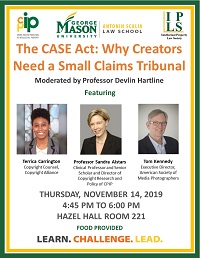
CASE act panel flyer

On Thursday, November 14, CPIP and the Intellectual Property Law Society (IPLS) will co-host a panel presentation entitled The CASE Act: Why Creators Need a Small Claims Tribunal at Scalia Law. The panel includes CPIP Director of Copyright Research and Policy Sandra Aistars, Terrica Carrington of the Copyright Alliance, and Tom Kennedy of American Society of Media Photographers (ASMP), and it will be moderated by CPIP Director of Communications Devlin Hartline.

The Copyright Alternative Small-Claims Enforcement Act (CASE Act) would create a tribunal within the U.S. Copyright Office to hear small copyright claims. This panel features three leading experts who have each played an important role in advocating for the CASE Act. They will discuss the substance and history of the CASE Act, its prospect for being passed by the Senate, and what it means for individuals and small businesses who have welcomed the meaningful copyright protection that the bill would provide.


Spotlight on Scholarship

a pair of glasses, an apple, and a stack of books

Daryl Lim, Judging Equivalents (forthcoming)

In this forthcoming paper from our Thomas Edison Innovation Fellowship, Daryl Lim of John Marshall Law School looks at the doctrine of equivalents, which gives patentees protection beyond the literal words of their claims. Professor Lim surveys the law and literature over the past 150 years and provides empirical data that helps to clarify the doctrine’s nature and contextualize its evolution and future.

Jonathan Ashtor, Modeling Patent Clarity (forthcoming)

In this forthcoming paper supported by a CPIP Leonardo da Vinci Fellowship Research Grant, Jonathan Ashtor of Cardozo Law employs sophisticated machine learning techniques to model patent clarity and provide unprecedented empirical analyses of the relationships between patent clarity and the public and private value of patent rights. The results empirically demonstrate the importance of patent clarity to the social and private functions of patents.

Runhua Wang, New Private Law? Intellectual Property ‘Common-Law Precedents’ in China (forthcoming)

In this forthcoming paper from our Thomas Edison Innovation Fellowship, Runhua Wang of Chicago-Kent College of Law surveys twenty-two guiding cases that act as binding precedent in IP cases in China and compares them with corresponding judicial precedents in the United States. Dr. Wang argues that these guiding cases are not conventional private or public law, and she explains how they take a utilitarian and pragmatic approach to statutory interpretation.


Activities, News, & Events

a lit lightbulb hanging next to unlit bulbs

CPIP Senior Scholar Kristen Osenga has been appointed the Austin E. Owen Research Scholar at the University of Richmond School of Law. Professor Osenga joined the faculty in Richmond in 2006, where her recent scholarship focuses on patent eligible subject matter, patent licensing firms, standard setting organizations, patent law reform, and claim construction, and she has written numerous law review articles on these and other topics. The CPIP team sends Professor Osenga its warmest congratulations on a well-deserved appointment!

The recent drug patent research paper written by CPIP Director of Life Sciences Erika Lietzan and Professor Kristina Acri of Colorado College has been positively received this past month. The paper, Distorted Drug Patents, will be published in the Washington Law Review, and it has been featured by Politico, Bloomberg Law, Patently-O, and FDA Law Blog as a valuable contribution to the empirical research on whether the patent system provides adequate incentives for innovation in the pharmaceutical industry.

CPIP Director of Copyright Research and Policy Sandra Aistars and CPIP Director of Communications Devlin Hartline lectured to a group of visiting IP professionals from the Zhejiang Provincial Administration for Market Regulation in China at George Mason University’s Schar School of Policy and Government. Professor Aistars discussed private ordering in copyright enforcement, while Professor Hartline talked about protecting brands in a modern economy.

Categories
Copyright

The CASE Act: Why Creators Need a Small Claims Tribunal


The Center for the Protection of Intellectual Property (CPIP) and the Intellectual Property Law Society (IPLS) at Antonin Scalia Law School, George Mason University, invite you to a panel discussion on the CASE Act.

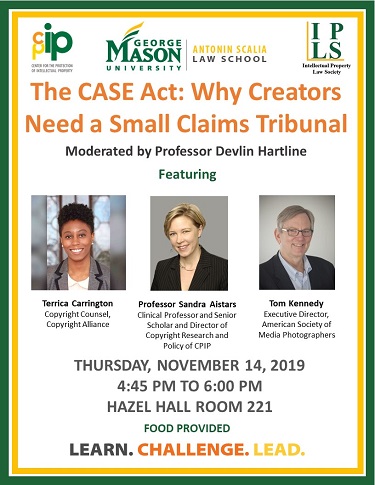
2019 CASE Act panel flyer
Click on image for full-size PDF flyer.

The CASE Act: Why Creators Need a Small Claims Tribunal

Thursday
November 14, 2019
4:45 – 6:00 PM

Antonin Scalia Law School
George Mason University
3301 Fairfax Drive
Hazel Hall, Room 221
Arlington, Virginia

The event is free and open to the public. Please register in advance by emailing Kristina Pietro at kpietro@gmu.edu by 5:00 PM on Monday, November 11. Food will be provided.


EVENT DESCRIPTION

The Copyright Alternative Small-Claims Enforcement Act (CASE Act) would create a tribunal within the U.S. Copyright Office to hear small copyright claims. The federal courts have exclusive jurisdiction over copyright cases, and the cost of bringing a federal lawsuit makes it difficult for many individuals or small businesses to sue for copyright infringement. The CASE Act would provide a cheaper and simpler alternative to resolve such claims, allowing copyright owners to sue without the need to hire an attorney. The bill would also create a cost-effective way for users of copyrighted works to fight back when challenged if they believe their use is noninfringing.

The CASE Act has broad bipartisan support, and it was passed by the House in a sweeping 410-6 vote on October 22, 2019. The bill heads next to the Senate, where two Senators have placed a hold on the bill that will make it more difficult to pass. While many artist advocacy groups, such as Copyright Alliance, American Society of Media Photographers, and Authors Guild, have applauded the CASE Act’s provision of remedies for disenfranchised copyright owners, other groups, such as Electronic Frontier Foundation, Re:Create Coalition, and Public Knowledge, have condemned the bill as an assault on civil liberties that will potentially bankrupt average Americans.

This panel features three leading experts who have each played an important role in advocating for the CASE Act. They will discuss the substance and history of the CASE Act, its prospect for being passed by the Senate, and what it means for individuals and small businesses who have welcomed the meaningful copyright protection that the bill would provide.


EVENT AGENDA

4:45 – 5:00 PM Welcome Reception

5:00 – 6:00 PM Panel Discussion

  • Prof. Sandra Aistars, Antonin Scalia Law School, George Mason University, Director of Copyright Research and Policy & Senior Scholar, Center for the Protection of Intellectual Property
  • Terrica Carrington, Copyright Counsel, Copyright Alliance
  • Tom Kennedy, Executive Director, American Society of Media Photographers
  • Moderator: Prof. Devlin Hartline, Antonin Scalia Law School, George Mason University, Director of Communications, Center for the Protection of Intellectual Property

Categories
Uncategorized

CPIP Roundup – September 30, 2019


Greetings from CPIP Executive Director Sean O’Connor

Sean O'Connor

The fall semester is now in full swing at Antonin Scalia Law School, and the CPIP team has been busy this past month with our various programs and events. On September 12-13, we hosted the third meeting of the 2019-2020 Thomas Edison Innovation Fellowship, where the Edison Fellows presented rough drafts of their papers and received valuable feedback. Then, on September 20-21, we co-hosted the 31st Annual Intellectual Property Section Seminar with the IP Section of the Virginia State Bar, which provided practitioners with an in-depth look at recent and upcoming developments in IP law. Finally, we’ve been getting ready for our Seventh Annual Fall Conference, which will take place at Scalia Law this Friday, October 4.

I am thrilled to announce that Erika Lietzan of Mizzou Law has joined CPIP as its new Director of Life Sciences. Prof. Lietzan is a leading expert in the fields of food and drug regulation, intellectual property, and administrative law, and her primary research focus lies at the intersection of IP law and FDA regulation of medical products. We’re very excited to have her join us as a core member of the CPIP team. In addition, I am especially proud of the work of CPIP Director of Copyright Research and Policy Sandra Aistars, who conducted an entertainment law education session and pop-up clinic for filmmakers with the students in her Arts & Entertainment Advocacy Clinic during the DC Shorts Film Festival on September 20.

We at CPIP send you our regards and best wishes for the coming month, and we hope to see you at our Fall Conference this Friday!


Join Us for CPIP’s Seventh Annual Fall Conference on Friday, October 4!

CPIP 2019 Fall Conference flyer

Online registration closes on Tuesday, October 1, 2019, at noon ET. Onsite registration will be available at the conference. 5 hours Virginia CLE, including 1.5 hours Ethics, available.

On Friday, October 4, 2019, CPIP will host its Seventh Annual Fall Conference at Antonin Scalia Law School in Arlington, Virginia. The theme of this year’s conference is The IP Bridge: Connecting the Lab & Studio, and the event will feature keynote addresses by Professor Robert Merges, UC Berkeley, and Maria Pallante, President & CEO of AAP and former Register of Copyrights.

This unique conference will highlight how IP rights facilitate the creative and innovative processes and preserve the vibrant ecosystems that deliver innovative products and creative works to consumers. In addition to exploring how IP helps to improve and enrich the lives of creators, inventors, and the public, this conference will also discuss how various efforts to impose price controls in the creative and innovation industries threaten established markets and the creation of innovative products and artistic works.

Please click here to register. We look forward to seeing you this Friday!


Spotlight on Scholarship

a pair of glasses, an apple, and a stack of books

Erika Lietzan & Kristina Acri, Distorted Drug Patents, ___ Wash. L. Rev. ___ (forthcoming)

In this forthcoming paper supported by a CPIP Leonardo da Vinci Fellowship Research Grant that will be published in the Washington Law Review, CPIP Director of Life Sciences Erika Lietzan and Professor Kristina Acri of Colorado College investigate whether the patent system provides adequate incentives for innovation in the pharmaceutical industry. Using a large dataset spanning 34 years, they find that longer clinical programs result in shorter effective patent life, even accounting for patent term restoration, which adds to the growing body of literature suggesting that the patent system may be systematically distorting drug research incentives.

Jonathan M. Barnett, Stealth Commoditization: The Misuse of Smartphone Antitrust, CPI Antitrust Chronicle (Sept. 2019)

In this article that was published by Competition Policy International, CPIP Senior Scholar Jonathan Barnett explores how antitrust regulators have implemented policies and taken actions that seek to limit the enforcement and licensing of standard-essential patents in the smartphone industry. Prof. Barnett explains how the real-world evidence does not support the patent holdup theory that underlies these antitrust decisions, and he notes that they in fact promote private interests of downstream producers at the expense of the public interest that the antitrust laws are intended to foster.

Ryan T. Holte & Ted M. Sichelman, Cycles of Obviousness, 105 Iowa L. Rev. ___ (2019)

In this paper that will be published by the Iowa Law Review, CPIP Senior Scholar Ted Sichelman and Judge Ryan Holte of the U.S. Court of Federal Claims conduct the first comprehensive empirical study of district court and Federal Circuit decisions both before and after the Supreme Court’s KSR v. Teleflex opinion. They explain how this recent shift in nonobviousness doctrine is part of an ongoing trend of courts raising and lowering the obviousness threshold based on the prevailing attitudes of judges as to the role of patents in promoting innovation.


Activities, News, & Events

a lit lightbulb hanging next to unlit bulbs

CPIP Senior Scholar Mark Schultz will join the faculty at the University of Akron School of Law in January 2020 as the Goodyear Tire & Rubber Company Chair in Intellectual Property Law and Director of the Center for Intellectual Property Law & Technology. Prof. Schultz’s research focuses on the law and economics of the global intellectual property system, and as Goodyear Chair, he will serve an important role in advancing critical thinking on IP law within the academic, business, and industry fields. At the IP Center, Prof. Schultz succeeds Judge Ryan Holte, who stepped down from his position to become a judge of the U.S. Court of Federal Claims.

CPIP Senior Scholar Kristen Osenga spoke at the Patent Masters Symposium, which was held in Arlington, Virginia, on September 10-11. Prof. Osenga joined the session entitled Balance, Transparency & Reasonableness: Converging Approaches to SEP Licenses and FRAND Royalties, where she presented her upcoming paper, IEEE IPR Policy Amendments: Strategic Behavior and Feedback Loops, that examines the problems with the IEEE’s 2015 amendments to its IPR policy. In the paper, Prof. Osenga examines the events leading to the amended IPR policy, including the theoretical problems of patent holdup and royalty stacking that supposedly justified it, and then she considers how the aftermath of the policy favors implementers over contributors.

Categories
Copyright

Publishers v. Audible: An Army of Red Herrings

a gavel lying on a desk in front of booksAudible has now filed its response to the publishers’ request for a preliminary injunction—twice. It filed the exact same brief to argue that it shouldn’t be preliminarily enjoined (Dkt. 34) and to argue that the complaint should be dismissed for failure to state a claim (Dkt. 41). Unfortunately for Audible, the repetition of fallacious arguments doesn’t make them true. You may have heard that a group of geese is a “gaggle” and that a group of crows is a “murder.” Groups of animals are often known by somewhat peculiar collective nouns. Perhaps less well-known is that a group of herrings—those foraging fish that favor shallow, temperate seas—is called an “army.” Audible’s response includes so many irrelevant distractions that it can accurately be described as an army of red herrings.

Audible argues that this should be a contract dispute, not a copyright case, and that Captions is nevertheless fair use—no matter who is doing the copying. Indeed, the one thing that Audible apparently wants to avoid discussing in detail is the one thing that I find interesting in this case, namely, who directly causes the various prima facie infringements of the publishers’ rights to occur. Audible’s response makes clear that it would rather jump straight to the fair use analysis without first analyzing exactly who is causing what to occur. But that fair use analysis only makes sense if we know who is doing the copying. The factors would be applied differently to Amazon, Audible, or its users, and Audible’s response elides such distinctions even though they are crucial.

In my last post about this case, I discussed how Audible was likely to cite cases such as Sony and Cablevision in arguing that it doesn’t make the copy, the user does, and that’s fair use. Remarkably, Audible does suggest that the user makes the copy, but it relegates this claim to the preliminary, factual background section of the brief—it’s not actually part of its main argument section. But this does give us some idea of what Audible will argue once it’s forced to clarify its theory of the case. Perhaps most interesting of all, Audible explains how the third-party Amazon Transcribe feature operates within Captions, and it’s less favorable to Audible than I had originally suggested.

Audible explicitly states that “a listener generates Audible Captions.” So that tells us who Audible thinks is doing the copying—and it’s not Audible. There are no citations to any case law, and there’s no explanation of why it’s the user doing the copying. Just the ipse dixit that it’s so. Audible then explains that the transcriptions are not, as I suggested in my last post, simply done in real time via Amazon Transcribe. That may be true in part, but the entire audiobook file is also sent to Amazon where it is converted into text and then sent back to the user. And that entire transcription is then stored on the user’s device, albeit in an encrypted file. Moreover, once one user requests a transcription, a cached copy of the file is then stored for 90 days on the server, and any subsequent user requesting a transcription of the same work in that time frame will get the cached copy—not a new transcription.

This business with the cached copy opens up another can of copyright worms, one that Audible presumably is not looking forward to discussing. Not only is there a full copy of the text on the user’s device, but there’s also another copy on the server. And there’s no doubt that both copies are fixed since there’s no argument that they exist for a mere transitory duration. Furthermore, the fact that the same source copy is being sent to different users destroys any claim under Cablevision that Audible might make that these are not public distributions. The Second Circuit there held that the transmissions weren’t public since there was a unique source copy that was used for each transmission to an individual user. While I don’t see how that holding survives Aereo, the cached copy here takes that argument off of the table.

Audible spills much ink arguing that Captions is not a replacement for the text of the underlying book since the experience with the same text of the transcription is different. For example, unlike an e-book, Captions displays at most 20 words at a time that is synchronized to the audio. And this “audio-first experience” has different punctuation, there are no page numbers, and the user can only scroll through the text by first scrolling through the audio. Of course, it’s true that there are differences between the user experience with Captions and an e-book, but these differences are irrelevant to the publishers’ prima facie copyright claims. Just because the user experiences the work differently doesn’t mean that there hasn’t been all sorts of actionable copying enabling that experience. These differences may be relevant to fair use, but not one of them matters for determining who is doing what.

After throwing its users under the bus by claiming that they make the copies with Captions, Audible sidesteps any actual analysis of that issue by arguing instead that the publishers failed to properly plead their copyright claims. The crux of Audible’s argument is that, since it has license agreements with the publishers to sell and produce audiobooks, the publishers have waived their right to sue for copyright infringement to the extent Audible’s conduct is licensed. Audible then argues that the burden is on the publishers to plead the licenses and conduct that exceeds their scope (or a violation of their conditions precedent) in order to state a copyright claim. And since the publishers didn’t plead any reason why the licenses wouldn’t permit Audible’s copying of the audiobooks, Audible argues that the case against it should be dismissed.

Audible correctly states the law, but not its application here. When the existence of a license is not in question, the copyright owner bears the burden of proving that the alleged infringer exceeded its scope or breached its condition. And Audible is certainly correct in arguing that it is a “licensed, paying user of the audiobooks from and for which it created Audible Captions.” Audible has licenses for the audiobooks, and the publishers didn’t plead them. The fallacy of this argument, however, is that the publishers’ copyright claims are not directed to those audiobook licenses—or even to those audiobooks. The publishers only claim infringement of the underlying works, that is, the literary works from which the sound recordings of the audiobooks are derived. Audible is probably violating various rights in the audiobooks as well, but the publishers have not brought those claims.

That the publishers are suing over the original books, and not the derivative audiobooks, is clear from the face of the complaint. The publishers charge Audible with “unlawfully creating derivative works of, reproducing, distributing, and publicly displaying unauthorized copies of the Works,” and the works identified are the registered, literary works of which the publishers are legal or beneficial owners. The complaint explicitly alleges that “Audible did not seek a license for the creation and provision of the transcriptions provided to consumers” and that “it has only been authorized to deliver the work in audiobook format.” If Audible turned an audiobook into a movie, the publishers would not have to plead that Audible thus exceeded the scope of its license for the simple reason that there was no such license to create the derivative movie in the first place.

The fact that the allegedly infringing transcriptions have as their source the licensed audiobooks doesn’t matter; what matters is that the transcriptions violate the publishers’ rights in the underlying literary works. For the bulk of audiobooks at issue that Audible didn’t create, i.e., the ones that were provided by the publishers or third parties, Audible had no license to create derivative works of any kind. And for the few audiobooks that Audible itself may have created under license—though Audible noticeably doesn’t claim to have a license to create derivatives of any of the specific works-in-suit—it only had a license to create the derivative sound recordings embodied in the audiobooks. Audible’s hand-waving about licenses is easily dismissed because, quite simply, there was never any license to create the derivative literary works over which it is being sued.

Despite the army of red herrings summoned to obfuscate its theory of exactly who is doing the copying in this case, the burden falls squarely on Audible to establish the existence of any license that may justify its actions. And the fact that Audible failed to mention any such license speaks volumes. Audible instead jumps straight to fair use, making the incredible claim that providing the text of the audiobook is somehow completely different than providing the text of the underlying book itself because the former allows users to “understand and engage with the audiobook they purchased.” I’ll leave the absurdity of Audible’s fair use argument for another day, but for now I’d like the court to sort out the preliminary issue of who is doing what. And that appears to be a conversation that Audible would rather not have.

Categories
Copyright

Audible’s Planned Caption Service is Not Fair Use

a shelf full of booksLate last month, a group of publishers filed a complaint against Audible in the Southern District of New York asking the court to enjoin the audiobook distributor’s launch of a new audio-to-text transcription service. Although Audible has yet to file a response, a statement from the company—a subsidiary of Amazon since 2008—hints at a fair use defense based on the service’s supposed educational purpose. Unfortunately for Audible, its unauthorized reproduction, distribution, adaptation, and display of the publishers’ copyright-protected works is unlikely to survive a sound fair use analysis.

New Captioning Feature Infringes Publishers’ Rights

Audible is the world’s largest distributor of digital audiobooks and “spoken-word entertainment,” making available to its subscribers hundreds of thousands of audio programs based on works licensed from publishers, broadcasters, entertainers, individual authors, and other copyright owners. For subscribers who want a cross-format experience where they can simultaneously read and listen to the text, Audible already offers a feature called Immersion Reading. Touted as an educational tool that can help with reading comprehension, Immersion Reading is made possible by Audible securing licenses for both the audio recording and text of the work—and subscribers are required to purchase both an audiobook and a Kindle edition ebook.

In July of 2019, Audible announced it would be adding an “Audible Captions” feature to its mobile app. The service utilizes Amazon’s transcription technology to provide Audible subscribers with text for a select number of works in Audible’s audio program catalog. When listening to a predetermined “caption-ready” work, a subscriber would have the ability to activate the transcription technology, which then generates and distributes text to the subscriber’s device in a matter of milliseconds while the audio continues to play.

As the publishers’ complaint explains, the Audible Captions service converts the publishers’ works into unauthorized and often error-ridden “new” digital books and then distributes them to its customers without permission. Unlike its Immersion Reading service, Audible has not secured a license to copy, repurpose, distribute, or display this text and has no intention of compensating publishers for this cross-format use that would compete directly with and devalue existing physical books and ebooks. Accordingly, the publishers’ complaint alleges direct, contributory, and vicarious infringement and asks the court to enjoin Audible from reproducing, adapting, distributing, or displaying the publishers’ works.

Fair Use Defense Falls Flat

While Audible’s response will likely include a variety of defenses (for an in-depth look into what Audible might argue on the merits of the publishers’ prima facie infringement case, see Devlin Hartline’s recent post), public statements by the company have focused on the purported educational purpose of the captioning service, setting the stage for a fair use affirmative defense. Despite lofty claims of the educational objectives of its service, Audible Captions would clearly serve entertainment purposes as well, profiting Audible while undermining the legitimate and existing market for ebooks and other cross-platform services.  A closer look at the four fair use factors reveals Audible’s tenuous position.

1. Purpose and Character of the Use


The first factor—and the factor that is most relevant to Audible’s statements on educational intentions—involves determining the purpose of the unauthorized use. Section 107 of the Copyright Act provides a non-exclusive list of a few traditional uses—news reporting, comment, criticism, teaching, research, and scholarship—that will usually tip the scales in favor of the alleged infringer. However, the language is clear that determining “whether such use is of a commercial nature or is for nonprofit educational purposes” is integral to a proper factor-one analysis.

In its press release response to the publishers’ complaint, Audible describes its captioning service as a “free initiative” and a “free, new technology.” But it’s critical to understand—especially in the age of pervasive and organized digital infringement—that offering something to a customer for free that may have an educational function does not mean the activity is nonprofit. Indeed, the online platforms and services we use free of charge on a daily basis distribute massive amounts of content that could be deemed educational, all the while raking in profits through ad revenue and data collection. While Audible’s business model is not the same as the social media and search engine giants that rule cyberspace, it is a commercial business that makes money from the sale of audiobooks and subscriptions, and it’s attempting to justify infringement with a familiar fair use refrain.

If Audible Captions is allowed to launch, Audible would no longer have to secure cross-format licenses for its existing Immersion Reading service. It would essentially replace its own product—more on this later—with a version designed to allow it to skirt licensing requirements and profit at the expense of publishers and other copyright owners. Providing an audio-to-text feature without having to compensate copyright owners would establish a clear commercial advantage for Audible, and this type of misappropriation is not what fair use is meant to protect.

It’s also important to note that, at a time when courts are citing transformative fair use to excuse more and more instances of misappropriation, Audible Captions does not transform the underlying work and serves no transformative purpose. Audible is reproducing the text of a literary work for the purpose of reading—whether for education or for entertainment—and that is the exact purpose of the underlying works of authorship. As the Second Circuit stated in Authors Guild v. Hathitrust, “a transformative work is one that serves a new and different function from the original work and is not a substitute for it.” There’s nothing new or different about Audible Caption’s output.

2. Nature of the Copyrighted Work


The second factor asks whether the underlying work is a fact-heavy informational work or a work of creative expression and entertainment, giving more fair use leniency to the former since there is a greater need to disseminate factual works. In the case of Audible Captions, most (if not all) of the books Audible lists in its promotional materials are literary works of fiction. Despite a few older titles that have fallen into the public domain, most of the books whose text would be made available through Audible Captions are copyright-protected works of creative expression. This factor weighs clearly against a fair use determination.

3. Amount and Substantiality of the Portion Used


Like the second factor in this case, this consideration is not complex and weighs quite clearly against a fair use finding. Audible Captions reproduces the entire text of the underlying work. While it may only display a certain amount of text on the screen of a device at a time, subscribers have the ability to pause, rewind, and otherwise jump to any part of the works which will then be transcribed and delivered to their device.

Some early commentators on the Audible Captions technology have used the word “snippet” to describe what subscribers are able to access. This is probably an attempt to liken the service to the Google Books project, which displayed limited amounts of text to a user and was found to be fair use. But Google Books never allowed users to read a work in its entirety, which is exactly what Audible’s service does.

4. Effect of the Use on the Potential Market or Value of the Underlying Work


Notwithstanding arguments about the educational and altruistic purpose of its service, Audible cannot survive a sensible analysis of the fourth factor for one very simple reason: their own Immersion Reading service proves that a legitimate market for cross-format use already exists and will be harmed by a free alternative. As mentioned earlier, Immersion Reading depends on Audible licensing both the audiobook and text from publishers, and the launch of Audible Captions represents a way for the company to provide a similar—yet poorer quality—product to its costumer without taking a license.

In the seminal fair use case Sony v. Universal, the Supreme Court discusses the fourth factor and asserts that in order for a noncommercial use to be disqualified as fair, there must be a showing that the use would be harmful and adversely affect the potential market for the copyrighted work. Justice Stevens explains:

Actual present harm need not be shown; such a requirement would leave the copyright holder with no defense against predictable damage. Nor is it necessary to show with certainty that future harm will result. What is necessary is a showing by a preponderance of the evidence that some meaningful likelihood of future harm exists.

And so even in the unlikely event that a court were to find Audible’s service to be a noncommercial use, an existing market for the publishers’ works and the licenses already entered into for the Immersion Reading service surely satisfy the test for future harm.

Furthermore, ebooks and other cross-format offerings are readily available from authors and publishers, and massive amounts of research, time, and money go into creating the best user experience. Not only would Audible Captions strip copyright owners and creators of deserved revenue, but it would deprive them of the ability to control the look and feel of their works in the digital word. Audible Captions would undermine this already vibrant digital book market by offering an inferior substitute outside of the creative control of those who actually care about its presentation and consumption.

With a readily available substitute—even an inferior one—legitimate ebooks and other cross-format services will be devalued and fewer resources will be reinvested in their development. Publishers will lose, authors will lose, and perhaps most importantly, consumers and the public will lose if this market is compromised.

Conclusion

Despite talk of “a mission that transcends financial success,” it is crucial to recognize that Audible (and ultimately Amazon) is the only one that will benefit from the introduction of the Audible Captions service. If serving those in need of literacy tools was the true objective, more attention should be paid to developing technology that doesn’t generate erroneous and confusing text. At a time when the boundaries of fair use seem to be spreading in every direction, the unauthorized for-profit appropriation of entire works of creative expression cannot be part of the expansion.

Categories
Copyright

Publishers v. Audible: VCRs and DVRs to the Rescue?

a remote pointed at a TV screen showing a sports gameOn August 23, a group of publishers, including Penguin Random House, HarperCollins, and Simon & Schuster, sued Audible for copyright infringement. Audible, which is a subsidiary of Amazon, sells and produces audiobooks, and it planned to launch a new speech-to-text feature on September 10. The feature, dubbed Audible Captions, would automatically convert the licensed audio of an audiobook into unlicensed text that appears on the user’s screen as the audiobook is played. In a video posted to YouTube on August 2, Audible mentions that Captions is powered by Amazon Transcribe, which appears to provide real-time transcriptions by sending audio to Amazon’s servers where it is converted to text and then sent back to the user.

The publishers allege that, through its Captions feature, Audible infringes their reproduction, adaptation, public distribution, and public display rights, either directly or indirectly, and they’ve moved for a preliminary injunction. The crux of their argument as to direct liability is that Audible—and not the user—directly causes the various infringements to occur. The publishers don’t specifically mention the role of Amazon or its Transcribe feature in their arguments, though they do note that “Audible has further arranged for software programs and servers” to create the unlicensed text. But it seems quite likely that Audible will use distinctions over exactly who is doing what—the user, Audible, or Amazon—to argue that its role in the copying is too remote to make it a direct infringer.

Audible has agreed to forgo enabling Captions for the publishers’ works until the court rules on the preliminary injunction motion, and its response is due this coming Friday, September 13. Other than the hint that it will likely argue fair use since it believes that the Captions feature will “help kids,” Audible has not tipped its hand as to what it will argue on the merits of the publishers’ prima facie infringement case. But, given the law in the Second Circuit where the publishers have filed suit, we can certainly guess what it will argue.

In a recent article at Ars Technica, Timothy B. Lee suggests that Audible is likely to rely on two seminal copyright cases in its defense: Sony v. Universal and Cartoon Network v. CSC Holdings (aka Cablevision). Lee points out the role of Amazon’s cloud-based Transcribe service in Audible’s automated captioning process, and he contends that it “strengthens the company’s argument that it can do this without a license from publishers.” With Sony, Lee references the Supreme Court’s holding that unauthorized time-shifting can be fair use, and he further notes that, while cases like this can be unpredictable, the courts might decide that automated speech-to-text conversion is likewise fair use.

Of course, there are significant differences between the time-shifting in Sony and the transcription that occurs with Captions. Sony time-shifting created a copy of an audiovisual work without changing its work-of-authorship category, and both the original broadcast and the copy made with the VCR were audiovisual works. With Captions, by contrast, the audiobook, which is a sound recording, gets transformed into a literary work. This isn’t merely creating a copy of a work to watch later; it’s creating an entirely different—though derivative—work. And, of course, in making this derivative work, a reproduction also occurs since the two works are substantially similar. But Captions nevertheless is an entirely different beast than time-shifting, or even space-shifting for that matter, since it in fact creates a new—and separate—work of authorship.

Moreover, the analysis in Sony turned on copying by the user, not Sony itself, and thus the fair use factors were applied differently than they would be here with the publishers’ direct liability claims. Most notably, the first and fourth factors here heavily favor the publishers since Audible’s for-profit use isn’t transformative and causes harm to an established market. Indeed, Audible itself currently offers Immersion Reading, where licensed audiobooks are combined with licensed e-books, allowing the user to follow along with the text while listening to the audio. Importantly, the user must purchase both the audiobook and the e-book to use this functionality in the Audible App.

Turning to Cablevision, Lee argues that “Audible’s case will likely be strengthened by the fact that its app never creates or saves a permanent, full transcript of an audiobook” since “the software only displays a few words on the screen at a time.” To be sure, the buffer copies at issue in Cablevision, which existed for at most 1.2 seconds before being automatically overwritten, were held to be unfixed and thus not copies that could give rise to infringement liability. But Lee misconstrues the import of this holding: There was no doubt that a work could be copied by chopping it up into little pieces at a time; the question was whether those pieces existed for more than a transitory duration. Unlike the buffer copies at issue there, the copies here are clearly fixed since the user can pause the text in Captions and keep it on the screen indefinitely.

Lee notes Cablevison’s holding that it was the user, and not Cablevision itself, that caused a copy to be made with the cloud-based DVR. And he posits that Audible will argue that it thus has the right to distribute “software tools that allow customers to do speech-to-text conversion.” I agree, and I think Audible is very likely to argue that it doesn’t make the copy, the user does, and that’s fair use. But I disagree with Lee’s further claim that, if the transcription actually takes place on Amazon’s servers, the “publishers are likely to argue this means Amazon—not users—are creating the transcripts.” If the publishers thought that Amazon was making the copies, Amazon would have been named as a defendant. It wasn’t—and for good reason.

As I understand the facts, I don’t think it’s likely that Amazon would be directly liable for the copying that takes place with its Transcribe feature. That system is fully automated, and Amazon plays no role in selecting or supplying the content that gets converted. The same, however, is not true for Audible. The publishers claim that Audible is a direct infringer since it selects which specific audiobooks have the Captions feature enabled and integrates the functionality for making the unauthorized transcriptions within its Audible App. To analyze this claim, we must determine whether Audible’s actions are sufficiently proximate such that Audible itself can be said to be doing the copying, and for that we need to look no further than the Cablevision opinion itself.

Cablevision turned on whether the remote-storage DVR (RS-DVR) was more analogous to a VCR or a video-on-demand (VOD) service. With a VCR, the user who pressed the record button supplied the necessary volition to be held liable as a direct infringer—not the company that manufactured and sold the VCR, which had no control over the content that was recorded. With VOD, by contrast, the user still pressed the button to initiate the streaming, but the service provider was the one that could be held directly liable since it selected and supplied the works that were available on its service. Cablevision’s cloud-based DVR fell somewhere in between, and the Second Circuit held that it was more like a VCR since Cablevision did not control the specific content that its users could record and stream:

Cablevision, we note, also has subscribers who use home VCRs or DVRs (like TiVo), and has significant control over the content recorded by these customers. But this control is limited to the channels of programming available to a customer and not to the programs themselves. Cablevision has no control over what programs are made available on individual channels or when those programs will air, if at all. In this respect, Cablevision possesses far less control over recordable content than it does in the VOD context, where it actively selects and makes available beforehand the individual programs available for viewing. For these reasons, we are not inclined to say that Cablevision, rather than the user, “does” the copying produced by the RS–DVR system.

Lee mentions that the “courts could decide that Amazon plays too active a role in the conversion process to portray itself as a passive supplier of technology like the maker of a VCR.” I think this is very likely, but only as to Audible, not Amazon. As noted above, Amazon Transcribe is a passive system; it will transcribe any audio that it receives. Captions, on the other hand, only transcribes the specific works that Audible has decided ex ante to include. The user can’t transcribe every sound recording on a device or even every audiobook within the Audible App. Audible instead chooses the specific works within its App that the user is allowed to convert into a derivative, literary work. And it’s this selection of the specific content that makes Audible more like a VOD service than a VCR or DVR.

The Supreme Court opinions in ABC v. Aereo—both the majority opinion by Justice Breyer and the dissent by Justice Scalia—buttress this conclusion. Like Cablevision, Aereo supplied a cloud-based DVR, though the content available on Aereo’s service depended on what was publicly available via over-the-air transmissions. The Aereo majority held that it was Aereo, and not the user, that caused the transmission to occur when the user pressed a button to initiate the streaming, and this was true even though Aereo had no control over the specific content that was made available to the user. The Court held that Aereo’s role in the copying—by setting up in-house antennas, transcoders, and servers that would retransmit television broadcasts to the public—was sufficiently proximate to render it the direct infringer.

In dissent, Justice Scalia took a far more limited view of the volition necessary to hold a service provider directly liable. Relying on Cablevision, Justice Scalia argued that direct liability “demands conduct directed to the plaintiff’s copyrighted material,” and since Aereo did not select the specific content to be streamed, he would have held that it could not be directly liable. Indeed, he argued that a VOD service could be directly liable precisely because the “selection and arrangement by the service provider constitutes a volitional act directed to specific copyrighted works and thus serves as a basis for direct liability.” In his estimation, “Aereo does not ‘perform’ for the sole and simple reason that it does not make the choice of content.”

Thus, even under Justice Scalia’s narrow view of direct liability, Audible can quite reasonably be said to have crossed the line from being a passive conduit to an active participant in the copying because Audible itself selects the specific works that can be transcribed with its Captions feature. Once Audible files its response brief this coming Friday, I hope to then take a deeper dive into these fascinating issues. And perhaps then I’ll discuss the secondary liability issues that I ignored in this post. But for now I’ll conclude by saying that, by making its Captions feature available only for the specific works that it selects, Audible will have an uphill battle in arguing that it’s more like a VCR or DVR than a VOD service.

Categories
CPIP Roundup

CPIP Roundup – August 29, 2019


Greetings from CPIP Executive Director Sean O’Connor

Sean O'Connor

With a new academic year beginning at Antonin Scalia Law School, the CPIP team continues to build on a productive summer of scholarship, events, and more. Our WIPO-CPIP Summer School on Intellectual Property this past June boasted 70 students from 30 countries for a two-week crash course on the law and policy of IP in order to help advance their careers. And our Fifth Summer Institute in Beaver Creek, Colorado, this past July brought together IP scholars, policy analysts, and professionals in the innovation and creative industries to discuss the current state of affairs and to work on translating ideas into policy.

Looking ahead, we’re getting ready for our upcoming Seventh Annual Fall Conference, which will take place at Scalia Law on October 4. We’ll also be co-hosting the 31st Annual Intellectual Property Section Seminar with the IP Section of the Virginia State Bar on September 20-21 at Scalia Law. We’re thrilled as well that CPIP Director of Copyright Research and Policy Sandra Aistars will continue her work with the law school’s Arts & Entertainment Advocacy Clinic, while I will be focusing more on the patent side as I lead the law school’s new Innovation Law Practicum.

I hope you’ve had a wonderful summer, and I look forward to seeing you at our future events!


Registration Open for CPIP’s Seventh Annual Fall Conference on October 4

CPIP 2019 Fall Conference flyer

On October 4, 2019, CPIP will host its Seventh Annual Fall Conference at Antonin Scalia Law School in Arlington, Virginia. The theme of this year’s conference is The IP Bridge: Connecting the Lab & Studio, and it features keynote addresses by Professor Robert Merges, UC Berkeley, and Maria Pallante, President & CEO of AAP and former Register of Copyrights. 5 hours Virginia CLE, including 1.5 hours Ethics, available!

This unique conference will highlight how IP rights facilitate the creative and innovative processes and preserve the vibrant ecosystems that deliver innovative products and creative works to consumers. In addition to exploring how IP helps to improve and enrich the lives of creators, inventors, and the public, this conference will also discuss how various efforts to impose price controls in the creative and innovation industries threaten established markets and the creation of innovative products and artistic works.

Please click here to register. We look forward to seeing you in October!


Spotlight on Scholarship

a pair of glasses, an apple, and a stack of books

Kristen Osenga, Institutional Design for Innovation: A Radical Proposal for Addressing § 101 Patent-Eligible Subject Matter, 68 Am. U. L. Rev. 1191 (2019)

In this paper supported by a CPIP Leonardo da Vinci Fellowship Research Grant, CPIP Senior Scholar Kristen Osenga investigates the jumbled state of patent-eligible subject matter in the United States. Following an analysis of those entities currently wielding the power to make decisions on patent eligibility—and an assessment suggesting that other reforms will not solve the issue at its roots—Professor Osenga instead proposes and defends the revolutionary plan of turning over patent-eligibility decisionmaking authority to the courts.

Mark F. Schultz, The Market for Performance Rights in Sound Recordings: Bargaining in the Shadow of Compulsory Licensing (forthcoming)

In this forthcoming paper, CPIP Senior Scholar Mark Schultz discusses government regulations on licensing rights and rates for sound recordings, focusing on how their artificial nature divorces creators’ control and compensation from the marketplace. After exploring the negative impact of this arrangement on creators, consumers, and the market at large, Professor Schultz suggests policy changes for overhauling (and not merely recalibrating) the current, outdated system.

Jonathan M. Barnett, Antitrust Overreach: Undoing Cooperative Standardization in the Digital Economy, 25 Mich. Telecomm. & Tech. L. Rev. 163 (2019)

In this paper from our Sixth Annual Fall Conference, CPIP Senior Scholar Jonathan Barnett analyzes the benefits of standardization in ICT markets and the importance of IP rights and enforced contracts in keeping standardization relationships reciprocal rather than imposed by exterior monopolization. Professor Barnett looks at threats to cooperative standardization as posed by regulators and legislation—in particular, how implementation is favored over, and to the detriment of, innovation.


Activities, News, & Events

a lit lightbulb hanging next to unlit bulbs

CPIP Executive Director Sean O’Connor leads the law school’s new Innovation Law Practicum this fall. The Practicum will provide teams of students the opportunity to counsel entrepreneurs, creators, and inventors from the university’s internal and external communities. The course will teach students about entrepreneurship and commercializing innovation and creativity, as well as how to craft an overall legal strategy in the context of a client’s business, technology, and/or artistic vision. Anticipated projects include providing an initial assessment of legal issues and business planning, followed by specific legal services such as entity formation, securing IP, or drafting employment agreements upon mutual agreement with the client.

CPIP Director of Copyright Research and Policy Sandra Aistars heads the law school’s Arts & Entertainment Advocacy Clinic again this fall. The Clinic will continue its partnership with the U.S. Copyright Office by helping it and the World Intellectual Property Organization (WIPO) organize a conference on AI and copyright. The Clinic will also help mentor Native American musicians and promote cultural understanding via their music, work with a Grammy-nominated musician on a multi-disciplinary project, work with an author to register numerous books, advocate for the CASE Act, explore the intersection of copyright and constitutional law by representing parties interested in solving problems related to state sovereign immunity in cases of willful copyright infringement, and conduct an entertainment law education session and pop-up clinic with the Washington Area Lawyers for the Arts (WALA) during the DC Shorts Film Festival.

CPIP Executive Director Sean O’Connor joined Professors Lateef Mtima and Steve Jamar of the Institute for Intellectual Property and Social Justice (IIPSJ) in filing an amicus brief in Skidmore v. Led Zeppelin, a case currently before the en banc Ninth Circuit. The amicus brief argues that the courts should not improperly restrict composers to the “lead sheet” deposit copy for determining the scope of copyright protection for a musical composition. The brief explains how this position denies social justice to those whose backgrounds or musical styles preclude the use of traditional musical notation, and it argues that phonorecords or other contemporaneous documentation should be allowed as evidence of the scope of the copyrighted work.

Categories
Biotech Patents Pharma

“No Combination Drug Patents Act” Stalls, but Threats to Innovation Remain

superimposed images from a chemistry labBy Kevin Madigan & Sean O’Connor

This week, the Senate Judiciary Committee was to mark up a bill limiting patent eligibility for combination drug patents—new forms, uses, and administrations of FDA approved medicines. While the impetus was to curb so-called “evergreening” of drug patents, the effect would have been to stifle life-saving therapeutic innovations. Though the “No Combination Drug Patents Act”—reportedly to be introduced by Senator Lindsey Graham (R-SC)—was wisely withdrawn at the last minute, it’s likely not the last time that such a misconceived legislative effort will be introduced.

An Exaggerated Response to a Disputed Theory

The bill would have established a presumption of obviousness for drug or biologic patent applications whose invention was a new: dosing regimen, method of delivery, method of treatment, or formulation. While there was a rebuttal provision where the claim covered a new treatment for a new indication or “increase[d] . . . efficacy,” the latter was almost certain to introduce years of uncertainty and litigation. Further, the bill would have covered a broader class than true combination drug patents, in which one active ingredient is combined with another or with a non-drug.

Like many recent legislative efforts, the amendment sought to address a perceived lack of affordability of prescription drugs. After praising the America Invents Act of 2011 and subsequent Supreme Court rulings for strengthening the US patent system, the bill claimed that rising drug prices have outpaced “spending on research and development with respect to those drugs.” In addition to applauding Supreme Court decisions that have injected unquestionable uncertainty into patentable subject matter standards, the amendment went on to blame high drug prices on continually overstated issues related to advanced drug patents.

According to critics, combination drug patents have granted drug makers unearned and extended protection over existing drugs or biological products. But, quite simply, when properly issued by the USPTO under existing patentability standards, these are new patents for new products or processes.

Combination patents have been maligned as anticompetitive, resulting in a “thicket” of patents that impedes innovation through transaction costs and other inefficiencies. Unfortunately, notwithstanding a lack of empirical evidence validating the harm of follow-on innovation patents, patent thicket rhetoric is now being echoed by the media, the academy, courts, and policy makers in a fraught attempt to fix drug pricing.

Reports (see here, here, here, and here) from leading antitrust experts and intellectual property scholars have detailed the value of incremental innovation and challenged the notion that patent thickets are a true threat to competition and innovation. These studies have exposed patent thicket claims—much like the “troll” narrative that for years infected patent law debates—as an empty strawman theory, the repetition of which has led to undue confidence in its accuracy. The reality is that what critics point to as problematic cases of combination patents are in fact infrequent outliers, strategically highlighted to discount evidence of the value of new and innovative drug uses and administrations.

A similar claim by those promoting the patent thicket narrative is that combination patents extend exclusivity on a drug for years beyond an initial patent term, thereby blocking generic entry in the market. But if an underlying drug has gone off patent, no follow-on or combination patent will prevent a generic drug company from producing the underlying formulation—it’s only the new formulation, use, or administration that is protected.

Vague, Yet Oddly Familiar Standards

The language of the Graham amendment asserted that because “numerous” combination patents “contain obvious product developments,” a restructuring of 35 USC 103 is necessary to combat patent thickets and achieve optimal drug pricing. Suggesting that 103 obvious standards for advanced drug development should include a presumption that the covered claimed invention and the prior art to which it relates would have been obvious, the legislation would have undermined a unitary system of patent law in favor of different standards for different fields of technology. It was a bold proposal, and it’s one that ignored the proven value of new drug formulations and methods of treatment.

While the amendment provided for a rebuttal to the presumption of obviousness, the language was ambiguous and likely to render the patent system even more unreliable than it already is. The proposed statute said that an applicant may rebut the presumption of obviousness if the covered claimed invention “results in a statistically significant increase in the efficacy of the drug or biological product that the covered claimed invention contains or uses.” It is unclear what would qualify as “statistically significant,” and proving this vague standard would be nearly impossible.

In order to show a “statistically significant increase in efficacy,” long and costly head-to-head clinical trials would be necessary. To be clear, this is not a standard required by the FDA for new drug approval, let alone patentability.

As if that wasn’t enough reason to reject the Graham amendment, the language was alarmingly similar to that of an Indian patent law statute that has been recognized by the US Trade Representative as a “major obstacle to innovators.” In 2005, in order to comply with the WTO’s Trade-Related Aspects of Intellectual Property Rights (TRIPS) agreement, India adopted for the first time patent protection for pharmaceuticals. Despite its recognition of IP rights in pharmaceuticals, India’s Act contains a troubling ambiguity in its Section 3(d), which requires an “enhanced efficacy” for known drugs in addition to the standard novelty, inventive step, and industrial applicability requirements.

India’s Section 3(d) has been invoked to reject patent protection for life-saving drug innovations, including Novartis’ landmark leukemia drug, Gleevec. Drug companies, government agencies, and policy makers have all recognized the threat to innovation that India’s patent law poses. In 2013, not long after the Novartis ruling, a bipartisan group of 40 Senators signed a letter to then Secretary of State John Kerry urging the state department to take action against India’s “deteriorating IP environment,” citing its willingness to “break or revoke patents for nearly a dozen lifesaving medications.”

Despite the widespread condemnation of India’s Section 3(d), the Graham amendment proposed adopting similarly indefinable standards to US patent law. While the language differed slightly—replacing “enhanced efficacy” with “increase in the efficacy”—it was no clearer, and implementation of this type of standard would only cause more confusion.

Protecting and Incentivizing Medical Innovation

Like most forms of innovation, the development of medicines and therapeutics is a process by which one builds and improves upon previous discoveries and breakthroughs. Sometimes those improvements are major advancements, but often they are incremental steps forward. In the pharmaceutical field, incremental or follow-on innovation frequently results in new therapeutic uses for existing drugs, which address serious challenges related to adverse effects, delivery systems, and dosing schedules. While they might not sound like medical breakthroughs on par with the discovery of penicillin, these advancements in the administration and use of pharmaceuticals improve public health and save lives.

Additionally, follow-on innovations are—and should remain—subject to the same patentability standards as any other technologies. Patents reward advancements that are novel, useful, and nonobvious, and our patent system has long recognized that patent claims are to be presumed patentable and nonobvious. The Graham amendment would have turned this established standard on its head, creating a separate and ill-defined hurdle for certain advancements in medicine.

The benefits of incremental innovation to public health and patients cannot be overstated. New formulations of malaria drugs, dosing regimens and delivery systems for AIDS patients, more efficient administrations of insulin for the treatment of diabetes, and developments in the treatment of cognitive heart disease have all been possible because of incremental innovation.

Imposing unjustified restrictions on the patentability of advancements like these would be disastrous for drug development, as the incentives that come with patent protection would be all but eliminated. Without the assurance that their innovative labor would be supported by intellectual property protection, pioneering drug developers would shift resources away from improving drug formulations and uses. The development of more effective treatments of some of the most devastating diseases would stall, as innovators would be unable to commercialize their products, recoup losses, or fund future research and development.

As critics continue to target myopically the patent system for a broader issue of drug prices in the American health care system, it’s likely not the last time that language like this will be proposed. In order to avoid the implementation of such ill-conceived standards into our patent laws, understanding what’s at stake is critical. The future of medical innovation depends on it.

Categories
CPIP Roundup

CPIP Roundup – May 23, 2019


Sean O’Connor Joins George Mason University’s Scalia Law Faculty

Sean O'Connor

O’Connor will lead the Center for the Protection of Intellectual Property and expand innovation and entrepreneurship programs.

Professor Sean O’Connor, noted innovation law scholar, is joining George Mason University’s Scalia Law faculty as a tenured full professor and Executive Director of the Center for Protection of Intellectual Property (CPIP). He will continue the renowned CPIP programming while also expanding it into innovation and entrepreneurship law more broadly. O’Connor will lead development of new clinics and the law school’s participation in university-wide multidisciplinary initiatives such as the proposed Institute for Digital InnovAtion (IDIA).

“The time is right for George Mason and Northern Virginia to mature into the world class tech and innovation hub that is already emergent,” says O’Connor. Henry N. Butler, Dean of Scalia Law, embraces the move, “given CPIP’s impact on IP to date, our location, and the arrival of Amazon’s HQ2, the law school is perfectly situated to expand CPIP’s sphere of influence into innovation and entrepreneurship law.”

To read the rest of this announcement, please click here.


Spotlight on Scholarship

a shelf full of books

Here is some excellent, recently-published scholarship from the growing network of scholars participating in our various programs and events:

Ryan Abbott, Everything is Obvious, 66 UCLA L. Rev. 2 (2018)

Jonathan H. Ashtor, Does Patented Information Promote the Progress of Technology?, 113 Nw. U. L. Rev. 943 (2019)

Robert D. Atkinson, IP Protection in the Data Economy: Getting the Balance Right on 13 Critical Issues (forthcoming)

Shyamkrishna Balganesh, Censorial Copyright, 73 Vand. L. Rev. ___ (2020)

Jonathan M. Barnett, Antitrust Overreach: Undoing Cooperative Standardization in the Digital Economy (forthcoming)

Michael Greve, Exceptional, After All and After Oil States: Judicial Review and the Patent System (forthcoming)

Natasha Nayak, Barrier to Entry and Disruptive Innovation Potential in Big Data Markets: A Literature Review (forthcoming)

Sean O’Connor, The Multiple Levels of ‘Property’ in IP and Why That Matters for the Natural Versus Regulatory IP Debates, 27 Geo. Mason L. Rev. ___ (2019)

David Orozco, Assessing the Efficacy of the Bayh-Dole Act Through the Lens of University Technology Transfer Offices (TTOs), 21 N.C. J.L. & Tech. ___ (2019)

To read these papers and others, please click here.


George Mason Law Review Publishes Papers from CPIP’s Fifth Annual Fall Conference

a pair of glasses, an apple, and a stack of books

The papers from our Fifth Annual Fall Conference have been published by the George Mason Law Review. The papers can be found online at the Law Review’s website, or you can download them below:

Gary Lawson, Appointments and Illegal Adjudication: The America Invents Act Through a Constitutional Lens, 26 Geo. Mason L. Rev. 26 (2018)

Sandra M. Aistars, Ensuring Only Good Claims in Small Packages: A Response to Scholarly Concerns About a Proposed Small Copyright Claims Tribunal, 26 Geo. Mason L. Rev. 65 (2018)

Mark Schultz, Debra Waggoner, Roy Kamphausen, & Kevin Madigan, Using IP Best Practices Dialogues to Improve IP Systems Globally: The Example of the Trade Secrets Law Best Practices Dialogue, 26 Geo. Mason L. Rev. 88 (2018)

Ryan T. Holte, Clarity in Remedies for Patent Cases, 26 Geo. Mason L. Rev. 128 (2018)

Erika Lietzan, Paper Promises for Drug Innovation, 26 Geo. Mason L. Rev. 168 (2018)

Gregory Salmieri, Intellectual Property and the Freedom Needed to Solve the Crisis of Resistant Infections, 26 Geo. Mason L. Rev. 215 (2018)

To read the conference papers, please click here.


Smithsonian Panel Presentation on Software as Intellectual Property

a lit lightbulb hanging next to unlit bulbs

On Wednesday, June 12, 2019, from 1:00 – 2:30 PM, CPIP and the Smithsonian’s Lemelson Center for the Study of Invention and Innovation will co-host a panel discussion at the Smithsonian National Museum of American History in Washington, D.C., entitled Software as Intellectual Property. This event is free and open to the public, and there is no registration.

Panelists will discuss the history and development of software IP protections while considering the concerns of inventors, corporations, and consumers.

Speakers include:

Robert W. Bahr, Deputy Commissioner for Patent Examination Policy, U.S. Patent and Trademark OfficeGerardo Con Diaz, Assistant Professor, Science and Technology Studies, University of California, Davis

Susann Keohane, Global Leader for Healthy Aging & Longevity, IBM Research

Moderator: Arthur Daemmrich, Director, Lemelson Center for the Study of Invention and Innovation

Closing Remarks: Sean O’Connor, Professor of Law, Antonin Scalia Law School, George Mason University

To visit our event website, please click here.


Recent CPIP Programs & Events

a hand under a lightbulb drawn on a blackboard

IP & Philosophy Research Colloquium. On May 2-3, 2019, CPIP held its fourth annual Philosophical Approaches to Intellectual Property colloquium at Antonin Scalia Law School in Arlington, Virginia. The colloquium brought together scholars conducting research at the intersection of IP and philosophy, featuring works-in-progress presentations as well as roundtable discussions.

Second 2019-2020 Edison Fellowship Meeting. On April 18-19, 2019, CPIP hosted the second meeting of the 2019-2020 Thomas Edison Innovation Fellowship in Scottsdale, Arizona. At the meeting, the Edison Fellows presented their research proposals and received valuable feedback from Senior Commentators and other Fellows.

Copyright Roundtable. On March 28-29, 2019, CPIP hosted an academic roundtable, Copyrightability and Developments in Technology and the Law, in New Orleans, Louisiana. This roundtable explored current “hot topics” in copyrightability, technology, and the law, investigating what has transpired in the courts as well as how these precedents might impact the rights of authors and interests of audiences as AI takes hold in various sectors.

To see more of our programs and events, please click here.


CPIP Scholars File Amicus Brief on Fixing Section 101

Washington, D.C. at night

On April 22, 2019, CPIP scholars filed an amicus brief on behalf of seven patent law professors in Athena Diagnostics Inc. v. Mayo Collaborative Services LLC, a case currently before the Federal Circuit. The brief argues that the Federal Circuit should take the case en banc to correct the continued misapplication of the Mayo-Alice test, which has resulted in many breakthrough inventions and discoveries in the biopharmaceutical sector being struck down as patent-ineligible subject matter.

The brief concludes: “The majority’s analysis of patent eligibility doctrine contradicts Supreme Court decisions in famous and oft-cited cases in which the Court affirmed the patentability of cutting-edge inventions and discoveries. This Court has the decisional authority within the Supreme Court’s Mayo-Alice framework to reestablish reliable and effective patent rights in new and useful diagnostic methods made possible by the biotech revolution. Thus, this Court should grant the petition for rehearing en banc and reverse the panel decision.”

To read the amicus brief, please click here.


Recent CPIP Scholar Essays & Op-Eds

the word "inspiration" typed on a typewriter

Sandra Aistars & Kevin Madigan, CASE Act Promises Long-Overdue Access to Justice for Individuals and Small Businesses in the Arts, IPWatchdog, May 9, 2019

Devlin Hartline, Twenty Years Later, DMCA More Broken Than Ever, CPIP Blog, April 24, 2019

Chris Katopis, Empirical Study Confirms Positive Relationship Among Patents, Technological Progress, and Societal Benefit, CPIP Blog, April 16, 2019

Erika Lietzan, Case To Watch: Eagle v. Azar’s Hidden Chevron-Step-1 Issue, Objective Intent, May 14, 2019

Kristen Osenga, Moving the (Over-Regulated) Music Industry into Modern Times, Federalist Society, April 24, 2019

Kristen Osenga, When the Patent System Works, Washington Times, April 25, 2019

Kristen Osenga, Over-Regulation is Killing Medical Innovation – But It’s Not the Agency You Think, Federalist Society, April 30, 2019

Ted Sichelman, Sichelman: A Defense And Explanation Of The U.S. News ‘Citation’ Ranking, TaxProf Blog, March 20, 2019

To read more essays and op-eds, please click here.


Recent CPIP Scholar News Mentions

U.S. Capitol building at night

Sandra Aistars, Friday’s Endnotes – 05/10/19, Copyhype, May 10, 2019

Jonathan Barnett, Why It’s Rarely Easy to Prove Joke Theft in the Legal World, Variety, March 19, 2019

Devlin Hartline, Fordham 27 (Report 3): DMCA – 20 Years Later, IPKat, April 25, 2019

Devlin Hartline, ASCAP Daily Brief for April 30, 2019, ASCAP, April 30, 2019

Chris Holman, Athena Diagnostics Amici Warn of Harms to Biotech Revolution under Current Alice/Mayo Framework, IPWatchdog, April 25, 2019

Erika Lietzan, Selling CBD in Food is Illegal, FDA Says. So Why Are So Many Retailers Selling It?, The Ledger, March 26, 2019

Erika Lietzan, Social Media Reacts to Study Claiming Skipping Breakfast Leads to Heart Death, DocWire, April 24, 2019

Erika Lietzan, Professor Lietzan Speaks About Top Cases in Food and Drug Law, University of Missouri School of Law News, May 9, 2019

Erika Lietzan, Professor Lietzan Presents Paper at Law and Biosciences Workshop, University of Missouri School of Law News, May 13, 2019

Kevin Madigan, Friday’s Endnotes – 05/10/19, Copyhype, May 10, 2019

Sean O’Connor, Sean O’Connor Joins George Mason University’s Scalia Law Faculty, Scalia Law News, May 14, 2019

Sean O’Connor, Transitions: New President at Iona College, U. of California at Los Angeles Selects Provost, The Chronicle of Higher Education, May 16, 2019

Kristen Osenga, Apple Pays for Its Patent Infringement, But Important Legal Cases Continue, IPWatchdog, March 19, 2019

Kristen Osenga, Athena Diagnostics Amici Warn of Harms to Biotech Revolution under Current Alice/Mayo Framework, IPWatchdog, April 25, 2019

Ted Sichelman, Athena Diagnostics Amici Warn of Harms to Biotech Revolution under Current Alice/Mayo Framework, IPWatchdog, April 25, 2019

To see more scholars in the news, please click here.


Recent CPIP Scholar Speaking Engagements

the Washington Monument

Jonathan Barnett, Panelist, LeadershIP 2019, The IP Policy Landscape: US and the World, March 26, 2019

Devlin Hartline, Speaker, U.S. Copyright Office Roundtable, Section 512 Study, April 8, 2019

Devlin Hartline, Speaker, 2019 Fordham IP Conference, Twenty Years Later, DMCA More Broken Than Ever, April 25, 2019

Chris Holman, Speaker, McGeorge Changing Regulation of Pharmaceuticals Conference, Drug Cost and Access, April 6, 2019

Erika Lietzan, Speaker, Mason Law & Economics Center Symposium, The Hatch-Waxman Act and Generic Drugs, April 14, 2019

Erika Lietzan, Speaker, Stanford Law and the Biosciences Workshop, Access Before Evidence and the Price of FDA’s New Drug Authorities, May 6, 2019

Sean O’Connor, Speaker, McGeorge Changing Regulation of Pharmaceuticals Conference, Drug Cost and Access, April 6, 2019

Sean O’Connor, Speaker, 2019 Fordham IP Conference, Can the Music Modernization Act’s Database Actually Solve the Music Licensing Problem?, April 26, 2019

Kristen Osenga, Speaker, 2nd Annual Intellectual Property Scholarship Redux Conference, Patent-Eligible Subject Matter, April 12, 2019

Kristen Osenga, Speaker, Federalist Society Video, Iancu v. Brunetti [SCOTUSbrief], April 12, 2019

Kristen Osenga, Panelist, Federalist Society Teleforum, The Songwriting Industry and Antitrust Consent Decrees, April 25, 2019

Kristen Osenga, Speaker, University of Richmond Synopsis, The Synopsis: Apple v. Pepper, 2019, May 17, 2019

To see more scholar speaking engagements, please click here.