Categories
CPIP Roundup

CPIP Roundup – May 23, 2019


Sean O’Connor Joins George Mason University’s Scalia Law Faculty

Sean O'Connor

O’Connor will lead the Center for the Protection of Intellectual Property and expand innovation and entrepreneurship programs.

Professor Sean O’Connor, noted innovation law scholar, is joining George Mason University’s Scalia Law faculty as a tenured full professor and Executive Director of the Center for Protection of Intellectual Property (CPIP). He will continue the renowned CPIP programming while also expanding it into innovation and entrepreneurship law more broadly. O’Connor will lead development of new clinics and the law school’s participation in university-wide multidisciplinary initiatives such as the proposed Institute for Digital InnovAtion (IDIA).

“The time is right for George Mason and Northern Virginia to mature into the world class tech and innovation hub that is already emergent,” says O’Connor. Henry N. Butler, Dean of Scalia Law, embraces the move, “given CPIP’s impact on IP to date, our location, and the arrival of Amazon’s HQ2, the law school is perfectly situated to expand CPIP’s sphere of influence into innovation and entrepreneurship law.”

To read the rest of this announcement, please click here.


Spotlight on Scholarship

a shelf full of books

Here is some excellent, recently-published scholarship from the growing network of scholars participating in our various programs and events:

Ryan Abbott, Everything is Obvious, 66 UCLA L. Rev. 2 (2018)

Jonathan H. Ashtor, Does Patented Information Promote the Progress of Technology?, 113 Nw. U. L. Rev. 943 (2019)

Robert D. Atkinson, IP Protection in the Data Economy: Getting the Balance Right on 13 Critical Issues (forthcoming)

Shyamkrishna Balganesh, Censorial Copyright, 73 Vand. L. Rev. ___ (2020)

Jonathan M. Barnett, Antitrust Overreach: Undoing Cooperative Standardization in the Digital Economy (forthcoming)

Michael Greve, Exceptional, After All and After Oil States: Judicial Review and the Patent System (forthcoming)

Natasha Nayak, Barrier to Entry and Disruptive Innovation Potential in Big Data Markets: A Literature Review (forthcoming)

Sean O’Connor, The Multiple Levels of ‘Property’ in IP and Why That Matters for the Natural Versus Regulatory IP Debates, 27 Geo. Mason L. Rev. ___ (2019)

David Orozco, Assessing the Efficacy of the Bayh-Dole Act Through the Lens of University Technology Transfer Offices (TTOs), 21 N.C. J.L. & Tech. ___ (2019)

To read these papers and others, please click here.


George Mason Law Review Publishes Papers from CPIP’s Fifth Annual Fall Conference

a pair of glasses, an apple, and a stack of books

The papers from our Fifth Annual Fall Conference have been published by the George Mason Law Review. The papers can be found online at the Law Review’s website, or you can download them below:

Gary Lawson, Appointments and Illegal Adjudication: The America Invents Act Through a Constitutional Lens, 26 Geo. Mason L. Rev. 26 (2018)

Sandra M. Aistars, Ensuring Only Good Claims in Small Packages: A Response to Scholarly Concerns About a Proposed Small Copyright Claims Tribunal, 26 Geo. Mason L. Rev. 65 (2018)

Mark Schultz, Debra Waggoner, Roy Kamphausen, & Kevin Madigan, Using IP Best Practices Dialogues to Improve IP Systems Globally: The Example of the Trade Secrets Law Best Practices Dialogue, 26 Geo. Mason L. Rev. 88 (2018)

Ryan T. Holte, Clarity in Remedies for Patent Cases, 26 Geo. Mason L. Rev. 128 (2018)

Erika Lietzan, Paper Promises for Drug Innovation, 26 Geo. Mason L. Rev. 168 (2018)

Gregory Salmieri, Intellectual Property and the Freedom Needed to Solve the Crisis of Resistant Infections, 26 Geo. Mason L. Rev. 215 (2018)

To read the conference papers, please click here.


Smithsonian Panel Presentation on Software as Intellectual Property

a lit lightbulb hanging next to unlit bulbs

On Wednesday, June 12, 2019, from 1:00 – 2:30 PM, CPIP and the Smithsonian’s Lemelson Center for the Study of Invention and Innovation will co-host a panel discussion at the Smithsonian National Museum of American History in Washington, D.C., entitled Software as Intellectual Property. This event is free and open to the public, and there is no registration.

Panelists will discuss the history and development of software IP protections while considering the concerns of inventors, corporations, and consumers.

Speakers include:

Robert W. Bahr, Deputy Commissioner for Patent Examination Policy, U.S. Patent and Trademark OfficeGerardo Con Diaz, Assistant Professor, Science and Technology Studies, University of California, Davis

Susann Keohane, Global Leader for Healthy Aging & Longevity, IBM Research

Moderator: Arthur Daemmrich, Director, Lemelson Center for the Study of Invention and Innovation

Closing Remarks: Sean O’Connor, Professor of Law, Antonin Scalia Law School, George Mason University

To visit our event website, please click here.


Recent CPIP Programs & Events

a hand under a lightbulb drawn on a blackboard

IP & Philosophy Research Colloquium. On May 2-3, 2019, CPIP held its fourth annual Philosophical Approaches to Intellectual Property colloquium at Antonin Scalia Law School in Arlington, Virginia. The colloquium brought together scholars conducting research at the intersection of IP and philosophy, featuring works-in-progress presentations as well as roundtable discussions.

Second 2019-2020 Edison Fellowship Meeting. On April 18-19, 2019, CPIP hosted the second meeting of the 2019-2020 Thomas Edison Innovation Fellowship in Scottsdale, Arizona. At the meeting, the Edison Fellows presented their research proposals and received valuable feedback from Senior Commentators and other Fellows.

Copyright Roundtable. On March 28-29, 2019, CPIP hosted an academic roundtable, Copyrightability and Developments in Technology and the Law, in New Orleans, Louisiana. This roundtable explored current “hot topics” in copyrightability, technology, and the law, investigating what has transpired in the courts as well as how these precedents might impact the rights of authors and interests of audiences as AI takes hold in various sectors.

To see more of our programs and events, please click here.


CPIP Scholars File Amicus Brief on Fixing Section 101

Washington, D.C. at night

On April 22, 2019, CPIP scholars filed an amicus brief on behalf of seven patent law professors in Athena Diagnostics Inc. v. Mayo Collaborative Services LLC, a case currently before the Federal Circuit. The brief argues that the Federal Circuit should take the case en banc to correct the continued misapplication of the Mayo-Alice test, which has resulted in many breakthrough inventions and discoveries in the biopharmaceutical sector being struck down as patent-ineligible subject matter.

The brief concludes: “The majority’s analysis of patent eligibility doctrine contradicts Supreme Court decisions in famous and oft-cited cases in which the Court affirmed the patentability of cutting-edge inventions and discoveries. This Court has the decisional authority within the Supreme Court’s Mayo-Alice framework to reestablish reliable and effective patent rights in new and useful diagnostic methods made possible by the biotech revolution. Thus, this Court should grant the petition for rehearing en banc and reverse the panel decision.”

To read the amicus brief, please click here.


Recent CPIP Scholar Essays & Op-Eds

the word "inspiration" typed on a typewriter

Sandra Aistars & Kevin Madigan, CASE Act Promises Long-Overdue Access to Justice for Individuals and Small Businesses in the Arts, IPWatchdog, May 9, 2019

Devlin Hartline, Twenty Years Later, DMCA More Broken Than Ever, CPIP Blog, April 24, 2019

Chris Katopis, Empirical Study Confirms Positive Relationship Among Patents, Technological Progress, and Societal Benefit, CPIP Blog, April 16, 2019

Erika Lietzan, Case To Watch: Eagle v. Azar’s Hidden Chevron-Step-1 Issue, Objective Intent, May 14, 2019

Kristen Osenga, Moving the (Over-Regulated) Music Industry into Modern Times, Federalist Society, April 24, 2019

Kristen Osenga, When the Patent System Works, Washington Times, April 25, 2019

Kristen Osenga, Over-Regulation is Killing Medical Innovation – But It’s Not the Agency You Think, Federalist Society, April 30, 2019

Ted Sichelman, Sichelman: A Defense And Explanation Of The U.S. News ‘Citation’ Ranking, TaxProf Blog, March 20, 2019

To read more essays and op-eds, please click here.


Recent CPIP Scholar News Mentions

U.S. Capitol building at night

Sandra Aistars, Friday’s Endnotes – 05/10/19, Copyhype, May 10, 2019

Jonathan Barnett, Why It’s Rarely Easy to Prove Joke Theft in the Legal World, Variety, March 19, 2019

Devlin Hartline, Fordham 27 (Report 3): DMCA – 20 Years Later, IPKat, April 25, 2019

Devlin Hartline, ASCAP Daily Brief for April 30, 2019, ASCAP, April 30, 2019

Chris Holman, Athena Diagnostics Amici Warn of Harms to Biotech Revolution under Current Alice/Mayo Framework, IPWatchdog, April 25, 2019

Erika Lietzan, Selling CBD in Food is Illegal, FDA Says. So Why Are So Many Retailers Selling It?, The Ledger, March 26, 2019

Erika Lietzan, Social Media Reacts to Study Claiming Skipping Breakfast Leads to Heart Death, DocWire, April 24, 2019

Erika Lietzan, Professor Lietzan Speaks About Top Cases in Food and Drug Law, University of Missouri School of Law News, May 9, 2019

Erika Lietzan, Professor Lietzan Presents Paper at Law and Biosciences Workshop, University of Missouri School of Law News, May 13, 2019

Kevin Madigan, Friday’s Endnotes – 05/10/19, Copyhype, May 10, 2019

Sean O’Connor, Sean O’Connor Joins George Mason University’s Scalia Law Faculty, Scalia Law News, May 14, 2019

Sean O’Connor, Transitions: New President at Iona College, U. of California at Los Angeles Selects Provost, The Chronicle of Higher Education, May 16, 2019

Kristen Osenga, Apple Pays for Its Patent Infringement, But Important Legal Cases Continue, IPWatchdog, March 19, 2019

Kristen Osenga, Athena Diagnostics Amici Warn of Harms to Biotech Revolution under Current Alice/Mayo Framework, IPWatchdog, April 25, 2019

Ted Sichelman, Athena Diagnostics Amici Warn of Harms to Biotech Revolution under Current Alice/Mayo Framework, IPWatchdog, April 25, 2019

To see more scholars in the news, please click here.


Recent CPIP Scholar Speaking Engagements

the Washington Monument

Jonathan Barnett, Panelist, LeadershIP 2019, The IP Policy Landscape: US and the World, March 26, 2019

Devlin Hartline, Speaker, U.S. Copyright Office Roundtable, Section 512 Study, April 8, 2019

Devlin Hartline, Speaker, 2019 Fordham IP Conference, Twenty Years Later, DMCA More Broken Than Ever, April 25, 2019

Chris Holman, Speaker, McGeorge Changing Regulation of Pharmaceuticals Conference, Drug Cost and Access, April 6, 2019

Erika Lietzan, Speaker, Mason Law & Economics Center Symposium, The Hatch-Waxman Act and Generic Drugs, April 14, 2019

Erika Lietzan, Speaker, Stanford Law and the Biosciences Workshop, Access Before Evidence and the Price of FDA’s New Drug Authorities, May 6, 2019

Sean O’Connor, Speaker, McGeorge Changing Regulation of Pharmaceuticals Conference, Drug Cost and Access, April 6, 2019

Sean O’Connor, Speaker, 2019 Fordham IP Conference, Can the Music Modernization Act’s Database Actually Solve the Music Licensing Problem?, April 26, 2019

Kristen Osenga, Speaker, 2nd Annual Intellectual Property Scholarship Redux Conference, Patent-Eligible Subject Matter, April 12, 2019

Kristen Osenga, Speaker, Federalist Society Video, Iancu v. Brunetti [SCOTUSbrief], April 12, 2019

Kristen Osenga, Panelist, Federalist Society Teleforum, The Songwriting Industry and Antitrust Consent Decrees, April 25, 2019

Kristen Osenga, Speaker, University of Richmond Synopsis, The Synopsis: Apple v. Pepper, 2019, May 17, 2019

To see more scholar speaking engagements, please click here.

Categories
Copyright

Twenty Years Later, DMCA More Broken Than Ever

a lightbulb shatteringWith Section 512 of the DMCA, Congress sought to “preserve[] strong incentives for service providers and copyright owners to cooperate to detect and deal with copyright infringements that take place in the digital networked environment.”[1] Given the symbiotic relationship between copyright owners and service providers, Congress meant to establish an online ecosystem where both would take on the benefits and burdens of policing copyright infringement. This shared-responsibility approach was codified in the Section 512 safe harbors. But rather than service providers and copyright owners working together to prevent online piracy, Section 512 has turned into a notice-and-takedown regime where copyright owners do most of the work. This is not what Congress intended, and the main culprit is how the courts have misinterpreted Section 512’s red flag knowledge standards.

Several provisions in Section 512 demonstrate that Congress expected service providers to also play a role in preventing copyright infringement by doing some of the work in finding and removing infringing material. In order to benefit from the safe harbors, service providers must designate an agent to receive takedown notices, respond expeditiously to takedown notices, act upon representative lists, implement reasonable repeat infringer policies, and accommodate standard technical measures. But it’s also clear that service providers have the duty to remove infringing content even without input from copyright owners. As the Senate Report notes, “Section 512 does not require use of the notice and take-down procedure.”[2] And the knowledge provisions in Section 512 reflect this. Absent a takedown notice, service providers must, “upon obtaining . . . knowledge or awareness” of infringing material or activity, “act[] expeditiously to remove . . . the material” in order to maintain safe harbor protection.[3]

Under Section 512, there are two kinds of knowledge that trigger the removal obligation without input from the copyright owner—actual and red flag. For sites hosting user-uploaded content, actual knowledge is “knowledge that the material or an activity using the material on the system or network is infringing[4] and red flag knowledge is “aware[ness] of facts or circumstances from which infringing activity is apparent.”[5] Thus, actual knowledge requires knowledge that specific material (“the material”) or activity using that specific material (“activity using the material”) is actually infringing (“is infringing”), while red flag knowledge requires only general awareness (“aware[ness] of facts or circumstances”) that activity appears to be infringing (“is apparent”). There are similar knowledge provisions for search engines.[6]

Importantly, actual knowledge refers to “the material,” and red flag knowledge does not. It instead refers to “infringing activity”—and it’s not the infringing activity, but infringing activity generally.[7] However, with both actual and red flag knowledge, the service provider is obligated to remove “the material.”[8] With actual knowledge, the service provider doesn’t have to go looking for “the material” since it already has actual, subjective knowledge of it. But what about with red flag knowledge where the service provider only knows of “infringing activity” generally? How does it know “the material” to take down? The answer is simple: Once the service provider is subjectively aware of facts or circumstances from which infringing activity would be objectively apparent[9]—that is, once it has red flag knowledge—it has to investigate and find “the material” to remove.[10]

The examples given in the legislative history, which relate to search engines, show that red flag knowledge puts the burden on the service provider. As the Senate Report notes, merely viewing “one or more well known photographs of a celebrity at a site devoted to that person” would not hoist the red flag since the images might be licensed or fair use.[11] However, sites that are “obviously infringing because they . . . use words such as ‘pirate,’ ‘bootleg,’ or slang terms . . . to make their illegal purpose obvious . . . from even a brief and casual viewing” do raise the red flag.[12] And a search engine “that views such a site and then establishes a link to it . . . must do so without the benefit of a safe harbor.”[13] Thus, Congress didn’t want search engines worrying about questionable infringements on a small scale, but it also didn’t want search engines to catalog sites that are clearly dedicated to piracy. And, most importantly, red flag knowledge kicks in once a service provider looks at something that is “obviously pirate”—even if it’s an entire website.[14]

So how has Congress’s commonsensical plan worked out? Not very well. As of today, Google indexes nearly 1.5 million results from the infamous pirate site, The Pirate Bay.[15] Like the examples in the legislative history, The Pirate Bay has the word “pirate” in its title, and a brief viewing of the site reveals its obvious, infringing purpose. And it’s not like Google hasn’t been told that The Pirate Bay is dedicated to infringement—nor that it needs to be told. According to data from the Google Transparency Report,[16] the search engine has received requests to remove over 4 million URLs from thepiratebay.org domain alone. There are many other related domains, such as thepiratebay.se, that have received millions of requests as well. In fact, Google tells us that it has received requests to remove over 4 billion URLs from its search engine due to copyright infringement, with many domains receiving more than 10 million requests each.

So how is it that Google can index The Pirate Bay and not be worried about losing its safe harbor? The answer is that the courts have construed Section 512 in a way that contradicts the statutory text and Congress’s intent. They’ve all but read red flag knowledge out of Section 512 and placed the burden of policing infringement disproportionately on the copyright owner. And by narrowing the applicability of red flag knowledge, the courts have perversely incentivized service providers to do as little as possible to prevent infringements. Instead of looking into infringing activity of which they are subjectively aware, they are better off doing nothing lest they gain actual, specific knowledge that would remove their safe harbor protection.

A brief traverse through the case law, especially in the Second and Ninth Circuits, shows how the red flag knowledge train has been derailed. In Perfect 10 v. CCBill, the Ninth Circuit held that domains such as illegal.net and stolencelebritypics.com—the very sort of indicia mentioned in the legislative history—were not enough to raise the red flag.[17] According to the court, “describing photographs as ‘illegal’ or ‘stolen’ may be an attempt to increase their salacious appeal, rather than an admission that the photographs are actually illegal or stolen.”[18] While that’s certainly possible, it’s not likely. And it defies common sense. The Ninth Circuit concluded: “We do not place the burden of determining whether photographs are actually illegal on a service provider.”[19] But this misses the point, and it conflates red flag knowledge with actual knowledge.

The Second Circuit in Viacom v. YouTube held that the “difference between actual and red flag knowledge is . . . not between specific and generalized knowledge, but instead between a subjective and an objective standard.”[20] The court arrived there by focusing on the removal obligation, reasoning that “expeditious removal is possible only if the service provider knows with particularity which items to remove.”[21] And it rejected an “amorphous obligation” to investigate “in response to a generalized awareness of infringement.”[22] By limiting red flag knowledge to specific instances of infringement, the Second Circuit severely curtailed the obligations of service providers to police infringements on their systems. The entire point of red flag knowledge is to place a burden on the service provider to investigate the infringing activity further so that the specific material can be removed.[23]

The Ninth Circuit followed suit in UMG Recordings v. Shelter Capital, holding that red flag knowledge requires specificity.[24] The court reasoned that requiring “specific knowledge of particular infringing activity makes good sense” because it will “foster cooperation” between copyright owners and service providers “in dealing with infringement” online.[25] This “cooperation,” according to the Ninth Circuit, would come from takedown notices sent by copyright owners, who “know precisely what materials they own, and are thus better able to efficiently identify” infringing materials than service providers, “who cannot readily ascertain what material is copyrighted and what is not.”[26] Of course, this is not the shared-responsibility approach envisioned by Congress, and it conflates the red flag knowledge standards with the obligation to respond to takedown notices—separate provisions in Section 512.

Perhaps the most significant gutting of red flag knowledge can be found in the Second Circuit’s opinion in Capitol Records v. Vimeo.[27] The district court below had held that it was a question for the jury whether full-length music videos of current, famous songs that had been viewed by the service provider amounted to red flag knowledge.[28] But the Second Circuit disagreed that there was any jury question: “[T]he mere fact that a video contains all or substantially all of a piece of recognizable, or even famous, copyrighted music and was to some extent viewed . . . would be insufficient (without more) to sustain the copyright owner’s burden of showing red flag knowledge.”[29] That this gloss on red flag knowledge “reduces it to a very small category” was of “no significance,” the Second Circuit reasoned, since “the purpose of § 512(c) was to give service providers immunity, in exchange for augmenting the arsenal of copyright owners by creating the notice-and-takedown mechanism.”[30]

The Second Circuit thus held as a matter of law that there was no need for the factfinder to determine whether the material was so obviously infringing that it would raise the red flag. How is this a question of law and not fact? The court never explains. More importantly, this flies in the face of what Congress provided for with red flag knowledge, and it demotes Section 512 to being merely a notice-and-takedown regime where copyright owners are burdened with identifying infringements on URL-by-URL basis. Giving service providers a free pass when confronted with a red flag turns the Section 512 framework on its head. And it enables service providers to game the system and build business models on widespread, infringing content—even if they welcome it—so long as they respond to takedown notices. The end result is that an overwhelming amount of obvious infringements goes unchecked, and there’s essentially no cooperation between service providers and copyright owners as Congress intended.


[1] S. Rep. No. 105-190, at 40 (emphasis added); see also H.R. Rep. No. 105-551(II), at 49.

[2] Id. at 45; see also H.R. Rep. No. 105-551(II), at 54.

[3] 17 U.S.C. § 512(c)(1)(A)(iii); see also 17 U.S.C. § 512(d)(1)(C).

[4] Id. at § 512(c)(1)(A)(i) (emphasis added).

[5] Id. at § 512(c)(1)(A)(ii) (emphasis added).

[6] See id. at §§ 512(d)(1)(A)-(B).

[7] See 4-12B Nimmer on Copyright § 12B.04[A][1][b][ii] (“By contrast, to show that a ‘red flag’ disqualifies defendant from the safe harbor, the copyright owner must simply show that ‘infringing activity’ is apparent—pointedly, not ‘the infringing activity’ alleged in the complaint.” (emphasis in original)).

[8] 17 U.S.C. § 512(c)(1)(A)(iii)

[9] S. Rep. No. 105-190, at 44 (“The ‘red flag’ test has both a subjective and an objective element. In determining whether the service provider was aware of a ‘red flag,’ the subjective awareness of the service provider of the facts or circumstances in question must be determined. However, in deciding whether those facts or circumstances constitute a ‘red flag’–in other words, whether infringing activity would have been apparent to a reasonable person operating under the same or similar circumstances–an objective standard should be used.”); see also H.R. Rep. No. 105-551(II), at 53.

[10] Id at 48 (“Under this standard, a service provider would have no obligation to seek out copyright infringement, but it would not qualify for the safe harbor if it had turned a blind eye to ‘red flags’ of obvious infringement.”); see also H.R. Rep. No. 105-551(II), at 57.

[11] Id.; see also H.R. Rep. No. 105-551(II), at 57-58.

[12] Id.; see also H.R. Rep. No. 105-551(II), at 58.

[13] Id. at 48-49; see also H.R. Rep. No. 105-551(II), at 58.

[14] Id. at 49; see also H.R. Rep. No. 105-551(II), at 58.

[15] See The Pirate Bay, available at https://www.thepiratebay.org/.

[16] See Google Transparency Report, available at https://transparencyreport.google.com/.

[17] See Perfect 10, Inc. v. CCBill LLC, 488 F.3d 1102 (9th Cir. 2007).

[18] Id. at 1114.

[19] Id.

[20] Viacom Int’l, Inc. v. YouTube, Inc., 676 F.3d 19, 31 (2d Cir. 2012).

[21] Id. at 30.

[22] Id. at 30-31.

[23] See, e.g., H.R. Rep. No. 105-551(I), at 26 (“Once one becomes aware of such information, however, one may have an obligation to check further.”).

[24] UMG Recordings, Inc. v. Shelter Capital Partners LLC, 718 F.3d 1006 (9th Cir. 2013).

[25] Id. at 1021-22.

[26] Id. at 1022.

[27] Capitol Records, LLC v. Vimeo, LLC, 826 F.3d 78 (2d Cir. 2016).

[28] Capitol Records, LLC v. Vimeo, LLC, 972 F. Supp. 2d 537, 549 (S.D.N.Y. 2013) (“[B]ased on the type of music the videos used here—songs by well-known artists, whose names were prominently displayed—and the placement of the songs within the video (played in virtually unaltered form for the entirety of the video), a jury could find that Defendants had ‘red flag’ knowledge of the infringing nature of the videos.”).

[29] Capitol Records, 826 F.3d at 94 (emphasis in original).

[30] Id. at 97.


I presented this at the Fordham IP Conference on April 25, 2019. My oral presentation is here, and the accompanying slides are here.

Categories
Economic Study Patents

Empirical Study Confirms Positive Relationship Among Patents, Technological Progress, and Societal Benefit

dictionary entry for the word "innovate"We “stand on the shoulder of giants,” goes the famous adage. In a groundbreaking new law review article, Does Patented Information Promote the Progress of Technology?, Cardozo Law’s Jonathan H. Ashtor examines the relationship among patents, information theory, and their corresponding benefits to society and technology. His study applies economic theory to empirical patent data, concluding that a patent’s disclosure, and hence its informational content, has a positive technological impact on society beyond any limited private monopoly bestowed on the inventor. The paper was supported with a research grant from CPIP’s Leonardo da Vinci Fellowship Research Program.

Today’s populist, conventional wisdom is that patents are monopolies that block public benefits and restrict innovative behavior. Ashtor’s research reveals the opposite. He explains that “this study finds that the greater the information content of a patent’s disclosure, the higher the probability it will be held valid, and in turn, the larger its expected positive impact on the development of future technologies.” Combining an in-depth review of the underlying economic theories around the role of the patent system’s information dissemination function with a rigorous empirical study methodology, Ashtor confirms that valid patents have a greater positive impact on future technologies.

Economic Theory Validates Patent System’s Ultimate Societal Benefits

Academics often cite a variety of theories underlying the fundamental benefits of the patent system. But, at its core, the patent system is a quid pro quo between the private benefit of the grant of a limited monopoly in exchange for the public dissemination of the knowledge of a discovery, in turn, allowing others to build upon this information. While the U.S. Constitution enshrines this concept for promoting the “useful Arts,” (Art. 1, sec. 8, cl. 8), the theory around this bargain dates back thousands of years.

Modern economic patent theories are rooted in classics such as Aristotle’s Politics, in which the ancient Greeks advocated for recognition, awards, and honors for the achievements of discoverers. The “storehouse of knowledge” theory states that patent activity contributes to expanding public storehouse of knowledge. Relatedly, the “prospect theory” advances an understanding that the opportunity to obtain a patent monopoly creates the incentive for investment in research for new inventions. Finally, the “innovation theory” infers that patents are necessary to induce people to put existing inventions to practical use. Together, these theories speak to how patents on discoveries ultimately contribute to the public’s benefit.

Moving beyond these traditional concepts, Ashtor’s paper explores the economic “tradeoff theory” of patents. First appearing in Nobel Laureate William Nordhaus’ famous 1969 article regarding the technological development process, tradeoff theory states that when the patent disclosure function works properly, patents tend to promote technological progress notwithstanding the exclusive monopoly rights. Ashtor explains that tradeoff theory supports the idea that more robust patents have the greatest positive impact on technological development. He observes that “[p]atent law provides a convenient lens through which to observe the impact of a patent on future technology.” Conversely, invalid patents, such as those lacking novelty, are found to have the weakest impact on future technologies. (Ashtor notes that even an invalidated patent is useful; it is prior art and can also guide future technological development.) While this causal relationship may be intuitive for some, Ashtor uses empirical evidence to back it up.

Empirical Analysis Verifies Positive Impact of Patents

Employing a solid empirical research methodology, the study examines patents and data obtained from federal court patent litigation records, along with input from the USPTO’s Office of Economic Analysis. In essence, the study charts the impact of future patented technological progress as a product of the resulting new patents filed (noted through the use of forward citations). Forward citations are widely used as a measure of innovation, particularly when comparing patented technology in a broad range of fields. Ashtor’s study relies on a dataset of approximately 1,000 U.S. patents. A multitude of variables are considered in determining whether the patents are demonstrating this positive effect, including the number patent claims, the length of the respective patent claims, the size of the patent family, the number of inventors, the written description’s length, the vintage of the patents, and the adjudicated validity or invalidity.

The study incorporates data modeling and log-linear regression analysis. It then measures future technological innovation through indicia such as future additional patents or other cumulative innovation. For example, by counting the number of additional citations each patent generates, one can assess the impact, including the follow-on technological advancement regardless whether they are subsequently validated or invalidated patents. Ashtor’s models are designed to consider, and overcome, various systemic challenges, such as biases in the dataset or other idiosyncrasies.

Information Theory Supports the Value of Patents

At the heart of Ashtor’s paper is a discussion about how the information contained in a patent disclosure has real value not only for the inventor, but also for the public at large. The debate around intellectual property often conjures fear that it “locks up” public knowledge or somehow “holds up” progress. But Professor Nordhaus’ tradeoff theory demonstrates that “patents do not provide permanent or very powerful exclusive rights over information.” In fact, the very dissemination of information arising from the patent system leads to real public benefits. It’s critical to understand that a patent protects the disclosed inventions, not the underlying ideas. Ashtor demonstrates that the patent system is critical to the dissemination of knowledge.

Ashtor’s study validates the tradeoff theory of patents. Namely, the tradeoff arising from the societal benefit of a valid patent’s information disclosure is generally greater than the restrictions from the private right of exclusivity due to any patent monopoly. Hence, valid patents promote more technological progress than invalid patents. The way in which patents are invalidated corresponds to varying impacts on technology, and Ashtor’s empirical data demonstrates a direct relationship between a patent’s technological impact and certain intrinsic characteristics of its disclosure. Generally, valid patents tend to have greater information content than invalid ones.

Human Genome Project Provides Perspective

The importance of Ashtor’s research is highlighted through the additional context of a case study. He considers how patent activity impacts cutting-edge fields like health care and molecular biology. While prior studies have looked at gene patenting activity surrounding the Human Genome Project (HGP), they’ve largely been limited to examinations of follow-on activity arising from both the publicly available patented information and the gene patenting activity by private firms. Ashtor is quick to note that past studies around the Human Genome Project do not “directly address cumulative innovation of patented technologies,” the focus of his exploration. Ashtor argues that all of the gene-related patents flowing from the HGP illustrate the positive impact of future patented technological progress. He concludes that his case study hence shows that the resulting gene patenting activity from the HGP supports the tradeoff theory of patents.

Ashtor’s study is groundbreaking, empirically rigorous, and provides much for future researchers to consider. As skeptics of intellectual property continue to voice their doubts, it’s critical to understand the societal benefits that patents confer. Ashtor’s work takes a step in the right direction, and we can expect other researchers will stand on his shoulders as they build upon his work.

Ashtor’s article was recently published in the Northwestern University Law Review, and the full text can be downloaded here: https://scholarlycommons.law.northwestern.edu/nulr/vol113/iss5/2/

Categories
CPIP Roundup

CPIP Roundup – March 19, 2019


Spotlight on Scholarship

shelf full of books

There has been some excellent, recently-published scholarship from the growing network of scholars participating in our various programs and events. Here are five law review articles that you should check out!

Adam MacLeod, Public Rights After Oil States Energy, 95 Notre Dame L. Rev. ___ (2019). In this paper from our Thomas Edison Innovation Fellowship, Professor Adam MacLeod of Faulkner Law discusses the important role of public rights in the Supreme Court’s jurisprudence, particularly in the recent Oil States v. Greene’s Energy case.

Erika F. Lietzan, Access Before Evidence and the Price of FDA’s New Drug Authorities, 53 U. Rich. L. Rev. ___ (2019). In this paper from our Sixth Annual Fall Conference, Professor Erika Lietzan of Mizzou Law looks at the costs and benefits when new drugs are made available before their efficacy and safety has been established.

Daniel R. Cahoy, Patently Uncertain (forthcoming). In this paper from our Thomas Edison Innovation Fellowship, Professor Dan Cahoy of Penn State draws upon behavioral economics to develop a new framework for assessing the effects of uncertainty for innovators in the patent system.

V.K. Unni, India’s TRIPS-Compliant Patent Decade – The Tumultuous Journey in Search of a Pragmatic Equilibrium, 50 Int’l Rev. Intell. Prop. & Competition L. 161 (2019). In this paper from our Thomas Edison Innovation Fellowship, Professor V.K. Unni of IIM Calcutta surveys patent disputes in India during the first decade of its compliance with TRIPS.

David O. Taylor, Patent Eligibility and Investment (forthcoming). In this paper from our Thomas Edison Innovation Fellowship, Professor David Taylor of SMU Law presents empirical data about the impact of the Supreme Court’s patent-eligibility jurisprudence on investment decisionmaking.

To read these papers and many more on our Scholarship page, please click here.


Registration Now Open for WIPO-CPIP Summer School on Intellectual Property

WIPO Summer School flyer

CPIP has again partnered with the World Intellectual Property Organization (WIPO) to host the second iteration of the WIPO-CPIP Summer School on Intellectual Property on June 3-14, 2019, at Antonin Scalia Law School, George Mason University, in Arlington Virginia. U.S. law students can receive 3 hours of academic credit from Scalia Law!

This exclusive, two-week summer course will be held just minutes from Washington, D.C., one of the world’s key centers of IP law and policymaking. The course provides a unique opportunity for students, professionals, and government officials to work with leading experts to gain a deeper knowledge of IP to advance their careers.

For more information, please click here.


Recent CPIP Programs & Events

U.S. Capitol building at night

On March 3, 2019, the Arts & Entertainment Advocacy Clinic joined the Washington Area Lawyers for the Arts (WALA) to co-host an Intellectual Property Drop-In Clinic at the D.C. Independent Film Festival in Washington, D.C. The Clinic students provided legal information and conducted intake interviews to help artists determine if they might need and qualify for a referral to an attorney offering pro bono or low-fee legal services.

On February 28-March 2, 2019, CPIP hosted the first meeting of the 2019-2020 Thomas Edison Innovation Fellowship in San Diego, California. The meeting, which focused on research methodologies and developing research ideas, featured several days of academic roundtable discussions, as well as presentations by inventors and other representatives from the innovation industries.

On February 7-8, 2019, CPIP hosted a research symposium, Safe Harbors and Private Ordering in the Creative Industries, at Antonin Scalia Law School, George Mason University, in Arlington, Virginia. The symposium brought together scholars, lawyers, and industry professionals to discuss the legal and policy issues surrounding Section 512(i) of the Digital Millennium Copyright Act.

On January 17-18, 2019, CPIP held the final meeting of the 2018-2019 Thomas Edison Innovation Fellowship in Orlando, Florida. At the meeting, the Edison Fellows presented final drafts of their research papers and received valuable feedback from Senior Commentators and other Fellows.


CPIP Scholars Join Issue Paper Arguing for End to Outdated ASCAP and BMI Consent Decrees

sheet music

On February 21, 2019, CPIP Senior Scholars Adam Mossoff and Kristen Osenga joined SIU Law’s Mark Schultz and Texas A&M Law’s Saurabh Vishnubhakat in drafting an issue paper entitled De-Regulating the Songwriting Business. The issue paper, which was published by the Federalist Society’s Regulatory Transparency Project, argues that the consent decrees that have governed songwriters since the 1940s should be ended in order to take full advantage of modern technologies for the distribution of music.

The issue paper concludes: “The ASCAP and BMI consent decrees are long outdated relics, imposing heavy and often unpredictable regulation on songwriters and music publishers. DOJ’s 2016 attempt to double down on regulating the industry instead of easing regulation shows just how problematic running an industry by consent decree can be. This over-reaching interpretation would have limited the flexibility of songwriters to determine their own creative and economic destinies.”

To read the issue paper, please click here.


CPIP Scholars File Comments with ITC to Correct Misapplication of Public Interest Factor for Injunctive Relief

Washington, D.C. at night

On February 7, 2019, CPIP Senior Scholars Kristen Osenga and Adam Mossoff filed comments with the International Trade Commission (ITC) entitled The Use and Abuse of the “Public Interest” in the International Trade Commission and in Article III Courts. The comments were filed as part of the ITC’s investigation into the dispute between Qualcomm and Apple over the importation of infringing smartphones.

In the ITC proceedings, the administrative law judge held that, even though the smartphones contained infringing technology, the public interest precluded the issuance of an exclusion order. The comments note how the recent trend in which injunctive relief is denied upon a finding of infringement harms the innovation economy that depends on stable and effective patent rights. Moreover, the comments survey the historical role of the public interest factor, noting that it was used improperly in this case given the way it has traditionally been used.

To read the comments, please click here.


CPIP Scholars Draft Federalist Society Issue Paper on How the FTC Harms Healthcare Innovation

scientist looking through a microscope

On January 28, 2019, the Federalist Society’s Regulatory Transparency Project published an issue paper entitled How Antitrust Overreach is Threatening Healthcare Innovation. CPIP Senior Scholars Adam Mossoff and Kristen Osenga joined former Federal Circuit Chief Judge Randall Rader, SIU Law’s Mark Schultz, and Texas A&M Law’s Saurabh Vishnubhakat in drafting the issue paper.

The issue paper, which addresses how the FTC’s antitrust overreach in the healthcare market hinders innovation and harms consumers, concludes: “The FTC’s goals may be well-intentioned, but its intrusion into domains that other, more expert agencies already oversee and comprehensively regulate is troubling. By substituting its own agenda for the business judgment of sophisticated parties in the marketplace, the FTC has overreached its proper role and begun to disrupt the cycle of investment, product development, recoupment, further incremental advancement, and risk management that drives the creation of new drugs that save lives and promote greater public health.”

To read the issue paper, please click here.


Essays & Op-Eds

hand under a lightbulb drawn on a chalkboard

Kristen Osenga, What Happened to the Public’s Interest in Patent Law?

Erika Lietzan, Changes in the New Orange Book — Or, Too Much Time on My Hands

Vanessa Pierce Rollins, Unverified Theory Continues to Inform FTC’s Policies Toward Patent Owners

Kevin Madigan, Supreme Court Holding on Recoverable Costs Misses the Mark

Devlin Hartline, How the Supreme Court Made it Harder for Copyright Owners to Protect Their Rights—And Why Congress Should Fix It

Chris Katopis & Devlin Hartline, Supreme Court to Assess USPTO’s Controversial Attorneys’ Fees Position

Devlin Hartline, CPIP Scholars Join Comments to FTC on How Antitrust Overreach is Threatening Healthcare Innovation

Erika Lietzan, Patent Term Restoration – Denied!

Devlin Hartline, CPIP’s Sean O’Connor Files Comments with FTC on Consumer and Competition Concerns with Copyright Licensing

Kevin Madigan, Netflix’s Alliance with the MPAA Signals a Shift

Devlin Hartline, CPIP Scholars Join Comment Letter to FTC Supporting Evidence-Based Approach to IP Policymaking

Chris Katopis, U.S. Rise in International IP Index Signals Progress in Ongoing Effort to Restore Faith in the Patent System


CPIP Scholar Mentions & Speaking Engagements

a pair of glasses, an apple, and a stack of books

Jonathan Barnett, Dispatches from the Patent Wars: The High-Stakes Battle Between Qualcomm and Apple, Federalist Society Teleforum

Jonathan Barnett, What it All Boils Down to in FTC vs. Qualcomm, San Diego Union-Tribune

Jonathan Barnett, SEPs Need Injunctions Too, Law360

Jonathan Barnett, Fox Employees on High Alert as Disney Acquisition Looms, CBR

Jonathan Barnett, Anxiety, AWOL Executives and “Bloodshed”: How Disney Is Making 21st Century Fox Disappear, Hollywood Reporter

Devlin Hartline, The ASCAP Daily Brief for March 11, 2019, ASCAP

Chris Katopis, IP Policy and Congress, GW Law IP Writing Seminar

Erika Lietzan, Professor Lietzan Quoted by CBS News on Pharmaceutical Manufacturing Recall, University of Missouri School of Law News

Erika Lietzan, Drugmaker Behind Ibuprofen Recall Has History of FDA Violations, CBS News

Adam Mossoff, The FTC Goes After Qualcomm, Forbes

Adam Mossoff, An Overreaching Patent Office Appeal Board Threatens Innovation and Inventors, Politico

Adam Mossoff, The FTC Joins Huawei on a Misguided Troll Hunt, Wall Street Journal

Adam Mossoff, SEPs Need Injunctions Too, Law360

Adam Mossoff, Supreme Court to Hear Clothing Brand’s ‘Scandalous’ Trademark Case, Washington Times

Adam Mossoff, Did eBay v. MercExchange Go Too Far?, USC Gould Reforming Patent Reform Conference

Adam Mossoff, Cicero Cares What Thomas Jefferson Thought About Patents, Written Description

Kristen Osenga, The Realpolitik of Intellectual Property, 2019 AALS Annual Meeting

Kristen Osenga, Dispatches from the Patent Wars: The High-Stakes Battle Between Qualcomm and Apple, Federalist Society Teleforum

Kristen Osenga, Industry Insiders: Opinions Mixed in Aftermath of Supreme Court Holding in Helsinn, IPWatchdog

Eric Priest, Music in the Digital Age, 3rd Annual Oregon Sports and Entertainment Conference

Ted Sichelman, Did eBay v. MercExchange Go Too Far?, USC Gould Reforming Patent Reform Conference

Categories
Copyright

How the Supreme Court Made it Harder for Copyright Owners to Protect Their Rights—And Why Congress Should Fix It

U.S. Supreme Court buildingEarlier this week, the Supreme Court handed down its decision in Fourth Estate v. Wall-Street.com, a case examining the registration precondition to filing a suit for copyright infringement in the federal district courts. While I agree with the Court’s exegesis of the statute at issue, it’s worth noting how the Court’s construction leaves many, if not most, copyright owners in the lurch. Under the Court’s holding, in fact, this very blog post could be infringed today, and there’s very little that could be done to stop it for many months to come. As the Court noted in Harper & Row v. Nation, “copyright supplies the economic incentive to create and disseminate ideas.” The Court’s holding in Fourth Estate, by contrast, disincentivizes dissemination since it undermines effective copyright protection and prejudices the public interest in the production of, and access to, creative works. Again, I don’t blame the Court for this outcome—in fact, I think it’s correct. The problem, as I’ll explain, lies in the unfortunate fact that nowadays it takes too long to register a copyright claim. And that’s something that Congress needs to fix.
The issue in Fourth Estate is straightforward. Under the first sentence of Section 411(a) of the Copyright Act, “no civil action for infringement of the copyright in any United States work shall be instituted until preregistration or registration of the copyright claim has been made in accordance with this title.” Some courts, like the Ninth Circuit, have applied the so-called “application approach,” finding that “registration . . . has been made” when the copyright owner delivers a complete application to the Copyright Office. Other courts, like the Tenth Circuit, have applied the so-called “registration approach,” where “registration” is not “made” until the Register of Copyrights has acted upon the application (by either approving or rejecting it). Confounding the analysis is the fact that other sections of the Copyright Act alternatively delineate registration as something done by the applicant or by the Copyright Office.

In the decision below, the Eleventh Circuit applied the registration approach, affirming the district court’s dismissal of Fourth Estate’s complaint since the Register of Copyrights had not yet approved or denied its application to register. The Supreme Court, in a unanimous decision by Justice Ginsburg, affirmed: “We hold . . . that registration occurs, and a copyright claimant may commence an infringement suit, when the Copyright Office registers a copyright.” The issue for the Court was one of pure statutory construction, and the problem for proponents of the application approach is that the second sentence of Section 411(a) clearly indicates that registration is something done by the Copyright Office. It provides, as an exception to the first sentence, that a copyright owner can nevertheless sue for infringement once the application materials “have been delivered to the Copyright Office in proper form and registration has been refused.”

Justice Ginsburg reasoned: “If application alone sufficed to ‘ma[ke]’ registration, § 411(a)’s second sentence—allowing suit upon refusal of registration—would be superfluous.” I’ve always found this to be the better argument, and I’m not surprised to see it front-and-center in the Court’s analysis. Why would applicants need an exception that turns on the subsequent action of the Copyright Office if merely delivering a completed application sufficed? As Justice Ginsburg noted, the application approach “requires the implausible assumption that Congress gave ‘registration’ different meanings in consecutive, related sentences within a single statutory provision.” I think the Court got this one exactly right, and I don’t find arguments to the contrary to be particularly persuasive.

That said, let me now explain why it’s wrong—well, at least why it’s bad for millions of copyright owners and why Congress should fix it ASAP.

The purpose of the registration approach and other similar provisions in the Copyright Act (such as the availability of statutory damages or attorney’s fees) is to incentivize timely registration, which is no longer a prerequisite to copyright protection as it was under the Copyright Act of 1909. Under the current Copyright Act, copyright protection nominally exists once a work is fixed in a tangible medium of expression, and registration is no longer mandatory. (I say “nominally” because the Court’s holding in Fourth Estate ensures that, as a practical matter, countless works with respect to which copyright owners have exclusive rights on paper in fact have no immediate rights in the real world since they can’t actually file suit to quickly stop any ongoing infringement.) However, the incentive-to-register theory makes little sense in the context of the debate over the proper interpretation of Section 411(a) itself as the works being sued upon must be registered under both the application and registration approaches.

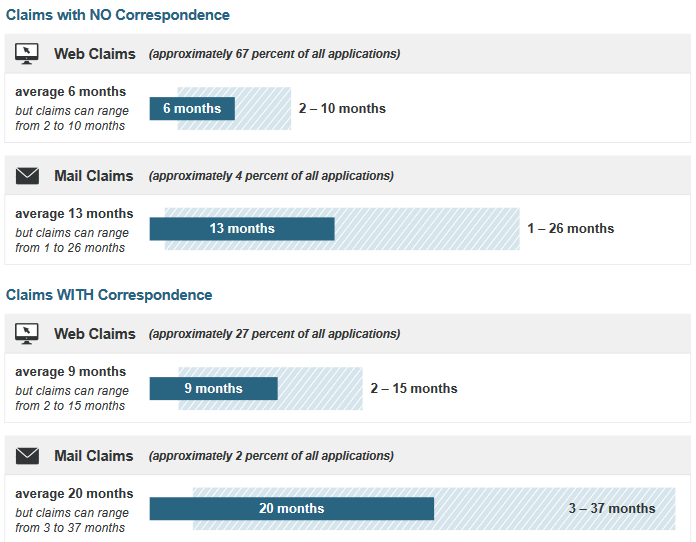
With due respect to the Copyright Office, processing a registration application is primarily a ministerial act. The vast majority of applications are granted—97% in 2017 according to the latest available data from the Copyright Office (though 29% of those applications required correspondence with the applicant). Are we really withholding remedies for all copyright owners because of the remaining 3%? And even for the 3% of applications that are denied, the copyright owner can still sue for infringement, asking the district court to reassess the agency’s refusal. No matter what the Copyright Office does with the application, whether it grants or denies, the copyright owner ultimately can sue. And, under the third sentence of Section 411(a), the Register of Copyrights can even “become a party to the action with respect to the issue of registrability of the copyright claim.” So it’s not like the Register can’t have a say should the application be in that slim minority of questionable ones that may merit intervention.

To its credit, the Supreme Court acknowledged that its holding would cause problems for copyright owners—but it also overplayed the exceptions to the registration approach that Congress put in place to alleviate some of these issues. For example, Justice Ginsburg pointed out that Section 408(f) empowers the Register of Copyrights to establish regulations for the preregistration of certain categories of works. Under this regime, as Justice Ginsburg noted, “Congress provided that owners of works especially susceptible to prepublication infringement should be allowed to institute suit before the Register has granted or refused registration.” That’s great for that particular subset of copyright owners, but what about everyone else? And what about authors who publish their works just as soon as they create them? Moreover, Justice Ginsburg’s blithe comment that copyright owners “may eventually recover damages for the past infringement” ignores the fact that injunctive relief to stop the actual, ongoing infringement is unavailable until the registration is processed by the Copyright Office.

The Court laments such policy ramifications: “True, the statutory scheme has not worked as Congress likely envisioned. Registration processing times have increased from one or two weeks in 1956 to many months today.” And this gets to the heart of the problem: The time it takes the Copyright Office to process an application has significantly increased over the years. Just four years after the Copyright Act of 1976 went into effect, the delay was “5 to 6 weeks.” And, as of October 2018, the delay has grown to an “average processing time for all claims” of “7 months.” Indeed, the fastest the Copyright Office processes an application now is one month, and the longest it takes is an incredible 37 months. The following illustration from the Copyright Office breaks this down with more particularity:

To be clear, I don’t think these delays are the Copyright Office’s fault. In fact, I think it’s Congress’s fault for not giving the agency more resources to do the very things that Congress requires it to do. Regardless, the fact remains that even copyright owners who do everything that the Copyright Act expects them to do in order to obtain the greatest protection for their works at the earliest that they can reasonably do so are still left without remedies should—or, perhaps more likely, when—infringement occur once they release their works to the world. The aforementioned constitutional goal of dissemination is thus undercut by the subservient goal of registration, for rational copyright owners would be less motivated to disseminate their works by the right to exclude when that right is in fact illusory. If Congress really wants authors to promote progress via dissemination of new works, it should adjust Section 411(a) to provide for immediate protection to all works, whether registered or not. It can still incentivize registration by limiting the remedies available, but it shouldn’t make it so that there are none.

To see the injustice, one need look no further than this very blog post. According to the Copyright Act, this post was protected the moment it was fixed in a tangible medium of expression (i.e., yesterday evening). Should the copyright owner—presumably the university where I work as this is a work made for hire—have filed for registration as quickly as possible (i.e., this morning), there still would be no way to obtain any injunctive relief while the Copyright Office processes the application. Preregistration was never an option as this post is not a literary work that is protected by the exception for certain works prone to prepublication infringement under Section 202.16 of the CFR. Even if the university had done everything that it was supposed to do as early as it could reasonably have done so to ensure the utmost copyright protection for this post, it could do nothing in the courts to stop an infringer who willfully exploits this post for profit until the Copyright Office acts upon the application—a lifetime for infringement in the digital age. (There is an option to expedite review for $800, but that amount of money is not reasonable for most people.)

Perhaps a takedown notice could be issued under Section 512 of the DMCA, but if there’s a counternotice, the university could not bring suit in the designated 10-14 day window to prevent the service provider from restoring the infringing material since there’s been no registration and thus it cannot sue for infringement. Despite having done everything Congress expected, the university would be powerless to stop the ongoing infringement of its exclusive rights in this post for perhaps several months into the future. And any argument that damages will compensate for infringements occurring before the Copyright Office got around to acting on the application is undercut by the fact that courts routinely grant preliminary injunctive relief precisely because the harm from infringement is irreparable—money damages cannot make the copyright owner whole.

The absurd result of all this is that the promise of exclusive rights in one’s original work of authorship is practically meaningless given the registration approach under Section 411(a). No doubt, Congress intended this disability to act as a stick in order to encourage the carrot of remedies should those rights be infringed. But the reality is that numerous copyright owners who do everything right get the stick and not the carrot—at least until the Copyright Office happens to process their applications. In the meantime, these copyright owners cannot be faulted for thinking twice before disseminating their works. Since enforcement of their rights is precluded through no fault of their own, what else does Congress expect them to do? A right without a remedy is senseless, and given the millions of original works that are created each day, Congress’s promise of copyright protection for new works may be one of the most illusory rights in modern times. Now that the Supreme Court has clarified Section 411(a), it’s time for Congress to fix it.

Categories
Copyright

Supreme Court Holding on Recoverable Costs Misses the Mark

U.S. Supreme Court buildingOn Monday, the Supreme Court issued a decision holding that the “full costs” available to a prevailing party in a copyright dispute are limited to those litigation expenses specified as taxable under federal law. The opinion by Justice Kavanaugh reverses a Ninth Circuit interpretation of 17 USC § 505, which held that any costs incurred in the enforcement (or defense) of a copyright claim are recoverable, including expert witness and jury consultation fees. Unfortunately, most of the twelve-page opinion is dedicated to a cursory analysis of the term “full costs” and does not consider the adverse impact the decision will have on creators and the fundamental aims of copyright law.

The holding in Rimini Street Inc. v. Oracle USA Inc. stems from a 2010 lawsuit Oracle brought against Rimini, a global provider of aftermarket support for Oracle software, for copyright infringement and various other causes of action. Following a verdict in favor of Oracle, the damages awarded included attorneys’ fees, expert fees, consultant fees, and e-discovery costs. Rimini appealed the district court’s decision to the Ninth Circuit, arguing that the Copyright Act limits costs awarded to the taxable costs laid out in 28 USC §§ 1821 and 1920. After the Ninth Circuit found that a successful plaintiff may recover any and all costs incurred in litigation, Rimini filed a petition for cert, claiming that the interpretation of § 505 was in conflict with Supreme Court precedent.

An Incomplete Assessment

Holding that the term “full costs” in § 505 of the Copyright Act means the costs specified in the general costs statutes codified in §§ 1821 and 1920, the Supreme Court focuses its opinion on a hasty statutory interpretation with little regard for the underlying purpose of the copyright law. Recognizing that the term of art “full costs” differs from the term “costs” that appears in many other federal statutes, the opinion proceeds to explore the linguistic qualities of the word “full” and concludes that it cannot be interpreted to mean anything more than the mere “costs” referred to in §§ 1821 and 1920. The opinion does not consider the reasons why the language of the Copyright Act differs from that of other statutes, and it does not address the greater issues raised by amici which explain that the Ninth Circuit’s interpretation of § 505 supports the Copyright Act’s mission to reward creators and serve the public interest.

The opinion also dismisses Oracle’s explanation of the historical context of the term “full costs,” claiming that Crawford Fitting Co. v. J.T. Gibbons, Inc., a 1987 Supreme Court case on expert witness fees, “explained that courts should not undertake extensive historical excavation to determine the meaning of costs statutes.” Curiously, just after dismissing the need for historical analysis, the Court gives credence to Rimini’s account of the term “full costs” in copyright decisions between 1831 and 1976. The opinion ends with a brief discussion of the problem of redundancy in a term like “full costs,” with the Court simply stating that “[s]ometimes the better overall reading of the statute contains some redundancy.”

Serving the Purpose of Copyright Law

Allowing parties to recover full costs encourages copyright owners to bring meritorious claims and incentivizes them to litigate a case to the end when the use of technical and specialized experts is critical. This is especially important for creators of limited means who face overwhelming litigation costs when bringing copyright infringement claims in federal court. Without the ability to recoup the non-taxable costs required of the unique challenges associated with fighting infringement in the digital age, these creators are stripped of the incentives to protect their work that copyright law is meant to provide.

But it’s not just claimants who will be disadvantaged by denying the recovery of costs outside of §§ 1821 and 1920. Parties with a meritorious defense often also need specialized experts, e-discovery, and consultants, and the inability to recover costs related to these services would just as likely eliminate incentives to defend against infringement claims. Removing incentives for both plaintiffs and defendants to pursue worthwhile claims and defenses in turn deprives courts the opportunity to develop—and the public the opportunity to understand—the distinctions of copyright law.

The Rimini v. Oracle opinion seems unconcerned with the consequences its interpretation of § 505 will likely have on copyright litigation. At a time when high costs are commonplace in the enforcement of (and defense against) copyright claims, incentivizing parties to see a case through is crucial. As individual creators and parties of limited means attempt to protect their works in the age of online infringement, courts should have the discretion to award costs based on the circumstances of the case.

Denying parties the ability to recover the significant costs will not only deter legitimate claims, but it will embolden wrongdoers who know that plaintiffs are unable to effectively enforce their rights. Removing incentives and thereby tipping the scales in favor of infringers will devalue intellectual property rights and stray from the goals of the Copyright Act. Unfortunately, the Supreme Court missed an opportunity to explore the fundamental purposes of copyright law and reinforce a system that should encourage meaningful litigation.

Categories
Patent Law

Supreme Court to Assess USPTO’s Controversial Attorneys’ Fees Position

U.S. Supreme Court buildingBy Chris Katopis & Devlin Hartline

This week, the U.S. Supreme Court agreed to hear an important case concerning patent law procedures and the American legal system in general. In Iancu v. NantKwest, the Court asks, “Does all really mean all?” Specifically, the Court will examine whether Section 145 of the Patent Act, which provides that “[a]ll the expenses of the proceedings shall be paid by the applicant,” includes the personnel expenses that the U.S. Patent & Trademark Office (USPTO) incurs when its employees and attorneys defend the agency in the proceedings.

Under U.S. patent law, a patent applicant who is disappointed with the final decision of the Patent Trial and Appeal Board (PTAB) has the right to seek judicial review through one of two options. Applicants may either appeal directly to the U.S. Court of Appeals for the Federal Circuit under Section 141, or they may file a civil action against the Director of the USPTO in the U.S. District Court for the Eastern District of Virginia under Section 145. Unlike Section 145, Section 141 mentions nothing about recouping expenses.

In the present case, NantKwest is the assignee of a patent application directed to a method for treating cancer. The examiner rejected the claims as obvious and the PTAB affirmed. NantKwest then sued the Director of the USPTO in the Eastern District of Virginia. The district court held on summary judgment that the claims were obvious, and the Federal Circuit affirmed in a nonprecedential opinion.

In the district court, the USPTO moved for reimbursement of nearly $112,000 in expenses under Section 145 to cover attorneys, paralegals, and expert witnesses. The district court granted the expert-witness expenses but denied the personnel expenses. A divided panel of the Federal Circuit reversed, finding that the personnel expenses were compensable under Section 145. The Federal Circuit then took the case en banc, with the majority affirming the district court’s holding that the personnel expenses were not “expenses” under Section 145.

The USPTO then petitioned the Supreme Court for a writ of certiorari, which NantKwest opposed. Just yesterday, the Court agreed to hear the case. The USPTO argues that when Congress enacted Section 145, it was clear that “all” meant “all” regarding any costs or expenses arising from the district court litigation. Accordingly, the USPTO argues, an applicant who initiates a civil action under Section 145 must pay all of the expenses borne by the USPTO in the proceedings, including the salaries of the government’s attorneys and paralegals.

Notably, this recent position on Section 145 by the USPTO is a sharp departure from decades of earlier practice. It also presents a potentially costly factor for patents applicants seeking to challenge adverse PTAB decisions in the Eastern District of Virginia, where they would have to pay the government’s personnel expenses even if their patent rights are vindicated by the federal courts.

In its en banc majority opinion by Judge Kara Stoll, the Federal Circuit held that “the American Rule prohibits courts from shifting attorneys’ fees from one party to another absent a ‘specific and explicit’ directive from Congress.” Under the American Rule, the opposing parties in litigation pay their own attorneys’ fees, whether they win or lose. This Rule, the majority noted, promotes “fair access to the legal system” for those who “might be unjustly discouraged from instituting actions to vindicate their rights,” especially the “small businesses and individual inventors” who seek to avail themselves of Section 145’s benefits.

Having held that the American Rule’s presumption against shifting attorneys’ fees applies to Section 145, the Federal Circuit found that nothing in the text of Section 145 rebutted it. Under Supreme Court precedent, there must be a “specific and explicit” authorization by Congress to displace the American Rule. The Federal Circuit held that Section 145’s statement that applicants must pay “[a]ll the expenses of the proceedings” was ambiguous and thus fell short of the Supreme Court’s stringent standard.

The majority emphasized the fact that, under the USPTO’s interpretation, even successful applicants would have to pay the government’s personnel expenses, and it noted that the USPTO itself could not identify any other such provision for shifting fees to the prevailing party. That sharp departure from the bedrock principle of the American Rule, the majority reasoned, made the government’s anomalous position all the more suspect since Congress would have made it more clear if it intended this odd result.

This case has significant ramifications for the American innovation economy. Patent applicants at the cutting-edge of innovation occasionally receive multiple rejections from patent examiners that are affirmed by the PTAB. Some seek to vindicate their rights in the Eastern District of Virginia, which is their right under Section 145 of the Patent Act as enacted by Congress. The shifting of attorneys’ fees to such applicants would increase the cost of inventing and commercializing new technology. It would strongly discourage dissatisfied applicants from challenging the PTAB before a federal district court.

The American Rule is grounded on the notion that those who feel they have been wronged should not be afraid to seek justice in the courts. The USPTO would flip this bedrock principle on its head, even in cases where the courts reverse the agency’s wrongful denial of patent rights to innovators. Hopefully the Supreme Court will affirm the Federal Circuit’s defense of the American innovation economy, lest our innovative entrepreneurs be forced to think twice before taking their case to the federal courts.

Categories
Innovation

U.S. Rise in International IP Index Signals Progress in Ongoing Effort to Restore Faith in the Patent System

dictionary entry for the word "innovate"Last week, the U.S. Chamber of Commerce, Global Innovation Policy Center (GIPC) released the seventh edition of the International IP Index for 2019, Inspiring Tomorrow. The report provides some long sought good news for the innovation community, as the U.S. rose from 12th to 2nd in the patent system rankings. But while the move signals an IP and economic transformation stemming from inspired IP leadership and a sensible approach to domestic and international IP policy, more work must be done to fully restore the global leadership position of the United States.

GIPC notes:

With this 7th edition, the U.S. Chamber International IP Index: Inspiring Tomorrow shows how intellectual property (IP) systems have been a driving force behind this transformation. Effective IP protections create a climate that drives the world’s innovators and creators to pursue a better tomorrow. Indeed, IP-driven innovation and creativity have ensured that our standards continue to rise.

The U.S. is ranked number one with the highest overall economy score; it is also ranked number one with respect to copyrights. As noted above, the U.S. moved to 2nd place in the annual patent rankings, up from 12th place last year (it is tied for the second place ranking with a number of E.U. nations and Japan). Yet, this is mixed news overall, and more work remains. The trend over the past several years has been downward for the U.S. patent system. The U.S. fell from first place in patents three years ago and was at 10th place in 2017.

The move upward is a result of ongoing efforts by top U.S. IP officials to improve domestic policies and international trade. The GIPC report explains the U.S.’s strong overall rating is based on its framework for legal protections for copyrights, patents, trade secrets, and its recent IP trade policies. The United States-Mexico-Canada Agreement (USMCA) is praised as raising the bar to set the new global standard for international IP protection.

Further, the report commends the USPTO leadership for addressing uncertainty around patent rights by recent reforms of its opposition system (e.g., through the Patent Trial and Appeal Board (PTAB) and inter partes review (IPR)). In his first year, USPTO Director Andrei Iancu launched several initiatives to address long-standing issues hampering U.S. innovation, including issuing new patent eligibility review guidelines for patent examiners and overhauling the PTAB review invalidation proceedings that can create uncertainty for parties. The report explains that these reforms will “creat[e] greater certainty around the inter partes review (IPR) process [and] reduce unpredictability in the patent opposition system.”

Historically, the U.S. has been a front-runner in worldwide innovation; just last year, the USPTO unveiled its 10 millionth U.S. patent. But misguided policies from courts and Congress have resulted in uncertainty for patent owners over the past 15 years (e.g., the systemically ill-advised PTAB opinions spurring our #FixPTAB posts). The GIPC report is a welcome reminder that sensible leadership and even modest reforms can return us to our historic front-runner position in innovation.

Despite more clarity and the recent USPTO reforms, patent owners require additional certainty and reform to ensure ongoing inventive activity, such as building new venture start-ups. CPIP and its network of scholars will continue to study how the new patent guidance and judicial jurisprudence can restore America’s global innovation leadership for the future. Hopefully, the U.S. can soon once again claim the unqualified number one spot.

To see the 2019 rankings, please click here.

To read GIPC’s 2019 Report, please click here.

Categories
FTC Innovation

Unverified Theory Continues to Inform FTC’s Policies Toward Patent Owners

dictionary entry for the word "innovate"The Federal Trade Commission’s unfair competition case against Qualcomm, Inc., has now concluded. The parties gave their closing arguments on Tuesday, January 29, and all that remains is Judge Lucy Koh’s ruling. To prevail, the FTC needed to demonstrate actual, quantifiable harm. It completely failed to do so.

The FTC’s complaint charged Qualcomm with using anticompetitive tactics to maintain its alleged monopoly position as a supplier of certain baseband processors (chips that manage cellular communications in mobile products). Specifically, the FTC alleged that Qualcomm engaged in “exclusionary conduct” through a “no license, no chips” policy in which it supplied CDMA[1] and Premium LTE chips[2] only on the condition that cell phone manufacturers agreed to Qualcomm’s license terms. The FTC claimed that Qualcomm’s conduct reduced competitors’ ability and incentive to innovate and raised prices paid by consumers for cellular devices.

In support of this position, the FTC offered Carl Shapiro, an Economics Professor from Berkeley, as an expert witness. Shapiro argued that Qualcomm’s “no license, no chips” policy gave it the market power to demand “supra-FRAND”[3] royalties. He claimed these royalties harmed competition by raising rivals’ costs, weakening them as competitors, and deterring them from doing R&D. Shapiro asserted that Qualcomm had monopoly power over CDMA and Premium LTE markets through 2016.

There are (at least) two glaring errors regarding the FTC’s and Shapiro’s arguments. First, the relevant market definitions for “CDMA” and “Premium LTE” chips are fatally flawed. Regarding CDMA, the FTC defined the relevant market solely as CDMA chips, yet the market includes both CDMA and WCDMA[4] chips, with WCDMA selling 5x more chips than CDMA. Regarding Premium LTE, there is no “premium” chip market separate from other mobile chips. What the FTC and Shapiro define as “premium” actually represents the end-result of a normal product evolution where newer, more innovative chips are incorporated first into higher-end devices. And even if one considers only Premium LTE chips, Qualcomm had a first-mover advantage because it invented the technology. A first-mover advantage is not an antitrust violation. The result of both flawed market definitions is an economic theoretical shell-game to divert attention from the fact that there is simply no evidence of harm to the properly defined actual market.[5]

And this leads to the second and even more critical point: the FTC presented no real-world evidence of harm to competitors or consumers from Qualcomm’s alleged exclusionary conduct. If R&D had been deterred by Qualcomm’s licensing practices, as Shapiro argued, he should have been able to identify at least one actual example.[6] Under his theory, the lack of ongoing R&D and harm to competitors should have resulted in an increasing number of inferior cell phones provided by a decreasing number of companies. To the contrary, more and more competitors have been entering the chip market with more and more innovations as cellular technology has advanced from 3G to 4G. Cell phone quality has dramatically increased over time, without concomitant quality-adjusted price increases.[7]

Notwithstanding the flawed market definition and lack of harm, the FTC has misconstrued the underlying basis for Qualcomm’s “no license, no chips” licensing policy, teeing it up as objectively anticompetitive and onerous. Yet, Qualcomm’s policy simply seeks to prevent “patent holdout” as a legitimate business strategy. Without this policy, device manufacturers could build phones using Qualcomm’s chips, then simply refuse to pay Qualcomm for its telecommunications patents. Qualcomm’s only recourse would be to sue for patent infringement, while the device manufacturers continue to profit from use of the chips. The “no-license, no chips” policy ensures that device manufacturers negotiate necessary patent licenses before receiving chips to build phones.

Assistant Attorney General for the Department of Justice, Makan Delrahim, has stated that condemning this kind of licensing practice, in isolation, as an antitrust violation, while ignoring equal incentives for patent holdout, “risks creating ‘false positive’ errors of over-enforcement that would discourage valuable innovation.” (Delrahim also recently criticized the FTC’s entire case saying that disputes about patent licensing should not be decided by antitrust law.)

The FTC, its experts, and its industry witnesses, however, are basically advocating for patent holdout as a legally legitimate, even preferable, strategy for dealing with patent owners like Qualcomm. Professor Shapiro’s model, in particular, advanced patent holdout in lieu of up-front patent licensing. Shapiro would require a patent owner to wait and then sue for infringement as a prerequisite to any license negotiations. But forcing the patent owner to pursue judicial recourse through a time-consuming and costly patent infringement suit leverages the cost of litigation to artificially decrease the ultimate reward to the patentee.

At the close of this case, one is left wondering why. Why did the FTC pursue a “midnight” filing at the tail end of the Obama Administration, just days before President Trump took office? Why did the FTC pursue the case over Commissioner Ohlhausen’s strong dissent in which she argued that the case was based on a flawed legal theory “that lacks economic and evidentiary support” and that “by its mere issuance, will undermine U.S. intellectual property rights in Asia and worldwide”? And finally, why is the FTC attempting to cripple Qualcomm in the developing 5G technological space in favor of China’s Huawei[8], which will result in actual, quantifiable harm to the U.S.’s competitive advantage over China?


[1] CDMA, which stands for “code-division multiple access,” permits several transmitters to send information over a single communication channel and is a second generation (2G) network used in mobile device.

[2] LTE, which stands for “long term evolution,” is a fourth generation (4G) standard for high-speed wireless communication used in mobile devices.

[3] FRAND stands for “fair, reasonable, and non-discriminatory.”

[4] WCDMA stands for “wide band code division multiple access.” It is a third generation (3G) network used in mobile devices.

[5] This is the same game the FTC played in the 1990s with Microsoft where the FTC defined the relevant market as operating systems for IBM compatible PCs, but that argument only worked if one excluded Apple, Linux, and other operating systems. These type of games about defining the relevant market are common in the high-tech context, and the FTC is repeating it here.

[7] “Several empirical studies demonstrate that the observed pattern in high-tech industries, especially in the smartphone industry, is one of constant lower quality-adjusted prices, increased entry and competition, and higher performance standards.” See: https://cip2.gmu.edu/wp-content/uploads/sites/31/2018/02/Letter-to-DOJ-Supporting-Evidence-Based-Approach-to-Antitrust-Enforcement-of-IP.pdf.

[8] One also wonders why the FTC relied so heavily on Huawei’s testimony in this case given the Trump Administration’s repeated concerns about this company culminating in the Department of Justice’s recent 10-count indictment against Huawei for theft of trade secrets, wire fraud, and obstruction of justice.

Categories
FTC Healthcare

CPIP Scholars Join Comments to FTC on How Antitrust Overreach is Threatening Healthcare Innovation

dictionary entry for the word "innovate"On December 21, 2018, CPIP Senior Scholars Adam Mossoff and Kristen Osenga joined former Federal Circuit Chief Judge Randall Rader and SIU Law’s Mark Schultz in comments submitted to the FTC as part of its ongoing Competition and Consumer Protection in the 21st Century Hearings. Through the hearings, the FTC is examining whether recent economic or technological changes warrant adjustments to competition or consumer protection laws. The comments submitted to the FTC explain how the FTC itself is harming innovation in the health sciences by meddling in patent disputes between branded and generic drug companies.

The introduction is copied below, and the comments can be downloaded here.

***

How Antitrust Overreach is Threatening Healthcare Innovation

Imagine passing a rigorous test with flying colors, only to be told that you need to start over because you weren’t wearing the right clothing or you wrote your answers in the wrong color. Does that sound silly? Unfair? That scenario is happening to the American pharmaceutical industry thanks to regulators at the Federal Trade Commission who aren’t content to let the Food & Drug Administration (the experts in pharmaceutical safety and regulation) and federal courts (which referee disputes between branded and generic drug companies) decide when new drugs are ready to come to market. The consequences of these regulatory actions impact people’s lives.

The development and widespread availability of safe and effective pharmaceutical products has helped people live longer and better lives. The pharmaceutical industry invests billions each year in research and infrastructure and employs millions of Americans. The industry is closely regulated by many agencies, most notably the FDA, which requires extensive testing for safety and effectiveness before new drugs enter the market. Many thoughtful proposals have been advanced to improve and modernize the FDA’s review and approval of new drugs, but there is broad agreement that the FDA’s basic role in drug approval serves valid ends.

In recent years, however, other government agencies have played an increasingly intrusive role in deciding whether and when new drugs can enter the market. One such agency is the Federal Trade Commission, which has recently taken steps to block branded drug companies from settling patent litigation with generic drug makers. The FTC substitutes its own judgment for the business judgment of sophisticated parties, simultaneously weakening the patent rights of branded drug companies that spend billions in drug discovery and development and delaying generic drug companies from bringing consumers low cost alternatives to branded drugs. This example of government agencies picking winners and losers—indeed, deciding there should be no winners and losers—harms consumers in the short run by slowing access to drugs and in the long run by weakening innovation.

This paper describes the role of patents in protecting drugs and the special patent litigation regime Congress enacted in the 1980s to carefully balance the needs of branded drug companies, generic competitors, and consumers. Although these systems are not perfect, the FTC’s overreach in its regulatory powers in this area of the innovation economy results in a net loss for American consumers, as described below.

To read the comments, please click here.