Categories
FTC Innovation

CPIP Scholars Join Comment Letter to FTC Supporting Evidence-Based Approach to IP Policymaking

a hand reaching for a hanging, shining keyOn December 21, 2018, CPIP Senior Scholars Jonathan Barnett, Chris Holman, Erika Lietzan, Adam Mossoff, Sean O’Connor, and Kristen Osenga joined a comment letter that was filed with the FTC as part of its ongoing hearings on Competition and Consumer Protection in the 21st Century. The comment letter was joined by 18 legal academics, economists, and former government officials—including former USPTO Director David Kappos and former Federal Circuit Chief Judge Paul Michel. The comment letter is copied below.

***

December 21, 2018

Via Electronic Submission

Mr. Donald S. Clark
Secretary of the Commission
Federal Trade Commission
600 Pennsylvania Avenue NW
Washington, DC 20580

Re: Competition and Consumer Protection in the 21st Century Hearings—
Public Comments Following Hearing #4 on Innovation and Intellectual Property Policy

Dear Secretary Clark,

As legal academics, economists, and former government officials who are experts in antitrust law and intellectual property law, we respectfully submit these comments and an Appendix in response to the request for public comments following the Federal Trade Commission’s Hearings on Innovation and Intellectual Property Policy held October 23-24, 2018, as part of the FTC’s Hearings on Competition and Consumer Protection in the 21st Century.

We support evidence-based policy-making by the FTC concerning all aspects of technological innovation, intellectual property (IP) rights, and the relationship between IP rights and innovation markets. It is imperative that the FTC ground any policy statements, investigations, or enforcement actions, not on academic theories about how IP rights might potentially be misused in stylized theoretical models, but on persuasive evidence of actual consumer harm from anti-competitive practices in real-world markets. Otherwise, regulatory overreach could undermine the economic incentives and resulting stream of innovative products and services that consumers enjoy in markets in which reliable and effective IP rights attract the private capital necessary to fund the high costs of R&D and the commercialization process.

Few economists and policymakers would question that reliable and effective property rights are a necessary predicate for supporting investment in conventional physical-goods markets. Logic holds that this economic principle applies for the innovators, investors, and entrepreneurs in the information technology and life sciences markets at the core of the US innovation economy.

Given reliable and effective IP rights, multiple empirical studies support the proposition that firms are more willing to incur substantial costs and bear significant risks in undertaking long-term R&D. Two well-known examples are the approximately $2.6 billion dollars required to bring a new drug to market or the billions in dollars required to develop new communications technologies like 5G. These and other long-term R&D investments occur in commercial environments in which courts and administrative agencies secure reliable and effective IP rights.

In recent years, antitrust agencies have sometimes taken policy actions in IP-intensive markets that overlook this fundamental connection between secure property rights, investment incentives, R&D, and commercialization activities. These regulatory actions have been based on academic theories and anecdotal reports that have not been put to thoroughgoing, rigorous empirical tests.

To illustrate the risks of making policy without firm empirical support, consider the smartphone industry. For over a decade, theoretical predictions have been made that comparatively high numbers of patents covering technologies used in a single multi-component consumer product—a smartphone—would create “patent thickets,” “royalty stacking,” and “patent holdup” that would increase prices, constrain output, and stunt innovation. Based on these conjectures, antitrust agencies around the world have issued policy statements, undertaken enforcement actions, and imposed billions of dollars in fines—often directed at the firms that had pioneered the fundamental technologies behind wireless communications. Yet those proposing this testable hypothesis never actually tested it. Empirical researchers who subsequently did so found little to no evidence of “patent holdup.” Contrary to theory, real-world market conditions in the smartphone industry are characterized by constant lower quality-adjusted prices, robust market entry by new producers, and continuously increasing performance standards. Consumers in the US and around the globe have benefited from the virtuous feedback effect between secure property rights in new technologies, strong investment flows, and robust R&D output. The evidentiary burden surely rests on those who propose taking policy actions that would erode the property-rights foundation behind this technological and economic success story.

The smartphone industry is just one of multiple innovation markets that exhibit a positive relationship between reliable and effective patent rights, increased innovation, and economic growth. This evidence demonstrates a close relationship in the biopharmaceutical, medical device and certain information technology markets between patent protection and startups’ ability to secure financing for R&D and to undertake the costly commercial task of translating R&D into new products and services for consumers. This relationship is especially powerful in the case of startups that are often the source of breakthrough innovation. One empirical study shows that a startup with a patent more than doubles its chances of obtaining venture capital funding compared to a startup without a patent. Without a secure IP portfolio, venture capital and other investors will decline to support startups that often have few other legal or commercial mechanisms by which to secure their products and services against imitation by larger incumbents. For similar reasons, larger firms that specialize in R&D but do not have downstream production and distribution capacities require a secure IP portfolio to support a licensing infrastructure that generates the returns necessary to fund continued R&D that ultimately benefits downstream companies in the value chain and end-users in the marketplace.

Antitrust policy has long followed an error-cost approach that takes into account the relative costs associated with overenforcement (false positive errors) and underenforcement (false negative errors) of the antitrust laws. Consistent with this approach, the FTC’s policymaking and enforcement actions in innovation markets should be based on valid empirical evidence that makes it possible to weigh the likely costs and benefits of the agency’s actions.

This concern is especially relevant in evaluating the likelihood of consumer harm and the impact on innovation from patent infringement litigation. Like any form of civil litigation, patent litigation can be used for either legitimate or opportunistic purposes. Based on a limited body of evidence that suffers from substantial methodological shortcomings, antitrust agencies have issued statements and taken actions supporting blanket denials of the availability of injunctive relief for all patent owners who primarily license their technologies (“non-practicing entities”).

A broader empirical literature has looked more closely with rigorous analysis and uncovered a far more nuanced market and legal reality. First, no empirical study has demonstrated that patent owners’ requests for injunctive relief after findings of defendants’ infringement of their property rights have resulted systematically either in consumer harm or in slowing down the pace of technological innovation. Second, researchers have found that the “non-practicing entities” or “patent assertion entities” rubric encompasses a large number of business models that generate social gains by providing licensing and other mechanisms for undercapitalized individual inventors, startups, small firms, and universities. These innovators lack the commercial means to extract revenue from R&D that can generate valuable new products and services for consumers. Painting all of these entities with the same rhetorical broad brush threatens to unravel a rich ecosystem of inventors, startups, and entrepreneurs that rely on the legal backstop of injunctive relief to support markets in intellectual assets. Abusive litigation practices by a limited number of patent owners could and should be targeted surgically through fee-shifting and other standard tools available in all civil litigation. Again, regulatory intervention without a firm evidentiary basis runs the risk of harming consumer welfare by undermining the reliable and effective patent rights on which innovators, venture capitalists, startups, and other market participants rely in creating and expanding the innovation markets that benefit everyone.

In support, we attach an Appendix of articles that provide rigorous empirical studies and evidence-based analyses of IP-driven innovation markets, patent licensing, and patent litigation.

In conclusion, the FTC should continue to develop policies and undertake enforcement actions only with evidence of proven harms to consumers and with proper consideration of the costs in undermining reliable and effective IP rights that have consumer-welfare enhancing effects in the US innovation economy. A balanced consideration of the evidence on both harms and benefits is necessary to ensure balanced protection of innovators and consumers. We are confident that a commitment by the FTC to a program of evidence-based policy-making will lead to a vibrant, dynamic innovation economy supported by a secure foundation of IP rights that will continue to benefit consumers in the US and around the world.

Sincerely,

Kristina M. L. Acri
Associate Professor of Economics
The Colorado College

Jonathan Barnett
Professor of Law
USC Gould School of Law

Andrew Beckerman-Rodau
Professor of Law
Suffolk University Law School

Ronald A. Cass
Dean Emeritus,
Boston University School of Law
Former Vice-Chairman and Commissioner,
United States International Trade Commission

The Honorable Douglas H. Ginsburg
Senior Circuit Judge,
United States Court of Appeals for the District of Columbia Circuit, and
Professor of Law,
Antonin Scalia Law School
George Mason University

Stephen Haber
A.A. and Jeanne Welch Milligan Professor
Stanford University

Christopher M. Holman
Professor of Law
UKMC School of Law

Keith N. Hylton
William Fairfield Warren Distinguished Professor
Boston University School of Law

David J. Kappos
Former Under Secretary of Commerce and Director
United States Patent & Trademark Office

Erika Lietzan
Associate Professor of Law
University of Missouri School of Law

The Honorable Paul Michel
Chief Judge (Ret.),
United States Court of Appeals for the Federal Circuit

Damon C. Matteo
Course Professor
Tsinghua University in Beijing

Adam Mossoff
Professor of Law
Antonin Scalia Law School
George Mason University

Sean M. O’Connor
Boeing International Professor of Law
University of Washington School of Law

Kristen Osenga
Professor of Law
University of Richmond School of Law

Matthew L. Spitzer
Howard and Elizabeth Chapman Professor of Law
Northwestern University School of Law

Saurabh Vishnubhakat
Associate Professor of Law
Texas A&M University School of Law

Joshua D. Wright
University Professor,
Antonin Scalia Law School
George Mason University
Former Commissioner,
Federal Trade Commission

APPENDIX

Kristina M. L. Acri, née Lybecker, Economic Growth and Prosperity Stem from Effective Intellectual Property Rights, 24 Geo. Mason L. Rev. 865 (2017), http://georgemasonlawreview.org/wp-content/uploads/2017/11/24_4_Lybecker.pdf

Ashish Arora & Robert P. Merges, Specialized Supply Firms, Property Rights and Firm Boundaries, 14 Ind. & Corp. Change 451 (2005)

Jonathan H. Ashtor, Does Patented Information Promote Progress? (June 22, 2017), https://ssrn.com/abstract=2857697

Jonathan H. Ashtor, Opening Pandora’s Box: Analyzing the Complexity of U.S. Patent Litigation, 18 Yale J. L. & Tech. 217 (2016), https://ssrn.com/abstract=2736556

Jonathan M. Barnett, Antitrust Overreach: Undoing Cooperative Standardization in the Digital Economy (Nov. 2018), https://ssrn.com/abstract=3277667

Jonathan M. Barnett, Has the Academy Led Patent Law Astray?, 32 Berk. Tech. L. J. 1313 (2017), http://btlj.org/data/articles2017/vol32/32_4/Barnett_web.pdf

Jonathan M. Barnett, From Patent Thickets to Patent Networks: The Legal Infrastructure of the Digital Economy, 55 Jurimetrics J. 1 (2014), https://ssrn.com/abstract=2431917

Jonathan M. Barnett, Three Quasi-Fallacies in the Conventional Understanding of Intellectual Property, 12 Journal of Law, Econ. and Pol. 1 (2016), https://ssrn.com/abstract=265636

Christopher A. Cotropia, Jay P. Kesan & David L. Schwartz, Unpacking Patent Assertion Entities (PAEs), 99 Minn. L. Rev. 649 (2014), https://ssrn.com/abstract=2346381

Richard Epstein, F. Scott Kieff & Daniel F. Spulber, The FTC, IP, and SSOs: Government Hold-Up Replacing Private Coordination, 8 J. Comp. L. & Econ. 1 (2012), https://ssrn.com/abstract=1907450

Richard A. Epstein & Kayvan Noroozi, Why Incentives for Patent Hold Out Threaten to Dismantle FRAND and Why It Matters, 32 Berkeley Tech. L. J. (2018), https://ssrn.com/abstract=2913105

Joan Farre-Mensa, Deepak Hegde, & Alexander Ljungqvist, What Is a Patent Worth? Evidence from the U.S. Patent ‘Lottery’ (USPTO Econ. Working Paper No. 2015-5, Mar. 2017), https://ssrn.com/abstract=2704028

Alexander Galetovic & Stephen Haber, The Fallacies of Patent Holdup Theory, 13 J. Comp. L. & Econ. 1 (2017), https://academic.oup.com/jcle/article/13/1/1/3060409

Alexander Galetovic, Stephen Haber, & Lew Zaretzki, An Estimate of the Average Cumulative Royalty Yield in the World Mobile Phone Industry: Theory, Measurement and Results (Feb. 7, 2018), https://hooverip2.org/working-paper/wp18005

Alexander Galetovic, Stephen Haber, & Ross Levine, An Empirical Examination of Patent Hold Up, 11 J. Comp. L. & Econ. 549 (2015), https://academic.oup.com/jcle/article/11/3/549/800066

Douglas H. Ginsburg, Koren W. Wong-Ervin, & Joshua Wright, The Troubling Use of Antitrust to Regulate FRAND Licensing, CPI Antitrust Chronicle (Oct. 2015), https://www.competitionpolicyinternational.com/assets/Uploads/GinsburgetalOct-151.pdf

Douglas H. Ginsburg, Taylor M. Ownings, & Joshua D. Wright, Enjoining Injunctions: The Case Against Antitrust Liability for Standard Essential Patent Holders Who Seek Injunctions, The Antitrust Source (Oct. 2014), https://ssrn.com/abstract=2515949

Stuart J.H. Graham & Ted Sichelman, Why Do Start-Ups Patent?, 23 Berk. Tech. L. J. 1063 (2008), https://ssrn.com/abstract=1121224

Stuart J.H. Graham & Saurabh Vishnubhakat, Of Smart Phone Wars and Software Patents, 27 J. Econ. Persp. 67 (2013), http://ssrn.com/abstract=2291603

Kirti Gupta, Technology Standards and Competition in the Mobile Wireless Industry, 22 Geo. Mason L. Rev. 865 (2015), http://www.georgemasonlawreview.org/wp-content/uploads/2015/06/GuptaTechStandards.pdf

Stephen Haber, Patents and the Wealth of Nations, 23 George Mason L. Rev. 811 (2016), https://ssrn.com/abstract=2776773

Christopher M. Holman, The Critical Role of Patents in the Development, Commercialization and Utilization of Innovative Genetic Diagnostic Tests and Personalized Medicine, 21 B.U. J. Sci. & Tech. L. 297 (2015), http://www.bu.edu/jostl/files/2015/12/HOLMAN_ART_FINALweb.pdf

Ryan T. Holte, Trolls or Great Inventors: Case Studies of Patent Assertion Entities, 59 St. Louis U. L.J. 1 (2014), https://ssrn.com/abstract=2426444

Albert G.Z. Hu and I.P.L. Png, Patent Rights and Economic Growth: Evidence from Cross-Country Panels of Manufacturing Industries, 65 Oxford Econ. Papers 675 (2013), https://academic.oup.com/oep/article-abstract/65/3/675/2362113

Keith N. Hylton, Patent Uncertainty: Toward a Framework with Applications, 96 B.U. L. Rev. 1117 (2016), https://ssrn.com/abstract=2714434

Zorina Khan, Trolls and Other Patent Inventions: Economic History and the Patent Controversy in the Twenty-First Century, 21 Geo. Mason L. Rev. 825 (2014), http://www.georgemasonlawreview.org/wp-content/uploads/2014/06/Khan-WebsiteVersion.pdf

Scott Kieff & Anne Layne-Farrar, Incentive Effects from Different Approaches to Holdup Mitigation Surrounding Patent Remedies and Standard-Setting Organizations, 9 J. Comp. L. & Econ. 1091 (2013), https://www.researchgate.net/publication/274522003_Incentive_effects_from_different_approaches_to_holdup_mitigation_surrounding_patent_remedies_and_standard-setting_organizations

Bruce H. Koboyashi & Joshua D. Wright, Federalism, Substantive Preemption, and Limits on Antitrust: An Application to Patent Holdup, 5 J. Comp. L. & Econ. 1 (2009), https://ssrn.com/abstract=1143602

Bruce H. Koboyashi & Joshua D. Wright, The Limits of Antitrust and Patent Holdup: A Reply to Cary et al., 78 Antitrust L.J. 505 (2012), https://ssrn.com/abstract=2704591

Anne Layne-Farrar, Why Patent Holdout is Not Just a Fancy Name for Plain Old Patent Infringement, CPI North American Column (Feb. 2016), https://www.competitionpolicyinternational.com/wp-content/uploads/2016/02/NorthAmerica-Column-February-Full.pdf

Anne Layne-Farrar, Patent Holdup and Royalty Stacking Theory and Evidence: Where Do We Stand After 15 Years of History?, OECD Intellectual Property and Standard Setting (Nov. 18, 2014), http://www.oecd.org/officialdocuments/publicdisplaydocumentpdf/?cote=DAF/COMP/WD%282014%2984&doclanguage=en

Anne Layne-Farrar, Moving Past the SEP RAND Obsession: Some Thoughts on the Economic Implications of Unilateral Commitments and the Complexities of Patent Licensing, 21 Geo. Mason L. Rev. 1093 (2014), http://www.georgemasonlawreview.org/wpcontent/uploads/2014/06/Layne-Farrar-Website-Version.pdf

Gerard Llobet & Jorge Padilla, The Optimal Scope of the Royalty Base in Patent Licensing, 59 J. L. & Econ. 45 (2016), https://ssrn.com/abstract=2417216

Alan C. Marco & Saurabh Vishnubhakat, Certain Patents, 16 Yale J.L. & Tech. 103 (2013), http://ssrn.com/abstract=2324538

Kevin R. Madigan & Adam Mossoff, Turning Gold to Lead: How Patent Eligibility Doctrine is Undermining U.S. Leadership in Innovation, 24 Geo. Mason L. Rev. 939 (2017), http://georgemasonlawreview.org/wpcontent/uploads/2017/11/24_4_Madigan_Mossoff_2.pdf

Keith Mallinson, Don’t Fix What Isn’t Broken: The Extraordinary Record of Innovation and Success in the Cellular Industry under Existing Licensing Practices, 23 Geo. Mason L. Rev. 967 (2016), http://www.georgemasonlawreview.org/wp-content/uploads/Mallinson-FINAL.pdf

Keith Mallinson, Theories of Harm with SEP Licensing Do Not Stack Up, IP Fin. Blog (May 24, 2013), http://www.ip.finance/2013/05/theories-of-harm-with-sep-licensing-do.html

Ronald J. Mann, Do Patents Facilitate Financing in the Software Industry?, 83 Tex. L. Rev. 961 (2005), https://ssrn.com/abstract=510103

Jorge Padilla & Koren W. Wong-Ervin, Portfolio Licensing to Makers of Downstream End-User Devices: Analyzing Refusals to License FRAND-Assured Standard-Essential Patents at the Component Level, 62 The Antitrust Bulletin 494 (2017), https://doi.org/10.1177/0003603X17719762

Kristen Osenga, Formerly Manufacturing Entities: Piercing the “Patent Troll” Rhetoric, 47 Conn. L. Rev. 435 (2014), https://ssrn.com/abstract=2476556

Kristen Osenga, Ignorance Over Innovation: Why Misunderstanding Standard Setting Operations Will Hinder Technological Progress, 56 U. Louisville L. Rev. 159 (2018). https://scholarship.richmond.edu/law-faculty-publications/1502/

Kristen Osenga, Sticks and Stones: How the FTC’s Name-Calling Misses the Complexity of Licensing-Based Business Models, 22 Geo. Mason L. Rev. 1001 (2015), https://ssrn.com/abstract=2834140

Jonathan D. Putnam & Tim A. Williams, The Smallest Salable Patent-Practicing Unit (SSPPU): Theory and Evidence (Sept. 2016), https://ssrn.com/abstract=2835617

David L. Schwartz & Jay P. Kesan, Analyzing the Role of Non-Practicing Entities in the Patent System, 99 Cornell L. Rev. 425 (2014), https://ssrn.com/abstract=2117421

Gregory Sidak, What Aggregate Royalty Do Manufacturers of Mobile Phones Pay to License Standard-Essential Patents?, 1 Criterion J. Innovation 701 (2016), https://www.criterioninnovation.com/articles/sidak-aggregate-royalty-to-license-standard-essential-patents.pdf

Gregory Sidak, The Antitrust Division’s Devaluation of Standard-Essential Patents, 104 Geo. L.J. Online 48 (2015), https://georgetownlawjournal.org/articles/161/antitrust-division-sdevaluation-of/pdf

Gregory Sidak, Testing for Bias to Suppress Royalties for Standard-Essential Patents, 1 Criterion J. on Innovation 301 (2016), https://www.criterioninnovation.com/articles/sidak-bias-to-suppress-sep-royalties.pdf

Matthew Spitzer, Patent Trolls, Nuisance Suits, and the Federal Trade Commission, 20 N.C. J.L. & Tech. 75 (2018), https://scholarship.law.unc.edu/ncjolt/vol20/iss1/2

Daniel F. Spulber, Standard Setting Organizations and Standard Essential Patents: Voting and Markets, Econ. J. (2018), https://doi.org/10.1111/ecoj.12606

Daniel F. Spulber, Patent Licensing and Bargaining with Innovative Complements and Substitutes (June 2018), https://ssrn.com/abstract=2818008

Daniel F. Spulber, How Patents Provide the Foundation of the Market for Inventions, 11 J. Comp. L. & Econ. 271 (2015), https://ssrn.com/abstract=2487564

David J. Teece, Competing Through Innovation: Technology Strategy and Antitrust Policies (Edward Elgar, 2013), https://www.e-elgar.com/shop/competing-through-innovation

David J. Teece, Edward F. Sherry, & Peter Grindley, Patents and ‘Patent Wars’ in Wireless Communications: An Economic Assessment, 95 Comm. & Strat. 85 (2014), https://ssrn.com/abstract=2603751

David J. Teece & Edward F. Sherry, On Patent ‘Monopolies’: An Economic Re-Appraisal, CPI Antitrust Chronicle (Apr. 2017), https://ssrn.com/abstract=2962208

Joanna Tsai & Joshua D. Wright, Standard Setting, Intellectual Property Rights, and the Role of Antitrust in Regulating Incomplete Contracts, 80 Antitrust L.J. 157 (2015), https://ssrn.com/abstract=2467939

Gregory J. Werden & Luke M. Froeb, Why Patent Hold-Up Does Not Violate Antitrust Law (Sep. 24, 2018), https://ssrn.com/abstract=3244425

Joshua D. Wright, SSOs, FRAND, and Antitrust: Lessons from the Economics of Incomplete Contracts, 21 Geo. Mason L. Rev. 791 (2014), http://www.georgemasonlawreview.org/wpcontent/uploads/2014/06/Wright-Website-Version.pdf

Ziedonis, Rosemarie H. and Bronwyn H. Hall, The Effects of Strengthening Patent Rights on Firms Engaged in Cumulative Innovation: Insights from the Semiconductor Industry, in Gary D. Libecap (ed.), Entrepreneurial Inputs and Outcomes: New Studies of Entrepreneurship in the United States (2001).

Categories
Patent Law Pharma

Recognizing the Limits of Government Procurement in the Pharmaceutical Industries

pharmaceuticalsWhile recent headlines claim that rising drug prices can be easily addressed through government intervention, the procedures involved with government use of patented technologies are complex and often misunderstood. In addition to owning and practicing a vast portfolio of patents, the government has the power to procure and use patented technologies—including pharmaceutical medicines—in limited circumstances without specific authorization, license, or consent. But despite established mechanisms for government use of intellectual property, some advocates are now promoting an unprecedented and expansive interpretation of procurement that would deprive patent owners of their rights and threaten pharmaceutical innovation.

Today, escalating health care costs raise concerns from lawmakers on both sides of the political aisle. The U.S. pharmaceutical market alone was $333 billion in 2014.[1] Critics cite the escalating cost of certain specialty drugs as a leading cause of the high cost of health care, and some argue that price disparities have a disproportionate effect on certain groups. Accordingly, it has been argued that the federal government already has a responsibility and the necessary legal tools to combat the high price of drugs, e.g., through its procurement procedures. Yet combating disproportionate drug prices through government procurement should be a carefully considered process and not one based on misrepresentations of the history and rationale behind federal procurement procedures.

Federal Government Procurement Overview

The U.S. government oversees a vast and complex procurement system, including the General Services Administration (e.g., real estate, property, and services), the Federal Acquisition Regulation (FAR) system, and vast federal contracting. In sum, the annual federal budget will exceed $4.4 trillion in 2019.[2] Advocates note that the federal government spent nearly $1.1 trillion on health care alone in 2018.[3] In the health care sector, the federal government’s role is also exemplified by the following categories of activity: the direct purchasing of pharmaceutical through federal agency programs including, the Veterans Health Administration, Department of Defense, Indian Health Service, and Federal Bureau of Prisons; indirectly through other federally sponsored health insurance programs, notably Medicare and Medicaid; and, more broadly through its oversight and other involvement with private sector health insurance plans.

There is no denying that the federal government is a significant participant in the health care system. In the aforementioned contexts, the government generally seeks the legal right to use a patented product (e.g., a medicine or medical device) at a specified purchase price. But federal law provides a mechanism for the government to procure patented products and services without a specific authorization, license, or consent. Further, federal law allows it to use patents without prior consent (this is the quintessential definition of infringement), under limited circumstances, in exchange for compensation to the patent holder. Advocates argue that the federal government should now broadly and unprecedentedly employ this procurement power to combat high drug prices.

Congress’ Enactment of Section 1498(a)

In the early 1900s, Congress enacted legislation permitting the federal government to use patented products without the permission of the rights holder in exchange for some compensation. The statute, § 1498, states:

Whenever an invention described in and covered by a patent of the United States is used or manufactured by or for the United States without license of the owner thereof or lawful right to use or manufacture the same, the owner’s remedy shall be by action against the United States in the United States Court of Federal Claims for the recovery of his reasonable and entire compensation for such use and manufacture.

28 U.S.C. § 1498(a) (emphasis added).

Congress enacted this law (and its subsequent amendments) in response to a number of war time and national security needs, which required the government and its federal contractors to use the inventions of recalcitrant patent owners. In essence, § 1498(a) is a waiver of the federal government’s historic sovereign immunity (hence allowing for lawsuits against the government) while ensuring that the patent owners receive fair compensation. As the statute currently reads, this government intervention is offset by promising “reasonable and entire compensation for such use and manufacture.”

Section 1498 emerged as a solution to a technical standing problem that was preventing IP owners from suing the government for infringement (going back into the 1800s) without reverting to legal fictions such as implied contract. It did not arise simply as strong-arm takings power to benefit the government and contractors. Rather, it is a careful compromise to provide a clear path forward for IP owners while freeing the government from the threats of litigation, such as injunctive relief. While any government intervention in the marketplace must be viewed with some suspicion, the statute ensures that the government will recognize the contribution of innovators through some form of compensation (e.g., an ex post facto royalty).

Scholars conclude that that the statute’s original purpose was to allow the federal government and contractors more flexibility in activities during war time efforts[4]—for example, the government’s procurement of the parts necessary for military equipment or naval ship building. The statute has been used in very few other categories. The Supreme Court observed:

The intention and purpose of Congress in the Act of 1918 was to stimulate contractors to furnish what was needed for the War, without fear of becoming liable themselves for infringements to inventors or the owners or assignees of patents. The letter of the Assistant Secretary of the Navy, upon which the Act of 1918 was passed, leaves no doubt that this was the occasion for it.

Richmond Screw Anchor Co. v. United States, 275 U.S. 331, 345 (1928).

The law and literature reveals two important aspects about § 1498(a). First, it was intended for the government’s limited use of a certain category of patented inventors while respecting their innovative contribution with compensation for their efforts. Rather than civilian inventions, the § 1498(a) case law presents a theme: a series of military, war time, and post-war research related inventions, including weapons, communications equipment involving the Signal Corps of the Army, to stealth airplane carbon fiber fighter plane panels.[5] Second, it was intended as a war time safety valve against recalcitrant inventors – essentially, as a national defense provision. It has been used rarely and in limited contexts. Even when the nation faced an anthrax attack scare, its use was threatened by then HHS Secretary Tommy Thompson, but never actually used.[6] Moreover, it is not a price control mechanism. Nowhere in the text of the statute, the legislative history, nor Supreme Court case law endorses § 1498 as a discount federal procurement mechanism. In other words, § 1498(a) is not a “Groupon” for discounted federal shopping sprees.

Even those advocating for the use § 1498 as a discount procurement tool note a number of potential problems, which include the likelihood of undercompensating innovators and undermining pharmaceutical firms’ incentives to innovate, the potential overuse by the federal government, and giving too much responsibility and discretion to courts to make decisions in this category. Critics of the statute’s use in this context observe that as with any government intervention in the marketplace, consequently, it has a number of negative effects—e.g., chilling innovation, more uncertainty around R&D. The issue about preserving the incentives for R&D for new cutting-edge medicines is not abstract. A Tufts University center study reports that, on average, more than $2.6 billion is spent on R&D for a new prescription drug that gains market approval; the life-cycle cost rises to $2.9 billion when other post-approval develop costs are included.[7] In practice, for every drug that is successfully developed, reviewed, and made available to patients, many dozens more fail.[8] Due to this high failure rate and the costly investment in R&D, well-balanced intellectual property rights are essential for innovators to commercialize the products that do make it to market and improve—or even save—patients’ lives.

In practice, the use of § 1498(a) raises a number of other challenges. The application of a “reasonable royalty” itself leads to uncertainty and lengthy dispute settlement time frames. Ultimately, the retroactive decision of whatever truly is a “reasonable royalty” requires a heightened reliance on the courts to determine its “reasonableness.” The opponents note that this undermines certainty and chills the incentives for innovation. Also, the limited scope of the government’s direct applicability (e.g., prisons, Indian tribes) questions whether this makes its use either an ineffective solution for the public at-large or it will distort markets further by the misallocation of costs on different communities.

Notwithstanding its poor legal mooring for this purpose, in the end, § 1498 is an impractical tool for lowering drug pricing nationwide, vis-à-vis, the widespread government procurement of medicines in the national health care marketplace. As a general proposition, every fundamental understanding of government and liberty informs us that the federal government cannot just seize one’s property—house, livestock, vehicles—for free. Nor can the government use patented inventions (IP) for free.

Conclusion

Today, the Nation faces an increasing populist hue and cry surrounding a number of public health challenges, including the availability and affordability of patented pharmaceuticals. As the cost of drugs sharply rises, outpacing the rate of inflation, policy-makers consider a range of public policy options. The use of a compulsory license or the § 1498 statute offers a superficial false hope/promise to reduce health care spending. Hence, it is naïve to suggest that the government procurement process is designed to give short shrift to inventors by depriving them of just compensation.

Nothing in the § 1498 statute’s wording, history, nor congressionally-mandated purpose supports its role as either a general procurement or price control tool. As with all government interventions into the market place, it has potential consequences. In this context, the consequences are ultimately harmful, e.g., threatening to harm future medical innovation by reducing the incentives for R&D and creating uncertainty in the marketplace. While the goals at the heart of this debate are quite worthy (i.e., increased drug availability and affordability), policy-makers should consider other measures that avoid the inevitable negative consequences. The federal government has an alternate, powerful array of tools at its disposal to improve the access and quality for health care. In sum, § 1498 was never contemplated to be a general procurement discount vehicle—hence the federal government should not begin mistakenly prescribing it.


[1] https://www.trade.gov/topmarkets/pdf/Pharmaceuticals_Executive_Summary.pdf.

[2] The federal government purchases hundreds of billions of dollars of goods and services annually through an array of intricate procurement procedures and systems. These systems are based on willing sellers who work within the government framework (e.g., the schedules also known as Federal Supply Schedules and the Multiple Award Schedules (MAS)) to ensure fairness and a level playing field with pre-negotiated prices rather than letting the federal government use patented products without compensation. See generally https://www.gsa.gov/buying-selling/purchasing-programs/gsa-schedules.

[3] https://www.taxpolicycenter.org/briefing-book/how-much-does-federal-government-spend-health-care (The break down includes spending Medicare ($583 billion), the Medicaid and Children’s Health Insurance Program (CHIP) ($399 billion), and veteran’s medical ($70 billion)).

[4] Sean M. O’Connor, Taking, Tort, or Crown Right? The Confused Early History of Government Patent Policy, 12 J. Marshall Rev. Intell. Prop. L. 145-204 (2012).

[5] Id. at 190.

[6]Thompson Negotiating With Drug Companies to Purchase Anthrax Antibiotics; Sees No Need to Override Cipro Patent,” June 11, 2009 (“Tony Jewell, an HHS spokesperson, said that agency officials ‘do not believe’ that breaking the patent is necessary, adding, ‘It would not save money to break the patent.'” https://khn.org/morning-breakout/dr00007586/.

[7] https://www.scientificamerican.com/article/cost-to-develop-new-pharmaceutical-drug-now-exceeds-2-5b/.

[8] “The overall attrition rate for new drugs remains high—‘horrendously high’ according to [U.S.] NIH Director Francis Collins—and may be increasing. Recent estimates place the phase 2 failure rate at sixty-five to seventy percent and even higher for drugs with new mechanisms of action.” Erika Lietzan, The Drug Innovation Paradox, 83 Missouri Law Review 39 at 78-79 (2018) (describing the U.S. regime).

Categories
Patent Law

CPIP Scholars Join Amicus Brief Arguing that the Government Cannot Petition for CBM Review

U.S. Supreme Court buildingOn December 17, 2018, CPIP Senior Scholars Adam Mossoff and Kristen Osenga joined an amicus brief written on behalf of seven law professors by Professor Adam MacLeod, a CPIP Thomas Edison Innovation Fellow for 2017 and 2018 and a member of CPIP’s growing community of scholars. The brief, which was filed in Return Mail Inc. v. United States Postal Service, asks the Supreme Court to reverse the Federal Circuit’s determination that the federal government has standing to challenge the validity of an issued patent in a covered business method (CBM) review before the Patent Trial and Appeal Board (PTAB).
The petitioner, Return Mail, owns a patent for a method of processing mail that is returned as undeliverable. After the Postal Service refused to take a license, Return Mail sued it for “reasonable and entire compensation” in the Court of Federal Claims under Section 1498(a). Thereafter, the Postal Service filed a petition at the PTAB seeking CBM review, arguing that several claims were unpatentable. Return Mail contested the ability of the Postal Service to petition for CBM review, arguing that it is not a “person” who has been “sued for infringement” within the meaning of Section 18(a)(1)(B) of the Leahy-Smith America Invents Act of 2011 (AIA). Over a forceful dissent by Judge Newman, the Federal Circuit upheld the PTAB’s determination that the Postal Service has standing to challenge Return Mail’s patent before the PTAB.

The amicus brief written by Prof. MacLeod argues that the Federal Circuit was wrong to hold that the federal government could be treated as a “person” who has been charged with infringement. The brief points out that the federal government cannot be liable for patent infringement since it has sovereign immunity. Instead, the government has the authority to take a license whenever it pleases under its eminent domain power—so long as it pays just compensation to the patentee. The Federal Circuit classified the Postal Service’s appropriation as infringement, thus bringing it within Section 18(a)(1)(B) of the AIA. But, as the amicus brief notes, an infringement is an unlawful exercise of the exclusive rights granted to a patentee. The government may have exercised Return Mail’s patent rights, but it did not do so unlawfully, and as such it is not in the same position as a private party who has been charged with infringement.

The Summary of Argument is copied below, and the amicus brief is available here.

SUMMARY OF ARGUMENT

The United States Postal Service (“Postal Service”) wants to be a sovereign power. It also wants not to be a sovereign power. It exercises the right of sovereignty to take patent rights by the power of eminent domain. But it wants to stray beyond the inherent limitations on sovereign power so it can contest the validity of patent rights in multiple venues and avoid the duty to pay just compensation for a license it appropriates.

At the same time, the Postal Service asserts the private rights of an accused infringer to initiate a covered business method review (“CBM”) proceeding though it is immune from the duties and liabilities of an infringer. In other words, the Postal Service is trying to have it both ways, twice. It wants the powers of sovereignty without its disadvantages, and the rights of a private party without exposure to liability.

The United States Court of Appeals for the Federal Circuit erroneously ruled that the Postal Service can exercise both the sovereign power to initiate an administrative patent review, which is entrusted to the Patent Office, and the sovereign power to appropriate patent rights by eminent domain, which is delegated to federal agencies that may exercise patent rights. Congress separated those powers and delegated them to different agencies for important constitutional and jurisprudential reasons. Furthermore, the Federal Circuit ruled that the Postal Service can be both immune from liability for infringement and vested with the powers of an accused infringer. It did this by misstating what a “person” is within the meaning of United States law and by reading unlawfulness out the definition of “infringement,” as the Petitioner explained in its Petition.

In the Leahy-Smith America Invents Act of 2011 (“AIA”), Pub. L. No. 112-29, 125 Stat. 284, Congress created alternatives to Article III litigation concerning patent validity—inter partes review (“IPR”), post-grant review (“PGR”), and covered business method proceedings (“CBM”). IPR, PGR, and CBM proceedings are intended as alternatives to inter alia infringement actions in which an accused infringer might challenge patent validity. This suggests that the Government, which is immune from liability for infringement, is not a “person” with power to initiate an IPR, PGR, or CBM proceeding.

In jurisprudential terms, the Postal Service claims the powers and immunities of the legislative sovereign, who possesses the inherent power of eminent domain and is immune from liability for infringement. At the same time, the Postal Service tries to claim the powers of an accused infringer and so disavow the legal disadvantages of the sovereign. It cannot have both.

In fact, the Postal Service cannot infringe and cannot be charged with infringement. The sovereign who exercises the power of eminent domain and pays just compensation has acted lawfully, not unlawfully, and therefore has not trespassed against the patent. And the Postal Service must pay compensation when it appropriates a license to practice a patented invention. Vested patents are property for Fifth Amendment purposes, and the Government must pay for licenses taken from them, just as it pays for real and personal property that it appropriates.

To read the amicus brief, please click here.

Categories
Inventors Patent Law

Qualcomm Founder Dr. Irwin M. Jacobs Delights Attendees at CPIP’s Sixth Annual Fall Conference

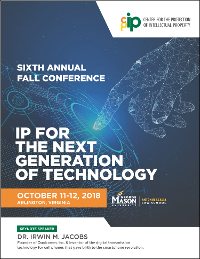
2018 Fall Conference flyerBy Kathleen Wills*

On October 11-12, 2018, the Center for the Protection of Intellectual Property (CPIP) hosted its Sixth Annual Fall Conference at Antonin Scalia Law School in Arlington, Virginia. The theme of the conference was IP for the Next Generation of Technology, and it featured a number of panel discussions and presentations on how IP rights and institutions can foster the next great technological advances.

In addition to the many renowned scholars and industry professionals who lent their expertise to the event, the conference’s keynote address was delivered by Dr. Irwin M. Jacobs, founder of Qualcomm Inc. and inventor of the digital transmission technology for cell phones that gave birth to the smartphone revolution. The video of Dr. Jacobs’ keynote address, embedded just below, is also available here, and the transcript is available here.

After beginning his career as an electrical engineer and professor at the Massachusetts Institute of Technology (MIT), Dr. Jacobs’ vision for the future of wireless communications drove him to found his first company, Linkabit, in the late 1960s. In the years that followed, Dr. Jacobs led teams that developed the first microprocessor-based satellite modem and scrambling systems for video and TV transmissions. In 1985, Dr. Jacobs founded Qualcomm, which pioneered the development of mobile satellite communications and digital wireless telephony on the national and international stage.

Dr. Jacobs’ keynote address focused on intellectual property’s role in the development of technology throughout his 50-year career. He began his speech by discussing his background in electrical engineering and academia at MIT and at the University of California, San Diego (UCSD). After publishing a textbook on digital communications, Dr. Jacobs explained that he then transitioned into consulting and started Linkabit, where he learned the importance of intellectual property.

Dr. Jacobs recounted how he later sold the company to start Qualcomm with the “mobile situation” of satellite communications on his mind. At Qualcomm, Dr. Jacobs wanted to break from the standard technology in favor of code-division multiple access (CDMA). CDMA had the potential to attract more users with a system that limited the total amount of interference affecting each channel, and it wasn’t long before Qualcomm was assigned the first patent on the new technology.

Qualcomm’s first product was Omnitracs, a small satellite terminal designed for communicating with dishes that led to the creation of a GPS system. Qualcomm’s patented GPS device used antenna technology to calculate locations based on information about the terrain, and it was very valuable to the company.

Using that source of income, Dr. Jacobs revisited CDMA at a time when the industry pursued time-division multiple access (TDMA) for supporting the shift to second-generation digital cellular technology. However, Dr. Jacobs knew that CDMA had the potential to support 10 to 20 times more subscribers in a given frequency band per antenna than TDMA. Within one year, Qualcomm built a demonstration of CDMA. At that time, the size of the mobile phone was large enough to need a van to drive it around!

Dr. Jacobs explained that commercializing the technology required an investment for chips, and it wasn’t long before AT&T, Motorola, and some other companies signed up for a license. Qualcomm decided to license every patent for the next “n” years to avoid future licensing issues and collect a small royalty. The industry eventually set up a meeting comparing TDMA to CDMA, and CDMA’s successful demonstration convinced the Cellular Telephone Industry Association to allow a second standard. A standards-setting process took place and, a year and a half later, the first standard issuance was completed in July of 1993.

Speaking on the push for CDMA, Dr. Jacob’s explained that there were “religious wars” in Europe because governments had agreed to only use an alternate type of technology. Nevertheless, CDMA continued to spread to other countries and rose to the international stage during talks about the third generation of cellular technology involving simultaneous voice and data transmissions. Dr. Jacobs visited the European Commissioner for Competition and eventually arranged an agreement with Ericsson around 1999 based on a strategic decision: instead of manufacturing CDMA phones in San Diego, there would be manufacturers everywhere in the world.

Selling the infrastructure to Ericsson, Qualcomm dove into the technology, funded by the licenses. The strategic decision to embed technology in chips in order to sell the software broadly has been Qualcomm’s business model ever since. Dr. Jacobs explained that since “we felt we had well-protected patents,” and had a steady income from the licenses, the team could do additional R&D. With that support, they were the first to put GPS technology into a chip and into a phone, developed the first application downloadable for the phone, and looked ahead at the next generation of technology.

Dr. Jacobs said that he’s often asked, “Did you anticipate where all of this might go?” To that question he replies, “Every so often.” Qualcomm was able to move the industry forward because of the returns generated through its intellectual property. Dr. Jacobs early realized that the devices people were carrying around everywhere were going to be very powerful computers, and that “it’s probably going to be the only computer most of us need several years from now.”

“Protecting intellectual property, having that available, is very critical for what was then a very small company being able to grow,” Dr. Jacobs said. Because Dr. Jacobs relied on secure intellectual property rights to commercialize and license innovative products, and in turn used income from licensing patents for R&D, Qualcomm was—and continues to be—able to prioritize high performance computing and to keep the cellular technology industry moving forward.

To watch the video of Dr. Jacobs’ keynote address, please click here, and to read the transcript, please click here.

*Kathleen Wills is a 2L at Antonin Scalia Law School, and she works as a Research Assistant at CPIP

Categories
Patent Theory

Flawed Marginal Cost Theory Should Not Be Applied to Intellectual Property

a lit lightbulb hanging next to unlit bulbsRecent calls for the government to lower prescription drug prices by overriding patent rights include proposals for the establishment of a marginal cost pricing system in the pharmaceutical industry (and in patent-based markets in general). As a previous article in this series details, some academics and advocates are now suggesting that the government use a federal law (known as § 1498) to force companies to sell patented drugs at the amount it costs to produce one unit of the drug—also known as the marginal cost. But while providing cheap prescription drugs for all sounds like a noble endeavor, the proposal ignores economists’ near complete rejection of the marginal cost theory and threatens to disrupt the development of potentially life-saving medicines.

Marginal Cost Theory Fails Economic Scrutiny

Proposed 80 years ago by American economist Harold Hotelling, traditional marginal cost pricing theory maintains that maximum societal benefit is realized when products are sold at a price that corresponds to the cost to produce one additional unit of a good. Not included in marginal cost are any “fixed” costs incurred prior to the production of that additional unit, such as rents, property taxes, salaries, or any other overhead costs not dependent on the amount of goods produced. To arrive at a balance that would maximize general welfare, Hotelling proposed that government revenues be used to cover fixed costs in industries where these costs were significant, such as power plants, railroads, and other public utilities. With the fixed costs of these industries subsidized by the government, companies could then offer consumers goods and services at the reduced marginal cost of production.

Despite some initial acclaim, it wasn’t long before Hotelling’s proposal was systematically challenged and repudiated by a number of preeminent economists. As detailed in a 1946 article by Ronald Coase, the key problem with Hotelling’s marginal cost proposal was that it assumed the government has very good information on the marketplace and consumer demand. Without good information and the will to use it, Coase explained that a system of government subsidies would result in a “maldistribution” of resources and income that would ultimately result in losses similar to those the system was aimed at alleviating. This critical problem of a less-than-omniscient government was echoed by others over the years, and now, as Professor John Duffy explains, “[t]he rejection of the Hotelling thesis is so complete that reputable economics encompasses the very opposite of Hotelling’s view.”

New Proposals Disregard Parallel Shortcomings 

Notwithstanding the widespread dismissal of Hotelling’s marginal cost theory, proponents of expansive and unprecedented use of § 1498 insist that that because intellectual property and innovative products are different from the public utilities referenced in Hotelling’s work, they will benefit from a government-run marginal cost pricing scheme. In a 2016 article calling for § 1498 to be used to lower drug prices, proponents argue that allowing the government to impose prices that reflect the marginal or “generic” cost of production will maximize social benefit. Their argument is based on the theory that intellectual property and information are non-rivalrous goods with a marginal cost of zero and that any “supra-marginal” costs result in inefficient deadweight loss.

But proposals for using significant government subsidies to address pricing in innovative industries ignore the fact that the critical problems with marginal cost pricing in public utilities are just as, if not more, apparent in intellectual property. Responding to arguments in favor of a system of public subsidies to cover fixed costs in a broad range of innovative and creative industries, Professor Duffy’s 2008 article on marginal cost controversy identifies four basic problems that, while originally raised to refute Hotelling’s proposal, directly apply to intellectual property.

The first and most obvious problem Professor Duffy confronts is the distortionary effects of taxes the government would need to impose on the general public to fund the subsidies marginal cost pricing requires. Proposals to implement government subsidies often assume, with little-to-no evidence, that tax distortions would be smaller than any distortions flowing from IP rights and non-marginal pricing. Professor Duffy contends that because there is no evidence that IP rights result in a price divergence any greater than other areas of the economy, they may actually be small in comparison to the taxes that would be required in a subsidy scheme.

The second problem is Coase’s aforementioned issue of government ignorance and the misallocation of resources that would result from a lack of information. Essential to government implementation of a successful marginal cost scheme is sufficient information about the demand for intellectual property—specifically whether consumers would have demanded the good if they had to pay the total cost. As Professor Duffy explains, gathering data in an attempt to answer this question would be impossible “because consumers are not paying full costs and never expected to do so.” Inaccurate assumptions that attempt to fill gaps in the data will inevitably lead to inefficiencies and the misallocation of resources.

Professor Duffy then challenges the notion that a marginal cost scheme would redistribute income in favor of those consuming the goods targeted by the price controls while using taxes to spread the cost of the subsidies to the general public. After questioning the fairness of this type of distribution, Professor Duffy moves on to an in-depth critique of the efficiency of such a system and a warning of the rent-seeking behavior likely to follow. He explains that this type of wealth transfer will result in inefficiencies when individuals are likely to expend resources to bring about the transfer. Professor Duffy describes a pricing scheme that promises far cheaper costs to consumers:

That regime will appeal most strongly to those who currently consume those goods, for they will obtain the largest benefit. But the economic efficiency of a reward system comes exclusively from increasing consumption among those consumers who value the good (or some units of the good) below the price that would be charged by the right holder under the current IP system.

A system that targets certain areas for subsidies invites consumers of those products to expend resources in attempt to secure the subsidies, thereby opening the door for rent-seeking behavior and increased inefficiencies.

Finally, Professor Duffy emphasizes Coase’s criticism that marginal cost proposals incorrectly compare marginal cost pricing to single-pricing schemes. Coase explained that the industries identified by Hotelling are free to rely on “multi-part” pricing, or price discrimination in which no deadweight loss occurs. Professor Duffy applies Coase’s argument to intellectual property and stresses that rights owners have a true incentive to minimize deadweight loss in an attempt to capture the resulting gains. Because rights owners have this incentive, have the power to charge different prices to different categories of consumers, and have potential constraints of competition from other innovative technology, Professor Duffy concludes that “it is by no means clear that the IP right holder will cause greater distortions than the government’s revenue agents.”

Incentives to Innovate Must be Preserved

While it may be true that costs associated with providing intellectual property to consumers are low or close to zero, the fixed costs of innovation are often very high. Creators and innovators rely on intellectual property rights to commercialize their products and recoup the massive fixed costs required to develop innovative products and creative works. Government mandated marginal cost pricing schemes implemented through § 1498 would threaten innovators’ ability to both recoup past losses and to fund the development of new technology. In a 2005 article on economics and IP law, Richard Posner warns of this dilemma:

Marginal-cost pricing would maximize access to existing intellectual property and deter or expel inefficient entrants, but it would reduce, indeed often eliminate, the incentive to create the property in the first place.

Recent calls for the government to impose marginal cost pricing in the innovative industries gloss over the serious flaws that have led to the widespread dismissal of such proposals in the past. While those advocating for § 1498 do suggest a type of risk-adjusted compensation for companies subject to the marginal cost scheme, they couch the proposal in highly abstract terms and fail to consider that appropriate compensation would be impossible to accurately calculate. Additionally, as Professor Duffy notes, the literature upon which these proposals rely “treats the marginal cost pricing problem of intellectual property as a unique phenomenon” without thoroughly examining whether IP is distinguishable enough from Hotelling’s public utilities that it would benefit from government price control.

The delivery of affordable drugs to people in need should be something that innovative companies and the government work together to ensure, but flawed mechanisms and unsound economic theories should not be the foundation of such an important endeavor. Before rushing to implement a marginal cost pricing system, proponents would be wise to consider the drastic effects it could have on incentives to innovate—and ultimately the development of the next ground-breaking drugs.

Categories
Copyright

Arts & Entertainment Advocacy Clinic Students File Amicus Brief in Brammer v. Violent Hues

a gavel lying on a desk in front of booksBy Rachelle Mortimer & Grant Ossler*

The Arts & Entertainment Advocacy Clinic at Antonin Scalia Law School recently filed an amicus brief in the Brammer v. Violent Hues case that is on appeal in the Fourth Circuit. The Clinic provides a unique opportunity for students interested in intellectual property and entertainment law. Each semester, students participating in the Clinic are able to gain practical experience working with clients and industry professionals on various projects related to copyright law and policy.

One organization that the Clinic often works with is Washington Area Lawyers for the Arts (WALA), which helps to provide legal services for local artists through volunteer attorneys who take on cases pro bono or at a reduced rate. By working with WALA to hold legal intake Clinics and take on pro bono cases, Clinic students are able to understand how copyright law affects individual artists. It is this understanding that led the Clinic to file the amicus brief in order to protect the rights of artists and prevent a dangerous expansion of the fair use defense to infringement.

Working with local attorneys from Protorae Law, students from the Clinic drafted portions of the amicus brief to explain how the U.S. District Court for the Eastern District of Virginia eviscerated the meaning and analysis of fair use under the Copyright Act.

Case Background

In 2016, the owner of defendant Violent Hues found a photograph online, copied it, cropped it, and posted it on a website that his organization created for its annual film festival. The photo in question was first posted to the photographer’s personal website, as well as to several online image-sharing websites. Violent Hues created the website to guide festival goers and provide information about the local area for filmmakers and festival attendees.

The owner of Violent Hues claimed he did not see a copyright notice on the photo when he used it, believing the photo was “a publicly available photograph.” Plaintiff Russell Brammer sent a demand letter, and upon receipt of the letter, Violent Hues removed the photo from its website. Brammer brought suit against Violent Hues claiming two causes of action: (1) copyright infringement under 17 U.S.C. § 504(b), and (2) removal and alteration of copyright management information under 17 U.S.C. § 1202.

District Court Decision

Brammer did not respond to arguments regarding count two, therefore the district court considered that claim abandoned. The district court granted summary judgment in favor of Violent Hues on count one, deeming the use of the photo was fair use per the Copyright Act. Fair use is codified in the Copyright Act and guides us through four factors of consideration when conducting an analysis to determine whether a use is a fair use. These factors are:

(1) The purpose and character of the use, including whether such use is of a commercial nature …; (2) the nature of the copyrighted work; (3) the amount and substantiality of the portion used in relation to the copyrighted work as a whole; and (4) the effect of the use upon the potential market for or value of the copyrighted work.

17 U.S.C.§ 107.

Unfortunately, the district court eviscerated any meaning to fair use under copyright law. In its examination of purpose and character, the district court determined Violent Hues’ use was “transformative in function and purpose” because Violent Hues’ use of the photo was informational: “to provide festival attendees with information regarding the local area.” The district court distinguished this from Brammer’s use, which was “promotional and expressive.” Additionally, the district court determined the use was non-commercial because the photo was not used for advertising or to generate revenue. Regrettably, this is as far as the transformative analysis went.

In the district court’s analysis of the second factor, fair use weighed in favor of Violent Hues again because the photo was factual in nature and “fair use is more likely to be found in factual works than in fictional works.” The district court acknowledged that Brammer incorporated creative elements in his photo (e.g., lighting and shutter speed), but ultimately held that because it was a “factual depiction of a real-world location,” it was purely factual content. The district court determined this without regard to creativity, though. The photo itself is a time-lapse photo of the Adams Morgan neighborhood of Washington, D.C.

In examining the third factor of fair use, the district court determined that Violent Hues did not use any more of the photo than was necessary, and therefore this factor substantiality weighed in favor of Violent Hues. Keep in mind, though, that the photo in question was merely cropped.

Lastly, the district court concluded that because there was no evidence that Violent Hues’ use had any effect on the potential market for the photo, the fourth factor also weighed in favor of Violent Hues. To support its decision, the district court stated: “The Court’s task is to determine whether the defendant’s use of the plaintiff’s works would materially impair the marketability of the works and whether it would act as a market substitute.” The district court arrived at this decision despite Brammer testifying he had been compensated for the photo six times—two times after Violent Hues’ infringement.

And thus, we have summary judgment for Violent Hues under a non-comprehensive fair use analysis.

Amicus Brief Summary and Commentary

The purpose of the Clinic’s amicus brief is to assist the court with regard to a proper, comprehensive fair use analysis, and to prevent the possible harm that an overly broad interpretation of the fair use defense could bring.

In examining the first factor of fair use, “purpose and character”, the district court unfortunately dedicated approximately two sentences to the analysis of why Violent Hues’ use was transformative in “function and purpose.” The district court simply stated that because the use was “informational,” and not “expressive” like Brammer’s use, the use was thus transformative. The proper examination requires looking at whether the new use adds something new “with a further purpose or different character.” As Judge Leval stated in his seminal article, Toward a Fair Use Standard, a different purpose or character, constituting a transformative use, is one that “alter[s] the first with new expression, meaning, or message,” and “employs the quoted matter in a different manner or for a different purpose from the original, thus transforming it.”

The district court failed to understand that Violent Hues’ use merely superseded Brammer’s. Violent Hues cropped the top and bottom of Brammer’s photo then posted it to its website with the purpose of showing the Adams Morgan neighborhood. A “wholesale taking” of the heart of the work, without adding additional value or meaning, is not transformative. The erroneous conclusion reached on this first factor destroys any meaning to transformative use and effectively erodes the exclusive rights held by copyright owners. To further illustrate this point, if the district court’s analysis is upheld, an author who writes a book regarding his life as president and his controversial pardon of a former political figure would have no recourse against a film producer who takes the author’s content verbatim and makes it into a movie. Why? Because the book is merely “informational,” while the film is “expressive” and thus transformative in function and purpose.

The district court’s opinion also addressed the role of “good faith” in a fair use defense and concluded that Violent Hues had acted in good faith when it found Brammer’s photo online because a copyright notice was not attached. This is not the law. Copyright protection under U.S. law is automatic from the moment of creation and notice need not be affixed to the published work for that protection to adhere. The good faith of alleged infringers is not frequently considered in fair use cases because “good faith” is not a statutory factor in the fair use analysis, and this has led to a lack of clear precedent on this point.

We proposed in our brief that if an alleged infringer acts in good faith, the court should neither weigh this factor for or against a finding of fair use. However, if an alleged infringer is shown to have acted in bad faith, using an artist’s work with the purpose of usurping the exclusive rights under 17 U.S.C. § 106, it should be weighed against a finding of fair use. Good faith should not weigh in favor of fair use because the purpose of the fair use defense is to protect First Amendment rights and allow limited uses of copyrighted works. On the other hand, bad faith should be weighed against a finding of fair use because trying to usurp an artist’s rights or using a work without paying for it does not align with the important purposes of the fair use defense.

Violent Hues did not act in good faith, but it also did not act in bad faith. Thus, the good faith factor should not have been considered at all in this case. A copyright notice is not required for a photograph to be protected. If the court allows Violent Hues’ lack of education on copyright law to be considered good faith, this would encourage internet users to remain ignorant of copyright law and infringe upon works more frequently. For these reasons, we asked the Fourth Circuit to clarify the role of the good faith factor in a fair use analysis.

The other factor our amicus brief addressed was the second factor of the fair use analysis. Digging into this factor, we asked that the court to clarify the analytical framework for evaluating the nature of the copyrighted work. In clarifying this framework, parties and other courts will be better able to determine when factual elements of copyrighted works are outweighed by the creative elements of such works. Brammer’s photo, specifically, is an appropriate vehicle for this since it combines creative and factual elements. Our brief articulates that a court can borrow from more familiar concepts of trademark’s nominative fair use and the defense of necessity to the tort of trespass on real property (noting that the prevailing theory of copyright is a property). Such theories provide for a defense on the basis of “necessity.”

In this analysis of necessity, one would believe that content in the factual lexicon would lean strongly toward a finding of fair use for the alleged infringer. However, where the use of the copyrighted work is not necessary to convey the same factual content, the motivation behind copyright law should be preserved—rewarding and protecting creativity. Brammer’s photo was a time-lapse photo of the Adams Morgan neighborhood; it was creative and depicted a factual setting. However, the mere fact that an original, creative work is factual does not imply that others may freely copy it.

The district court improperly analyzed this second factor in light of Violent Hues’ use of the photo, and not the intended use of the content creator, giving greater weight to the fact that the photo depicted a real-world location. We argued that this analysis “sanctions abuse of the fair use defense to appropriate copyrighted material so long as the user can claim that a factual element within the whole was the reason for their unauthorized appropriation.” The appropriate analysis centers on the concept of protecting creative elements while simultaneously not limiting the public’s use of facts. In the case at hand, Violent Hues’ use of Brammer’s photo to convey factual information about Adams Morgan was unnecessary because to convey the same message, and arguably in a more factual manner, Violent Hues could have driven to Adams Morgan to take its own snapshot of the neighborhood.

Finally, the district court’s determination that prior publication weighs in favor of a fair use is erroneous. As Patry on Fair Use provides: “The fact that a work is published does not mean that the scope of fair use is broader.” To state that publishing a copyrighted work broadens the scope of fair use renders the exclusive rights afforded to copyright owners null. Such a holding undermines the “special reward” of copyright protection and discourages creation of works—in stark contrast to the affirmative statements on copyright in the U.S. Constitution. Publication should be viewed as neutral until it can be considered under the fourth factor of the fair use analysis, wherein a court examines the impact of the alleged infringing use on the market for the copyrighted work. The district court’s simplistic approach to its analysis allows for parties to undermine the core purposes of copyright protection and, again, eviscerates a proper fair use analysis.

It is our hope that our amicus brief will help guide the Fourth Circuit as it assesses the extent of the fair use doctrine in the digital age. We are especially thankful to Antigone Peyton and David Johnson of Protorae Law, Terrica Carrington of the Copyright Alliance, and Professor Sandra Aistars of the Arts & Entertainment Advocacy Clinic for the opportunity to work on this important issue. To read our amicus brief, please click here.

*Rachelle Mortimer and Grant Ossler are students at Antonin Scalia Law School, where they study under Professor Sandra Aistars in the Arts & Entertainment Advocacy Clinic.

Categories
Innovation Patent Law Pharma

A Cure Worse Than the Disease? Proposed Changes to European Patent Law are Threatening Pharmaceutical Innovation

a hand reaching for a hanging, shining keyInnovation is all around us. We love and appreciate the latest video games, software apps, and smartphones. We await the integration of self-driving cars and other forms of artificial intelligence. Beyond the gadgets and luxuries we think we can’t live without, there are even more essential products that affect the lives of millions around the world on a daily basis. Patented medicines are at the top of the list of innovations that save lives and preserve the quality of life. Unfortunately, some proposed changes to European patent law are jeopardizing the development and delivery of safe and effective drugs, threatening jobs and innovation, and putting global public health at risk.

Policy-makers and the public acknowledge that balance is critical in the legal regimes governing essential medicines. Our generation is the beneficiary of patent protections which strike a balance. European regulators have long acknowledged that the benefits of new cures (e.g., arising from the research and development of therapies) require a societal investment in the form of intensive capital resources and strong intellectual property protection. In turn, a balanced system includes a reasonable patent term as a quid pro quo for the public disclosure of knowledge and the follow-on generic industry.

The medicines sector highlights the need for that careful balance, as well as the success of the current legal regime. New drug research and the development of new cures is extremely capital intensive. Legions of European scientists, engineers, and clinicians can work for years on a new drug’s development and regulatory review. A recent Tufts University center study reports that, on average, more than $2.6 billion is spent on R&D for a new prescription drug that gains market approval; the life-cycle cost rises to $2.9 billion when other post-approval development costs are included.[1] This is a 145% increase, correcting for inflation, over the estimate the center made in 2003.

In practice, for every drug that is successfully developed, reviewed, and made available to patients, many dozens more fail. CPIP Senior Scholar Erika Lietzan has observed:

The overall attrition rate for new drugs remains high—‘horrendously high’ according to [U.S.] NIH Director Francis Collins—and may be increasing. Recent estimates place the phase 2 failure rate at sixty-five to seventy percent and even higher for drugs with new mechanisms of action.[2]

Due to this high failure rate and costly investment in R&D, well-balanced intellectual property rights are essential for innovators to commercialize the products that do make it to market and improve—or even save—consumers’ lives.

Medicines must be safe and effective, and while regulatory review is essential, it is a time-consuming and highly expensive process. The reality is that the essential patent term is eaten away by years of regulatory review delay.[3] This extra review process is what makes the investment and research questions in the bio-pharmaceutical space so different from a smartphone or the latest virtual reality entertainment software. Professor Lietzan christened this the “innovation paradox.” She explains:

In medicine today, we face an innovation paradox. Companies that develop new medicines depend on a period of exclusive marketing after approval, to fund their research and development programs. This period is made possible by patent protection and regulatory data exclusivity.[4]

Likewise, it is the reason that there needs to be some supplementary legal protection to raise new capital and investments for cures and therapies.

The practical effect is that the necessary regulatory review results in the loss of years of effective patent term protection, warranting special treatment for innovative pharmaceutical products that come to market with little time to realize the benefits of exclusivity. In the 1990s, European policy-makers successfully restored the balance between innovation and the public interest by establishing the Supplementary Protection Certificate (SPC), which provides limited exclusive legal protection after a patent’s expiry.

Supplemental Protection Certificates Ensure a Necessary Balance

Supplementary Protection Certificates (SPCs) reinforce the balance between the rights of innovators and the public by extending the exclusive term for a variety of compounds, e.g., human and veterinary medicines and plant products. SPCs provide a limited extension of legal protections (e.g., exclusivity capped at five-and-one-half years) to compensate for the patent term effectively lost during the regulatory review process to ensure safety and efficacy.

Since SPCs were established, it is estimated that more than 20,000 SPCs for patented products have been filed in Europe during the period 1991–2016.[5] Despite the SPC’s twenty-plus-year track record of success, it, and the balance it preserves, is coming under pressure due to special interest lobbying by the generic drug industry.

The European Commission (EC) recently proposed waiving the SPC for pharmaceuticals and biosimilars[6] and permitting limited generic drug protection via the following two provisions prior to the SPC’s expiration:

(1) The “Manufacturing Provision.” This proposal would “allow EU generic or biosimilar manufacturers to develop and store generic or biosimilar manufacturers in Europe . . . with the goal of enabling immediate generic or biosimilar market entry following the expiration of intellectual property protections . . . .”

(2) The “Export Provision.” This proposal would “allow generic or biosimilar manufacturers to export products to countries where no intellectual property protection for the products is in place.”

While these two proposals are touted as limited in scope, their impact would be significant and detrimental on many fronts across Europe, including for the public health, innovation, jobs, and trade.

The Dangerous Impact of SPC Waiver

The overall impact of the SPC waiver threatens the balance that has worked so well for twenty-plus years, plain and simple. Specifically, the negative impact and risks are evidenced through the inherent complexity of a medicine’s regulatory review process, undermining the public health via counterfeit medicines, and harming Europe’s economy and jobs.

a. Risks of Limiting Innovation for a Variety of Important New Compounds and Cures


The most important reason to preserve the current balance is that it is a proven path to develop new medicines for the public’s health. Recently, a commentator highlighted two critical medicines that would not be available to patients, but for the opportunity afforded by the SPC process: (1) Fingolimod (a drug to treat renal failure after a kidney transplant that was subsequently brought to the market for the treatment of multiple sclerosis (MS)); and, (2) Secukinumab (a treatment of psoriasis, psoriatic arthritis, and ankylosing spondylitis (a type of spinal arthritis) that required an extended, more complicated clinical trial review period).[7] In both cases, the benefits of the additional period of exclusivity under the SPC provided the necessary time and resources for the follow-on clinical trials and research for the medicine’s safety and efficacy review.

Ultimately, SPCs benefit capital intensive pursuits, such as new drug discovery and development, by yielding new drugs or new applications for such drugs. More importantly, the patients who need these drugs clearly benefit. As Europe looks to an aging population and increasing health care costs, there is an ever growing need for effective cures for diseases such as HIV/AIDS, Alzheimer’s, multiple sclerosis (MS), cancers, and others requiring orphan drugs.[8] The SPC system is an important part of how the next generation of pioneering life-saving medicines will come into being.

b. Risk to the Public Health and Safety Through Counterfeit Medicines


Another key concern for stakeholders and the public at-large resulting from the current proposals is the inevitable increase of piracy and counterfeiting of these medicines. Global piracy and counterfeiting of medicines is big business. A 2016 study estimated that drug piracy costs Europe more than €10 billion each year, may result in the loss of up to 40,000 direct jobs, and may have a total direct and indirect negative impact of over €17 billion and 90,000 job losses.[9]

In addition to the significant financial impact, piracy and counterfeiting is a matter of public health and safety. It is often the case that the counterfeit medicines are manufactured without sufficient quality controls, or worse, with unsafe or dangerous substitute ingredients. The SPC Export Provision waiver heightens the risk that poor quality or unsafe counterfeits will be diverted across borders. Counterfeit drugs are a massive public health risk throughout Europe and big business for criminal enterprises that either ship fake, unsafe medicine or divert counterfeits across borders trying to profit on the product demand and price differentials among nations.

The SPC Export Provision waiver will ultimately increase medicines piracy and counterfeiting on many grounds, including making it difficult to distinguish between medicines produced legally in one country and other jurisdictions without adequate IP protection, making it difficult to prevent product diversion, and diminishing quality control due to infringement.

c. The European Economic Case: Jobs and Trade


Europe boasts a first-class research-based pharmaceutical industry which is estimated to have invested €31.5 billion in R&D in 2015 alone.[10] The leading European countries which contribute to this annual R&D investment include Germany, France, Italy, Spain, and the U.K. The research industry trade association, EFPIA, explains some of the economic benefits of the SPC regime:

The SPC is part of an incentives framework that helps to generate the 35 billion in investment in R&D in Europe by the research-based industry. . . . It helps to safeguard over 750,000 jobs directly employed by biopharmaceutical companies and critically facilitates, research into unmet medical needs, finding treatments and cures for patients across Europe and beyond.[11]

R&D Investment in Europe (2016). Germany, 19%. France, 15%. Italy, 4%. Spain, 3%. U.K., 16%. Rest of Europe, 43%.

European Pharmaceutical Industry: Recent Trends and Statistics[12]

Evaluating the economic factors around an industrial policy proposal—new manufactured units, SMEs, direct and indirect jobs—is a legitimate part of the policy debate. In the public health context, it is one of several factors for policy-makers. Both sides of the debate have offered competing economic analyses of the impact of the waiver.[13] However, the past is prologue, and Europe has 20-plus years of a positive economic experience with the SPC regime.

Today’s debate over the SPC waiver is reminiscent to biotechnology patentability debates in the 1980s that weakened intellectual property rights and drove innovative activity out of Europe. As a recent article explains, the legal choices made by Europe during that crucial era led to an irreparable loss of its technological global leadership in the biotech and health care arena:

Europe lost the competitive and commercial edge in biotechnology to the U.S., which had the foresight to protect a new and innovative industry. This new industry both revolutionized modern medical research and healthcare treatments and brought economic growth to the many U.S. cities in which these new companies sprouted and flourished.[14]

Likewise, additional commentators warn that an SPC waiver poses a threat to Europe’s global competiveness: “Europe is becoming an innovation backwater, easily outspent on R&D by peer nations such as the United States, Japan, South Korea and Australia, according to the 2017 European Innovation Scorecard.”[15] While there are allegations that the SPC waiver would be beneficial for European jobs and its economy, this has been debunked for their flawed methodology or extreme overstatement of the facts.[16]

Conclusion

The EC’s proposed SPC waiver provisions are a cure far worse than the disease. The policy debate around this subject boils down to whether Europe wants a strong or a weak health care system for its citizens. The purported goals advanced by special interest tactics certainly sound noble: more competition, lower prices. In fact, the opposite ignoble result is an inevitable undermining of the incentives for the discovery and development new medicines.

The EC should reconsider the proposed waiver for many reasons. The current SPC system offers a successful twenty-year-plus track record. It respects the balance between patients and the medicines innovation ecosystem. The waiver will directly stifle innovation in the guise of fostering competition, as well as dampen the future of innovative medicines and harm the European economy. One must conclude that the SPC waiver should be reconsidered for the sake of the public health and future well-being of the European citizenry.


[1] https://www.scientificamerican.com/article/cost-to-develop-new-pharmaceutical-drug-now-exceeds-2-5b/.

[2] Erika Lietzan, The Drug Innovation Paradox, 83 Missouri Law Review 39 at 78-79 (2018) (describing the U.S. regime), available at https://ssrn.com/abstract=2948604.

[3] Id. at 59 (“Through the 1970s, as the modern new drug premarket paradigm took shape, scholars and policymakers became aware of diminishing effective patent life. Because inventors typically file active ingredient patent applications before clinical testing starts, these patents tend to issue before or during the trials. At the time, a patent lasted for seventeen years from issuance. Today, it generally lasts for twenty years from the filing of the patent application. In either case, a significant portion of the term of an active ingredient patent may lapse before FDA approves the marketing application. This shortens the period of time that the drug sponsor may exploit the invention in the market while enjoying patent rights.”).

[4] Id.

[5] Malwina Mejer, 25 years of SPC protection for medicinal products in Europe: Insights and challenges (May 2017), available at https://ec.europa.eu/info/publications/25-years-spc-protection-medicinal-products-europe-insights-and-challenges_en.

[6] The European Medicines Agency (EMA) explains that “[a] biosimilar is a biological medicine highly similar to another already approved biological medicine (the ‘reference medicine’). Biosimilars are approved according to the same standards of pharmaceutical quality, safety and efficacy that apply to all biological medicines. The European Medicines Agency (EMA) is responsible for evaluating the majority of applications to market biosimilars in the European Union (EU). Biological medicines offer treatment options for patients with chronic and often disabling conditions such as diabetes, autoimmune disease and cancers.” Available at https://www.ema.europa.eu/en/human-regulatory/overview/biosimilar-medicines-overview.

[7] Nathalie Moll, Betting on innovation, the case for the SPC, available at https://www.efpia.eu/news-events/the-efpia-view/blog-articles/betting-on-innovation-the-case-for-the-spc/.

[8] The European Medicines Agency (EMA) notes that “[a]bout 30 million people living in the European Union (EU) suffer from a rare disease. The [EMA] plays a central role in facilitating the development and authorization of medicines for rare diseases, which are termed ‘orphan medicines’ in the medical world.” Available at https://www.ema.europa.eu/en/human-regulatory/overview/orphan-designation.

[9] http://www.pharmexec.com/counterfeit-drugs-cost-europe-more-10-billion-year.

[10] https://www.ihealthcareanalyst.com/european-pharmaceutical-industry-recent-trends-statistics/.

[11] https://efpia.eu/news-events/the-efpia-view/statements-press-releases/efpia-statement-on-the-implementation-of-the-spc-manufacturing-waiver/.

[12] https://www.ihealthcareanalyst.com/european-pharmaceutical-industry-recent-trends-statistics/.

[13] http://ecipe.org/blog/ec-spc/; https://www.medicinesforeurope.com/newsroom/.

[14] Kevin Madigan & Adam Mossoff, Turning Gold Into Lead: How Patent Eligibility Doctrine is Undermining U.S. Leadership in Innovation, 24 Geo. Mason L. Rev. 939 (2017) (“We believe these are sensible provisions to avoid weakening Europe’s IP framework further, particularly in today’s context of intense global competition for pharmaceutical research and development investment.”), available https://ssrn.com/abstract=2943431.

[15] See, e.g., Philip Stevens, The European Commission’s pharmaceutical innovation incentives review is at risk of serious overreach, available at http://ecipe.org/blog/ec-spc/.

[16] Sussell et al, Reconsidering the economic impact of the EU manufacturing and export provisions, J. of Generic Medicines, 1-17. (citing arithmetic error and providing a counter factual analysis of the unit, job, SME, and economic benefits in a recent generic industry study praising the SPC waiver proposal).

Categories
Patent Law Patent Theory

Proposed Misuse of Section 1498 Relies on the False Claim that Patents Are Not Property

hand under a lightbulb drawn on a chalkboardBy Kathleen Wills*

The question whether patents are property rights is a continuing and hotly debated topic in IP law. Despite an abundance of scholarship (see here, here, here, here, and here) detailing how intellectual property (“IP”) rights have long been equated with property rights in land and other tangible assets, critics often claim that this “propertarian” view of IP is a recent development. Misconceptions and false claims about patents as property rights have been perpetuated in an echo chamber of recent scholarship, despite a lack of evidentiary support.

Unfortunately, these misleading arguments are now influencing important pharmaceutical patent debates. Specifically, a new push to devalue patent rights through the misapplication of an allegedly obscure and misunderstood statute, Section 1498 in Title 28 of the U.S. Code (“Section 1498”), is now being used to promote price controls. Arguments for this push have gained traction through a recent article whose flawed analysis has subsequently been promoted by popular media outposts. A better understanding of the nature of patents as property reveals the problems in this argument.

The history of Section 1498 clearly contemplates that patents are property subject to the Takings Clause, which reflects a long-standing foundation of patent law as a whole: Patents are private property. In an influential paper, Professor Adam Mossoff established that from the founding of the United States, patents have been grounded in property law theories. While some scholars today argue that the perception of patents began as monopoly privileges, this is only partially correct.

The arguments usually revolve around certain stated views of Thomas Jefferson, but they ignore that his position was actually a minority view at the time. Even when the term “privilege” was used, it reflected the natural rights theory of property that a person owns those things in which he invests labor to create, including labors of the mind. The term did not reflect a discretionary grant revocable at the will of the government. Thus, an issued patent was a person’s property, as good against the government as against anyone else.

To understand the majority perspective of courts in the nineteenth century, it is important to note that James Madison, the author of the Takings Clause, wrote that the “[g]overnment is instituted to protect property of every sort.” What types of property? Courts often used real property rhetoric in patent infringement cases, as seen in Gray v. James. By 1831, the Supreme Court believed that patent rights were protected just like real property in land was protected. In Festo Corp. v. Shoketsu Kinzoku Kogyo Kabushiki Co., the Court established that patent rights represent legitimate expectations similar to property rights in land, which, in turn, are rights secured under the Takings Clause of the Constitution.

This understanding of patents reflected a stark break from the traditions in English law from which American law developed. In England, the “crown-right” granted the government the right to practice a patented invention wherever and however it pleased. In 1843, the Supreme Court in McClurg v. Kingsland explained that while England viewed a patent as “a grant” issued as a “royal favor,” which could not be excluded from the Crown’s use, the American system was intentionally different and patent rights were good against the government. This meant that Congress had to treat patents as vested property rights in the patent owner.

Justice Bradley enumerated this difference between the United States and England in James v. Campbell:

The United States has no such prerogative as that which is claimed by the sovereigns of England, by which it can reserve to itself, either expressly or by implication, a superior dominion and use in that which it grants by letters-patent to those who entitle themselves to such grants. The government of the United States, as well as the citizen, is subject to the Constitution; and when it grants a patent the grantee is entitled to it as a matter of right, and does not receive it, as was originally supposed to be the case in England, as a matter of grace and favor.

As an article by Professor Sean O’Connor explains, this change occasionally caused confusion in American courts when it came to patent owners seeking redress against unauthorized government use. The problem was that there was no single clear mechanism for suing the federal government for injunctive or monetary relief—in fact under sovereign immunity principles, in many cases the plaintiff could not sue the government. Various mechanisms such as implied or quasi contracts were used, but the varying nature of patentees—had they received some government funding leading to their invention or developed it purely outside of government support—complicated things further.

To provide a venue where citizens could sue the government for patent infringement and other claims, Congress created the Court of Claims in 1855. In 1878, the Court of Claims in McKeever v. United States explained that in the United States, patent rights secured the “mind-work which we term inventions,” authorized under the Copyright and Patent Clause in the Constitution. By explaining that patent rights derived from Article I in the Constitution, the Court of Claims suggested that patents were as important as other property rights and thus different from grants. Prof. O’Connor shows that the status of patents as property, and the recognition of this fact by the courts, solved much of the confusion over the history of American patent law.

The Supreme Court went on to affirm the Court of Claims’ decision to award damages to a patentee for an unauthorized governmental use of his patented invention. In United States v. Burns, the Court said that “[t]he government cannot, after the patent is issued, make use of the improvement any more than a private individual, without license of the inventor or making compensation to him.” In James v. Campbell, the Supreme Court echoed this idea when it held that patents confer owners an exclusive property in their invention, and that the government cannot use such an invention without just compensation any more than the government could appropriate land without compensation.

By 1881, it was clear that the courts recognized patents as property rights under constitutional protection from government takings, just like real property. With a strong historical record showing that the Supreme Court equated patents as protected property rights, a question remains: Where does the confusion today stem from?

As Prof. Mossoff explains, the confusion could come from misconstrued inferences of legislative intent regarding the Tucker Act (“Act”). The 1887 version of the Act did not address patents when giving the Court of Claims jurisdiction to hear claims arising from Constitution. This was used by the Federal Circuit in Zoltek Corp. v. United States to deny patents security under the Takings Clause. The Federal Circuit reasoned that patents weren’t constitutional private property. Judge Newman, however, dissented from the petition for rehearing en banc. She highlighted that “[a]lmost a century of precedent has implemented the right of patentees to the remedies afforded to private property taken for public use. There is no basis today to reject this principle.” (The Takings Clause analysis was subsequently vacated when the Federal Circuit eventually took the case en banc.)

An investigation of the Act’s legislative history also leads to a 1910 committee report (H.R. Rep. No. 61-1288), stating that the government’s unauthorized use of patents qualified as a taking. A few years after, the 1918 amendment adjusted the Act’s language to specifically allow patentees to sue the government for unauthorized uses of their property. Thus, the Tucker Act included patent claims in the kind of suits where the government’s unauthorized use was a constitutional issue, appropriately within the Court of Claims’ jurisdiction. Towards the end of the twentieth century, courts continued to hold that patents were constitutionally protected private property.

Modern cases have also confirmed that patents are property protected by the Takings Clause. Chief Justice Roberts, in Horne v. Department of Agriculture, used a patent case for the proposition that the Takings Clause extends to all forms of property, not just real property. Even in Oil States v Greene’s Energy, Justice Thomas went out of his way to assert that the Takings Clause still applies to patents, citing the same case cited by the Chief Justice in Horne.

There has always been a continuous understanding that patents are property, and thus, that Section 1498 is the eminent domain mechanism for the use of patents for the government’s own purposes. Popular media has recently misunderstood Section 1498, but the statute is not a price control statute as detailed in a previous post in this series. Additionally, forthcoming posts in this series will address other such misconceptions surrounding Section 1498.

*Kathleen Wills is a 2L at Antonin Scalia Law School, and she works as a Research Assistant at CPIP

Categories
Copyright Innovation Patent Law

VIDEOS: Panel Presentations from the CPIP 2018 Fall Conference

2018 Fall Conference flyerOn October 11-12, 2018, CPIP hosted its Sixth Annual Fall Conference, IP for the Next Generation of Technology, at Antonin Scalia Law School, George Mason University, in Arlington, Virginia.

After the breakthrough technology that gave us the mobile technology revolution of the past fifteen years, another leap forward in technology is about to break out into consumer products and services. Our panelists addressed how IP rights and institutions can foster and support this technological advance and considered how IP helps creators, inventors, the creative industries, and the innovation industries move forward.

We are grateful for the panelists, moderators, and audience members who made our Sixth Annual Fall Conference such a huge success, and we hope you will enjoy the videos!


PANEL 1: NEW TECHNOLOGIES, BUSINESS MODELS, AND STANDARDS

  • Jim Harlan, Senior Director, Standards and Competition Policy, InterDigital
  • Anne Layne-Farrar, Vice President, Charles River Associates
  • Robert Sachs, President, Robert R. Sachs PC
  • Prof. Ted Sichelman, University of San Diego School of Law, Senior Scholar, Center for the Protection of Intellectual Property
  • Moderator: Prof. Kristen Osenga, University of Richmond School of Law, Senior Scholar, Center for the Protection of Intellectual Property

PANEL 2: NEW/SHIFTING BUSINESS MODELS FOR THE CREATIVE INDUSTRIES

  • Troy Dow, Vice President & Counsel, The Walt Disney Company
  • Prof. Eric Priest, University of Oregon School of Law, Senior Scholar, Center for the Protection of Intellectual Property
  • Jessica Richard, Vice President, Federal Public Policy, Recording Industry Association of America
  • Nicola Searle, Digital Economy Fellow & Senior Lecturer, Goldsmiths, University of London
  • Moderator: Prof. Sandra Aistars, Antonin Scalia Law School, George Mason University, Director of Copyright Research and Policy & Senior Scholar, Center for the Protection of Intellectual Property

PANEL 3: NEW/SHIFTING BUSINESS MODELS FOR THE INNOVATION INDUSTRIES

  • Prof. Jonathan Barnett, USC Gould School of Law, Senior Scholar, Center for the Protection of Intellectual Property
  • Henry Hadad, Senior Vice President & Deputy General Counsel, Bristol-Myers Squibb
  • Prof. Erika Lietzan, University of Missouri School of Law, Senior Scholar, Center for the Protection of Intellectual Property
  • Jake Mace, Vice President of Licensing, Dominion Harbor
  • Moderator: Prof. Christopher Holman, University of Missouri-Kansas City School of Law, Senior Scholar, Center for the Protection of Intellectual Property

PANEL 4: A DIFFERENT PERSPECTIVE ON BIG DATA

  • Prof. Ryan Abbott, School of Law, University of Surrey
  • Robert Atkinson, Founder & President, Information Technology and Innovation Foundation
  • Prof. Michael Smith, Heinz College, Carnegie Mellon University
  • Marian Underweiser, Senior Counsel, IBM Research
  • Moderator: Prof. Robert Ledig, Antonin Scalia Law School, George Mason University

PANEL 5: THE FUTURE OF STANDARD SETTING, 5G, AND WHERE IT’S ALL HEADED

  • Kirti Gupta, Senior Director of Economic Strategy, Qualcomm
  • Prof. Adam Mossoff, Antonin Scalia Law School, George Mason University, Founder, Executive Director, & Senior Scholar, Center for the Protection of Intellectual Property
  • Richard Taffet, Partner, Morgan Lewis & Bockius LLP
  • Gregory Werden, Senior Economic Counsel, Antitrust Division, U.S. Department of Justice
  • Moderator: Prof. Sean O’Connor, Antonin Scalia Law School, George Mason University, Director of International Innovation Policy & Senior Scholar, Center for the Protection of Intellectual Property

PANEL 6: THE HISTORY OF IP AND TECHNOLOGICAL SHIFTS: LESSONS FROM THE ANCIENT HISTORY OF THE 1990S AND BEFORE

  • Prof. Bruce Boyden, Marquette University Law School
  • Prof. Joseph Gabriel, Florida State University College of Medicine
  • Prof. Justin Hughes, Loyola Law School, Los Angeles
  • Ron Katznelson, Founder & President, Bi-Level Technologies
  • Moderator: Prof. Ross Davies, Antonin Scalia Law School, George Mason University

Categories
Innovation Patent Law

Proposal for Drug Price Controls is Legally Unprecedented and Threatens Medical Innovation

dictionary entry for the word "innovate"By Adam Mossoff, Sean O’Connor, & Evan Moore*

The price of the miracle drugs everyone uses today is cause for concern among people today. The President has commented on it. Some academics, lawyers, and policymakers have routinely called for the government to “do something” to lower prices. The high prices are unsurprising: cutting-edge medical treatments are the result of billions of dollars spent by pharmaceutical companies over decades of research and development with additional lengthy testing trials required by the Food & Drug Administration. Earlier this year, though, the New York Times called for the government to use a federal law in forcing the sale of patented drugs by any private company to consumers in the healthcare market, effectively creating government-set prices for these drugs.

The New York Times proposal was prompted by an article in the Yale Journal of Law and Technology, which asserts that this law (known as § 1498) has been used by the federal government in the past to provide the public with lower-cost drugs. This claim—repeated as allegedly undisputed by the New York Times—is false. In fact, the proposal to use § 1498 for the government to set drug prices charged by private companies in the healthcare market would represent an unprecedented use of a law that was not written for this purpose.

Let’s first get clear on the law that the New York Times has invoked as the centerpiece of its proposal: § 1498 was first passed by Congress over a hundred years ago. It was a solution to a highly technical legal issue of how patent owners could overcome the government’s immunity from lawsuits when the government used their property without authorization. What ultimately became today’s § 1498 waived the federal government’s sovereign immunity against lawsuits, securing to patent owners the right to sue in federal court for reasonable compensation for unauthorized uses of their property.

This law resolved vexing legal questions about standing and jurisdiction, securing to patent owners the same right to constitutional protection of their property from a “taking” of their property by the government under the Fifth Amendment as all other property owners. This short summary makes clear that § 1498 is solely to provide compensation for government use of patented invention; it is neither a price control statute nor a general license for government agencies to intervene in private markets.

This is confirmed by the text of § 1498, which provides that when a patented invention is “used or manufactured by” the government, the patent owner is owed a “reasonable and entire compensation.” Thus, § 1498 acknowledges that the government has the power to use a patent for government use as long as it pays reasonable compensation to the patent owner. The predecessor statute was initially limited to direct government use of the invention. But in 1918 it was amended to cover government contractors as well. The issue was that patentees were suing and obtaining injunctions for infringement by private contractors, which slowed important production of war materials during World War One.

Just as the initial statute precluded an injunction against the government—providing only for “reasonable and entire compensation” as the sole remedy—the amended statute further shielded government contractors by placing the sole remedy for the latter’s infringement on the government as well. This makes sense given that the private company was working at the behest of the government itself. Thus, central to any such defense was that the contractor needed to show that it was infringing the patent on the “authorization and consent” of the government. And, just as for the government’s direct infringement, the contractor’s infringement was covered only to the extent it was for legitimate government use. Any private market use by the private company placed its infringing uses outside the statute and thus the company was fully liable for regular patent remedies, including injunctive relief.

The article published in the student-edited law journal that precipitated the New York Times proposal misconstrues § 1498 because it engages in an economic sleight of hand, characterizing pharmaceutical patents as an unwarranted tax paid by the public. The underlying argument is that drugs are expensive due to monopoly pricing and any drug sold above its basic cost of production represents economic deadweight loss. This argument ignores one of the key economic functions of the patent system, which is to secure the opportunity for innovators to recoup extensive costs in R&D expenditures and which are not reflected in costs of production themselves, such as the more than $2 billion in R&D spent by innovative pharmaceutical companies in creating a new drug.

The argument by the journal article thus applies to any patent (and has been made against all patents by other critics of the patent system), but the authors limit their proposal to cases of “excessive” prices for certain drugs, such as the cutting-edge, groundbreaking Hepatitis C treatment that ranges from $20,000-$90,000 for a 12-week treatment plan. Section 1498, they argue, should be used not just for the government’s own use of patented drugs for military personnel or other public employees, but for any infringement of the patent approved by the government in the name of providing lower prices to the public.

If the article authors and the New York Times had their way, the federal government would simply declare that a drug is too expensive and thus it would preemptively authorize any private company to make and sell the drug more cheaply. The pharmaceutical company would sue the companies for patent infringement, and the government would intervene under § 1498, claiming that these companies are essentially contractors acting at the behest of the government. Under the legal rules governing payment of “reasonable compensation” under § 1498 and payment of “just compensation” under the Fifth Amendment, the property owner receives the “fair market value” for the unauthorized use.

To the article authors and the New York Times this means a minimal royalty based off the mistaken premise that the price comparison would be retail price of the drug if it were not covered by a patent (like a generic). But instead, § 1498 procedures routinely rule that the government must compensate the patent owner the full measure of patent damages as would have been awarded in a regular patent infringement trial. Section 1498 does not provide a back door, cheaper “compulsory license” even for appropriate government use. The article authors and the New York Times would like to ignore the innovating pharmaceutical company’s R&D expenditures incurred beforehand and have the government compensate the company at significantly less than what it would receive under normal circumstances.

Aside from the flawed economic and legal argument underlying this price-control proposal, it represents an unprecedented use of § 1498, despite the claims by the article authors to the contrary. In the article, the authors assert that § 1498 was used exactly in this way in the 1950s and 1960s. But this is false: the federal government has never used § 1498 to authorize private companies to sell drugs to private consumers in the healthcare market in the United States. In these cases, the Department of Defense (“DoD”) relied on § 1498 to purchase military medical supplies from drug companies that infringed patents. Statements from agency heads during congressional hearings at the time confirm that the DoD, NASA, and the Comptroller General all understood the law as applying to procurement of goods for government use.

In other words, the government has never relied on or argued that § 1498 applies outside of the federal government procuring patented goods and services for its own use by its own agencies or officials. This is also true for government contractors: § 1498 shields a contractor’s infringement only while it is working directly for the federal government, and thus the private company cannot deliver the goods or services directly to private markets. If the contractor does this, its infringement falls outside the scope of § 1498, and it can be sued as a matter of private right directly for patent infringement under the patent laws.

Despite this significant commercial and legal difference between private companies working as contractors for the federal government and private companies selling products in the marketplace, the article authors (and thus the New York Times) claim otherwise. The New York Times, for instance, asserts that “In the late 1950s and 1960s, the federal government routinely used 1498 to obtain vital medications at a discount.” The New York Times further asserts that § 1498 “fell out of use” due mainly to the lobbying efforts of pharmaceutical companies. This is false. The historical record is absolutely clear that government agencies and courts have all applied § 1498 only to situations of government procurement and its own direct use. It has never been used to authorize private companies infringing patents for the sole purpose of selling the patented innovation to consumers in the free market.

The question then becomes whether § 1498 permits the federal government to simply declare certain patented products to be “too expensive” and this then justifies the government to indemnify private companies under its sovereign immunity to infringe the patent in selling the drug in the private healthcare market on the basis of this allegedly public purpose. Section 1498 has never been used in this way before, including when the government purchased drugs in the 1950s and 1960s. The authors of the article in the Yale Journal of Law and Technology claim they “recover this history and show how § 1498 can once again be used to increase access to life-saving medicines.” But § 1498 was never used in this way historically—the federal government has never used this law to permit private companies to sell drugs to private consumers in the private healthcare market. This proposal is an unprecedented use of a law in direct contradiction to its text and its 100+ years of application by federal agencies and courts.

Perhaps the most surprising aspect of the New York Times proposal is that it refers to § 1498 as an “obscure” provision of the patent law. First, it is not a statutory provision in the Patent Act, but rather is part of the federal statutes authorizing the judiciary to hear lawsuits. This underscores the early point that § 1498 was merely a technical fix to an unintended loophole existing since the 19th century that prevented, or at least complicated, patent owners suing the government for unauthorized uses by officials or agencies—even as the courts routinely opined that patents are property and that government should have to pay for their use. Second, while § 1498 may be “obscure” to the public at large, patent lawyers and government lawyers know this law very well. It is the bread and butter of government contract work and the legal basis of hundreds, if not thousands, of lawsuits against the federal government for over a century.

As the courts have long recognized, § 1498 is an eminent domain law. It provides a court with the authority to hear a lawsuit and award just compensation when the federal government or a person acting directly at its behest as its agent or contractor uses a patent without authorization. Section 1498 does not grant the government a new power to authorize infringement of a patent for the sole purpose of a company selling a product at a lower price in the market, effectively imposing de facto government price controls on drugs. The proposal in an academic journal and repeated by the New York Times to use § 1498 in this way is unprecedented. Even worse, it threatens the legal foundation of the incredible medical innovation in this country created by the promise to pharmaceutical companies of reliable and effective patent rights as a way to secure to them the fruits of their innovative labors.

*Evan Moore is a 2L at Antonin Scalia Law School, and he works as a Research Assistant at CPIP.