Categories
Innovation

VIDEO: Dr. Irwin M. Jacobs Delivers Keynote Address at CPIP 2018 Fall Conference

On October 11-12, 2018, CPIP hosted its Sixth Annual Fall Conference, IP for the Next Generation of Technology, at Antonin Scalia Law School, George Mason University, in Arlington, Virginia. Our conference addressed how IP rights and institutions can foster and support the next leap forward in technology that is about to break out into consumer products and services.

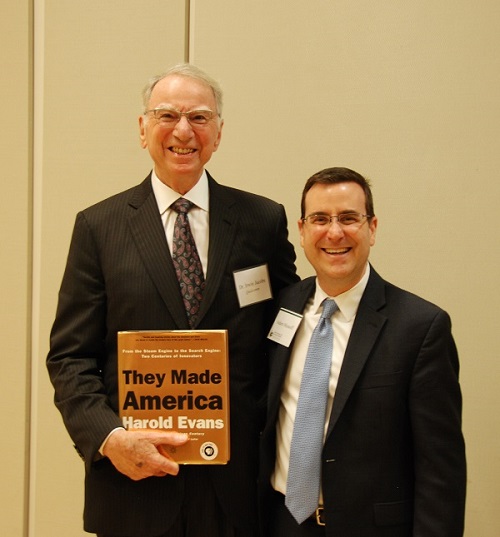
Dr. Irwin M. Jacobs with CPIP Founder Adam Mossoff

Without doubt, the highlight of our conference was the keynote address by Dr. Irwin M. Jacobs—the inventor of the digital transmission technology for cell phones that gave birth to the smartphone revolution and the founder of Qualcomm. Dr. Jacobs has been a luminary in the telecommunications industry for many years, and he delighted conference attendees with endearing stories and wonderful insights from his inventive and commercial activities over the years.

We hope you will enjoy Dr. Jacobs’ keynote address as much as we do!

The video is available here, and it is embedded below:

Categories
Innovation Inventors Patents

New “Invalidated” Documentary Highlights the Problems With the PTAB: Free Screening on October 26

a lit lightbulb hanging next to unlit bulbsBy Devlin Hartline and Aditi Kulkarni*

The “Invalidated” documentary will be screened this Friday, October 26, at 5:30 PM in Washington, D.C. To register for this free event, which features a presentation by Bunch O Balloons inventor Josh Malone among others, please click here.

Imagine that you’re a father of eight children who puts everything on the line to bring your invention to the marketplace. After a successful Kickstarter campaign that brings in close to $1 million, you protect your invention by securing several patents on the innovative technology. Your invention is a huge market success, and sales exceed your wildest dreams. When the copycats come along, you think your patent rights will protect you. After all, that’s what the patent system is for. But you quickly realize that the system is stacked against you, the lone inventor, and it instead favors the large companies that willingly violate your rights for profit.

While this horror story may sound farfetched, it’s exactly what happened to Josh Malone, the inventor of Bunch O Balloons. And the unfortunate reality is that Malone is not the only inventor to be let down by the patent system that is meant to protect inventors from unscrupulous infringers. Thankfully, Malone is not taking things lying down. Not only is he fighting for his rights in the courts and at the U.S. Patent & Trademark Office—the very Office that granted him the rights in the first place—but he also has become a vocal activist fighting to reform the patent system. In fact, Malone is now telling his story in a new documentary entitled “Invalidated.” The full video, which prominently features CPIP Founder Adam Mossoff and runs about 50 minutes long, is available at both iTunes and Amazon.

You can watch the trailer here:

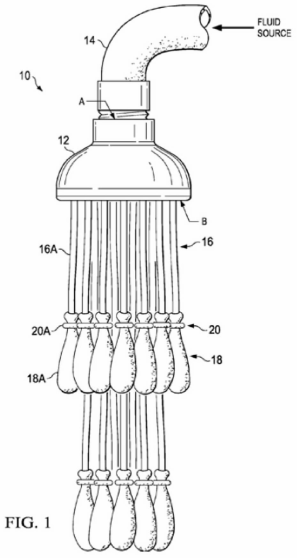
Inspired by childhood memories, Josh Malone invented Bunch O Balloons to solve a real-world problem. His invention allows anyone to fill and tie around 100 water balloons in just one minute. As a child, he spent days filling up hundreds of water balloons to play with his friends. Though he eventually stopped playing with balloons, the idea of finding a better way to play never left him. His idea finally materialized through a method to save his children’s time by filling several balloons at once. Malone burned the midnight oil perfecting his invention, and his family also invested their time and efforts backing his venture. After failing through several experiments and exhausting their savings, Malone finally succeeded with Bunch O Balloons.

Patent figure for Bunch O Balloons: fluid source leading to balloons

Ready with the product’s final prototype embodying his invention, Malone shot a video for a Kickstarter campaign to advertise his product and to raise some much-needed funds. The campaign was a hit, bringing in close to $1 million. Malone was even interviewed on the Today Show, where he got into an impromptu water balloon fight with Carson Daly. The purchase orders then started pouring in from toy manufacturers and big retailers like Walmart. They were all interested in profiting from the competitive advantage they would get from Malone’s novel—and fun—invention.

On realizing his invention’s strength and wanting to protect it from potential infringers, Malone filed several patent applications with the U.S. Patent & Trademark Office (USPTO). While the patent applications were pending, Malone came to know that a product nearly identical to his own was being advertised and sold in the marketplace under the name, “Balloon Bonanza.” Investigating further, Malone realized that Telebrands, the marketing company that originated the “As Seen On TV” advertisements, had stolen his idea and begun selling knock-off versions of his invention.

Image comparison of Bunch O Balloons versus Balloon Bonanza

Malone sued Telebrands in the Eastern District of Texas, seeking a preliminary injunction to prevent the marketer from further infringing his rights. The district court granted the injunction, agreeing with Malone that his patent was likely valid and infringed. Telebrands fought back, appealing the injunction to the Federal Circuit and again challenging the validity of Malone’s patent on indefiniteness and obviousness grounds. The Federal Circuit sided with Malone, holding that it was not clear error for the district court to conclude that he was likely to succeed on the merits. The Court of Appeals rejected Telebrands’ arguments as failing to raise a substantial question concerning the validity of Malone’s patent.

Telebrands also challenged the validity of Malone’s patent before the Patent Trial & Appeal Board (PTAB) in a post-grant review (PGR) proceeding. During the pendency of Telebrands’ appeal to the Federal Circuit on the preliminary injunction, the PTAB rendered its final written decision: Telebrands had shown by a preponderance of the evidence that Malone’s patent was invalid as indefinite. Of course, had the issue been decided in the district court, the mere preponderance standard would have been insufficient to overturn the presumably valid patent. But in the PTAB, the rules are different, and they favor challengers such as Telebrands that use the additional venue to game the system.

The Federal Circuit was well aware of the PTAB’s decision to the contrary when it upheld the district court’s determination that Malone was likely to succeed on merits in assessing the propriety of the preliminary injunction. In fact, it mentioned the PTAB proceedings in a footnote, noting that its decision was not binding and that it was nevertheless unpersuasive. When Malone subsequently appealed the PTAB loss, the Federal Circuit finally got its chance to directly address the PTAB’s decision on the merits. The Court of Appeals held that, even applying the PTAB’s more relaxed standard, Malone’s claims were not unpatentable for indefiniteness. The Federal Circuit thus made good on the earlier indications from both itself and the district court that Malone’s patent was indeed valid.

While Malone ultimately has been victorious so far, he’s been forced to spend millions of dollars protecting his rights. He reported in July of 2017 that he’d already spent $17 million, and that it might grow to as much as $50 million before it’s all through. That’s an insane amount of money for most lone inventors, and Malone is fortunate enough to have made enough revenue in sales to be able to afford it. Most people aren’t so lucky. And the battle for inventors is certainly far from over, especially when infringers with deep pockets can repeatedly play the game and wear down their victims in multiple forums. As Malone laments, “the PTAB simply encourages infringers like Telebrands to double down on the expense of litigation, rather than acquiescing to the adjudication by the District Court.”

It’s no wonder that, in his dismay, Malone joined other frustrated inventors to symbolically burn their patents outside of the USPTO in the summer of 2017. Malone’s story is a stereotype example of how the big infringers attempt to overwhelm the little guy by simply outspending them should they dare to challenge the wrong. Such gamesmanship at the expense of inventors is not the purpose of the PTAB. As Professor Mossoff notes in the documentary: “The original argument for why we needed the PTAB is that, every once in a while, there will be a mistakenly issued patent they shouldn’t have issued, and that these patents can clog the gears of the innovation economy. Unfortunately, what Congress created was a completely unrestrained, unrestricted agency whose job is to cancel patents.”

America’s Founders recognized that a stable and effective patent system is vitally important for the innovation ecosystem to thrive. American inventors like Josh Malone have made a significant difference in people’s lives, and the patent system exists to reward them for their efforts. Inventors should be able to trust that the patent system will be there to protect them when others trample on their rights. They need those rights to be meaningful in order to recoup their investments and to realize their just rewards. The Founders understood that benefiting inventors through such private gains would redound to the public benefit. But as Malone’s story demonstrates, we will need to make some changes to the patent system before the Founders’ vision can be fully realized.

*Aditi Kulkarni is working towards an LLM Degree in Intellectual Property at Antonin Scalia Law School, and she works as a Research Assistant at CPIP.

Categories
Antitrust Innovation Patent Licensing

IP for the Next Generation of Mobile Technology: How the Antitrust Division Devalued Standard-Essential Patents

In advance of our Sixth Annual Fall Conference on IP for the Next Generation of Technology, we are highlighting works on the challenges brought by the revolutionary developments in mobile technology of the past fifteen years.

hand holding a phone with holographs hovering over the screenAs we highlighted in previous posts in this series (see here and here), a 2015 policy change at the Institute of Electrical and Electronics Engineers-Standards Association (IEEE)—a standard-setting organization (SSO) for mobile technologies—placed one-sided restrictions on patent owners that have demonstrably harmed innovator participation and technological advancement.

Writing about the policy revisions, economist Gregory Sidak, the Founder and Chairman of Criterion Economics LLC in Washington, D.C., explains how the IEEE made these profound changes to its patent licensing policies with the encouragement and blessing of the Antitrust Division of the U.S. Department of Justice. The amendments were intended to ameliorate the supposed problems of patent holdup and royalty stacking, but they went much further than necessary and weakened the rights of patent owners in the process.

Despite the lack of evidence of harm from patent holdup or royalty stacking, the Antitrust Division commended the IEEE for changing its policies. Mr. Sidak notes that the Antitrust Division simultaneously turned a blind eye to the collusion of the implementers who had pushed for the changes (and who benefited from them by way of suppressed royalty obligations at the expense of the patent owners), and he argues that this course of action was a dereliction of duty on the part of the Antitrust Division to dispassionately assess the competitive implications of such concerted activity.

To read the Sidak article, which was published in the Georgetown Law Journal, please click here.

Categories
Innovation Patent Licensing

IP for the Next Generation of Mobile Technology: How Ignorance of Standard Setting Operations Hinders Innovation

In advance of our Sixth Annual Fall Conference on IP for the Next Generation of Technology, we are highlighting works on the challenges brought by the revolutionary developments in mobile technology of the past fifteen years.

hand holding a phone with holographs hovering over the screenThe development and implementation of technology standards is a complex process, and it’s one often misunderstood by commentators, courts, and government agencies. In an article detailing the Federal Trade Commission’s (FTC) misguided suit against Qualcomm for alleged unwillingness to license its patents on fair, reasonable, and nondiscriminatory (FRAND) terms, CPIP Senior Scholar Kristen Osenga exposes a pervasive ignorance of technology standards and the standard setting organizations (SSOs) that develop them.

According to Professor Osenga, the lack of sound economic evidence and evidentiary findings in the FTC’s allegations are indicative of a larger and more fundamental lack of knowledge that is negatively impacting important legal, business, and policy decisions. It’s a troubling trend that has the potential to not just hinder the development of technology standards, but innovation itself.

To read the Osenga article, which was published in the University of Louisville Law Review, please click here.

Categories
Innovation Patent Licensing

IP for the Next Generation of Mobile Technology: How IEEE’s Policy Changes Have Created Uncertainty for Innovators

In advance of our Sixth Annual Fall Conference on IP for the Next Generation of Technology, we are highlighting works on the challenges brought by the revolutionary developments in mobile technology of the past fifteen years.

hand holding a phone with holographs hovering over the screenEarlier this year, CPIP’s Adam Mossoff and Kevin Madigan detailed an in-depth empirical study on the troubling repercussions of policy changes at the Institute of Electrical and Electronics Engineers-Standards Association (IEEE).

In a rigorous study tracking the activity of creators and owners of technologies incorporated into standards by the IEEE, Kirti Gupta and Georgios Effraimidis show how policy shifts at the IEEE have required patent owners to effectively relinquish their legal right to stop the deliberate and unauthorized uses of their property. Unfortunately, as Gupta and Effraimidis explain, the current unbalanced nature of standard setting at the IEEE is resulting in inefficient licensing negotiations and delayed standards development, and it’s threatening the development of new and innovative consumer products at a crucial time for mobile technologies.

The full Gupta & Effraimidis study is available here, and the synopsis by Adam Mossoff and Kevin Madigan can be found here.

Categories
Innovation Patent Licensing

Focusing on IP for the Next Generation of Mobile Technology

hand holding a phone with holographs hovering over the screenIn advance of our Sixth Annual Fall Conference on IP for the Next Generation of Technology, the Center for the Protection of Intellectual Property will be highlighting works on the challenges brought by the revolutionary developments in mobile technology of the past fifteen years. These articles address issues related to patent licensing, standard setting in the mobile technology sector, and developing business models at the dawn of the 5G era. Contrary to the tread-worn claims that new technological developments render IP rights obsolete, these articles show how stable and effective property rights in innovative technologies continue to foster the groundbreaking advancements that benefit societies.

Much debate in the mobile technology sector has centered on recent policy changes in the standard setting organizations responsible for the development of global industry standards. In a recent paper focusing on the Institute of Electrical and Electronics Engineers Standards Association (IEEE), mobile industry expert Keith Mallinson explores the practical impact of policy changes made in 2015 by the IEEE that implemented the “patent holdup” theory by restricting the rights of owners of patents on technology that is contributed to standards.

Providing an empirical analysis of the activity of innovators of new standards technology since the 2015 change in the IEEE’s patent policy, Mallinson finds that innovators are not contributing their patents resulting from their massive investments over many years into risky research and development of cutting-edge technologies. This is evidence that the one-sided and unbalanced restrictions on innovators, and not on implementers, that were imposed by the IEEE in 2015 under the “patent holdup” theory have slowed the adoption and implementation of pioneering technologies. Mallinson explains that a more balanced and clear respect for the rights of owners of patented technologies that are contributed to standards must be restored in order to better facilitate technological advancements.

To read the Mallinson article, which first appeared on the 4iP Council website in September 2017, please click here.

Categories
Press Release

CPIP Announces Leadership Transitions

CPIP logoARLINGTON, Virginia – August 22, 2018 – The Center for the Protection of Intellectual Property (CPIP) announced today that Matthew Barblan, CPIP’s Executive Director, will leave the center this month to join the Association of American Publishers (AAP) as Vice President, Public Policy. “It has been an amazing journey working with such wonderful colleagues to build CPIP from the ground up over the past five years,” said Barblan. “I’m deeply grateful to my friends at CPIP and Scalia Law for making the center’s success possible, and I look forward to following CPIP’s growth and influence for years to come.”

Beginning on August 27, 2018, CPIP founder Adam Mossoff will become Executive Director of the center. “As a founding member of CPIP’s leadership team, Matt was absolutely essential to the success of the center over the last five years,” said Mossoff. “I will miss very much my day-to-day interactions with Matt at Scalia Law, but I’m looking forward to continuing to engage with him at future CPIP events on IP policy in his new role in representing the publishing industry.”

As part of the transition, longtime CPIP friend and senior scholar Sean O’Connor has joined CPIP as Director of International Innovation Policy. O’Connor will be an integral part of CPIP’s leadership team, focusing on law and policy issues regarding innovation and entrepreneurship, with a particular focus on international contexts.

“I’m excited about the future of CPIP, and it is a great pleasure to welcome Sean to the team,” said Henry N. Butler, Dean of Antonin Scalia Law School. “On behalf of the Scalia Law community, I also want to thank Matt for everything he has done over the past five years to take CPIP from idea to reality and build it into the successful center that it is today. Matt has been a great colleague and friend to the law school, and we wish him all the best in his new role at AAP.”

About the Center for the Protection of Intellectual Property

The Center for the Protection of Intellectual Property (CPIP) at Antonin Scalia Law School is dedicated to the scholarly analysis of intellectual property rights and the technological, commercial, and creative innovation they facilitate.

CONTACT:
Devlin Hartline
jhartli2@gmu.edu
703-993-8086

Categories
Innovation Patent Licensing

Study Finds IEEE’s 2015 Patent Policy Sowing Uncertainty and Slowing Innovation

dictionary entry for the word "innovate"By Kevin Madigan & Adam Mossoff

As the world prepares for the game-changing transition to 5G wireless systems, the high-tech industry must continue to efficiently develop and implement technologies and networks that work together across different platforms and devices. Few people are aware of how this happens, because it occurs solely between the companies who develop and implement technological products and services in the marketplace, such as Qualcomm, InterDigital, Microsoft, Apple, and others. These companies participate in private standard setting organizations, which develop technological standards agreed upon by these companies, such as three-prong electrical plugs, USB drives, hard disk storage drives, and even communications technologies such as Wi-Fi and 2G, 3G, and 4G.

In sum, the development of standards is a key part of how new technological innovations are efficiently sold and used by consumers and work for everyone. The reason standard setting organizations came into existence is because the alternative is neither efficient nor good for consumers. A standards “war” between companies in the marketplace leads to years of incompatible devices being sold while consumers wait for one company to establish (private) market dominance with its products and services such that everyone else must use that standard, such as what happened between VHS and Betamax in the 1980s or the market fight between Blu-ray Disc and HD DVD in the 1990s, to name just two examples. Standard setting organizations preempt this unnecessary and wasteful commercial war by bringing together the innovators and implementers of new technology to agree beforehand on a standard so that new standardized products and services can get into the hands of consumers faster.

Unfortunately, some standard setting organizations are changing their rules for the companies that invest hundreds of millions of dollars in long-term R&D to create groundbreaking technologies like those used in our smartphones. These new rules create uncertainty for these innovators. As a result, this uncertainty is threatening investments in new high-tech products and the ongoing growth in the U.S. innovation economy.

Detailing this troubling trend is a recently released, in-depth, and rigorous study by Kirti Gupta and Georgios Effraimidis, which tracks the changes in the rules for the creators and owners of the technologies incorporated into technological standards by one of the largest and more influential organizations—the Institute of Electrical and Electronics Engineers-Standards Association (IEEE). In 2015, the IEEE adopted a new policy governing how owners of patents on technologies incorporated into its technological standards can protect and secure their investments via their legal rights to their patents. This shift in policy required patent owners effectively to relinquish their legal right to stop deliberate and unauthorized uses of their property and thus made it harder for them to license reasonable royalties for the use of their technology equally among all industry stakeholders.

As Gupta and Effraimidis show through detailed analyses, the IEEE’s new policy has distorted the longstanding market processes and licensing negotiations that have led to billions of smartphones being sold to consumers at relatively low cost around the world over the past decade. This is a vitally important study, because it brings key data to the policy discussions about technological standards, patents, and the incredible products and services made possible by them and on which everyone relies on today.

A Quick Summary of Standard Setting Organizations and Patented Technologies

A traditional requirement of the IEEE and several other standard setting organizations is that innovators commit to license equally their patented technologies that are incorporated into an agreed-upon standard for all companies implementing this standard in products and services. The law already provides that a patent owner will receive a “reasonable royalty” as damages for any past unauthorized uses of a patented technology, and thus standard setting organizations added the contractual requirement that this reasonable royalty also be non-discriminatory. To create a pleasant-sounding acronym, the phrase used is that licensing rates for patented technologies incorporated into market standards must be fair, reasonable, and non-discriminatory (FRAND). The goal of FRAND is to ensure that all companies creating products and services that are sold to consumers in the marketplace pay the same rates for incorporating the necessary standardized technologies into these products and services, such as the standardized 4G transmission technology used by everyone’s smartphones.

About a decade ago, some professors and lawyers posited a theory based on an abstract, economic model that owners of patents on technologies incorporated into these standards could exploit their ability to seek injunctions for violations of their patents and thus impose unduly higher costs on the companies implementing these standards in things like smartphones, laptop computers, tablets, and other devices and services. It was a simple story about property owners “holding up” people who wished to use their technologies, cashing in on the ubiquitous knowledge that any property owner can post a sign that says “no trespassing.” Based on this “patent holdup” theory, which deduced from an abstract model that patent owners would demand inordinately high royalties from the companies that need to incorporate agreed-upon technological standards into their products and services, these academics argued for “reforms” in the law to stop “patent holdup.”

But the “patent holdup” theory is just that—a theory. More than a decade of rigorous empirical studies have not only failed to confirm the “patent holdup” hypothesis of systemic market failures in the patent-intensive high-tech industry, and instead have found market conditions that directly contradict the core claim of “patent holdup” theory (see here for a letter to Assistant Attorney General Makan Delrahim summarizing this research and listing many of the studies). One study has shown that the average royalty rate for key technologies used in smartphones is only 3.4%, which is contrary to the 67% royalty rate predicted by “patent holdup” theory. Another study, among others, found significant quality-adjusted drops in consumer prices of smartphones and increasing entry of new manufacturers of smartphones, as well as other market conditions in the smartphone industry, that directly contradict the predictions of “patent hold” theory.

Unfortunately, in response to lobbying and the successful pushing of the “broken patent system” narrative in Washington, D.C., antitrust regulators forged ahead at the DOJ to push for policy changes at standard setting organizations on the basis of this unproven “patent holdup” theory. (Thankfully, recent antitrust regulators have returned back to evidence-based, balanced policy-making.) Several years after the first article propounding the “patent holdup” theory was published in 2007, implementers began pushing this theory at the IEEE to effect changes in its internal patent policy, which ultimately responded to this effort by revising its patent policy in 2015.

IEEE Policy Changes for Owners of Patents on Technological Standards

As Gupta and Effraimidis explain, the IEEE’s new patent policy has been highly controversial and generated much discussion among academics and industry practitioners. Separate from what they disclose in their article, there have been allegations that the internal process at the IEEE in changing its patent policy was initially cloaked in secrecy and was not open to all IEEE members as to when meetings were held and as to what the substantive decision-making processes were at these meetings. One commentator referred to it politely as an “opaque decision-making process” by the IEEE. If true, this is very troubling given that this violates the exemption accorded to the IEEE under the antitrust laws for operating as a standards setting organization.

Essentially, the IEEE patent policy was changed in 2015 in two key ways that impacted innovators. First, the new policy prohibits a patent owner seeking an injunction until all efforts at obtaining a license fee have been exhausted, including suing and litigating to a final judicial decision awarding a reasonable royalty. This of course incentives purported licensors to drag out licensing negotiations while they are infringing the patent, imposing large costs on patent owners in having to file lawsuits and pursue their legal remedies in court for many years and who have no choice but to allow the unauthorized use of their property during this time.

Extending these negotiations then allows licensors to take advantage of the second major rule change by the IEEE in its patent policy: the policy shifts licensing rates from the longstanding, market-based licensing of the technology given the value of the consumer device to the component level of the value of the chip itself. Of course, a smartphone without 4G or Wi-Fi is a beautiful 1995 cell phone with a very pretty, colorful screen and nothing more, which is why the free market settled on the value added to the entire smartphone for the basis of the licensing rate for this standardized technology. Moreover, calculating royalty rates based on the very cheap computer chips that contain the valuable technology fails to account for the hundreds of millions of dollars in R&D investments in developing the technology in the first place. Again, this is why the arrangement first reached in the free market between innovators and implementers was a balanced approach in device-level licensing rates that accounted for the costs of R&D and the costs of manufacturing the smartphones that contained the technology derived from this R&D. As a recent empirical study has shown, this is approximately 3.4% per smartphone, which is anything but an example of a massive payment to patent owners on 4G or Wi-Fi, especially for these core technologies that make a cell phone a “smartphone.”

Why then did IEEE change its patent policy? Consistent with the concerns about the “opaque decision-making process” at the IEEE, economist Greg Sidak has identified how the new rules were drafted by an ad hoc committee at the IEEE dominated almost entirely by implementers who license the patented technologies from the innovators who develop and contribute these technologies to the standard-setting process. In effect, the licensees strategically dominated the process and used their clout to push through a policy change that devalued the patented technologies, because they were seeking to lower their own manufacturing costs in implementing this technology in the consumer products and services they manufacture and sell in the marketplace. As evidence, Sidak shows that comments submitted in opposition to the new rules were rejected at nearly double the rate of those in support, reflecting a process that betrayed the IEEE’s core principles of openness, consensus, and the right to appeal. Instead of alleviating any alleged problems caused by patent owners, the IEEE’s rule changes actually facilitated collusion among implementers and resulted in “buyer-side price-fixing” of the patented technologies.

Negative Impact on Contributions of New Technology to Standards at the IEEE

The heart of the Gupta and Effraimidis article is not the theoretical and empirical background to the “patent holdup” dispute, but a detailed empirical study of the impact the new IEEE patent policy has had on the standard development process. Focusing on IP-intensive standards related to the development of Wi-Fi and Ethernet networks, the study first looks into the number of Letters of Assurances (LoAs) submitted to the IEEE in the years before and after the patent policy change took effect.

(LoAs are documents submitted by inventing companies who contribute new technological innovation in the standard-setting process. These technology contributors have patents on these innovations, and in these LoAs, they identify what patents may be essential to the standard that is being developed and they identify the terms under which they’re willing to license this technology if it ends up being incorporated into the standard that is ultimately set by the standard setting organization. An LoA is labeled “positive” if the contributor agrees to license its technology under the patent policy set by the standard setting organization or “negative” if the contributor declines to commit to these terms.)

The Gupta and Effraimidis study found that the number of positive LoA submissions has dropped a whopping 91% since IEEE changed its patent policy in 2015 and the number of negative LoAs rose to an all-time high in 2016. Gupta and Effraimidis explain:

The results suggest that many [patent] owners are reluctant to license their patent portfolio on the new FRAND terms. More importantly, the uncertainty on implementers’ side has increased, as new standards . . . have been approved despite the presence of negative and/or missing LoAs . . . .

Their article also tracks changes in the duration of the comments period that takes place before a new standard is approved—this is the period of time during which IEEE members discuss, debate, and resolve any concerns about a standardized technology before it is ultimately adopted as an official standard by the IEEE. Before the IEEE’s new patent policy went into effect in 2015, the average duration of the first two rounds of comments was 233 days. After the new patent policy took effect, Gupta & Effraimidis found a 42.5% increase in the comment period duration, resulting in an average resolution time of 332 days. This increase by almost half in the standard-setting process, especially in an industry marked by rapid development of new smartphones, laptops, and other high-tech consumer products and services, is concerning, to say the least. These delays are wasting private as well as public resources and impeding the commercial development of important IP-intensive technologies.

Finally, the Gupta and Effraimidis study analyzes the change in the number documents submitted at the IEEE that trigger the development of a new standard technology, which is a proxy for the development of new standards by the IEEE. Here, Gupta and Effraimidis’ findings contradict another recent study that alleged a high number of submissions in 2016 reflected a positive impact of the IEEE’s new patent policy. Gupta and Effraimidis reveal that hundreds of the submissions counted in the prior study either came from standards for which no patented inventions were contributed or were for standards of little or no value. Focusing properly on submissions for technologies that have significant value and produce an overwhelming majority of IEEE standards, they find submissions of new standards documents have in fact declined by 16% since 2015.

In sum, the changes in the internal standard-setting process at the IEEE since it adopted its new patent policy in 2015 represent a concerning shift following a strategic and collusive effort by implementers to devalue the patented technology created by innovators and contributed to standard setting organizations like the IEEE. The evidence is slowly building, showing that the IEEE’s new patent policy has devalued the innovative activity of technological innovators based on a purely theoretical and unproven claim that there is a systemic problem with so-called “patent holdup” in the smartphone and other high-tech industries. Unfortunately, in leaping into action on the basis of unproven theories, the IEEE has contributed to pervasive uncertainty and weakened incentives in the development and commercial implementation of innovative technologies, as is increasingly being documented and discussed by legal scholars and economists.

Moving Forward

The Gupta and Effraimidis study analyzes for the first time empirical data in fully detailing the effects of the IEEE’s new patent policy on the standard setting process. Their study shows that innovators are unwilling to continue to contribute the technologies they develop to the standard setting process under onerous terms requiring them effectively to give up their legal rights to their patents, and that these policies are having a perverse effect in creating inefficient licensing negotiations and delayed standards development. Their findings may sound intuitive to patent lawyers and innovators, but it is imperative to bring data into the public policy debates after ten years of concerted efforts to implement unproven theories, such as “patent holdup” theory, in both law and in the policies of private organizations like IEEE.

Gupta and Effraimidis conclude that a proper patent policy for a standard setting organization like the IEEE “should enhance incentives of technology contributors to innovate, while ensuring unlimited access to the new technology standards.” In considering its key role as a long-time professional association for the high-tech industry reaching back to Nikola Tesla and Thomas Edison, as well as its key role as standard setting organization in the innovation economy, the IEEE hopefully will reconsider its patent policy in light of actual economic and legal evidence. It should return back to the balanced patent policy that successfully promoted the computer and mobile revolutions of the past four decades. The future of new and innovative consumer products is at stake, such as the 5G technology that was first being developed many years ago and will start to be introduced into consumer products in the coming year.

Categories
Copyright International Law

Will the EU Finally Hold Internet Giants Accountable?

gold 3D copyright symbolOn July 5th, the European Parliament will vote on a draft of the Copyright Directive for the Digital Single Market that has major implications for the future of copyright law in the European Union and beyond. At the center of the debate is Article 13, a provision that would require online platforms that feature user-generated content to screen uploads for infringing material. It’s a measure that represents a significant update to standards of accountability in the digital age, and it’s one that’s now necessary to combat the continual devaluation of creative works and to ensure the survival of essential creative ecosystems.
In the weeks and months leading up to the vote, advocates for Article 13’s defeat have become increasingly vocal in their opposition to the proposal. An overwhelming amount of those attacking Article 13 have resorted to fear-mongering and misinformed hyperbole. Detractors’ claims include everything from the ridiculous—insisting Article 13 will outlaw memes—to the clichéd—that efforts to impose platform accountability amount to censorship and will “break the internet.”

Fixing Outdated Safe Harbors and the YouTube Value Gap

Chief among opponents’ complaints is that Article 13 would destroy the safe harbors that guarantee platforms will not be liable for infringing content uploaded without their knowledge. At the turn of the century, the Digital Millennium Copyright Act in the US and E-commerce Directive in Europe included safe harbor immunities as a way to encourage the development of the internet and the companies that were leading the way in online innovation. But these protections were never meant to be sweeping get-out-of-jail-free cards that encourage platforms to ignore infringing activity.

What’s become clear is that the immunities granted to tech giants through safe harbors haven’t properly incentivized them to stop profiting from illegal activity. These once-nurtured companies are now the most powerful and wealthy entities in the world, and business models based on the unauthorized distribution of protected works must be challenged.

Making matters worse is the fact that mechanisms meant to give creators and copyright owners a way to fight infringement have fallen short. Notice and takedown is an ineffective weapon against the incessant uploading of unauthorized content, and safe harbors allow online intermediaries to repeatedly turn a blind eye to—and profit from—massive amounts of copyright infringement occurring on their platforms.

The failure of procedures like notice and takedown are nowhere more apparent than on YouTube, where the futility of artists’ efforts to fight infringement has led to an inability to be fairly compensated for the exploitation of their works. When YouTube rose to prominence as the most popular streaming platform in the world—offering up free illegal streams of thousands of popular songs and movies—copyright owners quickly realized the law left them powerless to hold YouTube accountable for being a clearinghouse of stolen creative works.

This lack of control for creators combined with YouTube’s market dominance has created a “value gap” which leaves artists in a lose-lose predicament where they must choose between the meager compensation YouTube offers and nothing at all. Furthermore, legitimate streaming platforms are forced to compete with YouTube’s enormous and popular black market. Sadly, efforts similar to  the current campaign against the EU Copyright Directive have enabled this market dysfunction to persist for over a decade.

A Campaign of Misinformation

Despite the Copyright Directive’s effort to clarify safe harbor qualifications and correct a glaring inequality, opponents of Article 13 insist content filtering provisions will result in censorship and destroy the internet as we know it. It’s a campaign that is recycling the same scare tactics and wild assumptions that seem to arise whenever there is an attempt to inject accountability in cyberspace.

A recent article by a leading European IP law expert takes many of these accusations to task, pointing to language in Article 13 that ensures a balancing of rights and interests through the introduction of exceptions and limitations by Member States “irrespective of whether the value gap proposal is adopted or not.” Article 13 clarifies that systems to prevent misuse or undue limitations to the exercise of exceptions must be adopted by Member States to ensure fundamental rights and freedom of expression are not compromised. The inclusion of carve outs and provisions that empower Member States to prohibit any behavior approaching censorship renders these doomsday “end of the internet” allegations baseless.

Additionally, the article explains that the current legal framework developed by the Court of Justice of the European Union (CJEU) has already been moving towards addressing the value gap, and Article 13 “would not represent a dramatic shift from the way in which the law has developed up till now.” The article points out that safe harbor protections under Article 14 of the E-Commerce Directive are only available to passive service providers who act as true intermediaries, and that hosting services who make unauthorized communications to the pubic are already precluded from safe harbor immunity.

So why would organizations who support tech giants spread misinformation and falsehoods about the contents of Article 13 and its repercussions? Unfortunately, it’s a strategy they’ve employed again and again whenever there is an initiative to implement responsibility and accountability online. By taking a reasonable bill or legislative effort and painting it as an attack on fundamental rights and freedom of expression, they have been able to drum up hysteria and knee-jerk reactions from those who may not fully understand the issues. It’s a formula that has worked to defeat sensible reform in the past, but it must be called out for what it is.

Accountability and Respect for Creation

Artists and representatives of the creative industries have weighed in on the proposals, explaining that content filtering isn’t just about protecting their livelihoods, but ensuring that the next generation of creators can flourish in a system that values and respects their contributions. A recent article criticizing Article 13 complained that there is no incentive for the public to welcome the implementation of content filtering. But this argument misses the point. Increasing accountability for internet giants who profit from infringement is an opportunity for the public to show that it values creative works, artists, and those responsible for bringing creative content to consumers.

It’s also an opportunity for the public to hold accountable companies and organizations that routinely behave as if they are above the law. When it comes to issues of increased accountability for their actions, internet giants have been able to trick the public in the past with misinformation campaigns similar to the one being waged against the Copyright Directive, but there is a growing tide of frustration with these deceptive practices, and the public should wake up and demand change.

As the European Parliament goes to vote on the Copyright Directive, it’s essential that parliament members, stakeholders, and the public understand what’s at stake. Recent events around the world have challenged notions of what is expected from the tech giants that have become the gatekeepers of the digital age, and it’s past time that they face responsibility for enabling and profiting from the theft of creative works. The future of creativity depends on it.

Categories
Legislation Patent Law Uncategorized

Rep. Massie Introduces New Legislation to Restore America’s Patent System

dictionary entry for the word "legislation"Yesterday, Representative Thomas Massie introduced the Restoring America’s Leadership in Innovation Act of 2018 (H.R. 6264). This legislation would reverse many of the harms that have been caused by recent changes to the patent laws from all three branches of government. Patents are an important part of our innovation economy, providing an incentive for inventors to invent and protecting those creations for commercialization and investment.

Unfortunately, the past decade has witnessed the gradual weakening of our patent system. The America Invents Act (AIA) created new post-issuance methods for reviewing patent validity on top of the review that already occurred in federal courts. The Supreme Court has handed down case after case weakening patents and excluding broad swaths of innovation from the patent system entirely. The USPTO, through the Patent Trial and Appeal Board (PTAB), has been systematically invalidating worthwhile patents based on flawed procedures that are easily abused. Together, these changes have done substantial damage to our innovation economy.,

This new bill will reverse many of these recent changes. Although some of the proposals are new, most are merely the codification of what had long been the law for the patent system. The following provides a breakdown of the most important sections of this legislation:

    • Section 3 (the first substantive section), returns the United States to a first to invent patent system. As noted by CPIP Founder Adam Mossoff, giving patents to the first inventor rewards the intellectual labor that results in the invention. This conception of patents as private property rights protecting the innovator’s creation is arguably required by the Patent Clause of the Constitution, and thus, this Act will bring patent laws back within constitutional limits. Conversely, a first to file system merely rewards those who can win a race to the Patent Office.
    • Section 4 abolishes Inter Partes Review (IPR) and Post-Grant Review (PGR). In addition to covered business method review, which was created with a sunset provision, these procedures allow the Patent Office to cancel at patent it has previously issued. Numerous scholars have identified the substantial harms caused by the PTAB. The problems have been so extensive that other legislation focused on trying to fix these procedures has been introduced. This bill goes the necessary next step. Because these procedures fundamentally undermine the status of patents as private property, the bill eliminates IPR and PGR entirely.
    • Section 5 abolishes the PTAB. The PTAB is a terrible example of regulatory overreach. In light of the elimination of IPR and PGR and the return to a first to file system, the creation of the PTAB by the AIA to administer these systems serves no purpose. The legislation instead recreates the Board of Patent Appeals and Interferences, which existed prior to the AIA and handled the administrative appeals and trials that occurred under the prior system. This change also overrules the holding of Oil States v. Greene’s Energy and accomplishes legislatively the outcome of a CPIP led amicus brief in that case.
    • Section 6 eliminates fee diversion and provides for full funding of the USPTO. Innovators and the public alike count on the USPTO to perform timely, quality examinations of patent applications in the first instance. Ensuring that adequate resources are available for this purpose is essential, particularly given that applicants pay fees to the USPTO for precisely this purpose.
    • Section 8 is mainly technical to assure that the restored § 102 retains the one-year grace period and that certain disclosures by the inventor do not become prior art.
    • Section 9 reestablishes the previously long-held status of patents as a property right. The Constitution secures a patent as a property right and many scholars have noted the important implications of treating patents as property. This section not only states that a patent is a property right, but confirms that a patent may only be revoked in a judicial proceeding, which has substantial benefits, unless the patent owner consents to another procedure. This reverses the broad reasoning in Oil States. The parts of this section returning to patent owners the right to control their property also largely overturn Impression Products v. Lexmark International, now allowing patent owners to exclude unlicensed users from their supply chains.
    • Section 10 ends the automatic publication of patent applications. This change will allow applicants to keep their inventions secret until they have the security that comes with an issued patent.
    • Section 11 codifies the details of the presumption of validity and available defenses to patent infringement. For the first time, this will enshrine in statute that the “clear and convincing standard” must be used to invalidate a patent. Additionally, this section provides for tolling of the patent term during litigation challenging the patent’s validity.
    • Section 12 confirms that injunctions are available to protect the patent property. Although not explicit, the new statutory presumption that infringement of patent causes irreparable harm largely abrogates the Supreme Court’s decision in eBay, which dramatically limited the availability of injunctions. Furthermore, having this rule placed into the statute will limit the inter-court variability that has led to inconsistent outcomes.
    • Section 13 restores the possibility of invalidating a patent for failure to comply with the best mode requirement.