Categories
Innovation Patent Law Uncategorized

Federal Circuit Improperly Extends Abstract Idea Exception to Industrial Machines

a gavel on a table in front of booksAn oil well drilling rig is not an abstract idea. A method of operating an oil well drilling rig is also not an abstract idea. This proposition should be clear to all, but in TDE Petroleum Data Solutions v AKM Enterprise, the Federal Circuit held that a method of operating an oil well drilling rig is directed to the abstract idea of “storing data, receiving data, and using mathematics or a computer to organize that data and generate additional information.”

Section 101 of the Patent Act has been interpreted to prohibit the patenting of abstract ideas, laws of nature, and natural phenomena. Although recent Supreme Court cases have universally found the patents at issue ineligible, Bilski, Alice and Mayo cite approvingly to a previous Supreme Court case, Diamond v. Diehr, which found a process for molding rubber articles with the aid of a computer to be patent eligible.

Alice and Mayo established a now-famous two-part test to determine whether a patent claims ineligible subject matter. The first step of the Alice/Mayo test asks whether the claim is “directed to” one of the prohibited categories. The second step asks whether the claim involves an “inventive concept” sufficient to confer patent eligibility. The Federal Circuit has applied this test with ruthless efficiency to invalidate patents, although sanity is slowly returning as the court has upheld patents improving computer animation of faces and the preservation of liver cells.

Unfortunately, the Federal Circuit rarely compares the facts of the cases before it to controlling Supreme Court precedent. The clear similarity between the claims to operating an oil well drilling rig in TDE and the claims to curing rubber in Diehr show how far off course the Federal Circuit has veered in interpreting section 101.

In Diehr, the claimed method used a computer to precisely control a rubber molding process. The computer allowed the inventors to measure and recalculate the time to cure the rubber while it was in the mold. At the end of the method, a rubber article was produced. In TDE, the claimed method used a computer to control the drilling of an oil well. The computer permitted the inventors to accurately determine the state of the well operation. Different claims provided for different ends of the method, including adjusting the operation of the drill (claim 30) and selecting the state of the well operation (claim 1).

A side-by-side analysis of representative claims from TDE and Diehr at the bottom of this post shows exactly how similar they are. Each claim recites (1) an industrial process that uses (2) initial data combined with (3) newly collected data that is (4) analyzed to (5) improve the output or operation of the industrial process.

It is worth repeating: in both Diehr and TDE, the claims were directed to an industrial process. The general industrial processes existed previously in the art. Molding rubber using the defined equation was well known. Drilling an oil well with consideration of the state of the well operation was known. The contributions in both Diehr and TDE were the addition of data collection and analysis to improve the operation of the industrial process. Neither portion of the Federal Circuit’s analysis in TDE cites to Diehr, let alone analyzes the obvious similarities between the claims at issue and those found patent eligible by the Supreme Court.

In a single paragraph of analysis regarding step one of the Mayo/Alice test, the Federal Circuit held that claim 1 of the TDE patent was directed to the abstract idea of “storing data, receiving data, and using mathematics or a computer to organize that data and generate additional information.” It completely ignored parts of the claim that required the data to be collected from an oil well drilling operation and to be used for the oil well drilling operation. Of course, ignoring these parts of the claim was required to find that the claim was directed to an abstract idea of data manipulation.

Also taking only a single paragraph, the Federal Circuit’s analysis of Mayo/Alice step two was similarly devoid of engagement with the explicit claim requirements of an oil well drilling operation. Instead, it focused only on what the computer was doing in the process, rather than the process as a whole. Diehr, along with many other cases, explicitly requires that the process be considered as a whole in the section 101 analysis.

The Federal Circuit’s error here is worse than it was in Ariosa v. Sequenom. In Ariosa, the court engaged with the closest factual Supreme Court precedent, although it felt bound by Mayo to find the claims ineligible. However, the court in TDE completely ignored and disregarded Diehr, the Supreme Court case that aligns in both law and fact with the claims at issue. Had the court analyzed or considered Diehr, it is likely the outcome would have been different.

To the extent that one asserts the final method of utilizing the data distinguished claim 1 in Diehr from claim 1 in TDE, dependent claim 30 of the patent at issue in TDE cured this defect. Claim 30 recites: “[t]he method of claim 1, further comprising using the state of the well operation to evaluate parameters and provide control for the well operation.” (emphasis added). Thus, the patent in TDE explicitly claimed the actual operation of the industrial machinery, just as the claim in Diehr.

The Federal Circuit stated that it was not considering separately the remaining claims of the patent, ostensibly because TDE did not “distinguish those claims from representative claim 1.” On the contrary, TDE argued claim 30 and related claims separately on precisely the ground that claim 30 “closed [the] loop” and required control of the well.

At this point, it is clear that neither the Federal Circuit nor the Supreme Court are going to step in to fix the wayward path of patent eligibility law. It will therefore be up to Congress to affirm what should be apparent to all: an oil rig is not an abstract idea.


Diehr – Claim 1* (US Application No. 05/602,463) TDE – Claim 1 (US Patent No. 6,892,812) Analysis
1 – Preamble A method of operating a rubber-molding press for precision molded compounds with the aid of a digital computer, comprising: An automated method for determining the state of a well operation, comprising: Both claims are directed to industrial processes where the underlying process (rubber molding or oil well drilling) existed prior to the invention
2 – Initial Data providing said computer with a database for said press, including at least,

natural logarithm conversion data (ln),

the activation energy constant (C) unique to each batch of said compound being molded, and

a constant (x) dependent upon the geometry of the particular mold of the press,

storing a plurality of states for a well operation; Both claims require data to be provided prior to operation of the method to interpret data collected.
3 – New Data Collection initiating an interval timer in said computer upon the closure of the press for monitoring the elapsed time of said closure,

constantly determining the temperature (Z) of the mold at a location closely adjacent to the mold cavity in the press during molding,

constantly providing the computer with the temperature (Z),

receiving mechanical and hydraulic data reported for the well operation from a plurality of systems; Both claims require collecting data from sources that are specific to the machinery being operated. Therefore, both claims require specific machinery, not just a general purpose computer.
4 – Data Analysis repetitively calculating in the computer, at frequent intervals during each cure, the Arrhenius equation for reaction time during the cure, which is

ln v = CZ + x

where v is the total required cure time,

repetitively comparing in the computer at said frequent intervals during the cure each said calculation of the total required cure time calculated with the Arrhenius equation and said elapsed time, and

and determining that at least some of the data is valid by comparing the at least some of the data to at least one limit, the at least one limit indicative of a threshold at which the at least some of the data do not accurately represent the mechanical or hydraulic condition purportedly represented by the at least some of the data; and when the at least some of the data are valid, based on the mechanical and hydraulic data, Both claims analyze the data.

Although not apparent on the face of the claims, the underlying data analysis existed in the art for both claims. The Arrhenius equation was well known. Validating well drilling data against a limit was known in the art although its usefulness was disputed.

5 – Utilizing the Data opening the press automatically when a said comparison indicates equivalence. automatically selecting one of the states as the state of the well operation. Both claims use the data generated in the industrial process. Selecting an individual state of a well operation in a necessary component of operating the well.

*Claim 1 is representative for both the application in Diehr and the patent in TDE.

Categories
Innovation Inventors Uncategorized

New CPIP Report: The Global Patent Pendency Problem

dictionary entry for the word "innovate"Why are some of the biggest fights about patent policy almost pointless in some places? Because in many countries, including some of the world’s most important emerging economies, it takes so long to get patents that the rights have little meaning.
The Center for the Protection of Intellectual Property (CPIP) released a report today entitled The Long Wait for Innovation: The Global Patent Pendency Problem. For the first time, this report documents a growing global problem of patent backlogs, which has long been the subject of anecdotal complaints.

In many countries, processing times are eating up much of the 20 year lifespan of patents. Patent offices are failing to keep up with the growth of the innovation economy and the resulting growth in patent applications. It’s a basic governance problem that threatens to undermine the global patent system.

Some of the report’s more surprising findings:

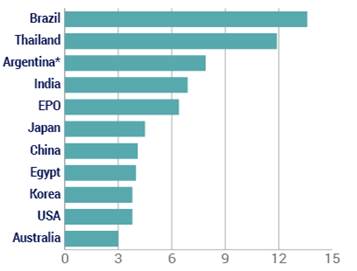
  • It now takes over 14 years on average to get a patent for mobile technology in Brazil. That goes back to days of flip-phones and the infancy of 3G!
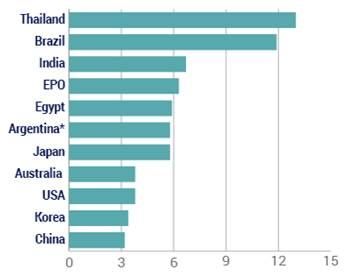
  • In Thailand, it takes more than 16 years on average to get a life sciences patent. In fact, Thailand regularly issues patents with mere months or weeks of life left before expiration.

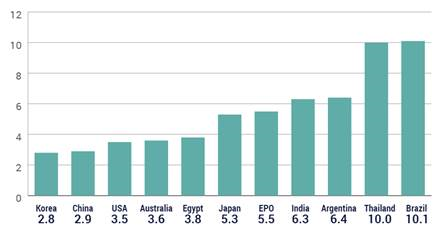
The news isn’t all bad. Japan has become much faster at examining patents in recent years. The U.S. still does a pretty good job — but it’s not the fastest. Interestingly, new leaders in global innovation are emerging, as Korea and China both now examine patents more promptly than the US.

Here are some further details from the new report.

Figure 1 below shows the average granted application age for selected countries 2008-2015 (in years).

patent-pendency-figure-1: Korea 2.8; China 2.9; USA 3.5; Australia 3.6; Egypt 3.8; Japan 5.3; EPO 5.5; India 6.3; Argentina 6.4; Thailand 10.0; Brazil 10.1

Also, our study finds that with regard to specific industries:

  • The issue of lengthy pendency times for patent applications is not confined to cutting edge industries.
  • Lengthy pendency is an issue for both the high tech and life sciences industries.
  • In many industries, some countries’ average wait times render patents largely futile.

Figure 2: Average age of granted life sciences patents 2011-2015 (in years).

patent-pendency-figure-2: China a little above 3; Korea a little farther above 3; USA and Australia around 4; Japan and Argentina closely under 6; Egypt just under 6; EPO slightly beyond 6; India about 7; Brazil just under 12; Thailand around 13

Figure 3: Average age of granted mobile technology patents 2011-2015 (in years).

patent-pendency-figure-3: Australia at 3; USA and Korea about 4; Egypt and China slightly beyond 4; Japan about 4.5; EPO a bit beyond 6; India about 7; Argentina about 8; Thailand just under 12; Brazil around 13.5

The Long Wait for Innovation: The Global Patent Pendency Problem

To read the report, please click here.

Categories
Copyright Infringement Uncategorized

Content Thief Turned Content Creator Rails Against Piracy

Cross-posted from the Mister Copyright blog.

cameraLast week, YouTube celebrity (yes, that’s a thing now) Olajide “JJ” Olatunji posted an expletive-filled tirade aimed at those illegally downloading his new movie “Laid in America.” After fans of Olatunji (aka KSI), whose YouTube page has over 14 million subscribers, began notifying him of the film’s availability on a number of illicit torrent sites, he lashed out at the people pirating the film, listing the many legal services offering his work, and explaining – in not so subtle terms – how illegally downloading the film hurts all who contributed to its creation. Some commenters were quick to point out that Olatunji himself used pirated software to create the very videos that made him famous. But while Olatunji readily admitted his outburst was somewhat hypocritical, the dramatic rant speaks to an important aspect of the nature of piracy: The extensive damage caused by the illegal downloading of creative works often isn’t appreciated by those unfamiliar with all that goes into producing them.

Illegally downloading creative content online is all too easy. Unlike stealing a physical product from a store, there’s no need to stealthily conceal the merchandise, avoid security guards, or worry about magnetic security tags. A user can visit any number of torrent sites, simply click on a title, and wait for the work to download. The ease and perceived absence of repercussions for illegally downloading content has been perhaps one of the biggest impediments to quelling the massive amount of piracy that continues to saturate the Internet. Unfortunately, it’s a mindset that seems to be ingrained in a younger generation of Internet users: How could something so easy and consequence-free be bad?

Even if some users realize that sharing pirated copies of music, movies, TV shows, or software is wrong and illegal, they often don’t understand why. A common narrative among those distributing illicit copies of copyrighted works is that movie studios or record labels are corrupt and already making enough money, and that illegally downloading a film or album won’t affect the entertainment business in the long run. Then there’s the exposure myth. It goes something like this: If I share this album with all my friends, the band will gain more fans and the fans will go see them live and buy their t-shirts. It’s a cute idea, but artists can’t live on exposure. Take their word for it herehere, and here.

Others just don’t understand all that goes into making an album, show, or film. They believe that when they pay for a movie, the money goes to an already wealthy actor, musician, or big studio executive. While portions of the proceeds certainly do, the money is also paying the salaries of the hundreds and sometimes thousands of people behind the scenes, without whom the work could never be created. As Olatunji so eloquently clarifies:

I’m not the only one that made this movie. There were hundreds, and hundreds, and hundreds of people that made this movie. Because it’s not just me you’re f*cking over. You’re f*cking over so many people. You’re f*cking over the producer, director, actors, people who did the music in the film, the cameramen, the lighting crew, the set crew. No, but seriously, it’s f*cking ridiculous.

A seasoned anti-piracy advocate couldn’t have said it any better.

The point is that the entertainment and copyright-based industry is larger and comprised of so many more components and workers than most realize. A 2014 report by the International Intellectual Property Alliance details the contribution copyright industries make to the United States GDP, quantifying the value at over 1.1 trillion dollars. The study found that copyright industries “make up an increasingly large percentage of value added to GDP; create more and better-paying jobs; grow faster than the rest of the U.S. economy; and contribute substantially to U.S. foreign sales and exports, outpacing many industry sectors.”

Illegal distribution of copyrighted works threatens much more than the pocketbooks of successful artists and executives. The fact that proponents of a “free” Internet and those engaged in piracy either don’t realize or refuse to acknowledge the far-reaching effects of stealing creative works is troublesome. The passion of Olatunji’s appeal to his fans and those stealing his movie speaks volumes about the misconceptions surrounding piracy and how a little insight into the creative process can make things so clear. Respect for creative processes shouldn’t be an abstract concept, and if more creators and celebrities lend their voice to educating the public, art and entertainment will flourish.

Categories
Copyright Uncategorized

Second Circuit Brings Some Sanity Back to Transformative Fair Use

the word "inspiration" typed on a typewriterThe Second Circuit handed down an opinion in TCA Television v. McCollum earlier this week holding that a play’s inclusion of Abbott and Costello’s famous “Who’s on First?” routine was not transformative fair use. Given how expansive transformativeness has become lately, especially in the Second Circuit, the opinion is somewhat surprising. What’s more, it’s not clear that the appellate court even needed to reach the fair use issue since it held for the defendants on the alternate ground of lack of ownership. If anything, it appears that this particular panel of judges went out of its way to push back on—and bring some much-needed sanity to—transformative fair use doctrine in the Second Circuit.

The play at issue, “Hand to God,” features an introverted boy named Jason who communicates through his alter ego sock puppet named Tyrone. In order to impress a girl, Jason and Tyrone perform over one minute of the “Who’s on First?” routine, with Jason as Abbott and Tyrone as Costello. The plaintiffs, including Abbott and Costello’s heirs, sent the defendants, producers and author of the play, a cease and desist letter. When the defendants refused to remove the scene from the play, the plaintiffs sued for copyright infringement. On the first fair use factor, which looks at the “purpose and character of the use,” the district court held that Jason/Tyrone’s almost-verbatim recitation of the heart of the “Who’s on First?” routine was “highly transformative”—so transformative that it was “determinative” of fair use.

The standard for transformativeness, which comes from the Supreme Court’s opinion in Campbell v. Acuff-Rose, looks at “whether the new work merely ‘supersede[s] the objects’ of the original creation” or whether it “instead adds something new, with a further purpose or different character, altering the first with new expression, meaning, or message[.]” The district court held that “Hand to God” used “Who’s on First?” for a different—and thus transformative—purpose, namely, to proffer a “darkly comedic critique of the social norms governing a small town in the Bible Belt.” While Abbott and Costello’s routine was standard vaudevillian fare, the district court reasoned that the play used it for a more dramatic purpose.

The Second Circuit rejected the district court’s conclusion, pointing out that “the critical inquiry is whether the new work uses the copyrighted material itself for a purpose, or imbues it with a character, different from that for which it was created.” In other words, it’s not enough for “Hand to God” to have a different purpose than “Who’s on First?” The issue is whether “Hand to God” used “Who’s on First?” for a different purpose than Abbott and Costello used the routine. The Second Circuit held that it did not: “The Play may convey a dark critique of society, but it does not transform Abbott and Costello’s Routine so that it conveys that message.”

The disagreement between the district court and the Second Circuit is subtle, yet important. The lower court determined that having Jason/Tyrone recite the “Who’s on First?” routine was transformative because it gave the audience a glimpse into Jason’s psyche. Whereas Jason is seemingly kind and soft-spoken on the surface, it becomes clear through his sock puppet persona Tyrone that there’s much murkiness beneath. And to the extent that Jason/Tyrone’s recitation of “Who’s on First?” is comedic, the district court thought that the “audience laughs at Jason’s lies, not, as the Plaintiffs claim, simply the words of the Routine itself.”

By contrast, the Second Circuit held that this “reasoning is flawed in that what it identifies are the general artistic and critical purpose and character of the Play.” Moreover, the district court failed to identify how the “defendants’ extensive copying of a famous comedy routine was necessary to this purpose, much less how the character of the Routine was transformed by defendants’ use.” The Second Circuit’s approach here recognizes that fair use is premised upon necessity, that is, there needs to be a justification for copying the specific original work. In this case, the point of having Jason/Tyrone recite “Who’s on First?” was to demonstrate that Jason was lying when he later claimed to have written it. But that could have been accomplished by using any recognizable work.

As the Second Circuit noted, “the particular subject of the lie—the Routine—appears irrelevant to that purpose.” And as such, the defendants’ use of “Who’s on First?” had “no bearing on the original work” and lacked the required “justification to qualify for a fair use defense.” This reasoning sounds very close to requiring the copyist to comment upon the original, a principle that, for better or worse, was rejected by the Second Circuit in Cariou v. Prince. Indeed, the appellate panel here mentioned Cariou, noting that, “although commentary frequently constitutes fair use, it is not essential that a new creative work comment on an incorporated copyrighted work to be transformative.” Nevertheless, the Second Circuit easily distinguished Cariou since there the artist at least changed the original work.

The Second Circuit’s opinion is a refreshing reminder that, despite what some would prefer, not everything arguably-transformative is transformative fair use. If the defendants wanted to use a copyrighted work within the play, the proper course would have been to negotiate a license or to not use the work at all. And given the way “Who’s on First?” was used within the play, there was certainly no shortage of alternatives that could have sufficed. It’s also nice to see that some judges in the Second Circuit are skeptical of cases like Cariou, which the panel here referred to as “the high-water mark of our court’s recognition of transformative works.” The panel also rightfully noted that an overly-expansive view of transformativeness threatens a copyright owner’s exclusive right to prepare derivative works. And the fact that this push-back is coming from within the Second Circuit makes it all the more interesting.

Categories
Copyright Uncategorized

WALA and Arts & Entertainment Advocacy Clinic Hosting Copyright Clinic and Panel

cameraScalia Law’s Arts & Entertainment Advocacy Clinic and Washington Area Lawyers for the Arts (WALA) are hosting a Copyright Clinic and Panel on the evening of Tuesday, November 1st, 2016, at the law school.

The event, which is free and open to the public, will give local artists, authors, and photographers the opportunity to join Arts & Entertainment Advocacy Clinic students and attorneys for a discussion on important copyright issues. The Clinic students and attorneys will answer questions on a range of issues, including the unauthorized use of photographs and the notice-and-takedown system under the Digital Millennium Copyright Act.

If you would like to attend the event, please register here: Copyright Panel Registration. The event will be held from 7 P.M. to 8:30 P.M. in Hazel Hall, Room 215, of the Arlington campus at George Mason University. For directions, see http://www.law.gmu.edu/about/directions.

We hope you will join us!

Categories
FTC Patent Law Uncategorized

FTC’s PAE Study Makes Unsupported Recommendations

Washington, D.C. at nightThe FTC released its long-awaited study of so-called patent assertion entities, or PAEs, today. As many predicted, the FTC makes several broad recommendations for substantive and procedural reforms. The problem with this, however, is that the study was not designed to reveal the sort of data that could support such policy recommendations.

The FTC itself even admitted this. When seeking approval from the Office of Management and Budget (OMB) to go ahead with the study, the FTC explained that its findings “will not be generalizable to the universe of all PAE activity.” In another submission to the OMB, the FTC acknowledged that “the case study should be viewed as descriptive and probative for future studies seeking to explore the relationships between organizational form and assertion behavior.” Now that the study is out, we see that the FTC has neglected to recognize the very limitations it once acknowledged to exist.

The simple fact is that the PAE study is just the first step down the long road to understanding the complicated world of PAEs. While the study’s results reveal some information about a handful of firms, they don’t—because they can’t—tell us how PAE activity affects competition and innovation in general. The sample size is too small, and the questions are too open-ended, to have any predictive power.

It’s clear that many had already jumped the gun, claiming both that we need this study to understand PAEs but that we know enough about PAEs to condemn them. They were going to use this study to argue for broad reforms no matter what it said. And now that the study is out, itself suggesting many fundamental changes, the anti-patent crowd has more fuel for the anti-inventor bonfire. That the study does not support its conclusions matters a great deal, and it’s disappointing that the FTC would use an exploratory study designed to simply suggest hypotheses to claim that those hypotheses have now been fully tested.

To better understand the limitations of the FTC’s study, here are some recommended readings:

Papers

  1. Anne Layne-Farrar, What Can the FTC’s §6(B) PAE Study Teach Us? A Practical Review of the Study’s Methodology
  2. Kristen Osenga, Sticks and Stones: How the FTC’s Name-Calling Misses the Complexity of Licensing-Based Business Models
  3. Fritz Scheuren, Statistics and the Paperwork Reduction Act: An FTC Case Study

Essays

  1. Devlin Hartline, Acknowledging the Limitations of the FTC’s PAE Study
  2. Devlin Hartline, How Rhetorical Epithets Have Led the FTC Astray in its Study of Patent Licensing Firms
  3. Anne Layne-Farrar, What Can the FTC’s PAE Study Teach Us?
  4. Kristen Osenga, Why the FTC Study on PAEs is Destined to Produce Incomplete and Inaccurate Results
  5. Fritz Scheuren, What Can We Learn From the FTC’s Patent Assertion Entity Study?
Categories
Copyright Licensing DOJ Uncategorized

Rejection of DOJ Consent Decree Interpretation is a Win for Songwriters

Cross-posted from the Mister Copyright blog.

sheet musicEarlier this month, a federal judge in the Southern District of New York issued an order rejecting the Department of Justice’s (DOJ) interpretation of a consent decree governing the way the performance rights organization Broadcast Music Inc. (BMI) licenses its songs. The ruling was in response to a DOJ statement that the consent decrees controlling BMI and ASCAP should be interpreted to include a “full-work” licensing agreement that would require any entity that controls part of a composition to offer a license for the whole composition. The implications of the DOJ’s evaluation would be disastrous for both artists and the organizations that represent them, and while the judge’s order is likely not the final say in the debate, it represents a strong endorsement of the rights of publishers and songwriters to control their creative works.

PROs and the Consent Decrees

Performance rights organizations (PROs) act as intermediaries between songwriters and parties who wish to perform their copyrighted works publicly. Pooling compositional copyrights and offering “blanket licenses” to users such as bars, stores, gyms, radio and television stations, and Internet music distributors, PROs facilitate access to millions of songs while eliminating the need for individualized negotiations and licensing agreements. PROs also collect royalties from their licensees and distribute them among their member songwriters, composers, and music publishers, providing a workable solution to an otherwise impossibly complex system of individual agreements.

ASCAP and BMI are governed by consent decree agreements that have been in place for over 75 years and were introduced by the Department of Justice to promote competition in the marketplace for musical works. Under the decrees, PROs are encouraged to compete with one another to recruit songwriters and must offer licenses to venues and users on equivalent terms. It’s a system intended to benefit both emerging, unknown songwriters and established artists in order to prevent any one PRO from leveraging undue market influence.

Full v. Fractional Licensing

But even with the support of PROs, complicated licensing issues arise when a musical composition has more than one author or rights owner. In 2014, the Antitrust Division of the DOJ initiated an inquiry into the effectiveness of the consent decrees, soliciting comments from various stakeholders on whether the decrees obligate ASCAP and BMI to offer licenses to an entire work when not all owners of the composition are members of the organization. “Full-work” licenses allow for a song to be licensed provided that one owner consents by way of membership in a PRO, regardless of how much of the composition that party owns or whether the co-owners have conflicting contractual agreements.

Default copyright law treats joint authors of a single work as tenants-in-common, with any co-owner retaining the right to grant a nonexclusive license to the entire work without the consent of other owners, so long as the licensor compensates the other co-owners. As this rule is strictly the default, co-owners are free to agree to alternate arrangements with regard to licensing the underlying work, including one in which an author may only offer a license to the partial interest it holds in the work. This type of agreement, known as “fractional” licensing, requires that a licensee obtain additional licenses from all other rights owners or the PROs representing them.

The comments received by the DOJ as part of its consent decree investigation showed conflicting views on the treatment of multi-owner works. Rightsholders claimed that PROs had never offered full licenses and urged the DOJ to add language to the decree that would confirm this understood feature of the agreement. Music users and licensees, by contrast, argued that full licensing was always part of the deal and also pressed the DOJ to amend the decree to reflect their opinion. These differing opinions were never addressed in past revisions of the decrees because most licensees would obtain blanket licenses from both BMI and ASCAP, which would then charge fees based on their respective market shares, accounting for songs to which they represented only a partial interest.

DOJ Gets it Wrong

With new licensees entering the market in the form of streaming internet services, the DOJ decided it was time to clarify this neglected, but important, part of the decrees. In a statement issued last month, the Department concluded that it would not be in the interest of the public to modify the decrees to permit fractional licensing, insisting that full-licensing was the intent of the decrees and would not upset the rights of co-authors. But despite positioning its statement as an interpretation of the existing decrees, the DOJ statement actually modified a decades-old industry standard while trampling on the rights of creators and rights owners.

Instead of explaining how full-licensing doesn’t violate copyright law, the statement focuses on the “immediate access” to works that would be threatened by fractional licensing. The DOJ repeatedly warns of the consequences of having to secure licenses from multiple owners or authors, claiming it will result in licensees “simply turning off the music.” But the statement seems to confuse the original intent of the decrees with the creation of a system that guarantees immediate access to any song a licensee might want to play. While licensing efficiency is important, respect for the rights of all those responsible for creating a work shouldn’t be discarded for a haphazard licensing mechanism.

The statement goes on to argue that fractional licensing would force licensees and music users to carefully track song ownership and rights information to avoid potential infringement, a process that would be nearly impossible due to the lack of a reliable source of ownership data. But as Register Pallante explains in her response to a request for the Copyright Office’s insight on the licensing of jointly-owned works, full-licensing would impose a much more extreme burden on PROs that would have to ascertain, song-by-song for millions of songs, whether they have the right to grant a full license. These logistical challenges would surely result in higher operational costs that would have to be recouped through higher commissions to PRO members.

In addition to logistical problems, Register Pallante warns of the legal complications that would inevitably result from a full-licensing scheme: “Such an approach would seemingly vitiate important principles of copyright law, interfere with creative collaborations among songwriters, negate private contracts, and impermissibly expand the reach of the consent decrees.”

Songwriters and PROs Strike Back

Not surprisingly, the songwriting community was outraged by the DOJ’s disregard for artists’ rights and criticized the statement for its betrayal of long-accepted and practical licensing mechanisms. Just weeks after the statement was issued, the Songwriters of North America (SONA) – an advocacy group founded by and made up of artists and composers – sued the DOJ, claiming the agency overstepped its authority and that its ruling violated the property rights of songwriters by potentially invalidating private contracts between co-authors and collaborators.

PROs also joined forces to fight the Justice Department’s interpretation of the consent decrees, with ASCAP pursuing legislative reform while BMI took legal action to challenge full-licensing in federal court. In a pre-motion letter to Judge Louis Stanton, BMI warns of the disastrous consequences of the DOJ’s interpretation and urges the court to determine that its consent decree allows for the long-standing industry practice of fractional licensing.

On September 16th, Judge Stanton issued an opinion and declaratory judgment unequivocally rejecting the Justice Department’s interpretation of BMI’s consent decree. The opinion makes clear that “nothing in the consent decree gives support to the Division’s views,” and that because infringements and remedies are not addressed, the decree “neither bars fractional licensing nor requires full-work licensing.”

The decision was celebrated by songwriters and PROs as a sensible and informed response to the DOJ’s misguided understanding of the decrees. But while Judge Stanton’s order is now the controlling interpretation of the BMI decree, the Justice Department may appeal the decision, and it’s likely that music licensees will push back with their own lawsuits and legislative efforts. Regardless of future developments, the unprecedented unified effort of PROs, mobilization of artist organizations such as SONA, and clear message by an informed federal court bode well for the protection of creators’ rights and the preservation of sound copyright law.

Categories
Copyright Internet Uncategorized

Professors Mislead FCC on Basic Copyright Law

U.S. Capitol buildingIn a letter submitted to the FCC late last week defending the Commission’s deeply flawed set-top box proposal,[1] a group of professors make an incredible claim: Everyone is perfectly free to distribute copyrighted works online however they please. No license? No problem! According to these professors, many of whom teach copyright law, copyright owners have no distribution right in cyberspace. If you think this sounds wrong, you’re right! This claim sounds ridiculous because it is ridiculous, and it’s simply amazing—and troubling—that professors would mislead the FCC in this way.

The professors argue that a copyright owner’s “right to distribute encompasses the distribution of physical copies of a work, not electronic transmissions.” In support, they cite no case law whatsoever. There’s a good reason for this: None exists. The reality is that every single court that has ever considered this argument on the merits has rejected it. Time and again, this argument has been summarily dismissed by the courts. As the Nimmer on Copyright treatise puts it: “No court has held to the contrary on this issue[.]” Yet, the professors present this to the FCC as an accurate description of the law, with no equivocation whatsoever.

In their defense, one can make a plausible argument that this follows from certain parts of the Copyright Act. And the professors do in fact cite these parts. They quote Section 106(3), which gives copyright owners the exclusive right “to distribute copies . . . of the copyrighted work to the public,” and Section 101, which says that “copies are material objects.” At first blush, one could question how it’s possible to distribute a “material object” online. Indeed, many academics have questioned this very thing. For example, one professor wrote in 2001 that “transmitting copyrightable works over a computer network such as the Internet do[es] not involve any transfer of such material objects.” On this view, transfers over digital networks are not distributions of material objects.

While some academics may insist that this is the only way to interpret the Copyright Act, the reality is that the courts have uniformly interpreted it differently. Many courts have explicitly rejected the textual argument that there are no digital distributions, and many others have just assumed that such digital distribution rights exist. As the district court in Arista Records v. Greubel noted in 2006, despite “scholarly articles reflecting debate over the scope” of the distribution right, “the courts have not hesitated to find copyright infringement by distribution in cases of file-sharing or electronic transmission of copyrighted works.” The district court then cited opinions by the Supreme Court in New York Times v. Tasini, the Seventh Circuit in In re Aimster, and the Ninth Circuit in A&M Records v. Napster that applied the distribution right in cyberspace without even flinching.

Perhaps the most in-depth analysis of the issue comes from London-Sire v. Doe, where District Judge Nancy Gertner held in 2008 that it “makes no difference that the distribution occurs electronically[.]” Judge Gertner reasoned that “[w]hat matters in the marketplace is not whether a material object ‘changes hands,’ but whether, when the transaction is completed, the distributee has a material object.” Even though the “distributee” has a different “material object”—the hard drive or other storage media where the file resides—Judge Gertner held that a digital distribution has taken place nonetheless. She warned that “an overly literal definition of ‘material object’ . . . ignores the phrase’s purpose in the copyright statutes.”

Other courts have adopted this reasoning. For example, the district court in Capitol Records v. ReDigi cited London-Sire approvingly: “[T]he Court agrees that ‘[a]n electronic file transfer is plainly within the sort of transaction that § 106(3) was intended to reach [and] … fit[s] within the definition of ‘distribution’ of a phonorecord.’” The court then held that the distribution right exists in cyberspace: “Accordingly, the court concludes that . . . the sale of digital music files on ReDigi’s website infringes Capitol’s exclusive right of distribution.” Likewise, just last year, the district court in BMG v. Cox relied on London-Sire in holding that, “[n]ot only can electronic files be ‘material objects,’ but transferring files using a BitTorrent protocol satisfies the transactional element of distribution.”

The fact is that courts have not wavered in finding that the distribution right applies online. As one district court said in 2012, “[i]n the electronic context, copies may be distributed electronically.” The point is so well-settled that it defies logic to claim otherwise, and it’s certainly consistent with other parts of the Copyright Act. For instance, Section 506(a)(1)(B) makes it a crime to “willfully” infringe by “distribution, including by electronic means[.]” And Section 115(c)(3)(A) creates a compulsory license “to distribute . . . by means of a digital transmission[.]” If digital distributions didn’t implicate the public distribution right, it wouldn’t be a crime to distribute “by electronic means,” and one wouldn’t need a license to distribute “by means of a digital transmission.”

To claim that the “right to distribute encompasses the distribution of physical copies of a work, not electronic transmissions,” as the professors do, is simply wrong. There’s certainly an argument that can be made, but it’s not an accurate description of the law—which is how the professors present it. Everyone knows the distribution right exists online, and it’s industry practice to license digital distributions. Do you think iTunes and Amazon pay for distribution licenses because they just feel like it? It’s disturbing that professors would state without any qualification that electronic transmissions don’t implicate the distribution rights of copyright owners. And if they’re willing to say that, it makes you wonder what else they’re willing to say.


[1] My colleagues and I have written extensively about the copyright concerns with the FCC’s set-top box proposal. See, for example, here, here, here, and here. The FCC now claims that a revised version of its proposal addresses these concerns, but the new language has not yet been released. Despite this fact, these professors claim that the yet-to-be-released proposal “does not interfere with any legitimate copyright interests of programmers, and that it is within the Commission’s authority to implement.” We’ll save our analysis of the new proposal for when the text itself is made available.

Categories
Biotech Economic Study Patent Licensing Uncategorized

UNITAID’s Request for Suggestions on Breaking Down IP Barriers Ignores Harmful Patent Delay

dictionary entry for the word "innovate"Last month, global health initiative UNITAID launched an appeal for suggestions on breaking down barriers that frustrate the progress of public health. UNITAID is a multilateral partnership hosted by the World Health Organization whose mission is to develop systematic approaches to identifying challenges in the treatment of devastating diseases such as HIV, TB, and malaria. The call for suggestions comes as UNITAID launches a renewed effort to improve access to health products for “the needy and vulnerable.”

Unfortunately, UNITAID’s request takes a narrow view of the obstacles to a better public health system, choosing to blame intellectual property and patents for blocking access to life-saving medicines. The call for suggestions posits that while patents reward innovation, they also hamper access to drugs by limiting competition. After promoting several controversial mechanisms that would strip patent owners of their intellectual property rights, UNITAID urges responders to submit ideas that would further weaken patent systems around the world.

In response to UNITAID’s request, CPIP’s Mark Schultz and Kevin Madigan submitted comments that call attention to a serious and underappreciated problem detailed in the forthcoming white paper, The Long Wait for Innovation: The Global Patent Pendency Problem. Excessive patent application processing delays and inefficient patent systems are obstructing the distribution of ground-breaking new drugs by deterring both home-grown startups and foreign companies from investing in innovation. The following comments stress that effective property rights are critical to delivering health products to patients and that without a competent patent system, the market for medical innovations cannot function.

High-Level Suggestions to UNITAID on Intellectual Property Rights
Mark Schultz & Kevin Madigan[1]
September 15, 2016

We submit these comments in response to UNITAID’s call for high-level suggestions on intellectual property rights (IPRs). UNITAID’s request for suggestions observes that IPRs can pose a barrier to health products reaching “the needy and vulnerable.” However, the suggestions received will be incomplete if they fail to account for how effective IPRs are critical to delivering health products to patients.

An effective IPR system is essential to a well-functioning market in health products. It’s not just that patents secure investment in inventing a new cure; they also secure the investment made to bring that cure to patients in each market. A country’s ineffective IPR system can deter companies from making the substantial investments necessary to build a market in that country—these investments can include regulatory compliance, securing and negotiating reimbursement, building a distribution system, and educating health care providers about the benefits and administration of the drug. In fact, recent studies have shown a link between weak patent protection and delayed availability of drugs.[2]

In a forthcoming white paper for the Center for the Protection of Intellectual Property at Antonin Scalia Law School, The Long Wait for Innovation: The Global Patent Pendency Problem, we illuminate an under-appreciated obstacle to bringing new drugs to patients. (The paper will be available soon at http://cip2.gmu.edu.) While debates and headlines focus on issues of patentable subject matter and exclusive property rights, the problem of patent pendency has been largely overlooked and under-examined. The reality is that in many countries, it simply takes too long to get a patent, thus deterring both home-grown startups and foreign companies from creating or even distributing ground-breaking new drugs.

Graph: Figure 1: Average Granted Pharmaceutical Application Age for Selected Countries 2011-2015 (in years). Argentina, 3.04. China, 3.1. USA, 3.8. Australia, 3.97. Korea, 4.37. Japan, 6.33. EPO, 6.51. India, 6.73. Egypt, 8.14. Brazil, 13.01. Thailand, 14.91.

As Figure 1 shows, our study found that in 2011-2015, average time from application to grant for pharmaceutical patents ranged from Argentina, at 3.04 years, to Thailand at 14.91 years. The averages mask even worse problems—in 2015, Thailand issued 10 pharmaceutical patents with less than a year of term left. Five of them had 3 months or less of term left.

A long patent pendency period can deter a drug-maker from entering a market. Until a patent grant confirms that it can protect its investment in building a market, it is less likely to enter the market. If a company takes a wait-and-see approach, then consumers are in for a very long wait in countries such as Thailand and Brazil.

Causes of patent delay include a number of factors, many of which simply call for good governance. They include a simple lack of patent examiners and duplication of work already done by other capable patent offices. Our study suggests accelerated examination procedures, hiring more and better-qualified examiners, and work-sharing and recognition programs.

UNITAID is to be lauded for its innovative, market-based solutions, but well-functioning markets are founded on effective property rights. Without a competent patent system, the market for medical innovations cannot function. There should be a functioning market before one seeks to identify and correct market failures.

[1] Mark Schultz is Co-Founder and Senior Scholar at the Center for the Protection of Intellectual Property (CPIP) at Antonin Scalia Law School at George Mason University. Kevin Madigan is Legal Fellow at CPIP. The views of the authors are their own and not those of CPIP or GMU.

[2] Iain M. Cockburn, Jean O. Lanjouw, & Mark Schankerman, Patents and the Global Diffusion of New Drugs, NBER Working Paper 20492, http://www.nber.org/papers/w20492 (2014); Ernst R. Berndt & Iain M. Cockburn, The Hidden Cost of Low Prices: Limited Access to New Drugs in India, 33 Health Affairs 1567 (2014); Joan-Ramon Borrell, Patents and the Faster Introduction of New Drugs in Developing Countries, 12 Applied Econ. Letters 379 (2005).


Categories
Copyright Infringement Trademarks Uncategorized

Criminal Copyright Infringement is Crime of "Moral Turpitude"

Cross-posted from the Law Theories blog.

sheet musicThis past Friday, the Board of Immigration Appeals held that criminal copyright infringement constitutes a “crime involving moral turpitude” under immigration law. The Board reasoned that criminal copyright infringement is inherently immoral because it involves the willful theft of property and causes harm to both the copyright owner and society.

The respondent, Raul Zaragoza-Vaquero, was indicted in 2012 for selling illicit CDs of popular artists including Justin Bieber, Lady Gaga, and Jennifer Lopez over a five-year period. After a three-day trial, the jury found Zaragoza-Vaquero guilty of criminal copyright infringement under Section 506(a)(1)(A), which makes it a crime to “willfully” infringe “for purposes of commercial advantage or private financial gain.” The crime was a felony under Section 2319(b)(1) because it involved the “reproduction or distribution, . . . during any 180-day period, of at least 10 copies or phonorecords, of 1 or more copyrighted works, which have a total retail value of more than $2,500.” Zaragoza-Vaquero was sentenced to 33 months in prison and ordered to pay $36,000 in restitution.

Under immigration law, an alien who has been ordered removed from the United States may ask the Attorney General to cancel the removal order. However, there is an exception for “any alien convicted of . . . a crime involving moral turpitude,” in which case the Attorney General is powerless to cancel the removal. Zaragoza-Vaquero was ordered removed in early 2015, and the Immigration Judge pretermitted his application to have the removal order cancelled by the Attorney General. The Immigration Judge held that criminal copyright infringement is a “crime involving moral turpitude,” thus making Zaragoza-Vaquero ineligible for such cancellation. On appeal, the Board agreed, rejecting Zaragoza-Vaquero’s bid to have the Attorney General consider his removal.

Even though crimes of “moral turpitude” have been removable offenses since 1891, Congress has never defined what the phrase means nor listed the crimes that qualify. That job instead has been left to immigration judges and the federal courts. In 1951, the U.S. Supreme Court noted that “crimes in which fraud was an ingredient have always been regarded as involving moral turpitude.” Indeed, many property crimes have been held to involve “moral turpitude” when committed willfully because there is the criminal intent to defraud the property owner of its rights. “Moral turpitude” has thus been found to exist in numerous crimes against property, including arson, burglary, embezzlement, extortion, blackmail, bribery, false pretenses, forgery, larceny, receiving or transporting stolen goods, and check or credit card fraud.

Crimes against intellectual property have likewise been found to involve “moral turpitude.” For example, the Ninth Circuit held in 2008 that the use of counterfeit marks, in violation of state law, is “a crime involving moral turpitude because it is an inherently fraudulent crime.” The Ninth Circuit reasoned: “Either an innocent purchaser is tricked into buying a fake item; or even if the purchaser knows the item is counterfeit, the owner of the mark has been robbed of its value. The crime is really a species of theft. . . . The commission of the crime necessarily defrauds the owner of the mark, or an innocent purchaser of the counterfeit items, or both.”

Similarly, the Board of Immigration Appeals held in 2007 that trafficking in counterfeit goods, in violation of federal law, is a crime of “moral turpitude.” The Board reasoned that the conviction required the federal prosecutor to prove that the defendant “intentionally trafficked” and “knowingly used a spurious trademark that was likely to confuse or deceive others.” Even though the statute did not require proof that the defendant had the specific intent to defraud, the Board held that such trafficking involved “moral turpitude” because it is “inherently immoral” to willfully exploit the property owner and the public.

Turning back to Zaragoza-Vaquero, the Board defined “moral turpitude” as “conduct that shocks the public conscience as being inherently base, vile, or depraved, and contrary to accepted rules of morality and the duties owed between persons or to society in general.” The Board then noted that trafficking in counterfeit goods has been held to be a crime of “moral turpitude” because it involves (1) “theft of someone else’s property,” (2) “proof of intent to traffic,” (3) “societal harm,” and (4) “dishonest dealing and deliberate exploitation of the public and the mark owner.”

Reasoning by analogy to these trafficking cases, the Board ultimately held that criminal copyright infringement “must also be a crime involving moral turpitude.” Criminal copyright infringement statutes “were enacted to protect a form of intellectual property,” and offenses “must be committed willfully, meaning that a defendant must voluntarily and intentionally violate a known legal duty not to infringe a copyright.” The Board noted that criminal copyright infringement “also involves significant societal harm,” since “piracy” has “harmed the film and recording industries, including actors, artists, and musicians.” It pointed to a recent report by the Government Accountability Office, which found that “intellectual property crimes cause negative effects on health, safety, and lost revenue.”

The Board’s holding that criminal copyright infringement is a crime of “moral turpitude” thus extends the long line of cases finding that crimes against property are inherently immoral when the criminal intentionally defrauds the owner of its rights. While many will surely balk at the suggestion that there’s anything immoral about criminal copyright infringement, I think the Board reached the right conclusion—both in the moral and legal sense. A defendant such as Zaragoza-Vaquero, who for years willfully infringed for profit, has acted in a way that shocks the conscience and has shown a conscious disregard for the rights of others. And while prosecutors need not show the specific intent to defraud in securing such a conviction, the element of willfulness suffices to establish the intent to defraud the copyright owner of its property.