Categories
Antitrust Commercialization DOJ High Tech Industry Innovation Inventors Patent Law Patent Licensing Uncategorized

Busting Smartphone Patent Licensing Myths

closeup of a circuit boardCPIP has released a new policy brief, Busting Smartphone Patent Licensing Myths, by Keith Mallinson, Founder of WiseHarbor. Mr. Mallinson is an expert with 25 years of experience in the wired and wireless telecommunications, media, and entertainment markets.

Mr. Mallinson discusses several common myths concerning smartphone patent licensing and argues that antitrust interventions and SSO policy changes based on these myths may have the unintended consequence of pushing patent owners away from open and collaborative patent licensing. He concludes that depriving patentees of licensing income based on these myths will remove incentives to invest and take risks in developing new technologies.

We’ve included the Executive Summary below. To read the full policy brief, please click here.

Busting Smartphone Patent Licensing Myths

By Keith Mallinson

Executive Summary

Smartphones are an outstanding success for hundreds of handset manufacturers and mobile operators, with rapid and broad adoption by billions of consumers worldwide. Major innovations for these—including standard-essential technologies developed at great expense and risk primarily by a small number of companies—have been shared openly and extensively through standard-setting organizations and commitments to license essential patents on “fair, reasonable, and non-discriminatory terms.”

Despite this success, manufacturers seeking to severely reduce what they must pay for the technologies that make their products possible have widely promoted several falsehoods about licensing in the cellular industry. Unsubstantiated by facts, these myths are being used to justify interventions in intellectual property (IP) markets by antitrust authorities, as well as changes to patent policies in standard-setting organizations. This paper identifies and dispels some of the most egregious and widespread myths about smartphone patent licensing:

Myth 1: Licensing royalties should be based on the smallest saleable patent practicing unit (SSPPU) implementing the patented technology, and not on the handset. The SSPPU concept is completely inapplicable in the real world of licensing negotiations involving portfolios that may have thousands of patents reading on various components, combinations of components, entire devices, and networks. In the cellular industry, negotiated license agreements almost invariably calculate royalties as a percentage of handset sales prices. The SSPPU concept is inapplicable because it would not only be impractical given the size and scope of those portfolios, but it would not reflect properly the utility and value that high-speed cellular connectivity brings to bear on all features in cellular handsets.

Myth 2: Licensing fees are an unfair tax on the wireless industry. License fees relate to the creation—not arbitrary subtraction—of value in the cellular industry. They are payments for use of essential patented technologies, developed at significant cost by others, when an implementer chooses to produce products made possible by those technologies. The revenue generated by those license fees encourages innovation, and is directly related to the use of the patented technologies.

Myth 3: Licensing fees and cross-licensing diminish licensee profits and impede them from investing in their own research and development (R&D). Profits among manufacturers are determined by competition among them, including differences in pricing power and costs. Core-technology royalty fees, which are charged on a non-discriminatory basis and are payable by all implementers, are not the cause of low profitability by some manufacturers while others are very profitable. Cross-licensing is widespread: It provides in-kind consideration, which reduces patent-licensing costs and incentivizes R&D.

Myth 4: Fixed royalty rates ignore the decreasing value of portfolio licenses as patents expire. Portfolio licensing is the norm because it is convenient and cost efficient for licensor and licensee alike. All parties know the composition of the portfolio will change as some patents expire and new patents are added. Indeed, this myth is particularly fanciful given that the number of new patents issued greatly exceeds the number that expires for the major patentees. In fact, each succeeding generation of cellular technology has represented and will continue to represent a far greater investment in the development of IP than the prior generation.

Myth 5: Royalty charges should be capped so they do not exceed figures such as 10% of the handset price or even well under $1 per device. There is no basis for arbitrary royalty caps. It is not unusual for the value of IP to predominate as a proportion of total selling prices, in books, CDs, DVDs, or computer programs. Market forces—not arbitrary benchmarks wished for or demanded by vested interests and which do not reflect costs, business risks, or values involved—should also be left to determine how costs and financial rewards are allocated in the cellular industry with smartphones.

Categories
Copyright Internet Uncategorized

Let’s Get Real About Kim Dotcom: The Indictment Clearly Alleges Felony Copyright Infringement

By Devlin Hartline & Terrica Carrington

After countless delays, the extradition hearing against Kim Dotcom began yesterday in New Zealand. Dotcom has been indicted on several charges, including criminal copyright infringement, racketeering, money laundering, and wire fraud, in connection with his notorious Megaupload website. He allegedly reproduced and distributed large amounts of copyrighted works, including movies, songs, TV programs, and computer software. In anticipation of the hearing, we’ve heard much opinion and speculation about the case against Dotcom.

Most recently, Harvard law professor Larry Lessig wrote a puzzling affidavit in which he argues that the superseding indictment and the summary of evidence against Dotcom are insufficient to establish a prima facie case of felony copyright infringement. Lessig has a long history of being on the losing end of things with his novel arguments concerning copyright law, and this affidavit appears to continue that trend. Lessig argues that “the DOJ fails to show direct criminal copyright infringement on the part of Megaupload personnel” and that “there is no showing that any specific Megaupload representative . . . had the requisite mens rea to willfully violate copyright law.”

Lessig is wrong: The superseding indictment and the summary of evidence allege direct criminal copyright infringement by Dotcom and his co-defendants. Looking at just two examples from the indictment, Count Four relates to the pre-release movie “Taken” that was uploaded to Megaupload by one of Dotcom’s co-defendants, and Count Eight concerns the scraping of YouTube done by the co-defendants at Dotcom’s command. There are smoking gun emails establishing that these crimes were done willfully. Remarkably, Lessig makes no mention whatsoever of the movie “Taken,” the scraping of YouTube, or the emails. It’s time to get real about Kim Dotcom.

Sufficiency of the Indictment

As a preliminary matter, it’s important to understand the procedural posture of this case. The case isn’t at trial, and it hasn’t even reached discovery yet—this is merely an indictment. Under federal law, a criminal indictment has two primary purposes: (1) to sufficiently outline the charges so that the accused is on notice and may prepare to defend against those charges, and (2) to enable the defendant to avoid double jeopardy by defining the scope of the charges.[1] At this early stage, courts assume that the prosecution’s alleged facts are true, and the indictment will only be dismissed if the allegations fail to state an offense.[2]

Lessig attacks the indictment’s sufficiency: “Counts Four through Eight allege that respondents themselves committed crimes of copyright infringement. General allegations in such Counts do not find support in specific facts set forth in the Record of the Case.” He further states that “no individual Megaupload defendant is shown to have . . . ‘willfully’ or criminally copied or distributed a copyrighted work.” While it’s true that these things haven’t been proved beyond a reasonable doubt after a trial on the merits, it’s simply not true that the indictment doesn’t allege these things sufficiently to put Dotcom on notice of the crimes he’s accused of committing.

As we’ll see below, Counts Four and Eight in the indictment simply follow the language of the applicable statutes, supported by the alleged facts that establish willfulness. The Supreme Court has stated numerous times that “[i]t is generally sufficient that an indictment set forth the offense in the words of the statute itself, as long as those words of themselves fully, directly, and expressly, without any uncertainty or ambiguity, set forth all the elements necessary to constitute the offence intended to be punished.”[3] The Counts here do just that—they quote the statutes and fully set forth the elements of the crimes.

Count Four: Pre-Release Movie “Taken”

Count Four of the indictment accuses Dotcom of felony copyright infringement for the pre-release distribution of the movie “Taken” in violation of Section 506(a)(1)(C) of the Copyright Act,[4] which provides:

Any person who willfully infringes a copyright shall be punished as provided under section 2319 of title 18, if the infringement was committed . . . by the distribution of a work being prepared for commercial distribution, by making it available on a computer network accessible to members of the public, if such person knew or should have known that the work was intended for commercial distribution.

Tracking the language of the statute, Count Four states:

On or about October 25, 2008, in the Eastern District of Virginia and elsewhere, the defendants . . . did willfully, and for purposes of commercial advantage and private financial gain, infringe a copyright by distributing a work being prepared for commercial distribution in the United States, to wit, the copyrighted motion picture “Taken ” (which would not be commercially distributed until on or about January 30, 2009) by making it available on a computer network accessible to members of the public, when defendants knew, and should have known, that the work was intended for commercial distribution.

The superseding indictment and summary of evidence clearly allege that this crime was committed willfully. “Taken” was released in the United States in January of 2009, and one of Dotcom’s co-defendants, Bram Van Der Kolk, uploaded it more than three months earlier in October of 2008:

On or about October 25, 2008, VAN DER KOLK uploaded an infringing copy of a copyrighted motion picture entitled “Taken 2008 DVDRip Repack [A Release Lounge H264 By Micky22].mp4” to Megaupload.com and e-mailed the URL link for the file to another individual. An infringing copy of this copyrighted work was still present as of October 27, 2011, on a server in the Eastern District of Virginia controlled by the Mega Conspiracy.

In February of 2009, Van Der Kolk told another co-defendant, Mathias Ortmann, that he had uploaded several movies, and then he sent Ortmann a link to “Taken”:

On or about February 7, 2009, via Skype, VAN DER KOLK told ORTMANN, “I have many old videos in my portfolio.” VAN DER KOLK then said, “I uploaded full dvd rips” and then sent ORTMANN a Mega URL to the copyrighted motion picture Taken and commented, “that was a 1013.05 MB upload :)” ORTMANN responded, “looks good :)” and VAN DER KOLK replied, “yeah.”

Three months later, another of Dotcom’s co-defendants, Finn Batato, emailed Ortmann with a message from a customer who had watched “Taken”:

On or about May 25, 2009, BATATO sent an e-mail to ORTMANN that contained customers’ e-mails. One of the customer e-mails indicated: “We watched Taken successfuly and then tried to watch the “Alphabet Killer ” a day later and got the message to upgrade if we wanted to continue watching.”

The alleged facts show that one of Dotcom’s co-defendants, Van Der Kolk, uploaded “Taken” and that two others, Ortmann and Batato, knew about it. Given his admission that he had “uploaded full dvd rips,” and given that the file was named “Taken 2008 DVDRip Repack [A Release Lounge H264 By Micky22].mp4,” it’s obvious that Van Der Kolk knew that this was infringement. These smoking gun emails establish that this infringement was done willfully, with the approval of two other co-defendants.

But what about Dotcom? Why is he charged with this crime? There is no evidence that Dotcom himself knew about this particular movie—nor does there have to be. Count Four of the indictment also alleges aiding and abetting, and Dotcom can be found guilty for the acts taken by his co-defendants since he’s their accomplice. Under federal criminal law, anyone who “aids, abets, counsels, commands, induces or procures” the commission of a federal crime can be punished as if he committed the crime himself. This “reflects a centuries-old view of culpability: that a person may be responsible for a crime he has not personally carried out if he helps another to complete its commission.”[5]

The test is whether Dotcom “(1) takes an affirmative act in furtherance of that offense, (2) with the intent of facilitating the offense’s commission.”[6] The government here alleges ample facts, including smoking gun emails, to show that Dotcom encouraged his co-defendants to commit copyright infringement on an incredible scale. For example, Dotcom forwarded an email from someone complaining about 130 “illegal links” to Ortmann and Van Der Kolk with the following instruction: “Never delete files from private requests like this.” In another email, Dotcom berated Van Der Kolk and two other co-defendants for deleting thousands of links after rightholders complained: “I told you many times not to delete links that are reported in batches of thousands from insignificant sources. . . . [T]he fact that we lost significant revenue because of it justifies my reaction.”

This evidence paints a picture of Dotcom creating Megaupload from the ground up as a profit-making, piracy-focused machine. To pin this crime on Dotcom, the government will have to prove that Van Der Kolk uploaded “Taken” as part of the venture Dotcom associated with, participated in, and sought by his own actions to make succeed.[7] This task hardly seems insurmountable.

Despite what Lessig would have us believe, Count Four clearly alleges facts sufficient to establish a prima facie case for felony copyright infringement of the pre-release movie “Taken.” The movie was uploaded by Van Der Kolk three months before it was released as part of the criminal enterprise Dotcom and his co-defendants participated in willfully. Remarkably, Lessig never even mentions the movie “Taken” in his affidavit.

Count Eight: Scraping YouTube Videos

A look at Count Eight of the indictment results in a similar conclusion. Count Eight accuses Dotcom of felony copyright infringement for scraping videos from YouTube in violation of Section 506(a)(1)(A) of the Copyright Act,[8] which provides:

Any person who willfully infringes a copyright shall be punished as provided under section 2319 of title 18, if the infringement was committed . . . for purposes of commercial advantage or private financial gain[.]

Tracking the language of the statute, Count Eight states:

For the 180 days up to and including October 31, 2007, in the Eastern District of Virginia and elsewhere, the defendants . . . did willfully, and for purposes of commercial advantage and private financial gain, infringe copyrights from the Youtube.com platform, by reproducing and distributing by electronic means, during a 180-day period, at least ten copies and phonorecords of one or more copyrighted works which had a total retail value of more than $2,500.

The superseding indictment and summary of evidence also clearly allege that this crime was committed willfully. The relevant 180-day period is from May of 2007 to October of 2007, but the scraping of YouTube started well before that. In April of 2006, Van Der Kolk messaged Ortmann to see if they had enough server space for the scraped YouTube videos that Dotcom himself had asked for:

On or about April 10, 2006, VAN DER KOLK sent an e-mail to ORTMANN asking “Do we have a server available to continue downloading of the Youtube’s vids? … Kim just mentioned again that this has really priority.”

Van Der Kolk also expressed concern that YouTube might detect the scraping:

On or about April 10, 2006, VAN DER KOLK sent an e-mail to ORTMANN indicating “Hope [Youtube.com is] not implementing a fraud detection system now… * praying *”.

Ortmann responded that this might not be a problem:

On or about April 10, 2006, ORTMANN sent an e-mail to VAN DER KOLK in reply to the “fraud detection” message indicating “Even if they did, the usefulness of their non-popular videos as a jumpstart for Megavideo is limited, in my opinion.”

Van Der Kolk then replied that they only had 30% of YouTube’s videos:

On or about April 10, 2006, VAN DER KOLK sent an e-mail to ORTMANN in reply to the “jumpstart for Megavideo ” message indicating that “Well we only have 30% of their videos yet.. In my opinion it’s nice to have everything so we can descide and brainstorm later how we’re going to benefit from it.”

In February of 2007, Van Der Kolk reminded Ortmann that Dotcom wanted every single YouTube video:

On or about February 11, 2007, VAN DER KOLK sent an e-mail to ORTMANN indicating that “Kim really wants to copy Youtube one to one.”

These emails establish that the co-defendants willfully infringed by scraping as many videos from YouTube as they could at Dotcom’s insistence. These scraped YouTube videos were part of their plan to “jumpstart” the popularity of their websites, and the co-defendants were concerned that YouTube would catch on to what they were doing. In order to cover their tracks, the government explains how the scraped YouTube videos would be made to appear under random users’ accounts:

A preliminary investigation of the data bases and associated software code shows that the Mega Conspiracy implemented a software tool to copy videos from Youtube.com. After copying a video from Youtube.com, the tool would import the video into the account of a randomly-selected, already-existing user of the Mega Sites. In addition, the tool would assign the video a random, false “view” count. This is consistent with what is discussed in Paragraph 28(d), which describes an August 12, 2007 e-mail, where a copyright owner complains that a video from his Youtube.com account appeared to have been infringed by a user on Megavideo.com, but that the Megavideo.com user had not logged on during that time period.

This practice of scraping YouTube continued for many years—presumably resulting in millions of intentional infringements. In January of 2011, one of the co-defendants, Sven Echternach, forwarded an email from an employee to Van Der Kolk and another co-defendant, Julius Bencko, acknowledging that YouTube was still a go-to video source:

On or about January 27, 2011, ECHTERNACH forwarded an e-mail to VAN DER KOLK and BENCKO that an employee from the Megateam in the Philippines wrote that asked about access to Youtube. In that e-mail, the employee admits, “Even video resource sites such as Youtube which is our source for videos which we upload to Megavideo.”

The alleged facts show that several of the co-defendants were involved in the scraping of YouTube under Dotcom’s direct command. This wasn’t some one-off fluke—it was deliberate infringement on an incredible scale. Dotcom’s role in the matter is obvious since he was the one who gave the order to the co-defendants to scrape every single YouTube video. And as with Count Four, this makes him guilty of the crime as if he had committed it himself since he’s an aider and abettor.

Remarkably, Lessig makes no mention of any of this evidence either. The years-long scraping of YouTube videos is not discussed anywhere in his affidavit. Despite Lessig’s claims to the contrary, Count Eight of the indictment clearly alleges facts sufficient to establish a prima facie case for felony copyright infringement.

Conclusion

As the Megaupload saga evolves, we’ll surely hear many more claims about the legal and moral implications of the case. Lessig is not the first, and he will certainly not be the last, to argue that Dotcom and his co-defendants should not be punished for their behavior. Nonetheless, it is important to keep in mind what allegedly happened here: Dotcom and his co-defendants made millions of dollars through the rampant theft and dissemination of countless artists’ and creators’ copyrighted works. For the sake of these artists and creators, who worked hard to produce the works that were unmercifully stolen, let us hope that Dotcom and his co-defendants are held accountable for their crimes.


[1] United States v. Williams, 152 F.3d 294, 299 (4th Cir.1998); Russell v. United States, 369 U.S. 749, 763-64 (2013).

[2] United States v. Thomas, 367 F.3d 194, 197 (4th Cir.2004).

[3] Hamling v. United States, 418 U.S. 87, 117 (1974) (quotations and citation omitted); see also Fed. R. Crim. P. 7(c)(1) (“The indictment or information must be a plain, concise, and definite written statement of the essential facts constituting the offense charged . . . . For each count, the indictment . . . must give the official or customary citation of the statute, rule, regulation, or other provision of law that the defendant is alleged to have violated.”).

[4] See also 18 U.S.C. § 2319(d)(2) (“Any person who commits an offense under section 506(a)(1)(C) of title 17 . . . shall be imprisoned not more than 5 years, fined under this title, or both, if the offense was committed for purposes of commercial advantage or private financial gain[.]”).

[5] Rosemond v. United States, 134 S. Ct. 1240, 1245 (2014).

[6] Id.

[7] United States v. Peoni, 100 F.2d 401, 402 (2d Cir. 1938) (L. Hand, J.) (“It will be observed that all these definitions . . . demand that [the defendant] in some sort associate himself with the venture, that he participate in it as in something that he wishes to bring about, that he seek by his action to make it succeed.”).

[8] See also 18 U.S.C. § 2319(b)(1) (“Any person who commits an offense under section 506(a)(1)(A) of title 17 . . . shall be imprisoned not more than 5 years, or fined in the amount set forth in this title, or both, if the offense consists of the reproduction or distribution, including by electronic means, during any 180-day period, of at least 10 copies or phonorecords, of 1 or more copyrighted works, which have a total retail value of more than $2,500[.]”).

Categories
Copyright Copyright Theory Internet Uncategorized

Ninth Circuit Gets Fair Use Wrong to the Detriment of Creators

The Ninth Circuit’s opinion in Lenz v. Universal is out, and it’s a doozy. The main issue in the case is whether a rightholder has to consider fair use before sending a DMCA takedown notice. Section 512 requires the sender to state that she “has a good faith belief that use of the material in the manner complained of is not authorized by the copyright owner, its agent, or the law.” Section 107 says that “the fair use of a copyrighted work . . . is not an infringement of copyright.” The question is whether fair use, which “is not an infringement” under Section 107, is therefore “authorized by . . . the law” under Section 512.

The court concludes that Section 512 “unambiguously contemplates fair use as a use authorized by the law.” This means that rightholders in the Ninth Circuit are now obligated to consider and reject fair use before sending a takedown notice. The court’s new spin on the DMCA places additional obstacles in the way of rightholders—particularly individual creators. The system is already confusing and onerous, and now it burdens people who are not lawyers with the duty to reach legal conclusions. The DMCA notice and takedown regime is a joke, often providing creators and rightholders less than a few minutes of relief before infringing works are reposted, and this opinion only makes the problem worse. But rather than rehash commentary you can read elsewhere, I want to highlight one startling error in the court’s reasoning.

In a bizarre section of the opinion, the Ninth Circuit declares that fair use is not an affirmative defense that excuses infringement: “Given that 17 U.S.C. § 107 expressly authorizes fair use, labeling it as an affirmative defense that excuses conduct is a misnomer[.]” In support, the court purports to quote a footnote from the Eleventh Circuit’s opinion in Bateman for the proposition that fair use is a right:

Although the traditional approach is to view “fair use” as an affirmative defense, . . . it is better viewed as a right granted by the Copyright Act of 1976. Originally, as a judicial doctrine without any statutory basis, fair use was an infringement that was excused—this is presumably why it was treated as a defense. As a statutory doctrine, however, fair use is not an infringement. Thus, since the passage of the 1976 Act, fair use should no longer be considered an infringement to be excused; instead, it is logical to view fair use as a right. Regardless of how fair use is viewed, it is clear that the burden of proving fair use is always on the putative infringer.

This is extremely misleading. The Ninth Circuit makes it sound like the Eleventh Circuit rejects the notion that fair use is an affirmative defense that excuses otherwise infringing conduct. The reality is that the Eleventh Circuit does no such thing. Here’s the full footnote from Bateman, with a paragraph break added:

Fair use traditionally has been treated as an affirmative defense to a charge of copyright infringement See Campbell v. Acuff–Rose Music, Inc., 510 U.S. 569, ––––, 114 S.Ct. 1164, 1177, 127 L.Ed.2d 500 (1994) (stating that “fair use is an affirmative defense”). In viewing fair use as an excused infringement, the court must, in addressing this mixed question of law and fact, determine whether the use made of the original components of a copyrighted work is “fair” under 17 U.S.C. § 107. See Harper & Row, Publishers, Inc. v. Nation Enters., 471 U.S. 539, 560, 105 S.Ct. 2218, 2230, 85 L.Ed.2d 588 (1985) (citing Pacific & Southern Co. v. Duncan, 744 F.2d 1490, 1495 n. 8 (11th Cir.1984), cert. denied, 471 U.S. 1004, 105 S.Ct. 1867, 85 L.Ed.2d 161 (1985)).

Although the traditional approach is to view “fair use” as an affirmative defense, this writer, speaking only for himself, is of the opinion that it is better viewed as a right granted by the Copyright Act of 1976. Originally, as a judicial doctrine without any statutory basis, fair use was an infringement that was excused—this is presumably why it was treated as a defense. As a statutory doctrine, however, fair use is not an infringement. Thus, since the passage of the 1976 Act, fair use should no longer be considered an infringement to be excused; instead, it is logical to view fair use as a right. Regardless of how fair use is viewed, it is clear that the burden of proving fair use is always on the putative infringer.

The Ninth Circuit here cut out the first half of the footnote, where the Eleventh Circuit quotes binding Supreme Court precedent explicitly saying that “fair use is an affirmative defense” and then explains what must be done when analyzing such an “excused infringement.” Even worse, the Ninth Circuit uses an ellipsis to cut out the part in the second half of the footnote where Judge Birch, who authored Bateman, makes clear that he’s “speaking only for himself” when he says that fair use is not an “infringement to be excused.” The Ninth Circuit pretends to be adopting the Eleventh Circuit’s reasoning, when in fact it’s rejecting it.

Judge Birch himself even reiterates the point five years later in his opinion for the Eleventh Circuit in the Suntrust case. In discussing the opinion of the court, he refers to the defendant’s “affirmative defense of fair use.” But then in the accompanying footnote, he likewise says that it’s only his personal opinion that fair use is a right. Here’s what he writes:

I believe that fair use should be considered an affirmative right under the 1976 Act, rather than merely an affirmative defense, as it is defined in the Act as a use that is not a violation of copyright. See Bateman v. Mnemonics, Inc., 79 F.3d 1532, 1542 n. 22 (11th Cir.1996). However, fair use is commonly referred to as an affirmative defense, see Campbell v. Acuff–Rose Music, Inc., 510 U.S. 569, 590, 114 S.Ct. 1164, 1177, 127 L.Ed.2d 500 (1994), and, as we are bound by Supreme Court precedent, we will apply it as such.

Judge Birch fully understands that fair use is an affirmative defense and that binding Supreme Court precedent compels him to “apply it as such.” And twice he has followed that precedent when writing for the Eleventh Circuit. Yet, the Ninth Circuit here makes it sound like it’s agreeing with the Eleventh Circuit in holding that fair use is a right and not an affirmative defense.

The Eleventh Circuit has even explicitly said that Judge Birch’s view is not the law in that circuit. In an opinion from 2010, the Eleventh Circuit rejects an argument made by the defendant that “fair use is merely a denial of copyright infringement rather than an affirmative defense[.]” The defendant had cited Judge Birch for the proposition, but the Eleventh Circuit notes that “a close reading of Judge Birch’s comments reveal that he was expressing his personal views, not the views of this Court,” and it again holds that “the fair use of copyrighted work is an affirmative defense and should be pleaded as such.”

It’s simply disingenuous for the Ninth Circuit to claim that fair use is not an affirmative defense in the Eleventh Circuit. It is an affirmative defense there and in every other circuit because the Supreme Court has said it’s so. Judge Birch doesn’t get to overrule the Supreme Court, and neither does the Ninth Circuit. Yet, that’s what it purports to do here in Lenz v. Universal.

Categories
Commercialization Innovation Inventors Patent Licensing Uncategorized

Google’s Patent Starter Program: What it Really Means for Startups

The following guest post comes from Brad Sheafe, Chief Intellectual Property Officer at Dominion Harbor Group, LLC.

By Brad Sheafe

Recalling its rags-to-riches story of two guys with nothing but a great idea, a garage, and a hope of making the world a better place, Google recently announced its new Patent Starter Program. As part of its commitment to the culture from which it came, Google claims that it simply wants to help startups navigate the patent landscape by assigning them certain patents while it receives a license back. It describes the situation as follows:

The world of patents can be very confusing, cumbersome and often distracting for startups. All too often these days, the first time a startup has to deal with a patent issue is when a patent troll attacks them. Or when a prospective investor may ask them how they are protecting their ideas (“You don’t have any patents???”). These problems are the impetus behind the Patent Starter Program[.]

There are of course many tendentious assertions here – from the well-established definitional problems with the use of the pejorative term “patent troll,” which is often used to attack startups, to the untrue statement that patents are “distracting” for startups (which is false, as any person who watches Shark Tank knows). But we will not go over this well-tread territory here. For our purposes, this statement is notable because it is couched entirely in terms of a desire to help other tech startups. But when one looks at the specific details of the Patent Starter Program (PSP), it’s quite clear that it is designed to benefit Google as well – perhaps even most of all.

On its face, the PSP is advertised as an opportunity for the first 50 eligible participants (“startups or developers having 2014 Revenues between US $500,000 and US $20,000,000”) to select 2 families from Google’s patent portfolio out of an offering of between 3-5 families of Google’s choosing. These families are intended to be broadly relevant to the participant’s business, but Google makes no guarantee that they will be, and there is no “re-do” if the participant doesn’t like what Google offers the first time.

In exchange for access to these patents, many are not paying attention to the fine print that creates some significant contractual restrictions on anyone who uses the PSP. First and foremost, the patents cannot be used to initiate a lawsuit for infringement. They can be used only “defensively,” that is, if the participant is sued for infringement first. In fact, if a participant does choose to assert the supposedly-owned patent rights outside of Google’s terms, the Patent Purchase Agreement punishes the startup by requiring “additional payments” to be made to Google.

The boilerplate text of the Agreement states that this additional payment will be $1 million or more! Although specific payments may end up varying from this based on the negotiating tactics of the startups who make use of the PSP, the punitive nature of this payment is clear. For an undercapitalized startup that is just starting out in the marketplace and perhaps still living on the life support provided by venture capitalists, a $1+ million payment is a monumental charge to write down. This is especially the case if the startup is simply exercising a valid legal right that is integral to all property ownership – the right to keep others from trespassing on one’s property.

Additionally, participants in the PSP must also join the LOT Network (LOT stands for “License on Transfer”), which presents itself as a cross-licensing network committed to reducing the alleged “PAE problem.” Members of the LOT Network must “grant a portfolio-wide license to the other participants” in the LOT Network, but “the license becomes effective ONLY when the participant transfers one or more patents to an entity other than another LOT Network participant, and ONLY for the patent(s) actually transferred.”

On its face, this might still seem a reasonable concession for the “free” acquisition of some of Google’s patents. But the fine print makes it clear that there are additional burdens agreed to by the startup. First, the LOT Network agreement includes all of the participant’s patents, and not just those it acquires from Google. Second, even if one decides later to withdraw from the LOT Network, the agreement explicitly states that all of the patents owned by the participant at the time of withdrawal will continue to remain subject to the terms of the LOT agreement. The LOT Network thus operates in much the same way Don Corleone viewed membership in the “family” – people are welcome in on certain non-negotiable terms, and good luck ever getting out.

These all add up to be incredibly onerous and surprising restrictions on startups, which often need flexibility in the marketplace to adopt their business models. But as the old, late-night television commercials used to say, “But wait, there’s more!” If the terms and conditions of the LOT Network seem highly limiting on the rights associated with patent ownership and overly broad in terms of who gets a license to the applicant’s patents, there’s an even greater surprise in the license-back provisions of Google’s Patent Purchase Agreement. Once one wades through the legalese, it becomes clear that while a participant in the PSP and LOT Network nominally owns the patents granted by Google, these patents are effectively licensed to everyone doing anything.

There is substantial legalese here that is clearly “very confusing, cumbersome and . . . distracting for startups,” the very charge leveled by Google against the patent system as the justification for the PSP and LOT Network. We’ll break it all down in a moment, but here’s the contractual language that creates this veritable universal license. The agreement gives Google, its “Affiliates” (defined to include any “future Affiliates, successors and assigns”), and its “Partners” (defined as “all agents, advisors, attorneys, representatives, suppliers, distributors, customers, advertisers, and users of [Google] and/or [Google] Affiliates”) a license to the patents Google grants to the participant if the participant were ever to allege infringement by any of these partners through their use of any of Google’s “Products” (defined as “…all former, current and future products, including but not limited to services, components, hardware, software, websites, processes, machines, manufactures, and any combinations and components thereof, of [Google] or any [Google] Affiliates that are designed, developed, sold, licensed, or made, in whole or substantial part, by or on behalf of that entity”).

So let’s review: A startup can acquire some patents from Google, but only from the handful of patents that Google itself picks out (which may or may not relate to the participant’s business). The startup must agree to an incredibly broad license-back provisions and promise not to assert any ownership rights (unless the participant gets sued first) on penalty of $1+ million payment to Google. And the startup is bound to join the LOT Network, where Google execs are on the Board of Directors, which further reduces the rights not only in the patents granted by Google, but in the startup’s entire portfolio of patents, including most importantly patents not acquired from Google.

To be fair, Google is far from the only large corporation to take advantage of its size and financial strength to mold public perception, markets, and even government policy to its liking. Some might even turn a blind eye, calling it “good business” and accepting such behavior as the price we all must pay for the products and services that established corporations like Google offer. To some extent, there is some truth in this – most of us use Google’s services every day and many of us working in the innovation industries continue to be impressed with its innovative approach to those services and its products.

When it comes to the underpinnings of the innovation economy – the startups that drive economic growth and the patent system that provides startups with legal and financial security against established market incumbents (again, as any episode of Shark Tanks makes clear) – the restrictive contractual conditions in the PSP and LOT Network give one pause. After all, Google began as a startup relying on fully-licensable IP, despite the fact that Google apparently wants us all to forget about its founding page-rank patent (Patent No. 6,285,999, filed on January 9, 1998). One will search in vain in Google’s corporate history website, for instance, for evidence of Larry Page’s patent. Yet it’s well-established that Google touted this “patent-pending” search technology in its announcement in 1999 that it had received critical venture-capital funding.

The next Google is out there, counting on the same patent rights to be in place for it to rely upon just as Google did in the late 1990s. Instead of making every effort to collapse the very structure on which its success was built, shouldn’t Google be the first to defend it? Competition will always be the greatest motivator for those who have what it takes to compete – and with its balance sheet and world-renowned collection of bright, inventive minds, Google should not be afraid of competition. Or worse, give the appearance of promoting competition and then use that appearance to dupe potentially competitive startups into emasculating the intellectual property those startups need to actually compete.

So, if Google and its far-flung business partners in the high-tech sector want to support startups on terms that are reasonable for both the startup and Google given their relative positions, there is certainly nothing wrong with this. But, Google shouldn’t hide behind the bugaboos of “patent trolls” and the supposed “complexity” of a patent system designed to benefit small innovators in order to drive a largely one-sided partnership while hiding behind confounding legalese that certainly does not match its feel-good rhetoric to startups, to Congress, or to the public.

If an established company wants to support innovation by providing worthy startups with the stepping stones they need for success, then go for it! Everyone should be 100% behind that concept – but that is not what Google’s PSP or the LOT Network represent. These aren’t stepping stones to successful innovation, but rather they are deliberately fashioned and enticingly placed paving stones that lead to the shackling of startups with terms and covenants that give the appearance of ownership but strip away the very rights that make that ownership meaningful – and all the while Google benefits both from the relationship and the public perception of munificence. When one is using someone else’s idea, one should compensate them for it, and the nature of the license and the compensation should certainly match what one is saying publicly about this agreement.

All we can ask, Google, is that you treat others as you were treated in the past as a startup, and now approximately fifteen years later as a market incumbent just, well, Don’t Be Evil.

Categories
Uncategorized

The MovieTube Litigation: Who Needs SOPA?

Cross-posted from the Law Theories blog.

On July 24th, six major studios sued MovieTube for direct and indirect copyright infringement, trademark infringement, and unfair competition in the Southern District of New York. MovieTube is alleged to have operated twenty-nine foreign-based websites that streamed, displayed, and uploaded infringing copies of the studios’ copyrighted works. Not knowing the defendants’ true identities, the studios brought suit against the “John Does, Jane Does and/or XYZ Corporations” that allegedly operated the MovieTube sites. The district court allowed the studios to serve process on the defendants via email.

The remedies being sought by the studios have raised a few feathers. MovieTube operates out of Singapore, and the studios argue that it is “essential . . . that injunctive relief include orders directed at third parties whose services enable Defendants’ activities.” Since MovieTube relies on “domain name registries and other third-party service providers and their network of affiliates to carry out their activities,” the studios are seeking an order “requiring that: (i) registries and registrars disable the domain names used to operate the MovieTube Websites and (ii) third-party service providers cease providing services to the MovieTube Websites and Defendants in relation to the Infringing Copies.”

While some have suggested that the studios “didn’t get the memo that SOPA failed,” I think the real question is, “Who needs SOPA?” Everyone knows that SOPA never became law, and the studios haven’t brought any claims under SOPA. Moreover, even if SOPA were the law, it would make no difference here. SOPA would have only provided private rightholders with statutory remedies against a “payment network provider” or an “Internet advertising service.” Only actions brought by the Attorney General would qualify for statutory remedies against service providers such as registrars, registries, and search engines.

The studios instead argue that the court’s power to issue such orders comes from:

(i) 17 U.S.C. § 502, which allows a court to “grant temporary and final injunctions on such terms as it may deem reasonable to prevent or restrain infringement of a copyright;”

(ii) 15 U.S.C § 1116(a), which provides for an injunction “according to the principles of equity and upon such terms as the court may deem reasonable, to prevent the violation of any right of the registrant of a mark registered in the Patent and Trademark Office or to prevent a violation under subsection (a), (c), or (d) of section 43 [15 U.S.C. § 1125];”

(iii) Federal Rule of Civil Procedure 65(d)(2), which imbues courts with the power to issue injunctions that bind parties, parties’ officers, agents, servants, employees, and attorneys and any “other persons who are in active concert or participation with” any such individuals or entities;

(iv) the Court’s “inherent equitable power to issue provisional remedies ancillary to its authority to provide final equitable relief,” which encompasses injunctions as broad as restraining defendants’ assets to preserve them for disgorgement of profits and equitable accounting . . . and/or

(v) the Court’s power pursuant to 28 U.S.C. § 1651 (the All Writs Act) to issue all writs necessary or appropriate in aid of its jurisdiction and agreeable to the usages and principles of law.

The question is whether the court has the power under these authorities to issue an injunction against MovieTube that binds third-party service providers. SOPA has nothing to do with it.[1]

After the studios filed suit, the MovieTube defendants shut down their operations. Nonetheless, a group of tech giants, comprised of Google, Facebook, Tumblr, Twitter, and Yahoo, filed an amicus brief arguing that “the proposed injunction violates Federal Rule of Civil Procedure 65 and the safe-harbor provisions of the DMCA.” Specifically, the amici claim that an injunction against MovieTube couldn’t bind third parties such as themselves because Rule 65(d)(2) and Section 512(j) of the DMCA wouldn’t allow it.[2] I don’t think either of these two arguments holds much water, especially for service providers like these amici that link to or host infringing material.

Blockowicz and Rule 65(d)(2)

Rule 65(d)(2) provides that only three groups may be bound by an injunction:

(2) Persons Bound. The order binds only the following who receive actual notice of it by personal service or otherwise:

(A) the parties;

(B) the parties’ officers, agents, servants, employees, and attorneys; and

(C) other persons who are in active concert or participation with anyone described in Rule 65(d)(2)(A) or (B).

The amici argue that Rule 65(d)(2) can’t bind third parties like them since it cannot be shown that they are in “active concert or participation” with the MovieTube defendants. In support, they cite the Seventh Circuit’s decision in Blockowicz v. Williams. The issue there was whether nonparty Ripoff Report was bound by an injunction against some of its users that had posted defamatory material to its site. Ripoff Report conceded “actual notice” of the injunction, but it argued that it was not in “active concert” with its defaming users.

The Seventh Circuit agreed:

Actions that aid and abet in violating the injunction must occur after the injunction is imposed for the purposes of Rule 65(d)(2)(C), and certainly after the wrongdoing that led to the injunction occurred. This requirement is apparent from Rule 65(d)(2)’s text, which requires that nonparties have “actual notice” of the injunction. A non-party who engages in conduct before an injunction is imposed cannot have “actual notice” of the injunction at the time of their relevant conduct. . . .

Further, the [plaintiffs] presented no evidence that [Ripoff Report] took any action to aid or abet the defendants in violating the injunction after it was issued, either by enforcing the Terms of Service or in any other way. . . . [Ripoff Report’s] mere inactivity is simply inadequate to render them aiders and abettors in violating the injunction.

Thus, Ripoff Report was not in “active concert” with its users by simply continuing to host the defamatory material that had been posted to its site before the injunction was issued. The amici here claim that this same logic applies to them: “[E]ven if Plaintiffs had shown that the Neutral Service Providers rendered services to the Defendants, merely continuing to provide those services cannot amount to acting in concert.’”

Blockowicz is not binding precedent here, of course, but the district court could find it persuasive. I think it’s clear that the Seventh Circuit reached the wrong conclusion. The test is whether the third party has actual notice of the injunction and then aids and abets the enjoined defendant. It’s black letter law that anyone who publishes or republishes defaming material is strictly liable for the defamation. On the other hand, a distributor is not liable as a publisher unless it knows or has reason to know that the material is defamatory.

For example, a book publisher is strictly liable for publishing a defamatory book. A bookseller that sells that defamatory book is not liable for the defamation unless it knows the material is defamatory. If it learns of the defamatory nature of the book and then continues to sell it, the bookseller is considered a publisher and is liable for the defamation along with the book publisher. In other words, the passive book distributor becomes an active aider and abettor of the book publisher once it gains knowledge of the defamation and fails to stop selling the book.

Of course, this rule from the physical world does not apply when it’s done on the internet. Section 230(c)(1) of the Communications Decency Act provides: “No provider or user of an interactive computer service shall be treated as the publisher or speaker of any information provided by another information content provider.” While the statute on its face only grants immunity to a “publisher,” courts have interpreted it broadly to apply to a “distributor” as well. As the Fourth Circuit put it in the leading case, “distributor liability. . . is merely a subset, or a species, of publisher liability, and is therefore also foreclosed by § 230.”

Section 230’s immunity for a publisher extends to a distributor with knowledge because that knowledge transforms the distributor into a publisher. The plaintiffs in Blockowicz could not go after Ripoff Report directly because Section 230 granted it immunity from civil liability. The reason it had such immunity was precisely because the knowledge of the defamation transformed it from a passive distributor to an active publisher. The plaintiffs instead went after the defamers directly, asking the court to bind Ripoff Report under Rule 65(d)(2). The Seventh Circuit’s refusal to stop Ripoff Report from aiding and abetting the enjoined defendants left the plaintiffs without a remedy—an absurd result.

Turning back to MovieTube, the amici claim that an injunction against the defendants could not bind them since they wouldn’t be aiding and abetting the defendants. This is simply not true. As with defamation, it’s black letter law that a service provider that knowingly provides material support to an infringer is contributorily liable for the infringement. In other words, the passive service provider becomes an active aider and abettor of the infringer once it gains knowledge of the underlying infringement and fails to act. This is why service providers such as the amici remove infringing material once they receive notice that they are linking to or hosting it.

When it comes to copyright infringement, the amici cannot hide behind the broad immunities of Section 230. They instead can only hope to qualify for the limitations on liability found in Section 512 of the DMCA. Of course, these safe harbors don’t protect the amici if they learn of infringing material on their systems and fail to remove it. Under Section 512(d)(1), a search engine such as Google or Yahoo does not get immunity unless it, “upon obtaining . . . knowledge or awareness” of infringing material, “acts expeditiously to remove, or disable access to, the material.”[3] The same holds true under Section 512(c)(1) for sites like Facebook, Tumblr, and Twitter that host content uploaded by their users.

When a service provider learns of infringing material on its system and fails to remove it, it becomes an aider and abettor that is jointly and severally liable with the direct infringer. But this is only true when that service provider’s contribution to the infringement is material. The DMCA codified exclusions to the safe harbors for contributions that were decidedly material, such as linking to or hosting infringing material. However, things get hazier at the margins. For example, a panel of the Ninth Circuit once split over whether a credit card processor materially contributes by servicing an infringing site. Over the vociferous dissent of Judge Alex Kozinski,[4] the two-judge majority held that it did not.

The problem for Google, Facebook, Tumblr, Twitter, and Yahoo is that there is no doubt that their failure to act once they receive notice of infringing material unquestionably constitutes aiding and abetting. Not only is it enough to find them in “active concert” with their users under Rule 65(d)(2), it’s enough to hold them contributorily liable for the infringement. They aren’t like a credit card processor, where the materiality of the contribution is in doubt. It’s well-settled that what the amici do—linking to and hosting copyrighted works—constitutes material contribution. That’s why the safe harbors under Section 512, which codified the case law, don’t apply to service providers such as them that fail to remove infringing material upon notice.


[1] I get that many people are just playing the SOPA card for rhetorical effect. But some are also arguing that SOPA would have provided rightholders with these remedies, and since SOPA is not the law, the studios therefore don’t have these remedies available. This argument is simply fallacious. With or without SOPA, the issue remains whether the court has the authority to grant the studios the requested relief.

[2] The amici do not address the existence of such authority under the Lanham Act or under the court’s inherent equitable power, and neither do I. They do argue that the All Writs Act provides no such authority, but I leave that argument aside.

[3] See also Perfect 10, Inc. v. Amazon.com, Inc., 508 F.3d 1146, 1172 (9th Cir. 2007) (“Accordingly, we hold that a computer system operator can be held contributorily liable if it has actual knowledge that specific infringing material is available using its system and can take simple measures to prevent further damage to copyrighted works yet continues to provide access to infringing works. . . . Applying our test, Google could be held contributorily liable if it had knowledge that infringing Perfect 10 images were available using its search engine, could take simple measures to prevent further damage to Perfect 10’s copyrighted works, and failed to take such steps.”) (quotations and citations omitted).

[4] See Perfect 10, Inc. v. Visa Int’l Serv. Ass’n, 494 F.3d 788, 816 (9th Cir. 2007) (Kozinski, J., dissenting) (“Defendants here are alleged to provide an essential service to infringers, a service that enables infringement on a massive scale. Defendants know about the infringements; they profit from them; they are intimately and causally involved in a vast number of infringing transactions that could not be consummated if they refused to process the payments; they have ready means to stop the infringements.”).

Categories
Uncategorized

Federal Circuit Should Reconsider Ariosa v. Sequenom: The Panel Decision Threatens Modern Innovation

Here’s a brief excerpt of a post by Devlin Hartline that was published on IPWatchdog.

In an amicus brief co-authored by Kevin Noonan of McDonnell Boehnen Hulbert & Berghoff LLP and Professor Adam Mossoff of George Mason University School of Law, twenty-three law professors urge the Federal Circuit to take a second look at the innovation-threatening panel decision in Ariosa v. Sequenom. They filed their amicus brief on Thursday, August 27, 2015, in support of Sequenom’s petition for rehearing en banc.

Before turning to the important points made by these amici, I’ll first explain what the Sequenom case is about and how the Federal Circuit panel reached the wrong conclusion in striking down Sequenom’s important innovation for diagnostic testing. . . .

To read the rest of this post, please visit IPWatchdog.


Categories
Patent Law Uncategorized

#AliceStorm: July is Smoking Hot, Hot, Hot…and Versata is Not, Not, Not

The following guest post from Robert R. Sachs, Partner at Fenwick & West LLP, first appeared on the Bilski Blog, and it is reposted here with permission.

By Robert R. Sachs

July invokes images of hot days, cool nights, and fireworks. When it comes to #Alicestorm, the fireworks are happening in the courts, with the Federal Circuit lighting up the sky.

Table1

In just the first ten days of July, there have been twelve decisions on patent eligibility—more decisions in the first ten days of any month since the dawn of time. At this pace, we could see some twenty to thirty decisions this month. #AliceStorm is accelerating.

Here are the numbers by motion type:

Motions

Here are the numbers for all the courts, by tribunal:

Courts

Finally, here’s a summary of the number of Section 101 decisions by the various judges on the Federal Circuit since Alice:

Fed cir

I leave the interpretation of this graph as an exercise for the reader.

Versata: The Federal Circuit is Large and In Charge

While the indices are steady, the recent decisions are very interesting. Most importantly, there have been two Federal Circuit decisions in July, Versata Development Group v. SAP Am., Inc. and Intellectual Ventures I LLC v. Capital One Bank (USA), both of which found the patents in suit ineligible. Today, I’ll focus on Versata.

Versata was a closely watched appeal since it was the first appeal to the Federal Circuit of a Covered Business Methods review. The Court covered a lot of ground including 1) whether it could review PTAB’s determination that Versata’s patent was eligible for CBM review, 2) what is the meaning of “covered business method patent,” including whether USPTO’s definitions of a “financial product or service” and “technological invention” were correct, 3) what is the appropriate standard for claim construction, broadest reasonable interpretation or one correct construction, and 4) an evaluation of the merits. Briefly, the court decided:

  • The Court can review PTAB final decisions, even when they touch upon the same legal issues that lead to the institution decision (which the Federal Circuit does not have authority to review), including whether a patent qualifies as a covered business method patent;
  • The USPTO’s definitions of covered business method patent (which simply copies the statutory language without any definition at all) are just fine.
  • PTAB can use broadest reasonable construction; and
  • Versata’s patent is for a financial service, not a technological invention and is an ineligible abstract idea.

I’m not going to do an extensive analysis of the Federal Circuit’s handling of all these issues. Essentially, the Federal Circuit is saying: PTAB, keep up the good work of invalidating patents, but just remember, we’re still in charge. Instead, I’m going just to highlight some of the issues in the Court’s reasoning regarding the definitions of a covered business method patent.

As background, Versata’s patent is a way of determining prices where you have a very complex collection of products types and business groups, all overlapping and intersecting. Consider a company like General Motors with dozens of divisions and subsidiaries, hundreds of cars, and millions of parts. The problem is that conventional systems use multiple database tables to track and compute prices, requiring significant storage and reducing run-time performance. In a nutshell, Versata used hierarchical data structures representing product and business organizational hierarchies to store and compute product prices. By using hierarchical data structures, Versata’s invention saved memory and resulted in faster run-time performance than existing approaches.

What Is a Financial Product or Service?

Section 18(d)(1) of the statute that authorizes the CBM review states that a covered business method patent is:

a patent that claims a method or corresponding apparatus for performing data processing or other operations used in the practice, administration, or management of a financial product or service, except that the term does not include patents for technological inventions

The question is what is a financial product or service. The Court adopted the USPTO’s parsing of the phrase into financial and product or service. In doing so, the Court adopted PTAB’s incorrect grammatical parsing of the statute, which looked at the definition of financial apart from products and services. According to PTAB, “The term financial is an adjective that simply means relating to monetary matters.”

Running with this analysis the court concludes:

We agree with the USPTO that, as a matter of statutory construction, the definition of “covered business method patent” is not limited to products and services of only the financial industry, or to patents owned by or directly affecting the activities of financial institutions such as banks and brokerage houses. The plain text of the statutory definition contained in § 18(d)(1)— “performing . . . operations used in the practice, administration, or management of a financial product or service”— on its face covers a wide range of finance-related activities. The statutory definition makes no reference to financial institutions as such, and does not limit itself only to those institutions.

To limit the definition as Versata argues would require reading limitations into the statute that are not there.

This analysis is incorrect. The phrase financial product or service is not just the adjective financial modifying the nouns products and services—it’s not like sweet pastries and pies or funny songs and videos or complex issues and problems. Rather, financial product and financial service are open compound nouns, like high school, cell phone, and half sister. The meaning of these nouns is not determined by looking at the meaning of the individual words; the entire noun has its own meaning. When you attended high school, you did not go to a school that was “of great vertical extent”; when you speak on your cell phone you’re not talking on a telephone made of “the smallest structural and functional unit of an organism.” And when you offer to introduce me to your half sister, I don’t ask “Left or right?”

The term financial product means something specific and different from the simple combination of financial and product. It’s important to remember that the Covered Business Method program was pushed by three of the largest financial lobbying groups: the Financial Services Roundtable, the Independent Community of Banks of America, and the Securities Industry and Financial Markets Association. In the financial industry, financial products and services has a specific meaning.

Consider the following definitions of financial product:

a product that is connected with the way in which you manage and use your money, such as a bank account, a credit card, insurance, etc.
Cambridge Dictionary of Business English

Financial products refer to instruments that help you save, invest, get insurance or get a mortgage. These are issued by various banks, financial institutions, stock brokerages, insurance providers, credit card agencies and government sponsored entities. Financial products are categorised in terms of their type or underlying asset class, volatility, risk and return.
EconomyWatch

Better yet, look at the U.S. Treasury’s definition:

The overarching definition of financial product will focus on the key attributes of, and functions performed by, financial products. A financial product will be defined as:

A facility or arrangement through which a person does one or more of the following:

— Makes a financial investment;
— Manages a financial risk;
— Obtains credit; or
— Obtains or receives a means of payment.

The facility or arrangement may be provided by means of a contract or agreement or a number of contracts or agreements.

The term financial services is equally specific

Financial services are the economic services provided by the finance industry, which encompasses a broad range of businesses that manage money, including credit unions, banks, credit card companies, insurance companies, accountancy companies, consumer finance companies, stock brokerages, investment funds, real estate funds and some government sponsored enterprises.
Wikipedia, “Financial services”

Financial Services is a term used to refer to the services provided by the finance market. Financial Services is also the term used to describe organizations that deal with the management of money. Examples are the Banks, investment banks, insurance companies, credit card companies and stock brokerages.
Streetdictionary.com, “What exactly does financial services mean?”

The USPTO and the Federal Circuit ignored these definitions of financial products and services as used by the very industries that sought protection from abusive business methods patents. The Court even notes that “It is often said, whether accurate or not, that Congress is presumed to know the background against which it is legislating.” Indeed, it did here, but the Court simply chooses to discount both that background and correct English language usage.

The Court further argues that the statutory definition makes no reference to financial institutions as such, implying that Congress did not intend to limit financial products and services to the financial services industries. To riff off the logical fallacy—evidence of an absence is not the absence of evidence. There was no need to mention explicitly the financial industry in the statute because the industry context is built into the terms themselves. Contrary to the Court’s final statement, the limitations are already in “the plain text of the statute.”

In short, looking up the Random House definition of the adjective financial apart from financial products and services is like extracting greasy from spoon and concluding that a greasy spoon is an oily small, shallow oval or round bowl on a long handle.

Spoons

Whether you are talking business or busing tables, you must interpret words according to the relevant context, the relevant grammar, and the relevant dictionary.

Deference to the USPTO’s Expertise: Only Sometimes

In concluding its analysis of the meaning of a covered business method patent, the Court relies on a deference argument. In its final paragraph regarding the propriety of USPTO’s definition of financial product and services, the Court says:

Furthermore, the expertise of the USPTO entitles the agency to substantial deference in how it defines its mission.

The overall mission of the USPTO is to issue patents for inventions. The Ninth Circuit made a similar observation about the Copyright Office. In Garcia v. Google, the Copyright Office refused to register Garcia’s five-second appearance in a film. The Ninth Circuit noted “We credit this expert opinion of the Copyright Office—the office charged with administration and enforcement of the copyright laws and registration.” And thus the Ninth Circuit found it appropriate to defer to the office’s expertise in deciding copyrightable subject matter. The parallel could not be more perfect: the USPTO is the office charged with the administration and enforcement of the patent laws and registration. Likewise, the courts should defer to its expertise as well.

Here, when the USPTO comes up with a definition of technology in its interpretation of Section 18(d)(1) of the patent statute–a very small part of its mission–the Federal Circuit says that the Office is due substantial deference. Yet, when the Office comes up with a definition of Section 101–the section of the statute most fundamental to its mission–and when an examiner implements that definition and determines that a particular claim satisfies Section 101, that definition and that decision is given no deference at all.

Thus, I find it rather inconsistent of the Court to be deferential the USPTO’s definition of technology in a very narrow context, but entirely dismissive of the USPTO’s historical expertise in identifying patent eligible subject matter. When it comes to patents, the USPTO is like Rodney Dangerfield: it gets no respect.

Categories
Uncategorized

Patent Licensing and Secondary Markets in the Nineteenth Century

The following post comes from CPIP Programs and Research Associate Terrica Carrington, a rising 3L at George Mason University School of Law, and Devlin Hartline, Assistant Director at CPIP. They review a paper from CPIP’s 2014 Fall Conference, Common Ground: How Intellectual Property Unites Creators and Innovators, that was recently published in the George Mason Law Review.

By Terrica Carrington & Devlin Hartline

In his paper, Patent Licensing and Secondary Markets in the Nineteenth Century, CPIP Senior Scholar Adam Mossoff gives important historical context to the ongoing debate over patent licensing firms. He explains that some of the biggest misconceptions about such firms are that the patent licensing business model and the secondary market for patents are relatively new phenomena. On the contrary, Mossoff shows that “famous nineteenth-century American inventors,” such as Charles Goodyear, Elias Howe, and Thomas Edison, “wholeheartedly embraced patent licensing to commercialize their inventions.” Moreover, he demonstrates that there was “a vibrant secondary market” where patents were bought and sold with regularity.

Like many inventors, Mossoff explains, it was curiosity—rather than market success—that drove Charles Goodyear to create. Despite having invented the process for vulcanized rubber, Goodyear “never manufactured or sold rubber products.” While he enjoyed finding new uses for the material, commercialization was not his niche. Instead, Goodyear “transferred his rights in his patented innovation to other individuals and firms” so that they could capitalize on his inventions. “As the archetypal obsessive inventor,” notes Mossoff, “Goodyear was not interested in manufacturing or selling his patented innovations.” In fact, his assignees and licensees “filed hundreds of lawsuits in the nineteenth century,” demonstrating that “patent licensing companies are nothing new in America’s innovation economy.”

Mossoff next looks at Elias Howe, best known for his invention of the sewing machine lockstitch in 1843, who “licensed his patented innovation for most of his life.” Howe was also famous for “suing commercial firms and individuals for patent infringement” and then entering into royalty agreements with them. It was Howe’s troubles with “noncompliant infringers” that “precipitated the first ‘patent war’ in the American patent system—called, at the time, the Sewing Machine War.” Howe engaged in “practices that are alleged to be relatively novel today,” such as “third-party litigation financing,” and he even joined “the first patent pool formed in American history,” known as “the Sewing Machine Combination of 1856.”

Finally, Mossoff discusses Thomas Edison, whom many consider to be “an early exemplar of the patent licensing business model.” Edison sold and licensed his patents, especially early on, so that he could fund his research and development. However, Edison is a “mixed historical example” since “he manufactured and sold some of his patented innovation to consumers, such as the electric light bulb and the phonograph.” Moreover, despite his “path-breaking inventions,” the marketplace was often dominated by his competitors. Mossoff notes that Edison was a better inventor than businessman: “At the end of the day, Edison should have stuck to the patent licensing business model that brought him his justly earned fame as a young innovator at Menlo Park.”

While some might call these inventors anomalies, Mossoff reveals that they were in good company with others who utilized the patent licensing business model to serve “one of the key policy functions of the patent system by commercializing patented innovation in the United States.” These include “William Woodworth (planing machine), Thomas Blanchard (lathe), and Obed Hussey and Cyrus McCormick (mechanical reaper)” and many others who “sold or licensed their patent rights in addition to engaging in manufacturing and other commercial activities.” This licensing business model continues to be used today by innovative firms such as Bell Labs, IBM, Apple, and Nokia.

Mossoff next rebuts the “oft-repeated claim” made by many law professors that “large-scale selling and licensing of patents in a secondary market is a recent phenomenon.” This claim is as “profoundly mistaken as the related assertion that the patent licensing business model is novel.” Mossoff notes that during the Sewing Machine War of the Antebellum Era, “the various patents obtained by different inventors on different components of the sewing machine were purchased or exchanged between a variety of individuals and firms.” As early as the 1840s, individuals acquired patents in the secondary market and used them to sue infringers.

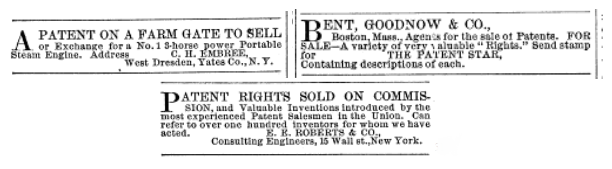
In fact, Mossoff points out that it was not uncommon to see newspaper ads offering patents for sale in the nineteenth century:

The classified ads in Scientific American provide a window into this vibrant and widespread secondary market. In an 1869 issue of Scientific American, among ads touting the value to purchasers of “Woodbury’s Patent Planing and Matching and Moulding Machines” and ads declaring “AGENTS WANTED—To sell H.V. Van Etten’s Patent Device for Catching and Holding Domestic Animals,” one finds ads offering patents and rights in patents for sale:

Such ads were ubiquitous in the nineteenth century, says Mossoff, and they “belie any assertions about the absence of such historical secondary markets by commentators today.” Similarly, Mossoff points to research showing the “fundamental and significant role” performed by intermediaries known as “patent agents,” the “predecessors of today’s patent aggregators.” These patent agents invested in a wide range of products and industries—a remarkable feat given the “constraints of primitive, nineteenth-century corporate law and the limited financial capabilities of market actors at that time.”

In his brief yet insightful account of the history of patent licensing firms, Mossoff refutes the modern misconception that “the patent licensing business model and secondary markets in patents are novel practices today.” It’s important to set the record straight, especially as many in modern patent policy debates rely on erroneous historical accounts to make negative inferences. The evidence from the nineteenth century isn’t that surprising since it reflects “the basic economic principle of the division of labor that Adam Smith famously recognized as essential to a successful free market and flourishing economy.” Casting “aspersions on this basic economic principle,” Mossoff concludes, “strikes at the very core of what it means to secure property rights in innovation through the patent system.”

Categories
Uncategorized

#AliceStorm In June: A Deeper Dive into Court Trends, and New Data On Alice inside the USPTO

The following guest post from Robert R. Sachs, Partner at Fenwick & West LLP, first appeared on the Bilski Blog, and it is reposted here with permission.

By Robert R. Sachs

The most important thing that happened in June was not the invalidation of yet another pile of patents, but the rather more consequential decision of the Supreme Court to recognize the right of same-sex couples to marry. Unlike patent law issues, when it comes to constitutional law, the Court can recognize the complexity and depth of the issue and, not surprisingly, the Court is deeply divided. That the Court is unanimous on equally complex and divisive issues in patent law—such as eligibility—speaks to me that they do not have the same deep understanding of the domain.

Now, let’s do the #AliceStorm numbers. First, the federal courts:

Table1

Since my May 28 update, there have been 19 § 101 decisions including two Federal Circuit decisions, Internet Patents Corp. v. Active Network, Inc. and Ariosa Diagnostics, Inc. v. Sequenom, Inc., both holding the challenged patents ineligible. Overall, the Federal Court index is up 3.1% in decisions and an (un?)healthy 6.2% in patents. The Motions on Pleading index is holding steady; the last five decisions on § 101 motions to dismiss have found the patents in suit invalid.

We can look more specifically at the invalidity rate by type of motion and tribunal:

Table2

For example, the 73.1% invalidity rate in the federal courts breaks down into 70.2% (66 of 96) in the district courts and a stunning 92.9% in the Federal Circuit (13 for 14). Motions on the pleadings and motions to dismiss are running equally, at a 69% defense win rate.

The 73.7% summary judgment success rate is consistent with the high rate on motions to dismiss. Since the courts have taken the position that there are no relevant facts to patent eligibility and there is no actual presumption of validity in practice, there is now little difference between the underlying showings required for the two types of motions. That’s odd since on the motions to dismiss the court is to look only at the pleadings, while on summary judgment they have the full file history, expert testimony, the inventor’s testimony and other evidence before them. Why such evidence is not helping—and indeed appears to be hurting—patentees is because the court is evaluating it from their lay perspective. In my opinion, the correct perspective is that of a person of ordinary skill in the art (POSITA). What a court may consider merely abstract may be easily recognized as a real-world technology by an engineer; a claim term that appears trivial to a court (“lookup table”, “isolated”) or may be significant to the expert.

We can also evaluate how individual the various district courts are doing.

Table3

(The (-1) values in the bottom five rows indicate that the court held that patent was not invalid).

Of the 66 district court decisions since Alice that have invalidated patents on § 101, Delaware, the Central and Northern Districts of California account for 58% of the decisions. The most prolific judges are shown here:

Table4

Yet, when it comes to finding abstract ideas, the USPTO remains the champ. The best avenue to attack a patent under § 101 is through the Covered Business Method (CBM) review program. A challenger files an institution petition before the Patent Trial and Appeal Board (PTAB) arguing that the challenged patent is directed to a financial product or service, and setting forth their ineligibility arguments. PTAB then issues an institution decision as to whether to grant the petition or not. The standard at this stage is whether it is more likely than not that the claims are ineligible. Once instituted, there is a full proceeding leading up to a final decision as to whether or not the patent is invalid.

At PTAB, CBM institution decisions are up (19 since May 28), and PTAB leads the race with the courts with an 88.6% invalidity rate on CBM institutions, and an unbeatable 100% rate (unchanged) on CBM final decisions.

Table5

If only the SF Giants could play their game this well.

Alice and the Patent Prosecutor

In my previous post, I drilled down in the impact of Alice on prosecution in terms of office action rejections and abandonments. My dataset was some 300,000 applications for the pre- and post-Alice period prepared for me by the team at Patent Advisor. Since then, I’ve received an additional 190,000 samples, comprising all office actions issued by the USPTO in September and October 2014. Together, the data set has over 490,000 office actions and notices of allowances:

Table6

The additional data from September and October fill in the trends in § 101 rejections that I showed before. As I explained, Tech Center 3600 includes more than just business methods, including literally down-to-earth technologies like earth moving and well boring. The § 101 rejections are concentrated in three E-commerce work groups:

Table7

There is some good news for software. The computer-related art units, TC 2100 and TC 2400, show considerably lower and steady § 101 rejection rates pre- and post-Alice.

Table8

After Alice, I think most software prosecutors expected to get non-final § 101 rejections, and consistent with past practice, expected to overcome them by amendment and argument. That would lead to final rejection based on prior art or an allowance. And that’s generally been true—except in a number of areas. In this following table, I compare the percentage of final office actions with § 101 rejections before and after Alice, in various Tech Centers and within TC 3600.

Table9

It’s important to remember the obvious: that you don’t get to a final rejection on § 101 without a first having a non-final rejection. Thus, this comparison shows how successful prosecutors were in overcoming non-final § 101 rejections before and after Alice—or equally how aggressive examiners were in maintaining these rejections. For example, before Alice 8.1% of final rejections in TC 1600 included a § 101 rejection, doubling to 16.7% after Alice—thus indicating that examiners were much more likely to maintain the rejection after Alice, but still a relatively low rate overall. By comparison in TC 2600, the rate of final rejections on § 101 declined after Alice, from 10% to 7.7%. This could be because it’s easier to explain why an invention in more traditional fields is an improvement in technology, one of the Alice safe harbors.

But when it comes to business methods, we see the killer statistics: prior to Alice, prosecutors overcame the non-final § 101 rejections generally about 62% of the time, leading to final rejection rates in the 23-46% range; thus prosecutors had more or less even odds of getting over the rejection. What is shocking is that after Alice, the final rejection rate soared into the 90% range. If you felt frustrated that your crafted (or crafty) arguments failed to impress the Examiner, get in line.

Now I’ve reviewed several hundred post-Alice rejections, and I’ve talked to a large number of prosecutors. What I’ve found is that majority of the non-final § 101 rejections were relatively formalistic, with little actual substantive analysis. Likewise, in a review of 87 office actions issued in November 2014 with § 101 rejections, Scott Alter and Richard Marsh found that 63 percent of those actions were “boilerplate” rejections. In my view, most prosecutors put forward at least a decent argument to show that the claims are not abstract, have at least one significant limitation, and do not preempt the abstract idea. Response arguments to § 101 rejections tend to run longer than response to prior art rejections, and I’ve seen many that resemble appeal briefs if not legal treatises, all to overcome a one paragraph rejection. They all presented at least enough of an argument to overcome the prima facie case for the rejection. And yet the final rejections keep coming—and often with little or no substantive rebuttal of the prosecutor’s arguments.

Outside of business methods, I found only two technology areas that had post-Alice rejection rates in excess of 30%: Amusement and Education devices in Tech Center 3700 (bottom row above) and molecular biology/bioinformatics/genetics in TC 1600 (not shown). This is a peculiar side effect of Alice. Historically, games and educational devices are classic fields of invention. There are thousands of patents on games, such as card games, board games, physical games, and the like. What is now hurting these applications are two aberrations in the law of patent eligibility: mental steps and methods of organizing human activity. The majority of § 101 rejections for games argue that the rules that define a game are simply ways of organizing human activity and can be performed by mental steps. Examiners typically cite the Federal Circuit’s Planet Bingo v. VKGS decision for the proposition that a game is an abstract idea and can be performed mentally. Only a small problem here: Planet Bingo is non-precedential and thus limited to its facts. In particular, the court did not hold that the game of bingo was an abstract idea. Instead, the alleged abstract idea was of “solving a tampering problem and also minimizing other security risks during bingo ticket purchases.” Thus, the case cannot be extended by examiners to argue that all games are abstract ideas.

As to methods of organizing human activity, it cannot be the case that all such methods are ineligible, since a vast array of such methods are in fact patented in fields such as farming, metalworking, sewing, manufacturing, tooling, conveying, and the like. This is just another example how simplistic rules of patent eligibility, taken out of context from one court opinion and repurposed generally, are at complete odds with the reality of invention.

Here is another view of the final rejection data on § 101, this time organized by the technology groups most negatively impacted by Alice (left side) and most positively impacted (right side).

Table10

The data here is organized by the percentage change in § 101 final rejection rates post-Alice. The group on the left is all of the technology areas that have had more than a 10% increase in final § 101 since Alice. Every other technology work group in the USPTO had less than 10% change in final rejection rates. On the right, we find the groups that seemed to benefit from Alice, in that the final rejection rates on § 101 declined. Most of these groups are in the computer area—and I’m sure that many of their applications have claims for purely software operations that could just as easily be argued to be mere data gathering, mental steps, or fundamental practices. And yet the examiners in these groups do not on average impose such blanket formulations on the claims, but appear overall to treat these inventions for what they are: real technology solving real world problems with real commercial applications.

To me, the data points to a clear conclusion. Contrary to what the USPTO’s Interim Guidance states as policy–that there is no per se exception for business methods–the behavior of examiners suggests that precisely such an exception is being applied in fact.

Categories
Innovation Legislation Patent Law Uncategorized

Will Increasing the Term of Data Exclusivity for Biologic Drugs in the TPP Reduce Access to Medicines?

The following guest post comes from Philip Stevens, Director of the Geneva Network, a research and advocacy organization working on international health, trade, and intellectual property issues. The original research note can be found here.

By Philip Stevens

scientist looking through a microscopeIn the Trans-Pacific Partnership (TPP) negotiations, the U.S. and Japan have proposed that TPP partners increase their period of regulatory data protection (RDP) for biologic medicines to align with practice in other countries. These proposals have been strongly opposed by a number of academics, who claim that such a move would significantly increase public spending on medicines, thereby potentially limiting access.[1], [2]

Past experiences in Canada and Japan, which lengthened their respective terms of RDP some years ago, however, indicate that these fears of budget increases are unlikely to materialise.

Canada and Japan increased RDP[i] substantially but did not experience increases in expenditures for medicines

Like several TPP countries, the governments of Canada and Japan have national health insurance systems, and cover most health care costs, including medicines. Unlike other TPP countries, Canada and Japan have in the past decade adopted substantially longer terms of RDP. Their experiences, captured in the data provided below, show that expenditures on medicines did not change appreciably from previous trends.

In 2006 Canada changed its regulations in a way that effectively increased their RDP term from 0 years to 8 years.[ii] As shown in Figure 1 (based on 2014 OECD data[iii]), pharmaceutical spending as a percentage of total health spending has actually decreased since then.

Figure 1: Pharmaceutical expenditure as a percentage of Canada’s healthcare expenditure (2005-2011)

Canada - OECD Health Data 2014. Pharma spend as % of total health spend. 2005: 17.2. 2006: 17.4 (Note: RDP Increased). 2007: 17.2. 2008: 17.0. 2009: 17.0. 2010. 16.6. 2011: 17.1.

As indicated in Figure 2 below, over the same period (2005-2011) pharmaceutical expenditure as a percentage of GDP (blue bars) remained relatively stable after RDP was increased in Canada in 2006, whereas overall health spending as a percentage of GDP in Canada has gradually increased (red bars).

Figure 2: Health and pharmaceutical expenditure as a percentage of Canada’s GDP (2005-2011)

Canada - OECD Health Data 2013. Red=Health spend as % of GDP. Blue=Pharma spend as % of GDP. 2005: Red, 9.8; Blue, 1.69. 2006: Red: 10.1; Blue 1.73. 2007: Red: 10.0; Blue: 1.73. 2008: Red: 10.3; Blue: 1.74. 2009: Red: 11.4; Blue: 1.93. 2010: Red: 11.4; Blue: 1.89. 2011: Red, 11.2; Blue: 1.86.

Similarly, Japan increased data protection in 2007 from 6 to 8 years (effectively 9 years).[iv] As indicated by Figure 3, fluctuations in expenditures after that time have been in line with growth in health care spending as a percentage of GDP. In fact, in 2010 pharmaceutical spending decreased in a year where health care spending increased.

Figure 3: Pharmaceutical expenditure as a percentage of Japan’s health care expenditure (2005-2010)

Japan - OECD Health Data 2014. Pharma spend as % of total health spend. 2005: 19.7. 2006: 19.5. 2007: 19.9 (Note: RDP Increased). 2008: 19.7. 2009: 20.7. 2010. 20.3.6. 2011: 20.8.

Figure 4 shows that the gradual increases in pharmaceutical expenditure as a percentage of GDP in Japan between 2005 and 2010 (blue bars) was in line with the overall increase in health spending as a percentage of GDP in Japan over the same period (red bars).

Figure 4: Health and pharmaceutical expenditure as a percentage of Japan’s GDP (2005-2010)

Japan - OECD Health Data 2013. Red=Health spend as % of GDP. Blue=Pharma spend as % of GDP. 2005: Red, 8.2; Blue, 1.62. 2006: Red: 8.2; Blue 1.60. 2007: Red: 8.2 (Note: RDP increased); Blue: 1.63. 2008: Red: 8.6; Blue: 1.70. 2009: Red: 9.5; Blue: 1.97. 2010: Red: 11.4; Blue: 1.89. 2011: Red, 9.6; Blue: 1.94.

Conclusion

The past experiences of Canada and Japan described above indicate that increases in RDP terms do not result in meaningful increases in health care expenditures or expenditures on medicines relative to overall health care spending. There could be many explanations for this result, ranging from changes in procurement policies, to increases in the number of medicines whose patent terms have expired. The evidence presented above, however, suggests that those concerned about access to medicines and the financial sustainability of public healthcare systems should focus their attention on policies other than Regulatory Data Protection for medicines.


[1] Moir et al, (2014) “Proposals for extending data protection for biologics in the TPPA: Potential consequences for Australia”, Submission to the Department of Foreign Affairs and Trade, available at http://dfat.gov.au/trade/agreements/tpp/submissions/Documents/tpp_sub_gleeson_lopert_moir.pdf

[2] Gleeson, D, Lopert, R, and Reid, P, (2013), “How the Trans Pacific Partnership Agreement could undermine PHARMAC and threaten access to affordable medicines and health equity in New Zealand”, Health Policy, 116:2-3

[i] Japan has a “post marketing surveillance system” which we consider a surrogate for RDP and use the term RDP in this paper to include Japan’s approach.

[ii] Canada’s 5-year data protection term was made ineffective by a 1998 Federal Court interpretation of regulations. Bayer Inc. v. Canada (Attorney General), 84 C.P.R. (3d) 129, aff’d 87 C.P.R. (3d) 293, leave to appeal to SCC refused, [1999] S.C.C.A. No. 386. The Federal Court held that RDP protection in Canada was not triggered if a generic applicant could demonstrate bioequivalence without requiring the Health Minister to consult the data submitted by the innovative company. Because that was a common occurrence, RDP rarely applied under the pre-2006 regulations.

[iii] 2013/14 OECD data on Canada and Japan is found at: http://www.oecd-ilibrary.org/social-issues-migration-health/health-key-tables-from-oecd_20758480;jsessionid=k26q30wbgljb.x-oecd-live-02.

[iv] Japan’s system prevents filing applications for follow-on approval for eight years after the innovator’s approval. An additional year after that is required for the regulatory approval process to conclude.