Categories
High Tech Industry Innovation Intellectual Property Theory Internet Inventors Patent Law Patent Theory Patentability Requirements Software Patent Supreme Court Uncategorized

Alice Gets the Most Important Question Right

By far the most important takeaway from today’s Supreme Court decision in Alice Corp. v. CLS Bank  is the Court’s acknowledgment that “many computer-implemented claims are formally addressed to patent-eligible subject matter.”  Despite failing to alleviate the profound confusion caused by its recent §101 analysis in cases like Bilski, Myriad, Mayo, and plenty of earlier cases going all the way back to Benson, the Court once and for all put to rest the absurd notion that computer-implemented inventions are not patentable under §101.

To its credit, the Alice Court issued its opinion without once using the term “software patent,” or even the term “software.”  Many people don’t realize that this is not a term of art in patent law.  There is no category of “software patents” at the PTO, although they do have classifications for every type of invention.  The term is also not an official category in any statutes or court decisions.  Instead, “software patent” is merely a pejorative, rhetorical term used by patent-skeptics in the patent policy debate.  One hears endless arguments about “all those crappy software patents,” or how we need to “fix the software patent problem,” as if there is something deeply wrong with providing patent protection for inventions implemented through software.  But from an inventive or technological standpoint, the notion of creating a separate category of “software patents” doesn’t even make sense. Any process that is implemented through software could also be implemented through hardware (as pointed out succinctly in the IEEE’s amicus brief in Alice), and the efficiencies and design decisions that guide the choice between hardware and software are essentially irrelevant to the core patentability requirements under the Patent Act.

Of course, the Alice Court’s decision still leaves inventors (not to mention patent examiners, lawyers, and judges) with shockingly little guidance for determining whether a claim is “directed to a patent-ineligible concept,” such as an “abstract idea,” and if so, whether it “contains an ‘inventive’ concept sufficient to ‘transform’ the claimed abstract idea into  a patent-eligible application.”  Citing Mayo, the Court again acknowledges that, when broken down into their basic elements, all inventions rely upon abstract ideas, natural phenomena, or laws of nature.  If that’s the case, we might ask why the Court added any of these exceptions into its §101 analysis in the first place.  After all, the Court’s “inventive concept” test for saving claims that are directed at abstract ideas really just looks like a hybrid novelty/non-obviousness determination.

Despite the remaining doctrinal confusion about how to apply the Court’s various pronouncements about which inventions are “abstract ideas” or “laws of nature” and which are not, the Court deserves credit for getting the most important question right.  At long last, it laid to rest the ridiculous argument that software isn’t patentable.  Are claims to computer-implemented inventions patent-eligible subject matter?  Of course they are.  Inventors in the high-tech industry can at least breathe a sigh of relief.  The Court has expressly recognized that the countless incredible technological inventions that form the bedrock of our innovation economy deserve patent protection.

Categories
Legislation Patent Law Patent Litigation Supreme Court Uncategorized

Supreme Court Revises Fee-Shifting Rules in Patent Cases: Weeding out Bad Actors in a Level Playing Field

By Adam Mossoff* and Brian O’Shaughnessy
Originally published in LES (USA & Canada)’s weekly e-newsletter, Insights.

On April 29, 2014, the Supreme Court handed down two unanimous decisions in Octane Fitness v. ICON Health & Fitness and Highmark v. Allcare Health Management System, which radically overhaul the rules governing court-awarded attorneys’ fees in patent cases. In brief, the Supreme Court has empowered district courts with greater authority to discourage bad actors in patent litigation. Yet, the Octane Fitness and Highmark decisions preserve valuable incentives for innovation in an equitable system for patent owners who properly assert valid property rights.

Octane Fitness and Highmark confirm that it is the proper role for courts to address problems created by bad faith patent litigation. This is a lesson that should be heeded by Congress, as it works toward new legislation further modifying our patent laws, including mandating fee-shifting in patent cases. Octane Fitness and Highmark counsel Congress to reconsider revising our patent laws, and instead allow courts to do what they do best —manage their dockets and craft rules and procedures to ensure the just and efficient resolution of disputes under federal law.

The legal issue in Octane Fitness and Highmark centered on what is the proper application of 35 U.S.C. § 285, which authorizes courts to award attorney fees “in exceptional cases” to the prevailing party. Since its inception, § 285 has been recognized as an exception to the “American Rule” (i.e., each party pays its own attorney fees regardless of the outcome). The Federal Circuit has construed § 285 as permitting fee-shifting in only two limited circumstances: An award of attorneys’ fees is permissible only when it is proven by clear and convincing evidence that (1) “there has been some material inappropriate conduct,” or (2) the litigation was “brought in subjective bad faith” and was “objectively baseless.”

The Octane Fitness Court found the Federal Circuit’s construction of § 285 imposed “an inflexible framework onto statutory text that is inherently flexible.” More specifically, the Octane Fitness Court struck down the Federal Circuit’s test because it conflated the “exceptional case” standard with other legally independent bases of punishing misconduct by a patent owner, such as the inequitable conduct doctrine that is similar to factor (1) of the Federal Circuit’s § 285 test. In accord with its plain meaning, the Court construed an “exceptional case” to mean simply a case that “stands out from others with respect to the substantive strength of a party’s litigating position (considering both the governing law and the facts of the case) or the unreasonable manner in which the case was litigated.”

Following its construction of “exceptional case” based on both its plain meaning and the legislative history for § 285 (Justice Scalia refused to join the three footnotes in Justice Sotomayor’s opinion that discussed the legislative history), the Octane Fitness Court held that a district court should have the discretionary authority to award attorney fees if the prevailing party has proven by a preponderance of evidence that the “totality of the circumstances” justify such an award. The Octane Fitness Court thus lowered both the evidentiary and the substantive legal requirements for a district court in awarding attorney fees under § 285—it is now a case-specific, holistic, equitable analysis more in accord with the approach traditionally taken by courts.

In a companion case, the Court in Highmark bolstered the authority of district courts to manage their dockets and to punish bad actors by revising the standard of review employed by the Federal Circuit in reviewing fee-shifting decisions under § 285. The Federal Circuit has reviewed de novo fee awards under § 285. Highmark holds that this was contrary to the fact-specific nature of § 285. Thus, Highmark reversed the Federal Circuit, holding that the discretionary award of attorneys’ fees under § 285 should be reviewed by an appellate court only for abuse of discretion.

Standing together, Octane Fitness and Highmark empower district courts to hold accountable those who engage in improper or abusive litigation. This is a valuable reminder that patent infringement suits are merely another form of federal civil litigation, and abusive behavior may be addressed with rules and practices traditionally employed by federal courts.

The carefully crafted holdings in Octane Fitness and Highmark stand in stark contrast to broad legislation pending in Congress. For example, in December 2013, the House passed H.R. 3309, which would impose mandatory fee-shifting to the non-prevailing party. Fees must be paid by the losing party unless it can prove that its position was “substantially justified” or that “special circumstances” would make an award of attorney fees unjust. This would create the same “inflexible framework” and inequitable “generalizations” for which the Supreme Court criticized the Federal Circuit in its prior application of § 285.

H.R. 3309 would penalize patent owners by creating an exception to the American rule. This would affect all patent owners, not just bad actors, and would increase risk, and therefore harm individual inventors, start-ups, small companies, universities, and other entities that create and license patented inventions. The risk of bearing the financial burden of both parties’ attorney fees would be an enormous disincentive for any poorly capitalized patent owner in enforcing its legitimate property rights in court; this would thus discourage, rather than promote, the progress of the useful arts.

Octane Fitness and Highmark will promote more responsible behavior among patent litigants.  Under the principles enunciated in these two cases, patent owners must be more careful in conducting pre-litigation due diligence.  Before bringing suit, patent owners would be well advised to retain objective and competent counsel to conduct a thorough infringement investigation, and to document the bases on which a suit might be brought.  Failure to procure such an opinion before bringing suit would increase a patent owner’s exposure to a challenge that the suit was brought without the requisite good faith basis, and with that, a claim for attorney fees.

A legislative approach that mandates fee shifting is a dramatic shift from the traditional American rule. It hinders a judge’s discretion and the court’s inherent power to impose appropriate sanctions. It will limit remedial measures that judges might otherwise employ to promptly and cost-effectively resolve cases and discourage litigation abuse. Further, it will invite gamesmanship to protect the bad faith litigant from suffering the fate of a “non-prevailing party.”

Case by case implementation of the Octane Fitness and Highmark decisions will afford equitable and predictable enforcement of legitimate patent rights, promoting innovation while preserving the power of the courts to punish bad actors. Overly broad legislation, however, will increase uncertainty and risk in patent enforcement, weaken the patent property right, diminish the commercial value of patents, and discourage innovation. This will have devastating consequences on the innovation economy, and will suppress economic development and job creation. Octane Fitness and Highmark show that judges, who witness abusive behavior firsthand, are in the best position to address and remedy bad faith litigation and abusive tactics. This is why we have traditionally left it to the courts to address such tactics. The Supreme Court has now clarified and enhanced that power. Congress should defer to the courts in exercising it.

* Professor of Law at George Mason University School of law. Professor Mossoff is also co-founder and Co-Director of Academic Programs of the Center for the Protection of Intellectual Property at Mason Law. Thank you to Steve Tjoe for his assistance with this essay.

† Regional Vice President, USA, of the Licensing Executives Society (USA and Canada), Inc.; and Shareholder in the law firm of RatnerPrestia, Washington, DC.

Categories
Commercialization Conferences High Tech Industry Innovation Intellectual Property Theory Law and Economics Legislation Patent Law Patent Licensing Patent Litigation Patent Theory Software Patent Uncategorized

The Unintended Consequences of Patent "Reform"

By Steven Tjoe

Much of today’s patent policy debate focuses on the dynamics of patent litigation.  Sensational anecdotes of abusive demand letters, litigants strategically exploiting bad patents, and tales of so-called “patent trolls” (reinforced by now debunked empirical claims) have captured the public’s imagination and spurred Congress to rush to revise the patent system.  Unfortunately, the fervor to address perceived patent litigation abuses often overlooks the substantial unintended consequences of recent and proposed legislation.

CPIP and WARF’s recent conference, From Lab to Market: How Intellectual Property Secures the Benefits of R&D, featured a panel designed to fill this void in the conversation.  Instead of myopically focusing on trolls and litigation abuse, the panelists, Eb Bright, Robert Sterne, and Carl Gulbrandsen, brought the discussion back to reality and addressed the greater context of how recent and proposed changes to patent law impact our innovation ecosystem at large.

First, an understanding of how ideas are developed and brought to market is crucial to evaluating the ramifications of patent legislation.  Eb Bright, Executive Vice President and General Counsel of ExploraMed, illustrated this often-overlooked process from the perspective of the medical device industry.  In the world of medical device development, the financial risks of bringing an idea to market are very high.  The cost from conception to market can range from approximately $75 million for low-risk devices to approximately $135 million for high-risk devices.  Additionally, it takes 8-10 years on average to begin seeing a return on investment.

The result is that innovators in the medical device space – mostly small start-up companies – must secure significant financing from venture capitalists and other investors to keep their companies alive during this lengthy process.  Strong patents are fundamental to securing this financing.  They are essential to keeping competitors from free-riding on a company’s work and poaching its investors’ returns.  Investors are loathe to finance a start-up without confidence that the company can protect its intellectual property (which often accounts for a significant portion of the company’s value) from free-riders.  In this fragile innovation ecosystem, legislation that weakens patents and makes it harder for small companies to enforce their patent rights could have devastating consequences on start-ups’ ability to secure essential financing.

Carl Gulbrandsen, Managing Director of WARF, discussed proposed patent legislation from the perspective of a large university technology transfer office.  As the University of Wisconsin’s licensing arm, WARF licenses university patents and returns approximately $80 million a year to the university to support further research.  This symbiotic relationship fuels research and also adds significant value to the university’s inventions.  By marketing and licensing inventions to companies (often small start-ups) that take on the substantial effort of turning those inventions into actual products, WARF plays a crucial role in moving innovation from the lab to the marketplace.  Importantly, strong patent rights lie at the center of this virtuous cycle.

Mr. Gulbrandsen observed that proposed legislation would disrupt this process by making it substantially more difficult for universities to enforce their patents, and therefore substantially more difficult for universities to license and commercialize their inventions.  While established organizations like WARF may be able to handle the increased costs and risks, at the margin fewer universities would be able to license their intellectual property.  The result is that fewer inventions would move from lab to market, and universities would have less revenue to fuel future research.

It is against this backdrop that efforts to revise our patent system occur.  Overbroad “patent abuse” legislation that fails to appreciate the economic realities of our innovation ecosystem can lead to significant unintended consequences.  Robert Sterne, Director of Sterne Kessler, illustrated some unintended consequences from the last major patent “reform” legislation, the America Invents Act of 2011 (AIA).  In particular, Mr. Sterne addressed issues arising from the Inter Partes Review (“IPR”) and Covered Business Method Patent Review (“CBM”) procedures implemented under the AIA.

Mr. Sterne spoke about trial practice before the USPTO Patent Trial and Appeal Board (“PTAB”), noting that Rule 42.1(b) establishes that the rules should “be construed to secure the just, speedy, and inexpensive resolution of every proceeding.”  While the resulting procedures are certainly speedy (cases proceed through the USPTO and through appeal at the Federal Circuit within 2 years) and are cheaper than District Court proceedings, the procedures are far from just, and have proved particularly unforgiving for patent owners as a result of vast departures from well-established rules and procedures utilized by the courts.

Mr. Sterne explained how the new IPR procedures include more limited claim construction rules, less stringent burdens of proof to invalidate a patent, and less opportunity to adequately prove non-obviousness.  Of particular concern to patent owners is the inability to show non-obviousness.  In District Court, patent owners generally show non-obviousness by telling the story of the invention.  Inventors recount the state of the technology prior to their invention and the contributions their invention made.  By contrast, PTAB’s narrow time limitations and constraints on responses filed strip patent owners of the ability to do the same in IPR proceedings.

Consequently, the trial outcomes under the new system have yielded startlingly negative results for patent holders.  As of March 7, 2014, the PTAB had issued 19 Final Written Decisions on the merits for IPRs and CBMs.  In all but three of these proceedings, the Board cancelled all claims for which trial was instituted.  In total, 95.2% of all claims for which trial was instituted were cancelled and 82.9% of all claims that were initially challenged by the petitioner were cancelled.

Furthermore, IPR proceedings are always available and may stand alone or exist as part of a litigation strategy.  A patent owner does not have to take any action before being challenged.   New business entities, such as subscription services designed to work around the estoppel provisions, are already being formed to capitalize on the lopsided nature of the process.  It’s important to note that the constant threat of IPR and the risks and costs associated with it are not only detrimental to patent owners, they also affect our entire innovation ecosystem.

The central takeaway from the panel was this:  As we consider patent legislation ostensibly designed to curb abusive litigation, it is crucial to consider the potential unintended consequences of weakening patent rights across the board.  We must recognize the economic realities of our innovation ecosystem, and we must narrowly tailor any solutions to address the limited instances of abuse without harming start-ups, universities, and all the other patent owners that fuel our innovation economy.

Categories
Antitrust Commercialization Damages DOJ Economic Study FTC High Tech Industry Innovation International Law Law and Economics Patent Law Patent Licensing Patent Litigation Reasonable Royalty Remedies Software Patent Uncategorized

An Insightful Analysis of “Fair and Reasonable” in the Determination of FRAND Terms

By Steven Tjoe

In his forthcoming George Mason University Law Review article entitled “The Meaning of ‘Fair and Reasonable’ in the Context of Third-Party Determination of FRAND Terms,” Professor Damien Geradin explores the delicate balance of interests protected by the current system of arm’s length negotiations in the standard-setting process, and the detrimental effect disrupting this balance would have on standards-related technologies and our innovation economy.

Fair, reasonable, and non-discriminatory (“FRAND”) commitments are the subject of frequent criticism in both legal and economic literature.  Many policymakers, practitioners, and academics have argued that the inherent ambiguity in establishing “fair and reasonable” terms creates inefficiencies and perverse incentives for standard-essential patent (“SEP”) holders to exercise ex post opportunism.  Based on this belief, some now argue that the standard-setting organization (“SSO”) contracting process is broken and requires additional legal and regulatory mechanisms to afford standard implementers greater protection.

Professor Geradin’s article brings some much-needed balance to this debate.  By highlighting the economic principles and the carefully negotiated terms underlying current SSO contracting processes, Geradin exposes the pitfalls of many of the reforms suggested.  Geradin’s analysis elucidates the SSO contracting process itself through dissection of the intensive discussions and negotiations giving rise to the prominent ETSI Intellectual Property Rights (“IPR”) policy, a policy that played a fundamental standardization role in the wireless communication field.  The ETSI IPR policy shows that its members understood the notions of “fairness and reasonable” to define a fair balance between the interests of SEP holders and standard implementers – securing the availability of the standards while simultaneously ensuring that SEP holders are “adequately and fairly rewarded for the use of their [intellectual property rights].”

Professor Geradin addresses two potential forms of ex post opportunism – “hold-up” and “royalty stacking” – and observes that though both could occur in theory, there is little evidence to suggest that they occur in real-world patent licensing.  Regarding the hold-up conjecture, Geradin observes that the relative absence of hold-up is consistent with the economics of contracting: parties who repeatedly deal with each other will limit opportunism to protect their reputation.  Similarly, royalty stacking is a rare occurrence in high-technology, where cross-licensing is common and greatly diminishes the risk of royalty-stacking.  Given the absence of empirical evidence demonstrating opportunistic behavior by SEP holders, Geradin cautions against implementing reforms that systematically weaken the bargaining power of SEP holders, as proposed reforms may themselves trigger reciprocal opportunistic behavior – such as “reverse hold-up” – by standard implementers.

In the context of FRAND licensing, Geradin observes that for rewards to be adequate and fair, they must not only compensate SEP holders for their risky R&D investments (including investments in prior failed projects), they must also give SEP holders sufficient incentive to keep investing in the development of standardized technologies.  The negative consequences of systematically offering below-FRAND terms to SEP holders are two-fold.  First, as Geradin eloquently observes, “[i]t is a basic law of finance that capital flows where the best opportunities arise,” and developers of technologies in standardized sectors unduly constrained by low returns may seek opportunities outside the standardized sectors.  Second, without adequate returns, major technological contributors may decide to no longer participate in SSOs in order to avoid being bound by FRAND commitments.  As a result, standards would likely fail to incorporate the best technology available.

Accordingly, Geradin is skeptical of many of the policy measures suggested to provide additional protections to potential licensees and consumers of standardized technologies.  One such measure is the “ex ante incremental value method,” where the rate that would have resulted from ex ante competition between the technology in question and alternative technological solutions serves as a benchmark to whether a royalty is fair and reasonable.  As Geradin observes:

While the pricing of SEPs at incremental value may facilitate the dissemination of the standard in the short-term, the licensing fee resulting from the incremental value of the SEP holder’s technology would certainly not be enough to properly compensate the investment costs and risks [a] company incurred in developing its superior technology, as well as to incentivize it to make investment in new technologies.

With respect to this method, Geradin concludes that the “ex ante incremental rule is thus not so much an instrument to prevent the theoretical risks of hold-up, but a tool to lower royalty rates to the benefit of standard implementers.”  As such, the ex ante incremental value rule could potentially have a devastating impact on innovation incentives and standards.

Geradin next explores the multi-factor test contained in Georgia-Pacific Corp. v. United States Plywood Corp. (“Georgia-Pacific”).  In Georgia-Pacific, a federal district court established a framework by which fifteen factors offering a variety of benchmarks are used to compute reasonable royalty damages by contemplating a “hypothetical negotiation” between a “willing licensor” and “willing licensee” at the time the infringement began.  Geradin observes:

A key strength of the Georgia-Pacific framework is that it is sufficiently flexible to establish a balance between the dual objective of SSO’s IPR policies … which are both to ensure standard dissemination and adequate remuneration of the SEP holder.  In other words, unlike abstract mathematical methods, which … can be easily tipped in favor of the prospective licensee (or the prospective licensor), the multi-factor test at the core of the Georgia-Pacific framework reduces the risk of bias if it is properly carried out.

As such, the Georgia-Pacific framework can better reflect the reality of contract negotiations, where the parties look to a variety of factors, and not some magic formula, to come to mutually acceptable licensing terms.

In the context of FRAND litigation, however, Geradin cautions against potential pitfalls of applying the Georgia-Pacific framework.  At the outset, Geradin notes that licensing agreements are often “highly relationship-specific and thus agreements will be hard to compare.”  Geradin discusses the practice of comparing the rate offered ex post standardization by SEP holders with the rate offered for the same patents ex ante standardization.  Though many are inclined to treat the ex ante rate as a “safe harbor” against any claim of opportunism, Geradin finds that there is little reason why licensors should be prohibited from charging higher rates ex post than ex ante.  Not only may ex post contracts be more efficient in the way they incorporate a clearer understanding of the technology and the market, but also forcing SEP holders to charge similar ex ante and ex post rates deprives SEP holders of giving preferential terms to early adopters of their technology.

Professor Geradin then explores whether patent pools offer a useful benchmark to determine FRAND license terms.  Due to the difficulties of forming pools and the different business models of the relevant patent holders, many standardized sectors simply do not have sizeable patent pools covering their standards.  Even where sizeable patent pools exist, Geradin observes that the pools often will not serve as the right benchmark for FRAND rate determination.  In many standardized sectors, such as in wireless communications, patent pools tend to be used by SEP holders to avoid transactions costs, rather than to obtain FRAND compensation.  Moreover, many patent pools base their method of remuneration on the number of a firm’s patents compared to the size of the pool rather than the relative strength of the patents themselves.  Where numerical proportionality serves as the metric of FRAND compensation, such as in the recent In re Innovatio IP Ventures LLC case, SEP holders have the incentive to inflate the number of patents they contribute to the pool.  Thus, using patent pools as a benchmark runs the risk of setting rates that are well below FRAND.

The potential welfare-reducing consequences of limiting the flexibility of the SSO negotiation process has been well documented in recent legal and economic literature.  As Professor Geradin observes, solutions to perceived FRAND inadequacies that aim to weaken the bargaining position of SEP holders often overreach, in effect triggering the “wholesale devaluation of patents.”  Instead, FRAND determinations should consider the “dynamic nature of standardization” and should be determined by balancing the need to (1) make standards available and, (2) fairly compensate SEP holders.  This delicate balance of interests is necessary to protect the future of standardization.

Categories
Commercialization Copyright Copyright Licensing Copyright Theory High Tech Industry Internet Legislation Uncategorized

Taking a Whack at the DMCA: The Problem of Continuous Re-Posting

By Steven Tjoe

On Thursday March 13, the House Judiciary Committee held a hearing on the Digital Millennium Copyright Act’s (DMCA) notice and takedown system.  Among the witnesses testifying at the hearing was CPIP Fellow Professor Sean O’Connor (Washington University School of Law), who offered his insights on Section 512 from his unique position as a law professor, former musician, and counsel to web businesses.  Professor O’Connor observed that while the notice and takedown system may have operated effectively in the late 90s, today it no longer works for any of its intended beneficiaries.

Professor O’Connor traced the shared problems faced by websites and creators today to an unfortunate and unintended consequence of Section 512: the incentive for web businesses not to monitor content.  According to Professor O’Connor, this incentive has emboldened bad actors and fostered a culture of copyright contempt.  Under current law, web businesses (including the small, start-up web businesses Professor O’Connor counsels) are generally given an odd piece of advice by their attorneys: “don’t monitor the content on your site.”  The rationale is that there are serious potential downsides to monitoring content, but no upsides.  Monitoring content can expose web businesses to knowledge or awareness of infringement, and they risk losing their safe harbor under Section 512.  The end result is that web businesses don’t monitor (or even look), and as they turn a blind eye, bad actors are emboldened to upload and continuously re-post stolen works regardless of how many times they are taken down.

Professor O’Connor proposed two solutions to return some sanity to the process and encourage all parties involved to “do the right thing.”  His proposals target the most egregious cases: continuous re-posting of wholesale copies of creators’ works (not mash-ups, parodies, or excerpts, but infringing copies of the entire work).  Targeting these egregious cases makes sense given that the continuous re-posting of blatantly (really, inarguably) infringing wholesale copies accounts for the vast majority of takedown notices.

First, Professor O’Connor proposed a “notice and stay-down” system.  In such a system, once a business receives a takedown notice for a given work, it would monitor for re-posted copies of the same work (which it has already been notified is infringing) and take them down without having to receive additional notices for that work.  Ideally, web businesses should adopt voluntary best practices to monitor and immediately remove re-posted works.  Absent a voluntary adoption, Professor O’Connor believes that Congress should consider amending the DMCA to add an affirmative duty to monitor and remove re-posted infringing works.

This solution reflects the technological advances that have become a reality since the DMCA was passed in 1998.  Automated systems like the YouTube Content ID System (YouTube is owned by Google) can now effectively identify copyrighted works.  Adapting such technologies to identify works that have already been taken down under Section 512 and adding those works to a filter catalog would be one way to automate a notice and stay-down system to deter repeat offenders.  This would not only alleviate the cost (on both sides) of repeated takedowns for the same re-posted works, but would also systematically curb instances of blatant, wholesale copyright infringement.

Second, Professor O’Connor proposed revisiting and strengthening the DMCA’s red flag provisions by codifying a stronger version of the “willful blindness” doctrine that courts have narrowly interpreted.  Some courts have failed to find willful blindness even in cases involving very high volumes of infringing activity on a website.  In his written testimony, Professor O’Connor notes that “[t]he ‘don’t monitor’ advice and glamorization of a piracy culture means that many websites are in fact turning a blind eye to extensive infringement on their sites.”  By defining willful blindness to discourage today’s common “do not look” policy, we could combat the culture of copyright contempt that emboldens bad actors and repeat infringers.

Testimony by some of the other witnesses at the hearing corroborated the significant problems with the current notice and takedown system.  Paul F. Doda, Global Litigation Counsel for Elsevier (a premier publishing company), noted that despite rigorously issuing takedown notices, Elsevier encounters a growing number of copyright infringements each year.  The same literary works that are taken down are repeatedly re-uploaded on the same sites hundreds of times after being taken down.

From a more general standpoint, the sheer volume of takedown notices each year is staggering.  Katherine Oyama, Senior Copyright Policy Counsel at Google, testified that Google received 230 million takedown notices in 2013 alone (acting on 99% of those).  As instances of infringement continue to increase, the expense of locating, identifying, and then sending (or acting on) separate takedown notices for each infringing file has become increasingly significant and prohibitive, especially for creative up-starts and smaller web businesses.

From an artist’s standpoint, Maria Schneider (three-time GRAMMY-winning composer, conductor, and producer of jazz and classical music) testified to the real-world harm artists suffer despite the current “solutions” offered by Section 512.  Ms. Schneider described her experience with the notice and takedown system as an “endless whack-a-mole game” where, immediately after being taken down, her work reappears on the same sites she sent takedown notices to, offering her no relief from constant infringement.  She observed that independent artists are “hemorrhaging red ink” on their intellectual property.  Worse yet, policing the constant re-posting of stolen copies of their work is incredibly time-consuming and defers the ability of independent artists to focus on artistic endeavors, an effect Ms. Schneider fears will prove disastrous to young, aspiring artists and the future of the industry.

Simply put, it is time to update the notice and takedown system to reflect the realities of our digital age.

Categories
Copyright Copyright Licensing High Tech Industry Internet Legislation Uncategorized

Improving the DMCA's Notice and Takedown System

In conjunction with today’s House Judiciary Committee hearing on the DMCA, CPIP Senior Scholar Prof. Mark Schultz published a critique of the notice and takedown system this morning on AEI’s TechPolicyDaily Blog.

In his critique, Prof. Schultz discusses CPIP’s policy brief by Prof. Bruce Boyden, which details the failures of the DMCA – despite the massive number of takedown notices sent, not a single day goes by when the infringing content is not readily available online. Prof. Schultz also highlights the written testimony of CPIP Fellow Prof. Sean O’Connor, a witness at today’s hearing, who proposes two simple, focused solutions – “notice and stay-down and codified “willful blindness” – to improve the notice and take-down process for all parties involved.

Categories
Copyright Copyright Theory History of Intellectual Property Intellectual Property Theory Law and Economics Patent Law Patent Theory Uncategorized

IP as a Source of Personal and Economic Freedom

CPIP’s Mark Schultz authored an excellent essay today in TechPolicyDaily.com advocating intellectual property as a source of personal and economic freedom.  The essay, “A Free Market Perspective on Intellectual Property Rights,” describes parallels between physical property and intellectual property and dispels several denigrating myths about intellectual property’s role in a free market.  It’s a quick read, and well-worth checking out.

Categories
Commercialization Innovation Patent Law Patent Licensing Patent Litigation Uncategorized

Two More Reasons to Think Twice Before Changing Our Patent System

By Steven Tjoe

Today, misguided fears of an explosion of patent litigation and the specter of the so-called “patent troll” problem continue to influence the popular perception of patent policy.  Over the past year, various organizations have spurred a movement to make significant legislative changes to our patent system, despite calls for caution and further investigation by judges, FTC Commissioners, former USPTO directors, and Congress’ very own Government Accountability Office (GAO).  With the final implementation of the America Invents Act (AIA) now less than a year old, the speed and the magnitude by which the American patent system is being overhauled has wrought uncertainty throughout the innovation economy.  Two pieces published last week show that there is good cause to think twice before making further changes to our patent system.

First, in A Balanced Approach to Patent Reform: Addressing the Patent-Troll Problem Without Stifling Innovation, John Malcolm and Andrew Kloster of The Heritage Foundation debunk the myths underpinning the calls for legislative action on patents.  Regarding the myth of a patent litigation explosion, Malcolm and Kloster observe that contrary to popular belief, the volume of patent lawsuits has remained remarkably stable, with the rate of infringement suits filed at 1.5 percent of the total patents issued by the PTO.  Moreover, the rise in the total number of infringement lawsuits can be attributed to the AIA’s new joinder rules and the fact that the PTO has issued more patents in recent years, a fact that likely reflects an actual increase in patent-worthy innovation.

Malcolm and Kloster also explore the harrowing specter of the so-called “patent troll,” noting that little evidence exists to support allegations of a systemic problem.   After disposing of the oft-cited statistic that patent trolls are costing the American economy $29 billion annually (see here and here), Malcolm and Kolster pinpoint a central pitfall of the legislative reform proposals today: the overly broad definition of a patent troll that “throw[s] the baby out with the bathwater.”  Instead, Malcolm and Kolster recognize that patent aggregators play a fundamental role in the innovation economy: “patent aggregators facilitate an efficient division of labor between inventors and those who wish to use those inventions for the betterment of their fellow man, allowing inventors to spend their time doing what they do best: inventing.”  Recognizing this, Malcom and Kolster conclude:

The proper way . . .  to address patent trolls is by using the same means and methods that would likely work against “ambulance chasers” or other bad actors who exist in other areas of law, such as medical malpractice, securities fraud, and product liability . . .

Indeed, this critical observation that litigation abuse in the patent context is no different than litigation abuse in any other area of law – and can be dealt with in similar fashion –  is sorely lacking in the patent policy discussions today.

Brian O’Shaughnessy cuts to the heart of the issue in his insightful essay, Federal Circuit Takes a Swipe at Baseless Patent Litigation.  The essay reviews the Federal Circuit’s recent decision in Kilopass Technology, Inc. v. Sidense Corp., and demonstrates that the courts are well-equipped and willing to deal with abusive patent litigation on a case-by-case basis.  As O’Shaughnessy succinctly concludes:

Targeted, incremental reform specifically addressing the acts of specific culpable litigants offers an effective fix without compromising, or further complicating, our patent system as a whole.  Our patent system is the most effective economic engine known to man.  Prudence dictates that we tinker with it cautiously.

As the Senate moves ahead to consider various proposals on patent litigation reform, we should exercise an abundance of caution.  There is good cause to pause and think twice before legislating further systemic changes to our patent system that could damage our innovation economy.

Categories
Copyright Internet Uncategorized

The Failure of the DMCA Notice and Takedown System

using a laptopToday, CPIP released an important new policy brief, The Failure of the DMCA Notice and Takedown System: A Twentieth Century Solution to a Twenty-First Century Problem, by Professor Bruce Boyden of Marquette University Law School.  Professor Boyden argues that the DMCA notice and takedown system is outdated and not up to the task of reducing the availability of infringing copies of creative works.  A tool that was originally designed as an emergency stopgap measure, to be used in isolated instances, is now expected to manage infringement on a persistent, ubiquitous, and gargantuan scale. Copyright owners currently send takedown notices at an annualized rate of over 78 million infringing files, and yet every day these same files are still available on the most heavily trafficked websites.  In short, the notice and takedown system is long overdue for an update that actually works to prevent today’s wide-scale infringement.

The full document is available here, and we’ve also included the text (and replaced end notes with hyperlinks) below.

The Failure of the DMCA Notice and Takedown System: A Twentieth Century Solution to a Twenty-First Century Problem

 Bruce Boyden

Section 512 of the Digital Millennium Copyright Act will be turning 15 years old soon, and it’s showing its age. Its design belongs to a different era. Like a 15-year-old automobile, it no longer runs as well as it used to. It can’t keep up with the newer, faster vehicles on the road. Its users are beginning to look for alternative forms of transportation. Pieces of it have been wearing down over time, and ultimately something is going to break that outweighs the cost of replacement.

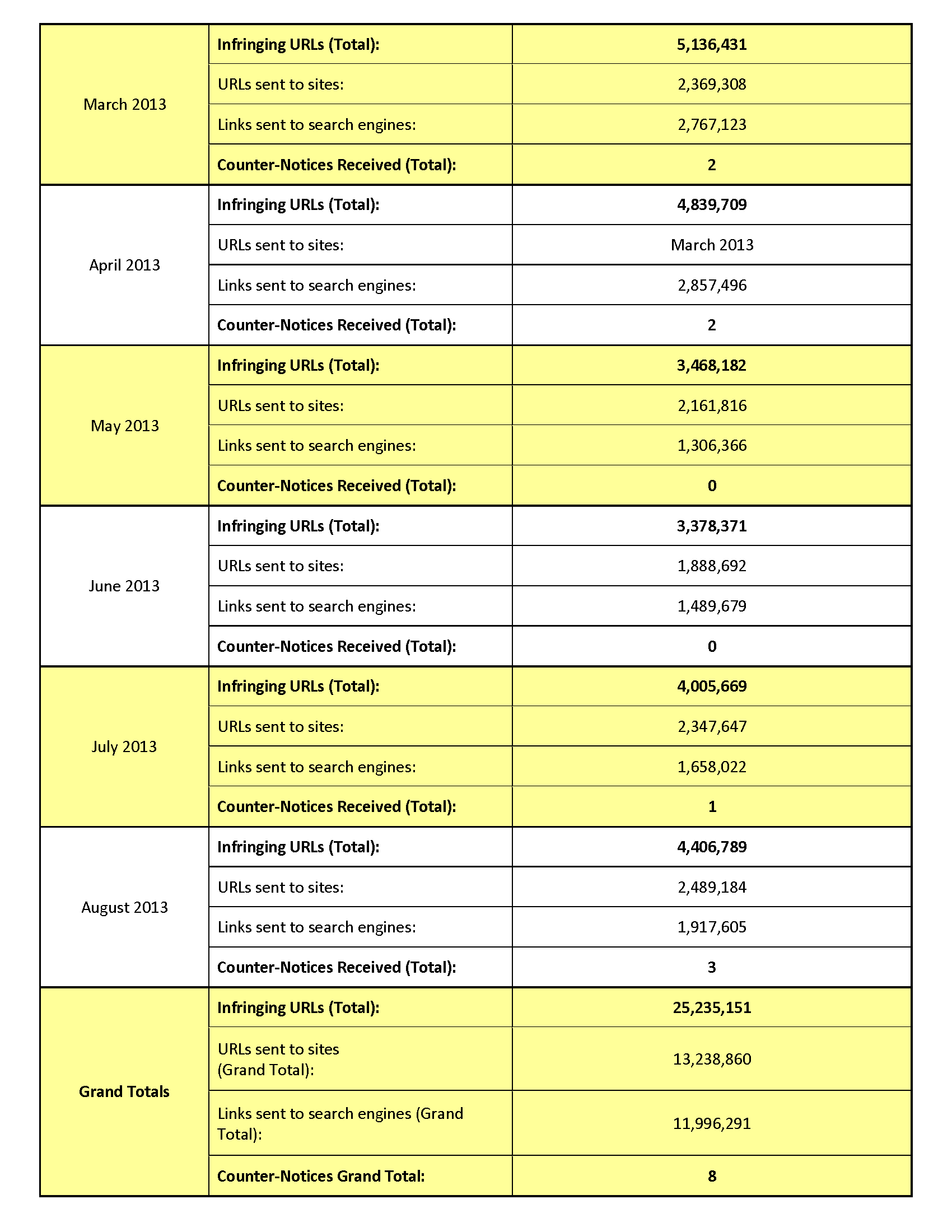
That time may be now: the notice-and-takedown provision of Section 512 is straining under the weight of a blizzard of notices, as copyright owners struggle to abate the availability of infringing copies of their most highly valued works. The tool is no longer up to the task. Mainstream copyright owners now send takedown notices for more than 6.5 million infringing files, on over 30,000 sites, each month. Printing out the list of sites for which Google receives takedown requests in just one week runs to 393 pages. And that just counts the notices sent to Google; duplicates of many of those notices are sent to the site hosts and to other search engines. For example, over a six-month period ending in August, the member companies of the Motion Picture Association of America sent takedown notices for 11,996,291 files to search engines, but sent even more notices—for 13,238,860 files—directly to site operators. (See chart below.)

That amount of effort might be worth the trouble if the flurry of paperwork made more than a dent in the availability of infringing files. Despite all the notice, there is precious little “takedown” to show for it. Unless a site employs some sort of content filtering technology, the same content typically re-appears within hours after it is removed. As a result, this is a system that makes no one happy. Copyright owners are unhappy with the amount of expense and effort the system requires for such paltry results. Online services are unhappy with the burden of having to process and respond to all of those notices. Users are unhappy with inconsistent enforcement and occasional, inevitable mistakes.

The problem is that notice-and-takedown has been pressed into service in a role for which it was never intended. Section 512 was originally designed as an emergency stopgap measure, to be used in isolated instances to remove infringing files from the Internet just long enough to allow a copyright owner to get into court. That design reflected the concerns of its time. In 1998, the dawn of widespread public use of the Internet, there was considerable anxiety about how the law would react to the growing problem of online infringement. Online services worried that they might be held directly liable as publishers for infringing copies of works uploaded by users, despite lacking any knowledge of those copies. Section 512 addressed these concerns by giving service providers a safe harbor to protect them from liability for unknowingly hosting or linking to infringing material.

Since Section 512 was a legislative compromise, Congress sought to address the concerns of copyright owners too – at least the ones they had in the late ‘90s. The problem the creative industries confronted in 1998 was one of content escapes—of copyrighted work moving off of physical formats and onto the Internet. Once there, the speed and accessibility of Internet transmission meant that even a single individual could create a website—or in the 1990s, perhaps a file transfer protocol (FTP) site—and distribute such copyrighted work worldwide. That approach suited the times. Since residential transmission speeds were slow, there was a chance that if copyrighted owners acted quickly enough they could prevent uploaded works from reaching a large audience. Even preparing court papers would take a few days, however; to get immediate results, they would need the assistance of the ISPs hosting the infringing site to help them take it down, at least temporarily.

And that’s why the notice-and-takedown system was added. The goal of notice-and-takedown was to get “service providers and copyright owners to cooperate to detect and deal with” infringing sites before the content was distributed too widely (S. Rep. No. 105-190 at 20 (1998)). It was a more immediate, but temporary, substitute for going into court and getting a temporary restraining order. Indeed, it lasts approximately the same amount of time as a TRO, ten business days.

The DMCA’s statutory language confirms the original, extraordinary nature of takedown requests. The notices themselves are cumbersome to draft, with six required pieces of information in a signed writing. Then, after the online service removes or disables access to the material, there is a complicated game of tennis, as the service provider must first forward the takedown notice to the user, who then may reply with a counternotice asking that the material be restored, which in turn must be forwarded back to the content owner. At that point, the copyright owner has “not less than 10, nor more than 14, business days” to stop the copyrighted work from being replaced by filing a lawsuit. (17 U.S.C. § 512(g)(2)(C)).

The notion that content might leak onto the Internet unless somehow stopped now seems almost quaint. Modern infringement is persistent, ubiquitous, and gargantuan in scale. It is a problem that needs to be policed, not prevented, if our current copyright system is to continue to function. Takedown notices, with their detailed requirements and elaborate back-and-forth, are a poor way to achieve the routine policing of sites that receive thousands of new files every hour.

Indeed, the situation has only gotten worse. The DMCA’s unsuitability as a tool to manage chronic, persistent, and pervasive infringement is particularly apparent after recent decisions from the Second Circuit and Ninth Circuit that construed the duty of website owners very narrowly under Section 512. (See Viacom Int’l, Inc. v. YouTube, Inc., 676 F.3d 19 (2d Cir. 2012); UMG Recordings, Inc. v. Shelter Capital Partners LLC, 106 U.S.P.Q.2d 1253 (9th Cir. 2013). In those decisions, the courts largely rejected any arguments that Section 512 requires site owners to do anything more than remove the specific file identified in a takedown notice, even if a flood of takedown notices arrives all identifying the same copyrighted work, and even if the site owner has tools in place to automatically identify copyrighted work by pattern-matching. (Viacom Int’l, 676 F.3d at 30-31, 41).

The result is that Section 512 takedowns have become largely ineffective for most works. Even for the largest media companies with the most resources at their disposal, attempting to purge a site of even a fraction of the highest-value content is like trying to bail out an oil tanker with a thimble. In their effort to make their most highly sought-after works just slightly harder to find, copyright owners are currently sending notices at an annualized rate of over 78 million infringing files. The expense of locating, identifying, and then sending a notice for that many files is so significant that even large companies must limit their efforts to only their most recent releases. And even then, despite intensive efforts targeted at the most popular files, takedown notices achieve not a single day when the content is not available on the most heavily trafficked sites.

That burden is falling on businesses of all sizes in every creative industry. Of the roughly 6.5 million files Google receives notices for each month from mainstream U.S. copyright owners, approximately 2.1 million are the subject of notices sent by the RIAA, and another 2 million are in notices sent by the MPAA member companies. But more than one-third of the notices received by Google are the results of efforts undertaken by other industries, such as publishing, video games, and software creators, and by smaller record labels and film and television producers.

The enormous investment of effort required under the notice-and-takedown system is a waste of everyone’s resources. Worse, it may create perverse incentives. The impossibility of keeping up with new uploads means that an online service can create a site aimed at and dedicated to hosting infringing copyrighted works, comply with every takedown notice, and still benefit from the safe harbor, as long as its intent remains hidden. If the site has enough users, any popular content removed will be supplanted by new copies almost immediately.

As a result of the increasing futility of takedown notices, some copyright owners and online services have begun seeking ways to avoid the notice-and-takedown system altogether. For example, several large user-generated content sites have adopted technological tools that allow copyright owners to identify their content and specify what should happen when it appears on the service provider’s system, such as blocking or ad placement. Access providers have joined with copyright owners in creating the Copyright Alert System, which is an attempt to police copyright infringement by issuing the equivalent of an escalating series of speeding tickets. These private agreements and coordination efforts (what economists call “private ordering”) may be moves in the right direction, but they also indicate the increasing frustration that copyright owners and online services have with the Sisyphean nature of takedown notices. It’s long past time for a retooling of the notice and takedown regime.

Section 512 Notices Sent by MPAA Companies (Based on information provided by the MPAA)
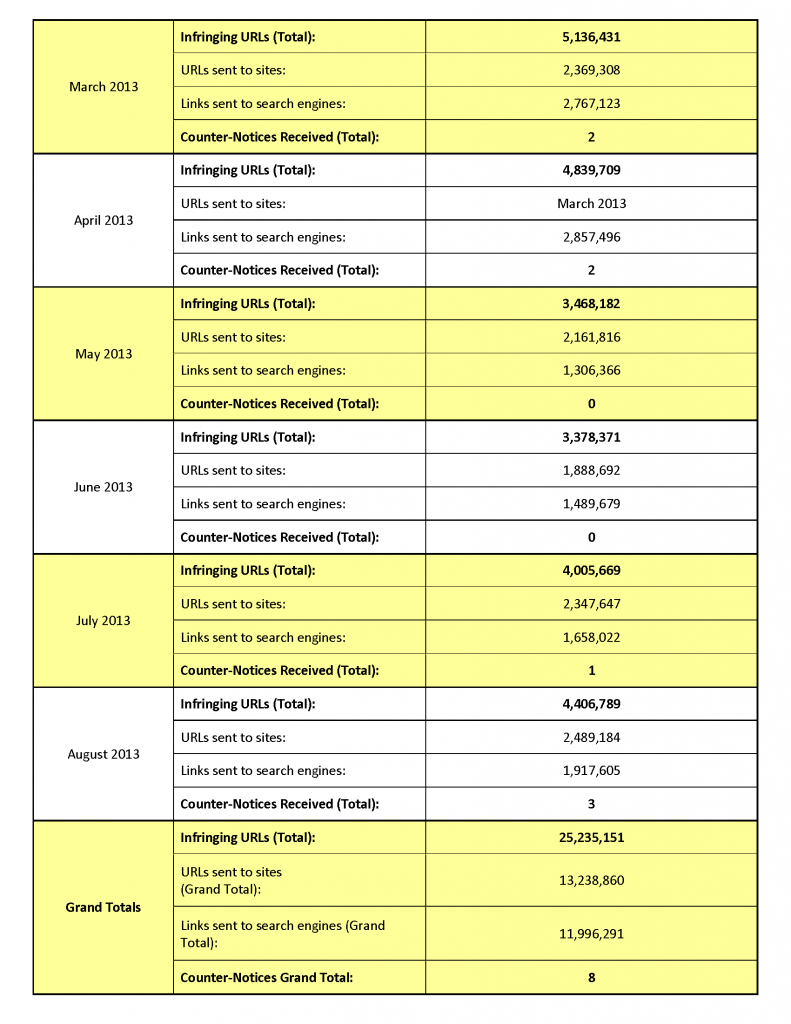
Chart. March 2013: Infringing URLs (Total): 5,136,431. URLs sent to sites: 2,369,308. Links sent to search engines: 2,767,123. Counter-Notices Received (Total): 2. April 2013: Infringing URLs (Total): 4,839,709. URLs sent to sites: March 2013. Links sent to search engines: 2,857,496. Counter-Notices Received (Total): 2. May 2013: Infringing URLs (Total): 3,468,182. URLs sent to sites: 2,161,816. Links sent to search engines: 1,306,366. Counter-Notices Received (Total): 0. June 2013: Infringing URLs (Total): 3,378,371. URLs sent to sites: 1,888,692. Links sent to search engines: 1,489,679. Counter-Notices Received (Total): 0. July 2013. Infringing URLs (Total): 4,005,669. URLs sent to sites: 2,347,647. Links sent to search engines: 1,658,022. Counter-Notices Received (Total): 1. August 2013: Infringing URLs (Total): 4,406,789. URLs sent to sites: 2,489,184. Links sent to search engines: 1,917,605. Counter-Notices Received (Total): 3. Grand Totals. Infringing URLs (Total): 25,235,151. URLs sent to sites (Grand Total): 13,238,860. Links sent to search engines (Grand Total): 11,996,291. Counter-Noticed Grand Total: 8.


Categories
Uncategorized

Copyright is Still Essential to a Free Market in Creative Works

In the modern digital era, strong copyright protection is still an essential component of a flourishing free market in creative works.  Viewed properly as a property right in creative works, copyright is fundamental to economic freedom in our creative economy.  Criticisms of copyright have flooded the public policy debate in recent years.  Proponents of weakening or eliminating copyright protection argue that copyright is outdated in the digital age, and that given the ease with which creative works can be distributed and shared online, creators today no longer need robust copyright protection to incentivize the development of creative works.  Arguments against strong copyright protection hinge on the belief that copyright should be treated differently from other property rights, eschewing the traditional “right to exclude” in favor of the public’s right to access or use the creative works of others.  But the arguments for weakening copyright overlook copyright’s fundamental role in fostering a vibrant creative economy – a role that is every bit as important today as it was before the digital revolution.

Proponents of scaling back copyright protection claim that a robust, property-based copyright system is undesirable because (1) it is not needed to incentivize the production of creative works, and (2) it harms the public by unduly restricting people’s right to access and use creative works.  Putting aside several inherent flaws in this reasoning (including the implicit assumption that having to pay for creative works will unduly restrict access, as well as the general disregard of individuals’ property interest in the fruit of their labor), this argument fails from an economic standpoint because it ignores the fundamental function of copyright in developing and maintaining the market mechanisms that facilitate not just the creation, but also the commercialization and distribution of creative works.  The approach also fails because it assumes the continued production of valuable creative works at economically optimal levels without a basis for such an assumption.  Furthermore, focusing primarily on the incentive to create, while ignoring copyright’s larger economic role in supporting a free market economy for creative works, overlooks a critical function of copyright protection.

It is particularly surprising when libertarians and conservatives, traditional champions of the free market, echo this flawed analysis and ignore copyright’s broad role in promoting an efficient market for creative works.  In general, conservatives and libertarians recognize that strong private property rights form the foundation of a free market economy.  Property rights are pre-market – they are essential building blocks of economic freedom, and without strong property protection it is difficult to imagine an efficient capitalist market for any set of goods or services.  Yet, when it comes to intellectual property (and copyright in particular) some libertarians and conservatives are willing to join forces with the far left in assuming that a vibrant economy for creative works can occur in the absence of strong property protection.

One common approach focuses on the idea that property-based copyright protection is unnecessary given the efficiencies and new potential business models of the digital age (sometimes bolstered by the argument that it is simply not possible to enforce intellectual property in the internet age).  Underlying this thinking is the implicit assumption that, because of their failure to adjust their business models away from reliance on copyright, creators themselves are responsible for today’s rampant digital theft.  The Mercatus Center’s recent piracydata.org project is a good example of this mindset.  The project does nothing more than lead us to the unsurprising conclusion that people are more likely to steal content that is not easily available by legal means.  As Jerry Brito (the project’s chief architect) explained to the Washington Post, Hollywood could change its business model to combat their piracy problem, and if they choose not to do so they have “no business complaining” about technology companies that facilitate digital theft.  This kind of reasoning echoes back to arguments from a decade ago that technology could serve as a “partial replacement” for copyright protection.  One need only look at the current state of our creative industries to see how well technology has “replaced” copyright in protecting the free market economy for creative works.

Despite repeated calls to weaken or eliminate the property-based copyright system, there are no clear alternative legal models that would maintain a functional economy for the creative industries.  Lessons from real-world examples of weakly-enforced copyright regimes, where piracy is rampant and royalty payments and licensing fees are rare, further underscore this point.  As Mark Schultz’s and Alec van Gelder’s research on creative development in Africa has revealed, lack of strong, effectively-enforced copyright laws can have a devastating effect on a country’s ability to develop economically functional creative industries.  As a result, creative industries remain heavily “underappreciated and underexploited,” with tragically low gross domestic product yields.  In some countries, musicians have even resorted to “noisy street protests and personal confrontations with pirates” to address the destruction of their livelihood by piracy and their countries’ failure to effectively support the creative industries. This stands in stark contrast to thriving creative upstart economies supported by strong copyright protection.

Another popular belief among opponents of property-based copyright protection is that alternative business models can effectively replace copyright and support an efficient free market for creative works.  For example, some argue that the music industry will evolve to a point where copyright is no longer relevant because recordings will be freely shared and live performance fees will fuel the creation of new music.  As Mark Schultz illustrates in his thoughtful study of the role of live performance in the music industry, this belief is sadly mistaken.  The live performance business model is not lucrative enough to support significant production of freely-distributed recorded music.  Rather, weaker (or non-existent) copyright protection would likely result in a loss “of the variety and vitality of the music market,” and artists who can’t generate enough touring revenue or alternative income would likely simply leave the industry.  The argument that changing business models can supplant copyright is even more absurd in the context of the film industry, where creative works are significantly more expensive to produce and often involve the joint effort of hundreds of people.

Inefficiencies are also common in models that tend to overregulate or distort the free market for creative works.  Compulsory licensing regimes introduce the inefficiencies of statutory rate-setting, where pre-set compensation can easily distort the free market pricing of creative works.  Such systems also notoriously lend themselves to rent-seeking efforts to influence rates.  Culturally protectionist state patronage models, such as certain European countries’ models for financing film production, likewise disrupt free market efficiencies in the creative economy.  By diminishing the link between creators and audiences (i.e. supply and demand), these models create a vicious cycle of falling revenues, diminished private funding, and low-quality creative works.

Lastly, even granting the assumption that in the absence of strong copyright protection creators would continue to produce an optimal level of valuable creative works, the lack of copyright protection would still disrupt the efficient commercialization of those works.  Adam Mossoff’s analysis of copyright in the context of scholarly publishing provides a good example in this regard.  Some scholars and scientists conduct research and produce work without incentives from potential copyright royalties.  Instead, they may be motivated by academic recognition, career placement, awards, or pure scholarly curiosity.  Copyright critics would argue that this is a perfect example of an area where copyright protection is unnecessary to the extent that it does not incentivize the production of these scholarly works.  What this analysis fails to consider, however, is copyright’s essential role in supporting the free market distribution of reliable scholarly works.

Compounding the problem is the mistaken belief that in the modern “digital age” publication and distribution of high-quality creative works is free.  In fact, as Adam Mossoff’s research finds, the infrastructure supporting digital distribution of scholarly articles is very expensive.  Publishers of digital scholarly works have invested hundreds of millions of dollars ex ante to establish mechanisms to efficiently deliver published research to scholarly consumers (including mobile platforms, websites, and other technology), and strong copyright protection in the underlying works is essential to protecting publishers’ investment in these innovative new distribution mechanisms.  Thus, even in rare cases where copyright may not provide an incentive for the initial creation of certain works, copyright is still essential to support the efficient free market for distributing those works.

In conclusion, even in today’s digital age, strong property-based copyright protection remains an essential component of our creative economy.  It is the bedrock supporting the free market for creative works, and it is vital to maintaining the market mechanisms that promote the creation, commercialization, and distribution of creative works.  Repeated calls to weaken copyright (and accompanying suggestions of alternative legal or business models) routinely ignore copyright’s fundamental economic importance.  Conservatives and libertarians that hold free markets in the highest esteem should be particularly sensitive to this.  Efficient free markets cannot occur without strong underlying property rights, and weakening copyright would thus undoubtedly hurt our creative economy.