Led by Prof. Adam Mossoff and C-IP2 Senior Fellow and Senior Scholar Prof. Jonathan M. Barnett, twenty-five law professors, economists, and former United States Government officials—including C-IP2 Advisory Board members the Honorable Andrei Iancu, the Honorable David J. Kappos, the Honorable Paul Michel, and the Honorable Randall R. Rader; Faculty Director Prof. Sean M. O’Connor; Senior Scholar Prof. Kristen Osenga; and Scholar Dr. Bowman Heiden—submitted a letter in response to a “call for evidence” on the licensing, litigation, and remedies of standard-essential patents (SEPs). The response discusses core functions of SEPs in the wireless ecosystem, the lack of evidence of Patent Holdup and Royalty Stacking, assumptions about SEPs and Market Power, the importance of the potential for injunctive relief even for FRAND, levels of licensing, and SEP licensing in SME markets. The letter is available here on SSRN.
The following post comes from Laura Mertens and is cross-posted here from Mason’s Center for the Arts website with permission.
Known for fearless musical exploration and beautifully blurring lines between genres, composer Maria Schneider has earned seven GRAMMY Awards across the realms of jazz, classical, and even her work with David Bowie. Serving as Mason Artist-in-Residence this April, she led a powerful series of events across Fairfax and Arlington campuses with students, faculty, staff, and community members. Launched during the 2019-2020 season, the Mason Artist-in-Residence program connects artists appearing at the Center for the Arts in Fairfax and the Hylton Performing Arts Center in Manassas with communities throughout Northern Virginia in a variety of activities for diverse audiences, creating opportunities for transformational experiences.
Through discussions, open rehearsals, and a culminating concert, the residency helped reinforce how Schneider became a groundbreaking visionary in the field. Events began with Beyond the Notes with Maria Schneider: A Conversation about Respecting Artist Rights, held on April 14 in Van Metre Hall on Mason’s Arlington Campus, and co-hosted by Mason’s Center for Intellectual Property x Innovation Policy (C-IP2) and Arts Management Program. George Mason University Antonin Scalia Law School Professor and Arts & Entertainment Advocacy Clinic Director Sandra Aistars moderated the conversation with Schneider, which was also streamed live to an audience including individuals joining in from Ghana, Nigeria, the UK, and India.
Aistars said, “Maria Schneider seamlessly blends her art and her advocacy. Her skill in both musical composition and arts advocacy is that she moves us to hear what she shows us, often through unconventional means—be it the beauty of the natural world, the poignancy of a shared moment between friends, or the artist’s struggle to preserve dignity and rights in the digital world. She is also fierce. We need artists like Maria who are not afraid to remind corporations, fans, and artists alike to behave ethically towards one another if they hope to maintain a healthy music ecosystem that will sustain the next generations of artists and audiences.”
Schneider discussed her expansive approach to big band instrumentation, noting that the ensemble is a “solid, powerful medium,” but that she loves to push its boundaries to explore further, asking, “How can I stretch this instrumentation?” Weaving together recorded clips of music and conversation, the Thursday event began with a recording of her work “Cerulean Sky,” which combined flute, muted trumpet—and birdsong. She acknowledged, “It doesn’t sound much like a big band, but it is.”
The LA Times has said, “…Schneider’s [music] reaches toward a significant new level of imagination, making hers the first truly novel approach to big jazz band composition of the new century.” She explained to the crowd, “I’ve always been a composer who wants to explore new ground.” She credits her mentors with helping her hone her unique compositional voice, including jazz pianist/arranger/composer/bandleader Gil Evans and the “ethereal quality” of his work, and Bob Brookmeyer, her composition teacher who saw her natural inclination towards jazz despite all her classical training, and encouraged her to go chart for big bands. Of her recent work, the 2021 Pulitzer Prize finalist piece Data Lords, NPR said, “This is music of extravagant mastery, and it comes imbued with a spirit of risk.”
Schneider’s risk-taking has also helped blaze a trail for the trend of crowdfunding, as one of the first artists to sign with ArtistShare, today widely recognized as an early precursor to websites like KickStarter, IndieGoGo, and PledgeMusic. She says ArtistShare founder Brian Camelio explained to her, “One thing you can’t fileshare is the creative process.” She notes that she documents her process on the platform through internet-exclusive streaming videos, sketches of her scores, and photos from rehearsals and concerts. “You can announce you’re doing a project, feature interviews with players, allow fans to become closer to the music. . . I like that I don’t have any anonymous sales.” Releasing her “Concert in the Garden” album on ArtistShare in 2004, she became the first artist to win a GRAMMY Award for an album not available in retail stores. Schneider exhorted artists in the room to “Never give up creative control of your work.”
Attendee and second-year law student Brianna Marie Christenson, a member of Prof. Aistars’ Arts and Entertainment clinic who has worked as a business manager and plans to go into copyright law, said, “Maria Schneider shows creatives how to use a technology built to serve the audience and not the artist, like music streaming platforms, work for both artist and fan. Her use of online platforms to find new fans and bring them to her own site for sale of her repertoire is a brilliant way to handle having a niche audience while trying to recoup on albums. . . .Her leadership in use of crowdfunding is something artists replicate en masse now.”
Schneider has also testified about digital rights before the House Judiciary Subcommittee on Intellectual Property, participated in round-tables for the United States Copyright Office, given commentary on CNN, and filed a class-action lawsuit against YouTube.
Mason Alumnus and Assistant Professor of Jazz Studies John M. Kocur, a saxophonist who also rehearsed for six hours with Schneider and played on the April 16 concert, notes, “Maria Schneider valiantly defends of the rights of musicians against corporate interests. She makes music for social advocacy and advocates for musical justice. The core of her message is that our intellectual property is valuable, and we ought to guard it carefully or our entire culture will suffer.”
While embracing technology to allow artists to be more independent, Schneider also emphasized the need to unplug, telling Mason Jazz Ensemble students in an open rehearsal/Q&A on April 15 at the Center for the Arts: “I don’t believe you can be a great artist unless you give yourself space. Leave your phone at home. Allow yourself to get bored. That’s when you start to imagine things. Dream it up. Make something. You will come through your music.”
Schneider’s rehearsal with the Mason Jazz Ensemble students and additional sessions with the professional Metropolitan Jazz Orchestra culminated in the galvanizing April 16 concert at the Center, with Schneider conducting her own works performed by the ensembles.
Featured Mason Artists-in-Residence in the newly announced 2022/2023 Center for the Arts season, will include Nrityagram Dance Ensemble, Indigenous Enterprise, and the launch of a three-year residency with Silkroad Ensemble. Learn more about the Mason Artist-in-Residence program at cfa.gmu.edu/about/artists-residence.
 Greetings from C-IP2 Faculty Director Sean O’Connor
As we move further into spring of 2022, we are simultaneously emerging––gradually and hopefully––from the global health crisis of these past two years. In-person gatherings and events are steadily resuming in the Washington, D.C., area and in many places around the world, and it’s wonderful to share the same spaces once again with friends and colleagues, old and new. Early last December, C-IP2 held our first large-scale in-person event since 2020 with our hybrid conference on Intellectual Property and Innovation Policy for 5G and the Internet of Things. Excepting January 2022’s Edison Fellowship meeting and precautions taken against the Omicron variant, we have been moving ahead with primarily in-person programming for 2022, and we hope you will keep an eye on our website and email communications for opportunities to join us and engage with us. In the meantime, our Spring 2022 Progress Report below (spanning December 2021 through February 2022) will catch you up on the activities and scholarship of C-IP2 and affiliates in recent months, and we continue to wish you good health in the months to come.
C-IP2 Hosted & Co-Hosted Events
Academic ConferenceOn December 2-3, 2021, C-IP2 hosted an academic conference on 5G and Beyond: Intellectual Property and Competition Policy in the Internet of Things. The event was both held in person and livestreamed from George Mason University, Antonin Scalia Law School, and featured as speakers many of the contributors for the upcoming corresponding book, 5G and Beyond: Intellectual Property and Competition Policy in the Internet of Things, which is being co-edited by Professors Jonathan Barnett and Sean O’Connor and has been accepted for publication by Cambridge University Press (Forthcoming 2022). Thomas Edison Innovation Law and Policy FellowshipOn January 20-21, 2022, C-IP2 hosted the third and final meeting of the 2021-2022 Thomas Edison Innovation Law and Policy Fellowship. The Edison Fellows presented substantially revised drafts of their research papers and received feedback from Distinguished Senior Commentators and other Fellows. The plan is for Fellows to submit their final papers to journals for the March submission period.
News & Speaking Engagements
We are pleased to welcome and announce the scholars and practitioners who have joined C-IP2 over the course of December 2021 through February 2022: Tun-Jen Chiang as a Senior Scholar; Gregory Dolin, John Liddicoat, and Amy Semet as Scholars; and Theo Cheng, Stephanie Semler, and Eric Solovy as Practitioners in Residence. The Antonin Scalia Law School winter graduation was held on December 16, 2021, at Eagle Bank Arena in Fairfax, VA. C-IP2’s December 2021 5G conference was mentioned by ThinkBRG, which noted BRG Executive Chairman David J. Teece’s participation in a panel on “Global Differences in Antitrust Treatment of SEPs and SSOs.” C-IP2 was mentioned in a February story on Broadway World, highlighting their upcoming April 2022 event with GRAMMY Award-winning composer Maria Schneider, co-hosted with George Mason University Center for the Arts. In February, Jeffrey E. Depp—a 2022-2023 Thomas Edison Innovation Law and Policy Fellow with C-IP2 and PhD student at the University of Pittsburgh Graduate School of Public and International Affairs—received the Volunteer of the Year Award from AUTM. Professor Sean M. O’Connor posted his book chapter “AI Replication of Musical Styles Points the Way to an Exclusive Rights Regime,” which is part of the upcoming book Research Handbook on Intellectual Property and Artificial Intelligence (Edward Elgar 2022 Forthcoming), edited by Dr. Ryan Abbott. Sandra Aistars (C-IP2 Senior Fellow for Copyright Research and Policy & Senior Scholar; Founding Director, Arts & Entertainment Advocacy Clinic; Clinical Professor of Law, George Mason University Antonin Scalia Law School)
-
- Served as a commentator at the University of Akron IP Scholars Forum on December 9-10, 2021
- Scholarly contributions to advancing copyright law cited in a December 16 IPWatchdog article on The Year in Copyright: From Google v. Oracle to the Takings Clause by Devlin Hartline, Legal Fellow at the Hudson Institute’s Forum for Intellectual Property in Washington, D.C. (Items cited include: March 27, 2018, organizing and drafting IP scholars briefing in a decade of briefing culminating before the Supreme Court in Google LLC v Oracle America, Inc. opinion; a May 9, 2019, IPWatchdog article with the Copyright Alliance’s Kevin Madigan on the CASE Act; 2018 scholarly article on a small copyright claims tribunal; and research and analysis cited in the August 2021 U.S. Copyright Office’s Copyright and State Sovereign Immunity report)
- On January 13, participated in a Copyright Alliance meeting to discuss the December 30 CASE Act notice of proposed rulemaking (NPRM)
- In February, along with the Arts & Entertainment Advocacy Clinic, filed initial and reply comments by IP scholars regarding Law Student and clinic participation in representation of individuals and small businesses before the CCB pursuant to the CASE Act
- Quoted in a February 11 article on The Verge, “Artists Are Playing Takedown Whack-A-Mole To Fight Counterfeit Merch”
Jonathan Barnett (C-IP2 Senior Fellow for Innovation Policy & Senior Scholar; Torrey H. Webb Professor of Law, USC Gould School of Law)
-
- Helped to organize and participated in C-IP2’s December conference on 5G and IP as a co-editor with Professor Sean O’Connor on the upcoming corresponding book, 5G and Beyond: Intellectual Property and Competition Policy in the Internet of Things
- On January 19, presented at a webinar hosted by the 4iP Council (Jan. 20, 2022), “Solution in Search of a Problem: The Economic Case Against Licensing Negotiation Groups in the Internet of Things”
- On February 4, co-authored and submitted comments with fellow scholars of law, economics, and business regarding the Draft USPTO, NIST, & DOJ Policy Statement on Licensing Negotiations and Remedies for Standard Essential Patents Subject to Voluntary F/RAND Commitments
- Mentioned in a February 7 Foss Patents blogpost, “In its replies to Apple’s public interest statements, Ericsson points the ITC to Apple’s 30% app tax and market definition in Epic Games case”
Chief Judge Susan G. Braden (Court of Federal Claims (Ret.); C-IP2 Jurist in Residence)
-
- On December 8, attended the USPTO Private Patent Advisory Committee Meeting on Congressional Legislation
- On January 19, took part in Designated Chair of Artificial Intelligence Tools and Information Technology Subcommittee, USPTO Private Patent Advisory Committee
- On January 27, joined Meeting with Matthew Such, Group Leader, Patent Product Line Lead, Office of Patent Information Management, USPTO re AI priorities for 2022
- On January 31, completed Working Draft of “Section 1498 (a): NOT A RX FOR LOWER PHARMA PRICES” (out for academic comment), which was co-authored with Joshua Kresh, C-IP2 Managing Director
- In February, was appointed to the 2022 National Vaccine Law Conference Committee
- On February 8, attended the USPTO Private Patent Advisory Committee Innovation, Expansion, and Outreach Subcommittee Meeting
- On February 9, attended the Executive Session of USPTO Private Patent Advisory Committee
- On February 10, attended the USPTO Private Patent Advisory Artificial Intelligence Tools and Information Technology Subcommittee Meeting
- On February 25, met with the Lead Business Development SAS US Alliances/Channels Team
Terrica Carrington (C-IP2 Practitioner in Residence; VP, Legal Policy and Copyright Counsel, Copyright Alliance)
-
- Helped organize and co-host a December 6 event (sponsored by the Copyright Alliance and the U.S. Chamber of Commerce’s Global Innovation Policy Center and Equality of Opportunity Initiative) titled “A Conversation on Diversity and Inclusion in Copyright,” where speakers and attendees discussed how to increase participation from underrepresented communities in the copyright sector industries and professions
- Nominated in January 2022 for the G. Hamilton Loeb Award for Pro Bono Excellence in recognition of her work to support the arts
- Quoted in a January 11 article by Franklin Graves on Tubefilter, “Here Are The Legal Issues Affecting Content Creators in 2022”
Theo Cheng (C-IP2 Practitioner in Residence; Arbitrator and Mediator, ADR Office of Theo Cheng LLC; Adjunct Professor, New York Law School)
-
- In December, his article “Conducting Remote Mediations During the Pandemic” was published in the New York State Bar Association Trial Lawyers Digest
- On December 22, gave a two-hour presentation on “Diversity, Implicit Bias & Cross-Cultural Skills in ADR” to the court staff at the Supreme Court of New York, Appellate Division, Second Department
- Joined C-IP2 as a Practitioner in Residence in January
- On January 11, was a co-presenter on a program entitled “Nonparty Discovery in U.S. Arbitrations: The Legal Challenges & Differences from Litigation” for the New York State Bar Association that was sponsored by the Dispute Resolution Section Domestic Arbitration Committee
- On February 23, moderated a panel entitled “Diversity, Inclusion and Elimination of Bias in Evidentiary Analysis and Decision Making.” The panel was part of an all-day program held by the New York County Lawyers Association for New York’s Part 137 Fee Disputes and Conciliation Arbitration Training Program
Tun-Jen Chiang (C-IP2 Senior Scholar; Professor of Law, George Mason University, Antonin Scalia Law School)
-
- Joined C-IP2 as a Senior Scholar in January
Eric Claeys (C-IP2 Senior Fellow for Scholarly Initiatives & Senior Scholar; Professor of Law, George Mason University Antonin Scalia Law School)
-
- On January 20-23, co-organized and participated in the third and final meeting of the 2021-2022 Thomas Edison Innovation Law and Policy Fellowship
Gregory Dolin (C-IP2 Scholar; Associate Professor of Law, University of Baltimore School of Law)
-
- Joined C-IP2 as a Scholar in January
John F. Duffy (C-IP2 Senior Scholar; Samuel H. McCoy II Professor of Law and Paul G. Mahoney Research Professor of Law, University of Virginia School of Law)
-
- On January 20-21, served as a Distinguished Senior Commentator during the third and final meeting of the 2021-2022 Thomas Edison Innovation Law and Policy Fellowship
Tabrez Ebrahim (C-IP2 Scholar; Associate Professor, California Western School of Law)
-
- Professor Ebrahim will be joining Lewis & Clark Law School and the Center for Business Law and Innovation [Lewis & Clark Law School, Leiter Law School] this coming Fall 2022
- In January, gave a presentation entitled “Datafication & Data Governance at the Patent Office” at the virtual AALS Annual Meeting: New Voices in Intellectual Property Law Scholarship
- Joined a research project with the University of Arizona’s Center for Quantum Networks (January 2022-Present) as a Fellow (Thrust 4: Societal Impact of the Quantum Internet)
- On February 4, presented on a panel entitled Data Privacy & Democracy at the Lewis & Clark Law School’s 3rd Annual Data Privacy Forum
- On February 19, presented a draft article entitled An Information Theory of Data Governance at the Patent Office as part of the 19th Works in Progress for Intellectual Property Scholars Colloquium (WIPIP 2022), co-hosted by St. Louis University School of Law and University of Missouri School of Law
Jon M. Garon (C-IP2 Senior Scholar; Professor of Law and Director of the Intellectual Property, Cybersecurity, and Technology Law program, Nova Southeastern University Shepard Broad College of Law)
-
- In December, served as Moderator and Program Coordinator for Business Law Basics – Lost in Tokenization: Legal Implications of Non-Fungible Tokens on Finance, Art, Property, and Culture, American Bar Association Business Law Section [This 90-minute CLE is free-on-demand for all ABA Business Law Section members]
- In December, developed a CLE program which he moderated entitled Business Law Basics – Lost in Tokenization: Legal Implications of Non-Fungible Tokens on Finance, Art, Property, and Culture, American Bar Association Business Law Section
- In January, presented Legal Strategies for the Metaverse and the Evolving Media Landscape (American Bar Association, Business Law Section Cyberspace Law Committee, Cyberspace Law Institute)
- Has contracted to publish a new book entitled Teaching and Learning in the Metaverse: Using Online Platforms, Games, NFTs, and Blockchain in Education with Rowman & Littlefield (2023)
- On February 22, gave a virtual presentation on Understanding the Evolving Media Landscape for Nova Southeastern University’s Lifelong Learning Institute
- On February 22, received a “Top Ten” Download from SSRN.com for six electric journals. His draft article, Legal Implications of a Ubiquitous Metaverse and a Web3 Future, is available at SSRN
- Latest book, Parenting for the Digital Generation – The Parent’s Guide to Digital Education and the Online Environment (Rowman & Littlefield 2022), is available for order both in stores and online [Rowman & Littlefield, Amazon, Barnes & Noble]
Christopher Holman (C-IP2 Senior Fellow for Life Sciences & Senior Scholar; Professor of Law, University of Missouri-Kansas City School of Law)
-
- Spoke at the FDA-PTO Roundtable at the George Washington University Law School on December 21
- On January 20-21, served as a Distinguished Senior Commentator during the third and final meeting of the 2021-2022 Thomas Edison Innovation Law and Policy Fellowship
- On January 21, spoke as a panelist at the FDA-PTO Roundtable on patents and pharmaceutical pricing at the George Washington University Law School
- On January 28, spoke on a panel entitled “FDA and Patents? FDA’s Letter to the USPTO and Possible Next Steps” as part of the Food, Drug & Cosmetic Law Section at the New York State Bar Association Annual Meeting
- On February 18, presented a draft article entitled Evolution of the Antibody Patent as part of the 19th Works in Progress for Intellectual Property Scholars Colloquium (WIPIP 2022), co-hosted by St. Louis University School of Law and University of Missouri School of Law
Camilla A. Hrdy (C-IP2 Scholar; Research Professor in Intellectual Property Law, University of Akron School of Law)
-
- Article “Abandoning Trade Secrets” (with Mark A. Lemley), 72 Stan. L. Rev. 1 (2021) was cited by a U.S. District court in Providence Title Co. v. Truly Title, Inc., et al., No. 4:21-CV-147-SDJ, 2021 WL 2701238 (E.D. Tex. July 1, 2021)
- Article “The Trade Secrecy Standard for Prior Art” (with Sharon K. Sandeen), 70 Am. U. L. Rev. 1269 (2021) was selected as the featured patent law article for American University Law Review’s annual Federal Circuit Symposium Issue
- On December 10, new article, “The Value in Secrecy,” was identified as one of the best works of recent scholarship relating to intellectual property law by Jotwell: The Journal of Things We Like (Lots) [SSRN]
- On December 13-14, attended The Sedona Conference WG12 Annual Meeting 2021 in Phoenix, AZ. Prof. Hrdy is a Member of Brainstorming Group on “What Can and Cannot Be a Protectable Trade Secret?”
- Authored a January 12 post on the Written Description blog entitled “Jessica Litman: Who Cares What Edward Rogers Thought About Trademark Law?”
- Mentioned in a February 10 Law360 article, “Hytera Indictment May Set New Path For Trade Secrets Cases”
Dmitry Karshtedt (C-IP2 Scholar; Associate Professor of Law, The George Washington University Law School)
-
- Co-authored a December 22 amicus brief on Amgen Inc. v. Sanofi
- Quoted in a January 12 BloombergLaw article by Ian Lopez, Hikma Drug Label Win Still Leaves Generics on Hook for Liability
- Spoke at the FDA-PTO Roundtable at the George Washington University Law School on January 21
- Quoted in a January 27 Law360 article by Ryan David, Breyer’s Rulings Shaped By Wariness Of Intellectual Property
- On February 18, presented a draft article entitled An Information Theory of Data Governance at the Patent Office as part of the 19th Works in Progress for Intellectual Property Scholars Colloquium (WIPIP 2022), co-hosted by St. Louis University School of Law and University of Missouri School of Law
- Placed in-progress paper, Pharmaceutical Patents and Adversarial Examination in The George Washington Law Review, forthcoming 2023
Hon. Prof. F. Scott Kieff (C-IP2 Senior Scholar; Fred C. Stevenson Research Professor, The George Washington University Law School)
-
- Gave the keynote address at C-IP2’s December conference on 5G and IP as a contributor to the upcoming corresponding book, 5G and Beyond: Intellectual Property and Competition Policy in the Internet of Things
Dr. John Liddicoat (C-IP2 Scholar; Senior Research Associate and Affiliated Lecturer, Faculty of Law, University of Cambridge)
-
- Joined C-IP2 as a Scholar in January 2022
- On January 20-21, participated as an Edison Fellow during the third and final meeting of the 2021-2022 Thomas Edison Innovation Law and Policy Fellowship
- Chaired a February 10 seminar hosted by Cambridge University’s Centre for Intellectual Property and Information Law (CIPIL), presented by speaker David Webb (Herbert Smith Freehills), and entitled FRAND: Where are we: And where are we going? (read more here and click here to view the recording on YouTube)
Joshua Kresh (C-IP2 Managing Director)
-
- On January 20-21, co-organized and participated in the third and final meeting of the 2021-2022 Thomas Edison Innovation Law and Policy Fellowship
- On January 31, completed Working Draft of “Section 1498 (a): NOT A RX FOR LOWER PHARMA PRICES” (out for academic comment), which was co-authored with Judge Susan G. Braden
Daryl Lim (C-IP2 Senior Scholar; Professor of Law and the Director of the Center for Intellectual Property (IP), Information & Privacy Law, University of Illinois Chicago School of Law)
-
- On December 9, was a Discussant during the virtual Fordham IP Institute Global IP Roundtable
- On December 14, was a Moderator during the virtual 4th edition of the Paris conference on Standard Essential Patents (SEPs) and FRAND (Session 1)
- Was a Speaker for “Can Computational Antitrust Succeed?” during the virtual Computational Antitrust: Exploring Antitrust 3.0 conference at the Stanford Center for Legal Informatics, December 13-15, 2021
- On December 17, was a Discussant/Commentator at the Centre for Financial Regulation and Economic Development (CFRED) at the Chinese University of Hong Kong Law (CUHK Law) and the Center for Law and Intellectual Property at Texas A&M University School of Law’s workshop on Anti-suit Injunctions and FRAND Litigation in China
- In a December 28 IPWatchdog piece, provided his choices for “the biggest moments in IP for 2021”
- Mentioned in a February 3 article by Penn State, “Penn State Dickinson Law announce new resident faculty appointment”
- On February 8, spoke on “What can Copyright Law Learn from Design Law?” during the virtual ABA-IPL Design Rights Committee Fireside Chat
Hina Mehta (C-IP2 Practitioner in Residence; Director, Office of Technology Transfer, George Mason University)
-
- Attended the February 20-23 Association of University Technology Managers Conference where she served as instructor for a half day professional development course on Negotiations
Emily Michiko Morris (C-IP2 Senior for Life Sciences and Scholar; C-IP2 2021-2022 Edison Fellow; David L. Brennan Endowed Chair, Associate Professor, and Associate Director of the Center for Intellectual Property Law & Technology, University of Akron School of Law)
-
- Spoke at the FDA-PTO Roundtable at the George Washington University Law School on December 21
- On January 20-21, participated as an Edison Fellow during the third and final meeting of the 2021-2022 Thomas Edison Innovation Law and Policy Fellowship
- Spoke at the FDA-PTO Roundtable at the George Washington University Law School on January 21
Sean M. O’Connor (C-IP2 Faculty Director; Faculty Director, Innovation Law Clinic; Professor of Law, George Mason University Antonin Scalia Law School)
-
- On December 1, gave an LLC presentation with Antonin Scalia Law School’s Dean Ken Randall to George Mason University’s Green Machine
- Helped to organize and spoke at C-IP2’s December conference on 5G and IP as a co-editor with Professor Jonathan Barnett on the upcoming corresponding book, 5G and Beyond: Intellectual Property and Competition Policy in the Internet of Things
- On January 20-21, co-organized and participated in the third and final meeting of the 2021-2022 Thomas Edison Innovation Law and Policy Fellowship
- On January 23, gave a virtual Texas A&M IP Management talk
- On January 31, spoke at a seminar as part of the Loyola Law School’s Intellectual Property and Information Law Speaker Series at Loyola Marymount University in Los Angeles, California
Kristen Jakobsen Osenga (C-IP2 Senior Scholar; Austin E. Owen Research Scholar and Professor of Law, University of Richmond School of Law)
-
- Spoke at C-IP2’s December conference on 5G and IP as a contributor to the upcoming corresponding book, 5G and Beyond: Intellectual Property and Competition Policy in the Internet of Things
- On January 5, served as a senior commentator in an IP Works in Progress session for a paper by Tabrez Ebrahim at the Association of American Law Schools (AALS) Annual Meeting
- On January 7, served a moderator for a Federalist Society Works in Progress Mini-Conference panel
- On January 25, participated in a Hudson Institute roundtable about national security & IP
- On February 4, was cited in and submitted comments with fellow scholars of law, economics, and business regarding the Draft USPTO, NIST, & DOJ Policy Statement on Licensing Negotiations and Remedies for Standard Essential Patents Subject to Voluntary F/RAND Commitments
- Filed a brief with Professors Jonathan Barnett, Richard Epstein, and Adam Mossoff to the International Trade Commission about the importance of exclusionary order for SEPs and public interest in the Ericsson v. Apple case. Filing was mentioned in a February 7 Foss Patents blogpost, “In its replies to Apple’s public interest statements, Ericsson points the ITC to Apple’s 30% app tax and market definition in Epic Games case”
- Spoke on a February 16 panel entitled, “Theory to Doctrine: Should Specific Antitrust Doctrines or Cases Be Revisited in the Digital Age?” The panel was part of the Big Tech and Antitrust Conference, and sponsored by the Gibbons Institute of Law, Science & Technology, and the Institute for Privacy Protection at Seton Hall Law School.
- On February 18, participated in the 15th Annual Evil Twin Debate against Jorge Contreras (Presidential Scholar and Professor of Law, University of Utah S.J. Quinney College of Law). Profs. Contreras and Osenga debated “Efficient Infringement: Awful or Awesome?”
Mark F. Schultz (C-IP2 Senior Scholar; Goodyear Tire & Rubber Company Chair in Intellectual Property Law, University of Akron School of Law; Director, Center for Intellectual Property Law and Technology)
-
- On December 2, participated in the Global Trade and Innovation Policy Alliance’s 2021 Global Trade and Innovation Policy Alliance Annual Summit in Washington, D.C., where he spoke on trends in national regulation of Video on Demand Streaming Services worldwide
- On December 16, spoke in a MacDonald-Laurier Institute (Canada) webinar regarding the appropriate regulatory and IP policies to avoid supply chain disruptions in the manufacturing and distribution of vaccines for the next pandemic
- Spoke in January 2022 at an event hosted by UC Berkeley and the Sunwater Institute on empirical methods for measuring the strength of national IP systems
- On January 20-21, served as a Distinguished Senior Commentator during the third and final meeting of the 2021-2022 Thomas Edison Innovation Law and Policy Fellowship
- On January 28-29, participated as a commentator at the Three Rivers IP Colloquium
- On February 8, spoke at a webinar entitled “Extending Bio-manufacturing Networks in Emerging Regions,” sponsored by Bobab (an Africa-based NGO) and the Innovation Council (a Swiss NGO), about creating an enabling environment for manufacturing vaccines and therapeutics in Africa and other emerging regions
- Quoted in a February 11 article on The Verge, “Artists Are Playing Takedown Whack-A-Mole To Fight Counterfeit Merch.”
- On February 18, spoke at an online roundtable sponsored by the National Law University of Bangalore and the Government of India about drafting a trade secret statute for India
Amy Semet (C-IP2 Scholar; Associate Professor, University at Buffalo School of Law)
-
- Joined C-IP2 as a Scholar in January 2022
Stephanie M. Semler (C-IP2 Practitioner in Residence; Adjunct Professor, George Mason University, Antonin Scalia Law School; Associate Attorney, Venable LLP; Supervising Attorney, Arts & Entertainment Advocacy Clinic)
-
- Joined C-IP2 as a Practitioner in Residence in January 2022
Eric M. Solovy (C-IP2 Practitioner in Residence; Partner, Sidley Austin LLP)
-
- In February, joined C-IP2 as a Practitioner in Residence
Scholarship & Other Writings
Jonathan Barnett, Does the Market Know Something the FTC Doesn’t?, Truth on the Market (February 10, 2022) Jonathan Barnett, The Economic Case Against Licensing Negotiation Groups in the Internet of Things (January 10, 2022). USC CLASS Research Paper Series No. CLASS22-1, USC Legal Studies Research Paper Series No. 22-1 [SSRN] Jonathan Barnett, How Not to Promote US Innovation (February 18, 2022), Truth on the Market Jonathan Barnett, Time To Nix Antitrust Policies That Fueled Blocked Nvidia Deal (February 10, 2022), Law360 Terrica Carrington, Copyright Office Activities in 2021: A Year In Review, Copyright Alliance (Jan. 11, 2022) Jon M. Garon, Book Chapter, “Legal Issues for Database Protection in the US and Abroad,” in Bioinformatics Law: Legal Issues for Computational Biology in the Post-Genome Era, ed. Jorge Contreras (Edward Elgar Publishing 2d Ed. 2021) (December 2021) Thomas Grant and Scott Kieff, 3 Safe Passages To Avoid Sanctions Double Binds, Law360 (February 9, 2022) Christopher M. Holman, Is the Chemical Genus Claim Really “Dead” at the Federal Circuit?: Part I, 41 Biotechnology Law Report 4 (2022) Camilla Hrdy, Jessica Litman: Who Cares What Edward Rogers Thought About Trademark Law?, Written Description (Jan. 12, 2022) Camilla Alexandra Hrdy, The Value in Secrecy (August 2, 2021). Fordham Law Review, Vol. 91, 2022 Dmitry Karshtedt and Mark A. Lemley and Sean B. Seymore, The Death of the Genus Claim, 35 Harv. J.L. & Tech. 1 (Fall 2021) [SSRN] Daryl Lim, AI, Equality, and the IP Gap, Southern Methodist University Law Review (Forthcoming 2022) Daryl Lim, Antitrust’s AI Revolution, Tennessee Law Review (Forthcoming 2022) Daryl Lim, Confusion, Simplified, Berkeley Technology Law Journal (Forthcoming 2022) Daryl Lim, Trademark Confusion Revealed: An Empirical Analysis, American University Law Review (Forthcoming 2022) Adam Mossoff and Jonathan Barnett, Comment of Legal Academics, Economists, and Former Government Officials on Draft Policy Statement on the Licensing and Remedies for Standard Essential Patents (February 4, 2022) Sean M. O’Connor, “AI Replication of Musical Styles Points the Way to An Exclusive Rights Regime” (February 15, 2022). Research Handbook on Intellectual Property and Artificial Intelligence, Ryan Abbott ed. (Edward Elgar 2022 Forthcoming) Kristen Osenga, More Antitrust Scrutiny Of Pharma Won’t Help Patient Health (February 16, 2022), Law360 Eric A. Priest, The Future of Music Copyright Collectives in the Digital Streaming Age (December 23, 2021), Columbia Journal of Law & the Arts, Vol. 45, 2021 (published February 2022) Philip Stevens and Mark Schultz, The role of intellectual property rights inpreparing for future pandemics, Geneva Network (February 28, 2022) Raju Narayana Swamy, COVID-19 Pandemic: Should Nations Resort to Compulsory Licensing of Drugs and Vaccines? An Analysis of the Effect of Such Pervasive Steps and Non-Market Price-Setting on the Economics and Political Economy of Creative Industries (October 26, 2021) [SSRN, LexForti] Shine (Sean) Tu and Christopher M. Holman, Technology Changes Drive Legal Changes for Antibody Patents: What Patent Examiners Can Teach Courts About the Written Description and Enablement Requirements (February 3, 2022) [Note: Offer has been accepted to publish this article in the Berkeley Technology Law Journal]
This post comes from Sandra Aistars, Clinical Professor and Director of the Arts & Entertainment Advocacy Clinic at George Mason University, Antonin Scalia Law School, and Senior Fellow for Copyright Research and Policy & Senior Scholar at C-IP2.
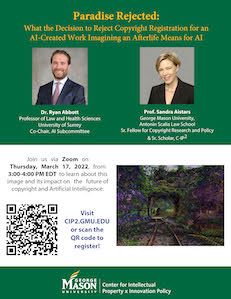
On March 17, 2022, I had the pleasure to discuss Artificial Intelligence and Authorship with Dr. Ryan Abbott, the lawyer representing Dr. Stephen Thaler, inventor of the “Creativity Machine.” The Creativity Machine is the AI that generated the artwork A Recent Entrance to Paradise, which was denied copyright registration by the United States Copyright Office. Dr. Abbott, Dr. Thaler, and his AI have exhausted all mandatory administrative appeals to the Office and announced that they would soon sue the Office in order to obtain judicial review of the denial. You can listen to the conversation here.
Background:
Dr. Thaler filed an application for copyright registration of A Recent Entrance to Paradise (the Work) on November 3, 2018. For copyright purposes, the Work is categorized as a work of visual art, autonomously generated by the AI without any human direction or intervention. However, it stems from a larger project involving Dr. Thaler’s experiments to design neural networks simulating the creative activities of the human brain. A Recent Entrance to Paradise is one in a series of images generated and described in text by the Creativity Machine as part of a simulated near-death experience Dr. Thaler undertook in his overall research into and invention of artificial neural networks. Thaler’s work also raises parallel issues of patent law and policy which were beyond the scope of our discussion.
The registration application identified the author of the Work as the “Creativity Machine,” with Thaler listed as the claimant as a result of a transfer resulting from “ownership of the machine.” In his application, Thaler explained to the Office that the Work “was autonomously created by a computer algorithm running on a machine,” and he sought to “register this computer-generated work as a work-for-hire to the owner of the Creativity Machine.”[i]
The Copyright Office Registration Specialist reviewing the application refused to register the claim, finding that it “lacks the human authorship necessary to support a copyright claim.”[ii]
Thaler requested that the Office reconsider its initial refusal to register the Work, arguing that “the human authorship requirement is unconstitutional and unsupported by either statute or case law.”[iii]
The Office re-evaluated the claims and held its ground, concluding that the Work “lacked the required human authorship necessary to sustain a claim in copyright” because Thaler had “provided no evidence on sufficient creative input or intervention by a human author in the Work.”[iv]
37 CFR 202.5 establishes the Reconsideration Procedure for Refusals to Register by the Copyright Office. Pursuant to this procedure Thaler appealed the refusal to the Copyright Office Review Board comprised of The Register of Copyrights, The General Counsel of the Copyright Office and a third individual sitting by designation. The relevant CFR section requires that the applicant “include the reasons the applicant believes registration was improperly refused, including any legal arguments in support of those reasons and any supplementary information, and must address the reasons stated by the Registration Program for refusing registration upon first reconsideration. The Board will base its decision on the applicant’s written submissions.”
According to the Copyright Office, Thaler renewed arguments from his first two unsuccessful attempts before the Office that failure to register AI created works is unconstitutional, largely continued to advance policy arguments that registering copyrights in AI generated works would further the underlying goals of copyright law, including the constitutional rationale for protection, and failed to address the Office’s request to cite to case law supporting his assertions that the Office should depart from its reliance on existing jurisprudence requiring human authorship.
The Office largely dismissed Thaler’s second argument, that the work should be registered as a work made for hire as dependent on its resolution of the first—since the Creativity Machine was not a human being, it could not enter into a “work made for hire” agreement with Thaler. Here, the Office rejected the argument that, because corporations could be considered persons under the law, other non-humans such as AIs should likewise enjoy rights that humans do. The Office noted that corporations are composed of collections of human beings. The Office also explained that “work made for hire” doctrine speaks only to who the owner of a given work is.
Of course, both Dr. Abbott and the Copyright Office were bound in this administrative exercise by their respective roles: the Copyright Office must take the law as it finds it—although Dr. Abbott criticized the Office for applying caselaw from “the Gilded Age” as the Office noted in its rejection “[I]t is generally for Congress,” not the Board, “to decide how best to pursue the Copyright Clause’s objectives.” Eldred v. Ashcroft, 537 U.S. 186, 212 (2003). The Board must apply the statute enacted by Congress; it cannot second-guess whether a different statutory scheme would better promote the progress of science and useful arts.”[v] Likewise, Dr. Abbott, acting on behalf of Dr. Thaler was required to exhaust all administrative avenues of appeal before pursuing judicial review of the correctness of the Office’s interpretation of constitutional and statutory directives, and case law.
Our lively discussion begins with level setting to ensure that the listeners understand the goals of Dr. Thaler’s project, goals which encompass scientific innovation, artistic creation, and apparently—legal and policy clarification of the IP space.
Dr. Abbott and I additionally investigate the constitutional rationales for copyright and how registering or not registering a copyright to an AI-created work is or is not in line with those goals. In particular, we debated utilitarian/incentive-based justifications, property rights theories, and how the rights of artists whose works might be used to train an AI might (or might not) be accounted for in different scenarios.
Turning to Dr. Thaler’s second argument, that the work should be registered to him as a work made for hire, we discussed the difficulties of maintaining the argument separately from the copyrightability question. It seems to me that the Copyright Office is correct that the argument must rise or fall with the resolution of the baseline question of whether a copyrightable work can be authored by an AI to begin with. The other challenging question that Dr. Abbott will face is how to overcome the statutory “work made for hire” doctrine requirements in the context of an AI-created work without corrupting what is intended to be a very narrow exception to the normal operation of copyright law and authorship. This is already a controversial area, and one thought by many to be unfavorable to individual authors because it deems a corporation to be the author of the work, sometimes in circumstances where the human author is not in a bargaining position to adequately understand the copyright implications or to bargain for them differently. In the case of an AI, the ability to bargain for rights or later challenge the rights granted, particularly if they are granted on the basis of property ownership, seems to be dubious.
In closing the discussion, Dr. Abbott confirmed that his client intends to seek judicial review of the refusal to register.
[i] Opinion Letter of Review Board Refusing Registration to Ryan Abbot (Feb. 14, 2022).
[ii] Id. (Citing Initial Letter Refusing Registration from U.S. Copyright Office to Ryan Abbott (Aug. 12, 2019).)
[iii] Id. (Citing Letter from Ryan Abbott to U.S. Copyright Office at 1 (Sept. 23, 2019) (“First Request”).)
[iv] Id. (Citing Refusal of First Request for Reconsideration from U.S. Copyright Office to Ryan Abbott at 1 (March 30, 2020).)
[v] Id at 4.
In Opposition to Copyright Protection for AI Works
This response to Dr. Ryan Abbott comes from David Newhoff.
On February 14, the U.S. Copyright Office confirmed its rejection of an application for a claim of copyright in a 2D artwork called “A Recent Entrance to Paradise.” The image, created by an AI designed by Dr. Stephen Thaler, was rejected by the Office on the longstanding doctrine which holds that in order for copyright to attach, a work must be the product of human authorship. Among the examples cited in the Copyright Office Compendium as ineligible for copyright protection is “a piece of driftwood shaped by the ocean,” a potentially instructive analog as the debate about copyright and AI gets louder in the near future.
What follows assumes that we are talking about autonomous AI machines producing creative works that no human envisions at the start of the process, other than perhaps the medium. So, the human programmers might know they are building a machine to produce music or visual works, but they do not engage in co-authorship with the AI to produce the expressive elements of the works themselves. Code and data go in, and something unpredictable comes out, much like nature forming the aesthetic piece of driftwood.
As a cultural question, I have argued many times that AI art is a contradiction in terms—not because an AI cannot produce something humans might enjoy, but because the purpose of art, at least in the human experience so far, would be obliterated in a world of machine-made works. It seems that what the AI would produce would be literally and metaphorically bloodless, and after some initial astonishment with the engineering, we may quickly become uninterested in most AI works that attempt to produce more than purely decorative accidents.
In this regard, I would argue that the question presented is not addressed by the “creative destruction” principle, which demands that we not stand in the way of machines doing things better than humans. “Better” is a meaningful concept if the job is microsurgery but meaningless in the creation or appreciation of art. Regardless, the copyrightability question does not need to delve too deeply into the nature or purpose of art because the human element in copyright is not just a paragraph about registration in the USCO Compendium but, in fact, runs throughout application of the law.
Doctrinal Oppositions to Copyright in AI Works
In the United States and elsewhere, copyright attaches automatically to the “mental conception” of a work the moment the conception is fixed in a tangible medium such that it can be perceived by an observer. So, even at this fundamental stage, separate from the Copyright Office approving an application, the AI is ineligible because it does not engage in “mental conception” by any reasonable definition of that term. We do not protect works made by animals, who possess consciousness that far exceeds anything that can be said to exist in the most sophisticated AI. (And if an AI attains true consciousness, we humans may have nothing to say about laws and policies on the other side of that event horizon.)
Next, the primary reason to register a claim of copyright with the USCO is to provide the author with the opportunity, if necessary, to file a claim of infringement in federal court. But to establish a basis for copying, a plaintiff must prove that the alleged infringer had access to the original work and that the secondary work is substantially or strikingly similar to the work allegedly copied. The inverse ratio rule applied by the courts holds that the more that access can be proven, the less similarity weighs in the consideration and vice-versa. But in all claims of copying, independent creation (i.e., the principle that two authors might independently create nearly identical works) nullifies any complaint. These are considerations not just about two works, but about human conduct.
If AIs do not interact with the world, listen to music, read books, etc. in the sense that humans do these things, then, presumably, all AI works are works of independent creation. If multiple AIs are fed the same corpus of works (whether in or out of copyright works) for the purpose of machine learning, and any two AIs produce two works that are substantially, or even strikingly, similar to one another, the assumption should still be independent creation. Not just independent, but literally mindless, unless again, the copyright question must first be answered by establishing AI consciousness.
In principle, AI Bob is not inspired by, or even aware of, the work of AI Betty. So, if AI Bob produces a work strikingly similar to a work made by AI Betty, any court would have to toss out BettyBot v. BobBot on a finding of independent creation. Alternatively, do we want human juries considering facts presented by human attorneys describing the alleged conduct of two machines?
If, on the other hand, an AI produces a work too similar to one of the in-copyright works fed into its database, this begs the question as to whether the AI designer has simply failed to achieve anything more than an elaborate Xerox machine. And hypothetical facts notwithstanding, it seems that there is little need to ask new copyright questions in such a circumstance.
The factual copying complication raises two issues. One is that if there cannot be a basis for litigation between two AI creators, then there is perhaps little or no reason to register the works with the Copyright Office. But more profoundly, in a world of mixed human and AI works, we could create a bizarre imbalance whereby a human could infringe the rights of a machine while the machine could potentially never infringe the rights of either humans or other machines. And this is because the arguments for copyright in AI works unavoidably dissociate copyright from the underlying meaning of authorship.
Authorship, Not Market Value, is the Foundation of Copyright
Proponents of copyright in AI works will argue that the creativity applied in programming (which is separately protected by copyright) is coextensive to the works produced by the AIs they have programmed. But this would be like saying that I have claim of co-authorship in a novel written by one of my children just because I taught them things when they were young. This does not negate the possibility of joint authorship between human and AI, but as stated above, the human must plausibly argue his own “mental conception” in the process as a foundation for his contribution.
Commercial interests vying for copyright in AI works will assert that the work-made-for-hire (WMFH) doctrine already implicates protection of machine-made works. When a human employee creates a protectable work in the course of his employment, the corporate entity, by operation of law, is automatically the author of that work. Thus, the argument will be made that if non-human entities called corporations may be legal authors of copyrightable works, then corporate entities may be the authors of works produced by the AIs they own. This analogizes copyrightable works to other salable property, like wines from a vineyard, but elides the fact that copyright attaches to certain products of labor, and not to others, because it is a fiction itself whose medium is the “personality of the author,” as Justice Holmes articulated in Bleistein.
The response to the WMFH argument should be that corporate-authored works are only protected because they are made by human employees who have agreed, under the terms of their employment, to provide authorship for the corporation. Authorship by the fictious entity does not exist without human authorship, and I maintain that it would be folly to remove the human creator entirely from the equation. We already struggle with corporate personhood in other areas of law, and we should ask ourselves why we believe that any social benefit would outweigh the risk of allowing copyright law to potentially exacerbate those tensions.
Alternatively, proponents of copyright for AI works may lobby for a sui generis revision to the Copyright Act with, perhaps, unique limitations for AI works. I will not speculate about the details of such a proposal, but it is hard to imagine one that would be worth the trouble, no matter how limited or narrow. If the purpose of copyright is to proscribe unlicensed copying (with certain limitations), we still run into the independent creation problem and the possible result that humans can infringe the rights of machines while machines cannot infringe the rights of humans. How does this produce a desirable outcome which does not expand the outsize role giant tech companies already play in society?
Moreover, copyright skeptics and critics, many with deep relationships with Big Tech, already advocate a rigidly utilitarian view of copyright law, which is then argued to propose new limits on exclusive rights and protections. The utilitarian view generally rejects the notion that copyright protects any natural rights of the author beyond the right to be “paid something” for the exploitation of her works, and this cynical, mercenary view of authors would likely gain traction if we were to establish a new framework for machine authorship.
Registration Workaround (i.e., lying)
In the meantime, as Stephen Carlisle predicts in his post on this matter, we may see a lot of lying by humans registering works that were autonomously created by their machines. This is plausible, but if the primary purpose of registration is to establish a foundation for defending copyrights in federal court, the prospect of a discovery process could militate against rampant falsification of copyright applications. Knowing misrepresentation on an application is grounds for invalidating the registration, subject to a fine of up to $2,500, and further implies perjury if asserted in court.
Of course, that’s only if the respondent can defend himself. A registration and threat of litigation can be enough to intimidate a party, especially if it is claimed by a big corporate tech company. So, instead of asking whether AI works should be protected, perhaps we should be asking exactly the opposite question: How do we protect human authorship against a technology experiment, which may have value in the world of data science, but which has nothing to do with the aim of copyright law?
About the IP Clause
And with that statement, I have just implicated a constitutional argument because the purpose of copyright law, as stated in Article I Clause 8, is to “promote science.” Moreover, the first three subjects of protection in 1790—maps, charts, and books—suggest a view at the founding period that copyright’s purpose, twinned with the foundation for patent law, was more pragmatic than artistic.
Of course, nobody could reasonably argue that the American framers imagined authors as anything other than human or that copyright law has not evolved to encompass a great deal of art which does not promote the endeavor we ordinarily call “science.” So, we may see AI copyright proponents take this semantic argument out for a spin, but I do not believe it should withstand scrutiny for very long.
Perhaps, the more compelling question presented by the IP clause, with respect to this conversation, is what it means to “promote progress.” Both our imaginations and our experiences reveal technological results that fail to promote progress for humans. And if progress for people is not the goal of all law and policy, then what is? Surely, against the present backdrop in which algorithms are seducing humans to engage in rampant, self-destructive behavior, it does seem like a mistake to call these machines artists.
The following post comes from Sabren H. Wahdan, a 3L at Scalia Law and a Research Assistant at C-IP2.
 In one of his final majority opinions before announcing his retirement, Justice Steven Breyer penned a nuanced ruling that carefully threads the policy needle on copyright registration issues. The case pitted fabric designer Unicolors against fast fashion company H&M, but it was ultimately a victory for creators of art, fashion, music, dance, literary works, and others who rely on copyright registrations to protect their rights but lack the means to hire an attorney to ensure that their registration applications are legally and factually perfect. As a result of the ruling, they can register their works without fear that their registration could be invalidated by a good-faith mistake.
Unicolors v. H&M answers a narrow question of copyright law: what is the requisite level of knowledge to invalidate copyright registration? Justice Stephen Breyer’s majority (6-3) opinion holds that actual knowledge of either a factual or legal mistake is required before a registration is invalidated. This makes good sense because copyright registration applications are often completed by creators who are not lawyers. Some background on the case is useful.
The District Court
In 2016, Unicolors sued H&M for copyright infringement in the United States District Court for the District of Central California, alleging that H&M sold apparel, specifically a jacket and skirt, with a design remarkably similar to a Unicolors-copyrighted design. The jury returned a verdict in favor of Unicolors.[i] Subsequently, H&M filed a renewed motion for judgment as a matter of law, arguing that Unicolors’ copyright registration was invalid because Unicolors knowingly submitted inaccurate information in its application for registration.[ii] The U.S. Copyright Office has established an administrative procedure that allows an applicant to register multiple works that were physically packaged or bundled together as a single unit and first published on the same date.[iii] However, under 37 C.F.R. § 202.3(b)(4), an applicant cannot use this provision if the works were published in different units or first distributed as separate, individual works.
Unicolors had filed an application with the Copyright Office seeking a collective copyright registration for thirty-one of its designs in 2011. H&M contended that Unicolors could not do so because it had sold some of the patterns separately to different customers at different times, invalidating Unicolors’ registration.[iv] The District Court denied H&M’s motion for judgment as a matter of law, holding that a registration may be valid even if it contains inaccurate information, provided the registrant did not know the information was inaccurate.[v] H&M had to show Unicolors had knowledge and intent to defraud in order to invalidate the registration. H&M appealed.[vi]
The Ninth Circuit Decision
On appeal, the U.S. Court of Appeals for the Ninth Circuit reversed the District Court’s judgment holding that invalidation under 17 U.S. Code § 411 does not require a showing that the registration applicant intended to defraud the Copyright Office.[vii] In other words, knowing about the inclusion of inaccurate facts and law in an application is enough to warrant invalidation. Furthermore, the Ninth Circuit stated that Unicolors had failed to satisfy 37 C.F.R. § 202.3(b)(4) – the single unit of publication requirement.[viii] The Court found that Unicolors’ registration was inaccurate because Unicolors registered all thirty-one of its designs together as a single unit with the same publication date, when in fact, the designs were not all published as a single unit. Some designs were available to the public, while others were confined designs only available to particular exclusive customers.[ix] The Court determined that Unicolors knew the designs would not be released together at the same time; therefore, they knew that the registration information was inaccurate.[x] Consequently, the Ninth Circuit remanded the case to the District Court for further proceedings.[xi]
The Supreme Court Reverses the Ninth Circuit Decision
In 2021, Unicolors filed a petition to the Supreme Court asking whether the Ninth Circuit erred in determining that §411(b)(1)(A) required referral to the Copyright Office on any inaccurate registration information, even without evidence of fraud or material error in conflict with other circuit courts and the Copyright Office’s own findings on §411(b)(1)(A). The United States Supreme Court granted certiorari.
Justice Breyer’s Majority Opinion
Justice Breyer is well known for his use of analogies to probe the arguments of parties appearing before the Court. Likewise, in Unicolors, the majority opinion relied not only on statutory construction, legislative history, and the plain language of the statute as informed by dictionary definitions, but also on analogies––both to adjacent provisions of the code, and to analogies involving birdwatching––to reach its conclusion, in the end finding that §411(b)(1)(A) does not distinguish between a mistake of law and a mistake of fact and thus excuses inaccuracies in registration applications premised on either mistakes of fact or law.
To explain employing Justice Breyer’s birdwatching analogy, Breyer imagines a man who sees a flash of red in a tree and mistakenly says it is a cardinal when the bird is actually a scarlet tanager: “[A man] may have failed to see the bird’s black wings. In that case, he has made a mistake about the facts.” Alternatively, if said man saw “the bird perfectly well, noting all of its relevant features,” it is possible that, “not being much of a birdwatcher, he may not have known that a tanager (unlike a cardinal) has black wings.” For Breyer, that is a “labeling mistake” because the man “saw the bird correctly, but does not know how to label what he saw” (analogous to a mistake of law).[xii] A business person in the arts may know specific facts about her business; however, she may not be cognizant of how the law applies to it and applies the law to those facts inaccurately. §411(b)(1)(A) states that a certificate of registration satisfies the requirements of section 411 and section 412, regardless of whether the certificate contains any inaccurate information–—unless the inaccurate information was included on the application for copyright registration with knowledge that it was inaccurate.
The plain language of the text does not support an interpretation that would read constructive knowledge of how legal requirements bear on the facts at issue into the standard. To reach this conclusion, the majority opinion analyzed not only the plain language of the text but also “case law and the dictionary to find that “knowledge” means an applicant’s understanding of the relevant law that applies to the submitted information.[xiii] Therefore, an applicant who believes information submitted on a registration application is accurate cannot have acted with knowledge that the information was inaccurate.
The Majority also examined other provisions in the Copyright Act that refer specifically to circumstances where an individual should have been aware that a particular legal requirement is implicated (e.g., “‘reasonable grounds to know . . .,’” “‘reasonable grounds to believe . . .,`” ”‘not aware of facts or circumstances from which . . . is apparent’” and concluded that §411(b)(1)(A) does not contain any such analogous language.[xiv]
According to the majority, “the absence of similar language in the statutory provision before us tends to confirm our conclusion that Congress intended ‘knowledge’ here to bear its ordinary meaning.” When Congress includes particular language in one section of a statute but omits it in another, there is a presumption that Congress intended a difference in meaning.[xv]
Finally, the majority considered the legislative history of the Copyright Act. The Court understood that Congress wanted to make it easier, not more difficult, for artists and nonlawyers to obtain valid copyright registrations. Congress did not intend for good-faith errors to invalidate registrations, whether those errors were in issues of fact or issues of law. Invalidating copyright registration when a copyright owner was unaware of or misunderstood the law undermines the purpose of the Copyright Act. The Court dismissed the often-cited legal maxim that ignorance of the law is not an excuse by stating that it does not apply to civil cases concerning the scope of a statutory safe harbor that arises from ignorance of collateral legal requirement.[xvi]
Justice Thomas’ Dissent
Careful readers will note that the question the majority opinion answers is somewhat different from that granted certiorari. Justice Clarence Thomas filed a dissenting opinion, joined by Justices Samuel Alito and Neil Gorsuch, arguing primarily that the majority decided a question not properly presented to the Court. The question originally taken up by the Court was whether fraud was necessary to invalidate a registration. The majority found that the knowledge question is close enough to the question presented in the petition to qualify as a “subsidiary question fairly included” in the question presented.[xvii]
Justice Thomas, not joined by Justice Gorsuch, further dissents from the majority view that ignorance of the law is not an excuse.[xviii] He would have ruled that individuals are responsible for knowing the law, whether that be in the context of criminal or civil cases.
Conclusion
Based on the ruling, a mistake in an application for copyright registration is excusable so long as the copyright registrant or claimant lacked actual knowledge of the inaccuracy. The more complex issue perhaps is the proof issue––proving the relevant knowledge or lack of knowledge. While some may worry that there is a risk that claimants will falsely argue lack of knowledge, courts are well-versed in evaluating truthfulness and parsing evidence, including when they must evaluate subjective viewpoints and experiences.
The majority opinion demonstrates a sensitive balancing of the interest in promoting accurate registration with the understanding of the challenges faced by artists, creators, and other non-lawyers who may unintentionally make errors in filing registrations. Importantly, this decision gives little shelter to copyright lawyers if they register works and make a mistake; on the contrary, it should serve as a warning to copyright lawyers to be careful when filing a copyright registration lest they face potential validity challenges in the future.
The case is going back down to the Ninth Circuit on remand, and the question is: what facts and law did Unicolors know when it filed these registration applications?
[i] Unicolors, Inc. v. H&M Hennes & Mauritz, L.P., 959 F.3d 1194, at 1195* (2020).
[ii] Id at 1197.
[iii] See U.S. Copyright Office, Circular No. 34: Multiple Works (2021).
[iv] Unicolors, 959 F.3d 1194, at 1195 (2020).
[v] Id at 1197.
[vi] Id.
[vii] Id at 1200.
[viii] Id.
[ix] Id at 1197.
[x] Id.
[xi] Id.
[xii] Unicolors Inc. v. H&M Hennes & Mauritz L.P., No. 20-915, 2022 WL 547681, at 4* (2022).
[xiii] Unicolors, WL 547681, at 4*(2022) (citing Intel Corp. Investment Policy Comm. v. Sulyma, 589 U. S. 140 S.Ct. 768, 776, 206 L.Ed.2d 103 (2020)).
[xiv] Unicolors, WL 547681, at 5*(citing §121A(a), §512(c)(1)(A), §901(a)(8), §1202(b) and §1401(c)(6)).
[xv] Unicolors, WL 547681, at 5* (2022) (citing Nken v. Holder, 556 U. S. 418, 430 (2009)).
[xvi] Unicolors, WL 547681, at 8*(2022) (citing Rehaif v. United States, 588 U. S. (2019)).
[xvii] Unicolors, WL 547681, at 8*(2022).
[xviii] Id.
By Molly Stech*
*The blog post below and the law review article it links to are the individual thoughts and views of the author and should not be attributed to any entity with which she is currently or has been affiliated.
 In a forthcoming article in the Vanderbilt Journal of Entertainment & Technology Law, I review the law and jurisprudence concerning joint authorship and provide an analysis of it with specific emphasis on photographers and portrait subjects. I wrote and edited this paper in conjunction with the George Mason University Scalia School of Law’s 2021-2022 Thomas Edison Innovation Law and Policy Fellowship, and am very grateful for the thoughtful comments I received from Senior Commentators and scholars involved with the Fellowship.
A recent string of litigation in this space, and the general question of ownership interests in one’s own likeness, are what prompted my interest. Paparazzi have filed lawsuits against models and other celebrities for reposting images of themselves on their social media feeds, without permission from or compensation for the photographer. Some celebrities have countersued, but many of these cases settle out of court. In a best-case scenario, paparazzi and their subjects enjoy a mutually-beneficial relationship, but these lawsuits highlight a problematic legal space. It is accepted domestically and abroad that copyright subsists in the vast majority of photographs and that the copyright belongs to the photographer. The bar to copyrightability is notoriously low; it requires only a modicum of creativity.
Photographers have a wide range of creative choices they can highlight to showcase where their authorship lies in a given photograph, including the camera and film used, the angle, the lighting, and the backdrop. What I explore in this paper is the possibility that subjects of photographs may also contribute copyrightable authorship to a given photograph, and may therefore be eligible to be deemed co-authors of certain photographs with the photographer. Copyright law aims to reward creative expression. Nothing in the statute can be read to proactively deny a subject co-authorship. I point out that copyright law is accustomed to doing the hard work of factual analysis (see, e.g., the fair use doctrine) and that any given work, including a photograph, should be considered on its own for purposes of correctly identifying authorial contribution. In some cases, a subject will contribute copyrightable expression by posing her limbs, arranging her facial expression, selecting her garments, or even arranging how her garments fall. So long as the contribution is adequately creative, co-authorship should be hers.
Joint (or Contributing) Authorship: Roadblocks
Two barriers to overcome in reaching this conclusion include some courts’ emphasis on joint authors’ intent; and some courts’ prerequisite that every contribution to a jointly-authored work be independently copyrightable. I address each of these problems in turn and underline that the statute itself does not make these requirements. Admittedly, in U.S. law, these are not easily surmountable obstacles. But, in taking copyright law back to its first principles, I believe the correct answer can be found in reemphasizing creative contribution. A recent case in the United Kingdom demonstrates an admirable flexibility that tailors an assignment of authorship to the degree of authorial contribution. An apportionment of authorship can be discerned from analyzing works one at a time. As mentioned, U.S. copyright law is no stranger to a work-by-work analysis in its fair use doctrine; another example is the idea-expression dichotomy, which provides that the more a work merges with its inevitable expression, the thinner its depth of copyright protection.
Other Thinking on These Issues
Any timely issue is likely to invite the contributions of other scholars, and this topic is no different. Other scholars have suggested sui generis rights for paparazzi subjects; separate types of exclusive rights for social media; and a personality-based right that could stretch copyright-like rights from covering “works” to people themselves. Another scholar argued persuasively for paparazzi subjects to receive an implied license to use photographs of themselves in certain ways. My analysis remains proscribed within copyright law itself, with the baseline argument that authorial creativity, whatever its guise, should be rewarded with rights.
There are other interesting avenues that are being explored to solve a similar problem, and I will follow them with interest. The right of privacy, a fascinating and complex legal discipline, may also offer solutions in the future. My paper mostly sidesteps the phenomenon of revenge porn, for example, and while a copyright argument could be made in the average scenario (no matter who pushes “record,” there are two people potentially offering creative expression to the final film), privacy law may be a more logical solution to protecting those subjects than copyright law. Another related argument that works in my favor, I believe, is rooted in freedom of expression. If copyright law is the engine of free expression, so should it contribute to people having a legal stake in their photographic likeness in order to control or at least contribute to the narrative attached to that photograph.
The paper is available in draft form at SSRN: https://papers.ssrn.com/sol3/papers.cfm?abstract_id=4049946
And it will be available in late 2022 from Vanderbilt’s JETLaw website: https://scholarship.law.vanderbilt.edu/jetlaw/
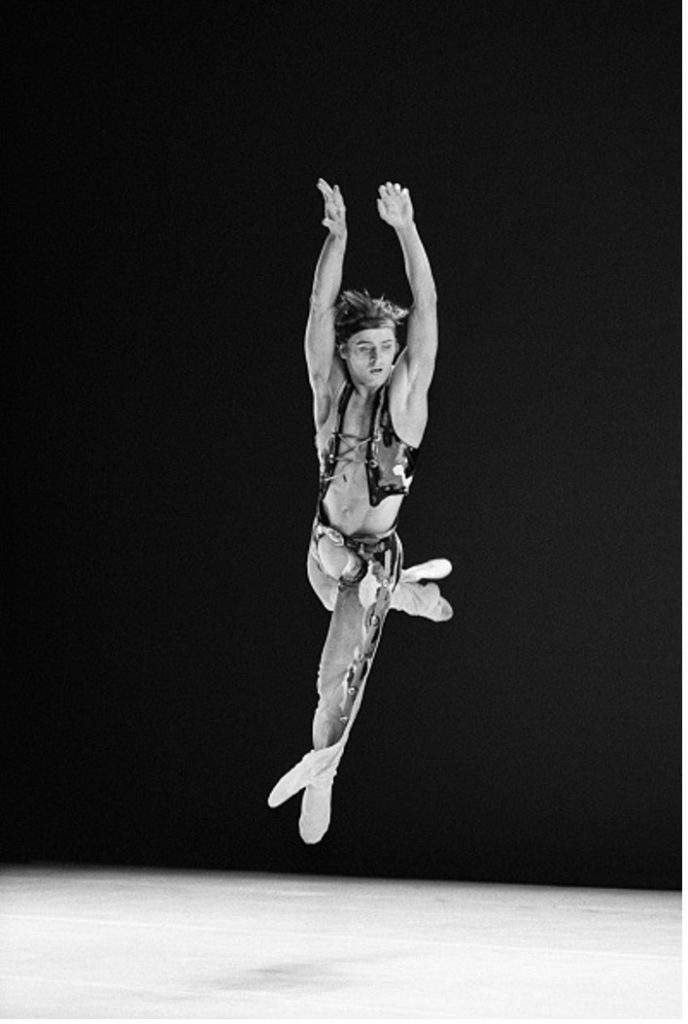
Santa Fe Saga, April 14, 1978. © Getty Images
Examples
While a revenge porn video may not make the best example for my analysis, I believe that selfies and photographs of dancers onstage do help demonstrate my view. A selfie is probably a copyrightable work. But in analyzing a given selfie to ascertain where the creativity lies, it will likely be in the pose, the facial expression, and the garments (the subject’s choices) as much as it will be in the framing, the backdrop, and the angle (the photographer’s choices). The photographer and the subject are of course the same person in the case of the selfie, but in deconstructing a photograph and searching for its authorial qualities, an argument certainly exists for the former forms of authorship as much as for the latter. And for a dancer onstage, his or her pose, facial expression, turnout, limb extension, jump arc, makeup, and any number of other attributes cannot reasonably be the result of the photographer’s efforts or talent, although the resulting photograph will of course likely benefit from them.
Conclusion
Co-authorship may exist in certain photographic portraits. It is essential that copyright law reexamine its interpretation of joint authorship in order to better capture and reward the contributions of the parties who offer creative expression to any given copyrightable work.
Greetings from C-IP2 Faculty Director Sean O’Connor
Warmest greetings for this holiday season. While 2021 has continued to be challenging, we are thankful that our community has stayed strong and thrived, nonetheless. We hope that if the pandemic has directly affected you or your loved ones, you are finding your way back to peace and health. As difficult as these times can be for many of us, I think we all know that it has been even harder for others. Take extra time this holiday season to be with loved ones and reflect on the things we do have.
In this Winter 2021 Progress Report, we include not only our news the last quarter of 2021, but also a recap of major developments this year.
This year we accomplished several major goals that have been in the works for a few years.
-
- Rebranded the Center. While our old name had developed good brand recognition, it had outlived much of its original usefulness and did not fully reflect the range of work we do in the innovation ecosystem. It is also important to signal that intellectual property (IP) is a core part of such ecosystems.
- Formed Advisory Board. A strong center such as ours needs the guidance of leaders in IP and innovation. We are so thankful that our “dream team” of influential leaders accepted our invitation to advise us. The Board includes:
- Troy Dow, Vice President and Counsel, Government Relations and IP Legal Policy and Strategy, The Walt Disney Company
- Mitch Glazier, Chairman and Chief Executive Officer, Recording Industry Association of America
- Dr. Kirti Gupta, Vice President, Economic Strategy | Chief Economist, Qualcomm
- Lawrence Horn, President and Chief Executive Officer, MPEG LA, LLC
- Andrei Iancu, Partner, Irell Manella LLP, Los Angeles, California; Former Director, United States Patent & Trademark Office
- David J. Kappos, Partner, Cravath, Swaine & Moore LLP, New York; Former Director, United States Patent & Trademark Office
- John Kolakowski, Director, Patent Licensing, & Head of IP Regulatory Affairs, North America, Nokia Technologies
- David Korn, Vice President, Intellectual Property and Law, Pharmaceutical Research and Manufacturers of America (PhRMA)
- Keith Kupferschmid, President and Chief Executive Officer, Copyright Alliance
- The Honorable Paul R. Michel, Former Chief Judge, United States Court of Appeals for the Federal Circuit
- Karen Marangi, Director, Federal Government Affairs, RELX Group
- Maria A. Pallante, President and Chief Executive Officer, Association of American Publishers; Former Register of Copyrights and Director, United States Copyright Office
- The Honorable Randall R. Rader, Former Chief Judge, United States Court of Appeals for the Federal Circuit
- Jon Santamauro, Senior Director, International Government Affairs, AbbVie
- Hans Sauer, Deputy General Counsel, Vice President for Intellectual Property, Biotechnology Innovation Organization
- Ian Slotin, Senior Vice President, Intellectual Property, NBCUniversal
- Dr. Claudia Tapia Garcia, LL.M., Director IPR Policy and Legal Academic Research, Ericsson; President, 4iP Council
- Karyn A. Temple, Senior Executive Vice President and Global General Counsel, Motion Picture Association; Former Register of Copyrights and Director, United States Copyright Office
- The Honorable John F. Witherspoon, Professor and Director Emeritus, Intellectual Property Program, George Mason University Antonin Scalia Law School
- Expanded Affiliate Scholars and Practitioners Network. This year we added a phenomenal group of leading academics and experienced practitioners such as Senior Fellows (directing our substantive area programming), Scholars (assistant and associate professors), Senior Scholars (full professors), Jurists in Residence, and Practitioners in Residence.
- Virtual and hybrid events. We were able to transition all of our extensive programming to either fully online or hybrid format. This included the WIPO-U.S. Summer School on Intellectual Property, 2021 Annual Fall Conference, BioPharma Roundtable, Thomas Edison Innovation Law and Policy Fellowship meetings, and academic conference Intellectual Property and Innovation Policy for 5G and the Internet of Things.
2022 will be our tenth year as an academic center, and we are excited to see how C-IP2 continues to grow in the years ahead. Whether you participated in our events this year or in the past, generously donated or helped sponsor C-IP2’s activities, engaged with us in any way, or simply looked out for our emails in your inbox—thank you very much for your interest and support. All our best wishes for your health and happiness this holiday season and for the New Year 2022!
C-IP2 Hosted & Co-Hosted Events
Now in its seventh iteration, C-IP2‘s Thomas Edison Innovation Law and Policy Fellowship is a year-long non-resident fellowship program that brings together a group of scholars to develop research papers on intellectual property law and policy. Meeting 2 of the Fellowship was held September 23-24 at George Mason University Antonin Scalia Law School. This meeting was devoted to the Edison Fellows’ presenting their draft works-in-progress that they researched and drafted over the summer months of 2021. Each Edison Fellow received extensive feedback during presentation sessions devoted to each draft work-in-progress, including specific commentary from the Distinguished Senior Commentators. Guest Speakers for this meeting were Walter Copan (Senior Adviser and Co-Founder, “Renewing American Innovation,” CSIS; Vice President for Research and Technology Transfer, Colorado School of Mines; Former Director, NIST) and Andrei Iancu. For more information on this Fellowship, please visit our website.
Washington Lawyers for the Arts (WALA) and DC Shorts co-hosted a presentation and free clinic session with Scalia Law’s Arts & Entertainment Advocacy Clinic. The session, “Entertainment Law 101 for Filmmakers,” was held virtually on September 11 and featured WALA’s Brian Frankel, Maggie Gladson, John Mason, and the Clinic’s Prof. Sandra Aistars and Terrica Carrington.
On October 13-14, C-IP2 hosted our 2021 Virtual Annual Fall Conference, with Artificial Intelligence and Intellectual Property as this year’s theme. This year’s Annual Conference was structured around Professor Ryan Abbott’s forthcoming edited volume Research Handbook on Intellectual Property and Artificial Intelligence, which is being funded in part by a C-IP2 Da Vinci Grant. The conference included panels covering the current state of the art in AI and how the various types of IP rights interact with AI in diverse and sometimes controversial contexts––such as authorship of AI-generated works, changing inventive step analysis, data and text mining exceptions, deep fakes, and more. The event also featured keynote speakers Grimes and Jaron Lanier, who participated in a fireside chat with C-IP2 Faculty Director Sean O’Connor. The conference was connected with and featured many speakers who are writing for the upcoming Research Handbook on Intellectual Property and Artificial Intelligence in the Research Handbooks in Intellectual Property Series by Edward Elgar (Forthcoming 2022), an edited volume with contributions from an internationally leading group of authors from academia, practice, and government that provides a broad overview of research in AI & IP as well as a deep critical examination. Conference videos are available on C-IP2‘s YouTube channel.
On November 18, C-IP2 hosted an academic roundtable on Intellectual Property and Biopharmaceutical Policy in person at and virtually from George Mason University Antonin Scalia Law School. The roundtable consisted of presentations of works in progress on topics including evergreening and time to generic entry, regulatory exclusivities, the history of Bayh-Dole, potential trade secret waivers, and more.
News & Speaking Engagements
In September 2021, C-IP2 RAs and Scalia Law students Kyle Maxey and David Ward began fall internships with the Copyright Alliance.
In September, C-IP2, in conjunction with Mason’s Center for Government Contracting at the School of Business, won a Department of Defense IP study contract on a study for Washington Headquarters Services covering the Defense Advanced Research Projects Agency (DARPA) and defense laboratories’ contracting and intellectual property management policies and their effects on commercialization of and further innovation in dual-use technology. Click here for more details.
Masami Kawase (JIPO) joined C-IP2 as a Visiting Scholar in September! While here, Masami will be working on a research project covering valuation of patents in the US and Japan.
In September, C-IP2 welcomed Professors Daryl Lim and Irina D. Manta as Senior Scholars.
C-IP2 Faculty Director Sean O’Connor and C-IP2 were featured in the “Research Spotlight” put out by Mason’s Institute for Digital InnovAtion (IDIA) in their “The Weekly” newsletter on October 10.
C-IP2 2021-2022 Edison Fellow and USPTO Attorney Advisor, Copyright Law and Policy Molly Torsen Stech moderated a panel discussion co-hosted by the USPTO and USCO on October 26 for the virtual conference Copyright Law and Machine Learning for AI: Where Are We and Where Are We Going?.
On October 26, Prof. Sandra Aistars and Terrica Carrington led Antonin Scalia Law School’s Arts & Entertainment Advocacy Clinic in co-hosting a virtual online chat and legal clinic on Copyright Law, Choreography, and Social Media with Washington Area Lawyers for the Arts (WALA). The event featured a fireside chat with the Copyright Alliance’s Terrica Carrington and David Hecht, founder of Hecht Partners LLP and attorney for celebrity choreographer JaQuel Knight, choreographer of Beyonce’s “Single Ladies” dance. The Arts & Entertainment Advocacy Clinic hosts similar events once or twice a semester, giving students a chance to give live advice to artists as part of their supervised legal clinic work.
In November 2021, C-IP2 welcomed Emily Michiko Morris (University of Akron School of Law Professor of Law and C-IP2 Scholar) as our Senior Fellow for Life Sciences.
Sandra Aistars (C-IP2 Senior Fellow for Copyright Research and Policy & Senior Scholar; Founding Director, Arts & Entertainment Advocacy Clinic; Clinical Professor of Law, George Mason University Antonin Scalia Law School)
-
- Organized and participated in a September 11 presentation and free clinic session with Scalia Law’s Arts & Entertainment Advocacy Clinic, Washington Lawyers for the Arts (WALA), and DC Shorts
- Interviewed in October as a guest for a forthcoming episode of the Pedagogy Podcast, hosted by Dr. Jason Lee Guthrie, Assistant Professor of Communication and Media Studies at Clayton State University
- On November 10, participated in a panel hosted by the Women’s Law Association, George Mason University Antonin Scalia Law School
- On November 11, participated in a panel on “IP Law and Culture” at the Federalist Society’s 2021 National Lawyers Convention, which was held in person in Washington, D.C. The panel also included the Hon. Karyn Temple, Prof. Lisa Ramsey, and Prof. Robert Spoo as panelists and the Hon. Ryan T. Holte as moderator
- Participated in a panel entitled “Legal Issues in Artificial Intelligence for the Entertainment Industry” during the 2021 31st Entertainment Law Institute (ELI), which took place via webcast November 18-19
Jonathan Barnett (C-IP2 Senior Fellow for Innovation Policy & Senior Scholar; Torrey H. Webb Professor of Law, USC Gould School of Law)
-
- On October 14, was a lead presenter of “Innovators, Firms, and Markets: The Organizational Logic of Intellectual Property,” hosted by Escuela de Gobierno, Universidad Adolfo Ibàñez
- On October 15, was a panelist during the webinar “Toward a Deeper Understanding: Berkeley Asia IP SEP Talk Series 2021, The Role of Antitrust,” hosted by the University of California at Berkeley, School of Law
- On October 28, was a panelist for “The Good, the Bad, and the Ugly – Outlook for the U.S. Patent System,” hosted by IPWatchdog
Chief Judge Susan G. Braden (Court of Federal Claims (Ret.); C-IP2 Jurist in Residence)
-
- On October 8, attended and participated in capacity as a Judicial Adviser to the American Law Institute’s Working Group Review of Preliminary Draft 7 of the Restatement of Copyright Law
- On October 12, attended and participated in the Board of Directors’ Meeting of the United Inventors Association
- On October 15, attended and participated in the Board of Directors’ Meeting for LegalSifter, Inc. in Pittsburg, PA
- On October 8, attended and participated in the IT and Artificial Intelligence Committee of the USPTO’s Private Patent Advisory Committee
- On October 19, attended the Senate Intellectual Property Subcommittee hearing, “Pride in Patent Ownership: The Value of Knowing Who Owns a Patent”
- On October 22, attended the USPTO’s presentation on DOCX
- On November 5, attended and participated in the USPTO’s Private Patent Advisory Committee’s AI and IT Subcommittee and PTAB Subcommittee meetings
- Also on November 5, attended and participated in Board of Directors meetings for LegalSifter, Inc. and Dustoff Technology, Inc.; both companies are engaged in using artificial intelligence and software in the commercial and defense sectors
- On November 9, attended and engaged in the USPTO’s International Subcommittee and Legislative Subcommittee
- On November 10, participated on a panel concerning the “Benefits of Arbitration in Resolving SEP Disputes,” hosted by IPWatchDog. The other panel members were Judge Randall Rader, former Chief Judge of the United States Court of Appeals for the Federal Circuit, and Judge David Folsom, former Chief Judge of the US District Court of the Eastern District of Texas
- On November 12, attended and participated in the USPTO’s PPAC’s International Subcommittee meeting
- On November 17, attended and participated in the USPTO’s Legislative Subcommittee meeting
- On November 17, attended the Executive Session of the USPTO’s PPAC
- On November 18, attended and participated in the Public Session of the USPTO’s PPAC
- Also on November 18, attended and participated in CIP2’s academic roundtable on Intellectual Property and Biopharmaceutical Policy in Arlington, Virginia
- Was a significant author on the USPTO’s 2021 Patent Public Advisory Committee (PPAC) Annual Report, which was made available to the public on November 30
Terrica Carrington (C-IP2 Practitioner in Residence; VP, Legal Policy and Copyright Counsel, Copyright Alliance)
-
- Organized and participated in a September 11 presentation and free clinic session with Scalia Law’s Arts & Entertainment Advocacy Clinic, Washington Lawyers for the Arts (WALA), and DC Shorts
- On September 29, participated in a fireside chat on the CASE Act for the LA Copyright Society, along with Congressman Hakeem Jeffries (D-NY)
- On October 27, participated in a roundtable on the CASE Act for the Digital Media Licensing Association’s (DMLA’s) 26th International Conference
Eric Claeys (C-IP2 Senior Fellow for Scholarly Initiatives & Senior Scholar; Professor of Law, George Mason University Antonin Scalia Law School)
-
- On September 23-24, participated at C-IP2’s Thomas Edison Innovation Law & Policy Fellowship meeting at GMU Antonin Scalia School
- On October 14, moderated a panel on “Owning AI and Protecting AI Output” during C-IP2’s 2021 Annual Fall Conference, Artificial Intelligence and Intellectual Property
John F. Duffy (C-IP2 Senior Scholar; Samuel H. McCoy II Professor of Law and Paul G. Mahoney Research Professor of Law, University of Virginia School of Law)
-
- On September 23-24, participated as a distinguished senior commentator at C-IP2’s Thomas Edison Innovation Law & Policy Fellowship meeting at GMU Antonin Scalia School
- In October, was elected to the American Law Institute
- Was cited in an October 4 article on Patently-O by Jason Rantanen, New PatentlyO L.J. Article: The AIA at Ten – How Much Do the Pre-AIA Prior Art Rules Still Matter?
- Was cited in a November 1 Patently-O article by Jason Rantanen, Patent Law Textbooks: A Micro-Symposium
Tabrez Ebrahim (C-IP2 Scholar; Associate Professor, California Western School of Law)
-
- Presented on “Monitoring Corporate Cybersecurity & Data Privacy Risk” at the Cybersecurity Law and Policy Scholars Conference (CLPSC), held virtually on Oct. 1-2; at the Fourth Junior Faculty Forum on Law and STEM, University of Pennsylvania Carey Law School, held on Oct. 15-16; and at the University of San Diego School of Law in Professor Orly Lobel’s Corporate Innovation & Legal Policy Seminar virtual course
- Organized and moderated “Commerce & Economics in Islamic Social Contexts: Past, Present, & Future” at the American Branch of the International Law Association (ABILA) International Law Weekend 2021, held virtually on Oct. 28-30
Jon Garon (C-IP2 Senior Scholar; Professor of Law and Director of the Intellectual Property, Cybersecurity, and Technology Law program, Nova Southeastern University Shepard Broad College of Law)
-
- Joined C-IP2 as a Senior Scholar in November
- Latest book, Parenting for the Digital Generation – The Parent’s Guide to Digital Education and the Online Environment (Rowman & Littlefield 2022) (forthcoming), is now available for pre-order and is expected to be in stores in February 2022 (click here to view a PDF of the press kit)
David Grossman (C-IP2 Practitioner in Residence; Senior Director of Technology Transfer & Industry Collaboration, Office of Technology Transfer, George Mason University)
-
- Gave a presentation to the Bioengineering Alliance on October 29 on Innovation and Economic Development
Christopher Holman (C-IP2 Senior Fellow for Life Sciences & Senior Scholar; Professor of Law, University of Missouri-Kansas City School of Law)
-
- On September 23-24, participated as a distinguished senior commentator at C-IP2’s Thomas Edison Innovation Law & Policy Fellowship meeting at George Mason University Antonin Scalia Law School
- On November 18, participated in the C-IP2’s academic roundtable on Intellectual Property and Biopharmaceutical Policy in Arlington, Virginia
Camilla A. Hrdy (C-IP2 Scholar; Research Professor in Intellectual Property Law, University of Akron School of Law)
-
- Contributed an October 10 post to the Written Description blog entitled Courtney Cox on Trade Secrets and Lying
Dmitry Karshtedt (C-IP2 Scholar; Associate Professor of Law, The George Washington University Law School)
-
- On September 10, presented a paper at European Policy for Intellectual Property Conference, Pharmaceutical Patents and Adversarial Examination, Madrid, Spain
- Was quoted by Bloomberg Law in an article published on September 29, “Fed. Cir. Limits Review of Serial Patent Challenges (Correct)”
- Started a new position as a Visiting Scholar at the Centre for Advanced Studies for Biomedical Innovation (CeBIL) at University of Copenhagen, Faculty of Law
- Presented a paper on Pharmaceutical Patents and Adversarial Examination on October 5 at the Virtual Israeli IP Scholar Conference
- On October 15, presented selected paper on Pharmaceutical Patents and Adversarial Examination at the virtual Fourth Junior Faculty Forum on Law & STEM, organized by the University of Pennsylvania Carey Law School
- On October 25, gave a seminar on Copyright Volition as Causal Responsibility with Professor Sean A. Pager, hosted by Assistant Professor Vishv Priya Kohli at the Copenhagen Business School Law Colloquium
- Gave an October 26 hybrid seminar on Pharmaceutical Patents and Adversarial Examination for the University of Copenhagen’s Centre for Advanced Studies in Biomedical Innovation Law (CeBIL) as part of a lunch seminar series
- On November 10, spoke on a panel on “Patent Law at the Supreme Court: Where We Are and Where We’re Going,” which was hosted virtually by Los Angeles Intellectual Property Law Association (LAIPLA)
- On November 16, gave a virtual presentation on “Pharmaceutical Patents and Adversarial Examination,” which was hosted by the Judge Paul R. Michel Intellectual Property American Inn of Court
Hon. Prof. F. Scott Kieff (C-IP2 Senior Scholar; Fred C. Stevenson Research Professor, The George Washington University Law School)
-
- Was referenced in a November 1 article by Jason Rantanen on Patently-O, Patent Law Textbooks: A Micro-Symposium
Joshua Kresh (C-IP2 Managing Director)
-
- On September 23-24, participated in C-IP2’s Thomas Edison Innovation Law & Policy Fellowship meeting at GMU Antonin Scalia School
- On October 13-14, participated in C-IP2’s 2021 Annual Fall Conference on Artificial Intelligence and Intellectual Property
- Spoke at AIPLA’s 2021 Annual Meeting during the October 30 Closing Plenary Session “The Year in Review” and gave the Patent Litigation Year in Review Update
- Concluded his term as Chair of AIPLA’s New Lawyers Committee and started as Vice Chair of AIPLA’s Patent Litigation Committee
- On November 18, participated in the CIP2’s academic roundtable on Intellectual Property and Biopharmaceutical Policy in Arlington, Virginia
Daryl Lim (C-IP2 Senior Scholar; Professor of Law and the Director of the Center for Intellectual Property (IP), Information & Privacy Law, University of Illinois Chicago School of Law)
-
- Joined C-IP2 as a Senior Scholar in September
- On October 14, spoke on a panel on “Tech Policy in Artificial Intelligence” during C-IP2’s 2021 Annual Fall Conference, Artificial Intelligence and Intellectual Property
- Speaker at an October 21 online event: Confusion Simplified, Indiana University Maurer School of Law, Bloomington, Issues in International Intellectual Property
- Speaker at an October 22 event: Life after Google v. Oracle, Indiana University Maurer School of Law, Bloomington, Symposium Honoring Professor Marshall Leaffer
- Discussant at an October 28 online event: Inventing Ideas: Patents, Prizes, and the Knowledge Economy, Classical Liberal Institute at the NYU School of Law
- Spoke on “AI in the Automotive Sector” on November 19 at the 2021 ijiwei Automotive Semiconductor Ecosystem Summit, hosted online from Shanghai
- Delegate during the virtual 37th Annual Meeting of the US Bar-EPO Liaison Council on November 3
- Featured in a November 25 IPWatchdog article, Thank You! From Trademark Amendments to Mentors, IP Stakeholders are Grateful, noting the consensus between the biopharmaceutical and technology industries about patents for AI. Many thanks to Professor Lim for his mention of C-IP2’s 2021 Annual Fall Conference on Artificial Intelligence and Intellectual Property!
Irina D. Manta (C-IP2 Senior Scholar; Professor of Law, Hofstra University School of Law)
-
- Joined C-IP2 as a Senior Scholar in September
Hina Mehta (C-IP2 Practitioner in Residence; Director, Office of Technology Transfer, George Mason University)
-
- Participated in Accelerate 2022 at George Mason University October 19-20
- On October 31, spoke at the National Institute of Technology, about “Technology Transfer: Bench to Market” at the International Conference on Women Leadership in Science and Technology
Emily Michiko Morris (C-IP2 Senior for Life Sciences and Scholar; C-IP2 2021-2022 Edison Fellow; David L. Brennan Endowed Chair, Associate Professor, and Associate Director of the Center for Intellectual Property Law & Technology, University of Akron School of Law)
-
- On September 23-24, participated as an Edison Fellow at C-IP2’s Thomas Edison Innovation Law & Policy Fellowship meeting at GMU Antonin Scalia School
- In November, accepted the position as C-IP2 Senior Fellow for Life Sciences
- On November 18, participated in the CIP2’s academic roundtable on Intellectual Property and Biopharmaceutical Policy in Arlington, Virginia
Christopher M. Newman (C-IP2 Scholar; Associate Professor of Law, George Mason University Antonin Scalia Law School)
-
- In October, participated in a meeting on American Law Institute’s Copyright Restatement project as part of the Members Consultative Group
- On October 13, moderated a panel on “Artificial Intelligence – Challenges and Controversies” during C-IP2’s 2021 Annual Fall Conference, Artificial Intelligence and Intellectual Property
Sean M. O’Connor (C-IP2 Faculty Director; Faculty Director, Innovation Law Clinic; Professor of Law, George Mason University Antonin Scalia Law School)
-
- Performed with the band, Buzzard Point Caucus, at the Sixth Annual LawRocks Washington D.C. on September 23 at the 9:30 Club to raise funds for Central Union Mission
- On September 23-24, participated at C-IP2’s Thomas Edison Innovation Law & Policy Fellowship meeting at George Mason University Antonin Scalia Law School
- On September 29, spoke on a panel hosted by George Mason University School of Business’ Center for Innovation and Entrepreneurship on “NIL (Name Image Likeness): Branding, Sports Marketing and Amateur Athletics” along with Dr. David J. Miller (CIE), Scott Lewis (Director of Strategic Initiatives, Zoomph), and Malcolm Grace (Deputy AD, Compliance and NCAA Governance, Intercollegiate Athletics at Mason)
- Moderated the keynote fireside chat between Grimes (Music Producer, Songwriter, Singer, and Innovator in the digital and AI art space) and Jaron Lanier (Scientist, Musician, Visual Artist & Author of Who Owns the Future?) during C-IP2’s 2021 Annual Fall Conference on Artificial Intelligence and Intellectual Property, held online from October 13-14
- On October 20, was featured with C-IP2 in the “Research Spotlight” of The Weekly, a newsletter put out by George Mason University’s Institute for Digital InnovAtion (IDIA)
- On October 28, spoke on “Panel 1: Ownership, Transfer, and Tracing of Intellectual Property Rights – Part 1: Contracting in the Face of Uncertainty – Music Tourism, Royalties Trademark, and Copyright Law” in Jackson, Mississippi, as part of the Sixteenth Meeting of the American College of Business Court Judges, hosted by the Judicial Education Program of the Law & Economics Center, George Mason University Antonin Scalia Law School
- Interviewed in October as a guest for a forthcoming episode of the Pedagogy Podcast, hosted by Dr. Jason Lee Guthrie, Assistant Professor of Communication and Media Studies at Clayton State University
- On November 4, moderated a panel discussion entitled “Copyright: The New Normal” during UIC John Marshall Law School’s 65th Annual IP Law Conference in Chicago, IL
- In November, joined George Mason University’s Intellectual Property (IP) Committee
- On November 18, participated in the CIP2’s academic roundtable on Intellectual Property and Biopharmaceutical Policy in Arlington, Virginia
Kristen Jakobsen Osenga (C-IP2 Senior Scholar; Austin E. Owen Research Scholar and Professor of Law, University of Richmond School of Law)
-
- Mentioned in an IPWatchdog post on Sept. 9, 2021, “Judge Lucy Koh Tapped for Ninth Circuit Alongside Seven Other Biden Nominees to Federal Bench”
- Quoted in a Sept. 20, 2021 Bloomberg Law story, “Effect of Contracts on Patent Reviews Ripe for Fed. Circ. Guidance”
- Moderated an October 1 panel for a symposium on Security, Privacy, and Innovation: Reshaping Law for the AI Era during a session on “Protecting and Promoting AI Innovation: Patent Eligibility Reform as an Imperative for National Security and Innovation.” The event was co-hosted by the Reiss Center on Law and Security, the National Security Commission on Artificial Intelligence, the Berkman Klein Center, and Just Security
- Paper Striking the Right Balance: Following the DOJ’s Lead for Innovation in Standardized Technology, which was partially supported by a C-IP2-funded Leonardo da Vinci Fellowship Research Grant, was published in the Akron Law Review
- Spoke on an October 25 panel on infringement & state sovereignty for the Hudson Institute
- On October 29, presented at the AIPLA 2021 Annual Meeting on “IP Injunctions After eBay: Are Presumptions Overrated?”
- On November 5, spoke on a panel on “Patents, Platforms, and Global Standards” at the virtual Seton Hall Law Review Symposium
- Narrated a Federalist Society video on “COVID-19 and IP Protections on Critical Medical Innovations,” which was published on November 15
Yogesh Pai (C-IP2 Scholar; Assistant Professor, National Law University Delhi (NLUD); Co-Director, Centre for Innovation, Intellectual Property and Competition at NLUD)
-
- On November 13, participated in the 2021 Annual Global Justice Programme Conference at Yale University Indian Perspectives on Innovation Incentives: Health Impact Fund and GIFT.
Mark F. Schultz (C-IP2 Senior Scholar; Goodyear Tire & Rubber Company Chair in Intellectual Property Law, University of Akron School of Law; Director, Center for Intellectual Property Law and Technology)
-
- Mentioned in Akron Legal News on Sept. 3, 2021, in the report “Akron Law kicks off its Centennial celebration”
- Spoke on a Geneva Network virtual panel on September 14 on “Why Trade Secrets Matter: “Covid vaccine manufacturing scale-up and the WTO’s proposed IP waiver”
- On September 23-24, participated as a distinguished senior commentator at C-IP2’s Thomas Edison Innovation Law & Policy Fellowship meeting at GMU Antonin Scalia School
- On October 12, spoke on a Geneva Network virtual panel on “Building the Gulf life science innovation economy: Lessons from the region and worldwide”
- On October 14, moderated a panel on “Artificial Intelligence in the Life Sciences” during C-IP2’s 2021 Annual Fall Conference, Artificial Intelligence and Intellectual Property
- Published a report for the Innovation Council, a Geneva Switzerland based NGO, entitled “Unprecedented: The Rapid Innovation Response to COVID-19 and the Role of Intellectual Property” (Innovation Council, December 2021). It is available on its own dedicated website at https://www.unpackingip.org. The report extensively documents the role of IP in the fight against COVID-19 and includes interviews with chief IP counsels and manufacturing experts from the world’s leading biopharma companies.
- Participated in the annual meeting of the U.S.-India IP Dialogue in November, speaking on IP and global supply chain issues related to manufacturing and delivery of COVID-19 vaccines. Prof. Schultz serves as an expert in this multilateral Track 1.5 diplomatic dialogue held by the U.S. Chamber of Commerce, the Federation of Indian Chambers of Commerce and Industry, and the Governments of the United States and India.
- On November 18, presented his research on IP and the fight against COVID-19 at CIP2’s academic roundtable on Intellectual Property and Biopharmaceutical Policy in Arlington, Virginia
Ted Sichelman (C-IP2 Senior Scholar; Professor of Law, University of San Diego School of Law; Director, Center for Intellectual Property Law & Markets; Founder & Director, Center for Computation, Mathematics, and the Law; Founder & Director, Technology Entrepreneurship and Intellectual Property Clinic)
-
- Provided a case in favor of noncompetes in a Wall Street Journal article on September 23, 2021, “Should Noncompete Clauses for Executives Be Legal?”
- Was referenced in an October 7 Law360 article, Split Fed. Circ. Says NDA Can’t Be Used to Bar Samsung IPRs
Scholarship & Other Writings
Jonathan M. Barnett, FTC strays from fact-based enforcement and rule of law, The Hill (Nov. 16, 2021)
Jonathan M. Barnett, “The Great Patent Grab,” in The Battle Over Patents: History and Politics of Innovation (ed. Stephen Haber and Naomi Lamoreaux, Oxford University Press 2021)
Joe Bennett and Sean M. O’Connor, “Determining the Composition,” in The Oxford Handbook of Music Law and Policy (ed. Sean M. O’Connor, Oxford University Press, published online July 2020)
C-IP2 Staff, C-IP2 2021 Fall Progress Report (June-August 2021), C-IP2 Blog (June 29, 2021)
Tabrez Y. Ebrahim, Guest Post: Patents In Islamic Law, Patently-O (Nov. 3, 2021)
Jon Garon, Article: Beyond the First Amendment: Higher Education’s Need for Procedural Safeguards to Mute Social Media Outrage, 40 Quinnipiac L. Rev. __ (2022) (forthcoming)
Jon Garon, Book Chapter: Legal Issues for Database Protection in the US and Abroad, in Bioinformatics: Legal Issues for Computational Biology in the Post-Genome Era (Jorge Contreras ed., Edward Elgar Publishing 2d Ed. 2021)
Jon Garon, Article: To be Seen but Not Heard: The Internet’s Impact on the Constitutional Right to Privacy, Speech, and Autonomy for Minors, __ Mecer L. Rev. __ (2022) (forthcoming)
Jon Garon, Book Chapter: Chapter 6: White v. Samsung Elecs. Am., Inc., 971 F.2d 1395 (9th Cir. 1992), in Feminist Judgments: Rewritten Property Opinions (Eloisa C. Rodriguez-Dod and Elena Maria Marty-Nelson, eds., Cambridge University Press 2021)
Camilly Hrdy, Courtney Cox on Trade Secrets and Lying, Written Description (Oct. 10, 2021)
Alan B. Morrison and Robert L. Glicksman and Dmitry Karshtedt and Mark A. Lemley and Joshua D. Sarnoff, Who is an Inferior Office, and Why Does it Matter? (February 18, 2021) (Yale Journal on Regulation Notice and Comment 2021)
Kristen Osenga, Big Tech’s IP theft a common problem with a high cost (Richmond Times Dispatch, Sep 26, 2021)
Kristen Osenga, Changing the Story: Artificial Intelligence and Patent Eligibility, Just Security (Oct. 25, 2021)
Kristen Osenga, COVID Vaccine IP Waiver: A Pathway to Fewer, Not More, Vaccines, released by the Regulatory Transparency Project of the Federalist Society (Oct. 28, 2021)
Kristen Osenga et al, Putting Innovation First: The “New Madison Approach” to Patent Licensing and Antitrust, released by the Regulatory Transparency Project of the Federalist Society (Oct. 19, 2021)
Kristen Osenga (2021), Striking the Right Balance: Following the DOJ’s Lead for Innovation in Standardized Technology (Akron Law Review: Vol. 54 : Iss. 3, Article 4)
Kristen Osenga, Time to Punish Big Tech’s IP Theft, AL DIA Opinion (Nov. 16, 2021)
Mark Schultz, Trade Secrecy and Covid-19: How trade secrets and other IPRs underpin innovation and manufacturing of Covid-19 Vaccines (Geneva Network, September 2021)
Ted Sichelman, The flawed case against noncompetes, The Hill (July 29, 2021)
Ted Sichelman, Should Noncompete Clauses for Executives Be Legal?, The Wall Street Journal (Sept. 22, 2021)
Eric M. Solovy and Deepak Raju, Recent Threats to Global Trade Secret Protection: Why Compulsory Licensing is Not (and Should Not Be) a Viable Legal Option (Ctr. for Intell. Prot. x Innov. Pol. Oct. 2021)
Greetings from C-IP2 Faculty Director Sean O’Connor
Now that fall has officially begun, C-IP2 is wrapping up the summer with our Fall Progress Report for 2021 covering activities June through August. This is also our first progress report under our new name, since we rebranded on July 1 as the Center for Intellectual Property x Innovation Policy (C-IP2, also: C-IP2), formerly the Center for the Protection of Intellectual Property (CPIP).
-
- Some of this summer’s highlights include the fourth iteration of the WIPO U.S. Summer School on Intellectual Property and a panel discussion on Vaccines, Intellectual Property, and Global Equity, co-hosted with the Lemelson Center for the Study of Invention and Innovation at the Smithsonian National Museum of American History. We are proud to organize and host the only WIPO U.S. summer school in the world. Both events were hosted virtually for a second year running, but we look forward to moving them in person again next year.
- We also had some exciting changes in staff and affiliates. Joshua Kresh was promoted to Managing Director in August and we expanded our affiliates to include our first Jurist in Residence, Chief Judge Susan Braden, U.S. Court of Federal Claims (ret.), and Practitioners in Residence Terrica Carrington, Copyright Alliance, and David Grossman, Senior Director of Technology Transfer and Industry Collaboration, George Mason University, as well as new affiliate scholars Professors John F. Duffy, University of Virginia School of Law; Tabrez Ebrahim, California Western School of Law; Camilla A. Hrdy, University of Akron School of Law; Dmitry Karshtedt, The George Washington University Law School; F. Scott Kieff, The George Washington University Law School; Emily Michiko Morris, University of Akron School of Law; Christopher M. Newman, George Mason University Antonin Scalia Law School; and Yogesh Pai, National Law University Delhi.
Keep an eye on our website or sign up for our News & Events mailing list to learn about upcoming fall events. Hope to see you at upcoming event, such as our Annual Conference on AI & IP in October featuring a fireside chat with Jaron Lanier and Grimes!
C-IP2 Hosted & Co-Hosted Events
C-IP2 proudly partnered with the World Intellectual Property Organization (WIPO) to host the fourth iteration of the only WIPO-U.S. Summer School on Intellectual Property in the world from June 1-12. This two-week summer course was held online due to COVID, but that format enabled a wider range of participants to attend. While we hope to return to in person next year to take advantage of our location in Arlington, Virginia—just minutes from Washington, D.C., one of the world’s key centers of IP law and policymaking—we may include a hybrid component to facilitate access among participants who cannot travel to the U.S. Among the instructors this year were several C-IP2 directors, scholars, and affiliates: Sandra Aistars, Jonathan Barnett, Chief Judge Susan G. Braden (ret.), Christopher Holman, Joshua Kresh, Hina Mehta, Christopher Newman, Sean O’Connor, Kristen Osenga, Eric Priest, and Mark Schultz. You can read more about the event here.
As part of the Summer School, C-IP2 co-hosted a panel on “Vaccines, Intellectual Property, and Global Equity” with the Lemelson Center for the Study of Invention and Innovation at the Smithsonian, following a presentation on the history of vaccines by Lemelson Director Arthur Daemmrich. Moderated by C-IP2 Faculty Director Professor Sean O’Connor, the panel featured speakers Eric Aaronson (Senior Vice President and Chief Counsel, Intellectual Property, Pfizer Inc.), Dan Laster (Director, Washington State COVID-19 Vaccine Action Command and Coordination System (VACCS) Center), and Dr. Arti K. Rai (Elvin R. Latty Professor of Law and co-Director, Duke Law Center for Innovation Policy). A recording of the panel is available here.
News & Speaking Engagements
On June 17, George Mason University’s President, Dr. Gregory Washington, took part in a fireside chat about technology and innovation at Mason’s Arlington campus, including the new Institution for InnovAtion (IDIA). Later, on July 30, Virginia Business published an article, “George Mason aims to produce nearly 16,000 high-tech workers,” focusing on the University’s Arlington Campus, plans for its new building, and Mason’s Institute for Digital InnovAtion (IDIA) and School of Computing. Professor Sean O’Connor’s Innovation Law Clinic and Professor Sandra Aistars’ Arts & Entertainment Advocacy Clinic will be housed in the IDIA space and working amid these exciting developments. Professor O’Connor serves on the Advisory Council for IDIA and on the Planning Committee for the Arlington Innovation Pilot project which includes the new building going up on the Arlington Campus. He works closely with Mason Associate Dean for Strategic Initiatives and Community Engagement Liza Wilson Durant and Associate Vice President of Innovation and Economic Development Paula Sorrell, both of whom are cited in July article.
In June, C-IP2 welcomed Professors Tabrez Ebrahim and Emily Michiko Morris as Scholars.
On July 1, our center––formerly the Center for the Protection of Intellectual Property (CPIP)––announced that we would be changing our name to the Center for Intellectual Property x Innovation Property (C-IP2, also: C-IP2; pronounced “sip-squared” or “Center for Intellectual Property by Innovation Policy”). C-IP2 produces research, education, and service at the intersection of IP and innovation policy to better understand and shape the means of innovation as a positive force for good. We do so by promoting a diverse set of perspectives and voices to present a fuller picture than that of the dominant legal academic literature on the role of IP and other legal mechanisms to transform great ideas into useful or aesthetic artifacts and activities. Find us on the web at cip2.gmu.edu, on Twitter @CIP2GMU, or on LinkedIn here.
This summer, Tomás Gómez-Arostegui, a 2019-2020 Edison Fellow, along with co-author Sean Bottomly, finalized an article for the Fellowship, The Traditional Burdens for Final Injunctions in Patent Cases c.1789 and Some Modern Implications. The article was originally published in 2020 in the Case Western Reserve Law Review and can be found on SSRN at the link above. Tomás is the Kay Kitagawa & Andy Johnson-Laird IP Faculty Scholar and Professor of Law at Lewis & Clark Law School.
In July, C-IP2 welcomed Professors John F. Duffy and F. Scott Kieff as Senior Scholars and Professors Dmitry Karshtedt and Yogesh Pai as Scholars.
This July, Gerardo Con Diaz’s Edison paper from his 2019-2020 participation in the Edison Fellowship, Patent Law and the Materiality of Inventions in the California Oil Industry: The Story of Halliburton v. Walker, 1935-1946, was published by Cambridge University Press. Con is an Associate Professor at UC Davis and a historian of digital law.
We are pleased to announce that, as of August 1, 2021, the Innovation Law Clinic has been accepted into the USPTO’s Clinic Certification Program. Many thanks to the USPTO and to Dale Lazar of Scalia Law, Randy Noranbrock and Thomas Auchterlonie of Hauptman Ham, and Raj Davé of Davé Law Group for their help in the process. We are fortunate to have such excellent support from our alumni and community.
In August, C-IP2 welcomed Chief Judge Susan G. Braden (Ret.) as our first Jurist in Residence. Judge Braden retired from the United States Court of Federal Claims in 2019 after serving for 16 years, including her time as the Chief Judge. Following her retirement, in addition to joining C-IP2, Judge Braden is serving on the USPTO’s Private Patent Advisory Committee, the Administrative Conference of the U.S., the Advisory Board of the Washington Legal Foundation, and the Board of Directors of the United Inventors Association, as well as on the boards of several other organizations. We look forward to continuing to work with Judge Braden on future projects, including an upcoming law review article that she is co-authoring with C-IP2 Faculty Director Professor Sean O’Connor.
In August, C-IP2 also welcomed Professors Camilla A. Hrdy and Christopher M. Newman as Scholars and Terrica Carrington, David Grossman, and Hina Mehta as Practitioners in Residence.
In August, C-IP2 announced the promotion of Deputy Director Joshua Kresh to Managing Director. Even as Joshua was C-IP2’s first “virtual hire” due to COVID-19, he successfully integrated with the team and has proved invaluable in C-IP2’s ability to not only maintain existing operations, but also advance new initiatives. “Joshua has exceeded my expectations for his position in C-IP2 and as we begin a new academic year it is only fitting to recognize formally the role he has been playing in leading our team,” said C-IP2 Faculty Director Sean O’Connor. In this new position, Joshua will be the primary point of contact for C-IP2, lead day-to-day operations, and manage staff. To reach Joshua, please see his profile page on C-IP2’s website.
Antonin Scalia Law School started a new semester on Monday, August 23 and welcomed 259 incoming First Year JD students, as well as 19 new residential LLMs, 37 online LLMs, 12 JM students, and 29 transfer students. This fall, C-IP2’s Professors Sean O’Connor and Sandra Aistars are again leading the Innovation Law Clinic and the Arts & Entertainment Advocacy, respectively.
The USCO Sovereign Immunity report was released in August 2021 and acknowledged the helpful work of the Arts and Entertainment Advocacy Clinic. Register of Copyrights and Director, Shira Perlmutter stated, “I am also grateful to the Arts & Entertainment Advocacy Clinic at the Antonin Scalia Law School. Led by Sandra Aistars, Senior Fellow for Copyright Research and Policy and a Senior Scholar at the Law School’s Center for Intellectual Property x Innovation Policy, and adjunct professor Stephanie Semler, law students Michaela Cloutier, Jacob Hopkins, Kyle Maxey, Gina McKlveen, Laura Quesada, and Austin Shaffer worked diligently to review evidence of state infringement submitted by parties in furtherance of this report. I appreciate their thoughtful contributions.”
Sandra Aistars (C-IP2 Senior Fellow for Copyright Research and Policy & Senior Scholar; Founding Director, Arts & Entertainment Advocacy Clinic; Clinical Professor of Law, George Mason University Antonin Scalia Law School)
-
- Spoke about IP and trade agreements, including the proposed TRIPS waiver, at Biocom California’s Q2 IP Committee virtual meeting on June 10
- During the 2021 WIPO-U.S. Summer School of IP, taught the session on “Fundamentals of Copyright,” moderated the panel on “Copyright in the Creative Industries,” and held a fireside chat with Shira Perlmutter, Register of Copyrights and Director of the United States Copyright Office. She also held an IP “Office Hours” session for students with Prof. O’Connor and Joshua Kresh.
Jonathan Barnett (C-IP2 Senior Fellow for Innovation Policy & Senior Scholar; Torrey H. Webb Professor of Law, USC Gould School of Law)
-
- During the 2021 WIPO-U.S. Summer School of IP, taught the session titled “Overview and Economics of Intellectual Property”
- Quoted in a June 30 article on LATimes.com, “Elizabeth Warren calls for more scrutiny of Amazon-MGM deal.”
- Cited in a July 19 article by Law360.com, “FTC Should Take Nuanced Approach on Noncompete Regs”
Chief Judge Susan G. Braden (Court of Federal Claims (Ret.); C-IP2 Jurist in Residence)
-
- Was a guest speaker for IPWatchdog’s Patent Masters™ Litigation 2021 on Wednesday, June 9, 2021
- During the 2021 WIPO-U.S. Summer School of IP, co-taught the session titled “Enforcing Right: U.S. Patent Litigation” with C-IP2 Managing Director Joshua Kresh
- Joined C-IP2 as a Juror in Residence in August
- In August, continued to work on an article with Professor Sean M. O’Connor discussing why Section 1498 is not a “license” for the federal government to infringe patents and thus cannot be used to lower drug prices
- In August, attended the USPTO Private Patent Advisory Committee (PPAC) PTAB Subcommittee meeting, Executive Meeting of the USPTO’s PPAC, and the Public Meeting of the USPTO’s PPAC
Terrica Carrington (C-IP2 Practitioner in Residence; VP, Legal Policy and Copyright Counsel, Copyright Alliance)
-
- On July 29, was appointed as a trustee of the Copyright Society of the USA (CSUSA)
- Joined C-IP2 as a Practitioner in Residence in August
Eric Claeys (C-IP2 Senior Fellow for Scholarly Initiatives & Senior Scholar; Professor of Law, George Mason University Antonin Scalia Law School)
-
- Quoted in a July 8 blog on The Beacon, “Protecting Intellectual Property Rights Will Save Lives Now and in the Future.”
John F. Duffy (C-IP2 Senior Scholar; Samuel H. McCoy II Professor of Law and Paul G. Mahoney Research Professor of Law, University of Virginia School of Law)
-
- Joined as C-IP2 as a Senior Scholar in July
- Mentioned in an August 11 Law360 post, “4 Things To Know About 2nd Circ. Nominee Beth Robinson”
Tabrez Ebrahim (C-IP2 Scholar; Associate Professor, California Western School of Law)
-
- Joined C-IP2 as a Scholar in June
- As part of the 2021 Southeastern Association of Law Schools (SEALS) Conference, gave a presentation on Datafication at the Patent Office during a discussion group on “New Perspectives in Technology Law and Intellectual Property” on July 28, and on July 29, gave a presentation on Monitoring Corporate Cybersecurity & Data Privacy Risk during an intellectual property workshop on “Tensions Within Law & Technology”
- Also gave a virtual presentation on Monitoring Corporate Cybersecurity & Data Privacy Risk to the Junior IP Scholars Association (JIPSA) in July
- Organized and moderated the July 29 panel on “Emerging Digital Legal Issues for Businesses & Managers” at the 2021 Society for Business Ethics (SBE) Annual Conference
- Joined C-IP2 as a Scholar in August
- In August, named a 2021-2022 faculty fellow with the Nebraska Governance and Technology Center at University of Nebraska College of Law
- Presented Monitoring Corporate Cybersecurity & Data Privacy Risk at Academy of Legal Studies in Business (ALSB) Annual Meeting, held virtually August 1-6, 2021.
- Presented Datafication at the Patent Office at the 21st Annual IP Scholars Conference (IPSC), held virtually August 4-5, and 11-12, 2021.
- Presented Monitoring Corporate Cybersecurity & Data Privacy Risk at Loyola Univ. Chicago School of Law: Prof. Charlotte Tschider’s Domestic Cybersecurity Law course, held virtually on Aug. 25, 2021.
David Grossman (C-IP2 Practitioner in Residence; Senior Director of Technology Transfer & Industry Collaboration, Office of Technology Transfer, George Mason University)
-
- Joined C-IP2 as a Practitioner in Residence in August
Christopher Holman (C-IP2 Senior Fellow for Life Sciences & Senior Scholar; Professor of Law, University of Missouri-Kansas City School of Law)
-
- During the 2021 WIPO-U.S. Summer School of IP, taught the session titled “IP Issues in Life Sciences R&D and Commercialization”
Camilla A. Hrdy (C-IP2 Scholar; Research Professor in Intellectual Property Law, University of Akron School of Law)
-
- Joined C-IP2 as a Scholar in August
Dmitry Karshtedt (C-IP2 Scholar; Associate Professor of Law, The George Washington University Law School)
-
- Joined C-IP2 as a Scholar in July
- Quoted in a July 8 article by Law.com, “Patent Owners are Throwing in the Towel on Arthrex – With a Couple Exceptions”
- Quoted in a July 21 article by MedCityNews., “Cost-cutting generics and biosimilars stuck in legal limbo”
- On July 22, presented a paper, Volition and Intent in the Law of Direct Copyright Infringement, at the virtual Junior IP Scholars Association Workshop with Sean Pager
- Started a visiting position at the University of Copenhagen’s Centre for Advanced Studies in Biomedical Innovation Law (CeBIL)
- Co-presenter, United States v. Arthrex (with Alan B. Morrison & John M. Whealan) at the George Washington Law School Summer Wednesday Virtual Lunch Series, on July 28.
- On August 4, presented a paper, Volition and Intent in the Law of Direct Copyright Infringement, at the virtual 21st Annual Intellectual Property Scholars Conference with Sean Pager
- Quoted in an August 6 article by Bloomberg Law, “Teva ‘Skinny Label’ Ruling Comes Amid Lawmaker Drug Cost Fight”
- On August 26, discussed the fate of genus claiming in patent law at an LSPN Connect webinar organized by Newton Media and World IP Review
The Honorable F. Scott Kieff (C-IP2 Senior Scholar; Fred C. Stevenson Research Professor, The George Washington University Law School; Former Commissioner, U.S. International Trade Commission)
-
- Joined C-IP2 as a Senior Scholar in July
Joshua Kresh (C-IP2 Managing Director)
-
- During the 2021 WIPO-U.S. Summer School on IP, he moderated the panel on “The Role of IP Institutions in the Global IP System” and co-taught the session titled “Enforcing Right: U.S. Patent Litigation” with Judge Susan G. Braden. He also held an IP “Office Hours” session for students with Profs. Sean O’Connor and Sandra Aistars.
- Promoted to C-IP2 Managing Director on August 25
Erika Lietzan (C-IP2 Senior Scholar; William H Pittman Professor of Law & Timothy J. Heinsz Professor of Law, University of Missouri School of Law)
-
- Forthcoming University of Missouri School of Law Legal Studies Research Paper Ignoring Drug Trademarks to be published in the Wake Forest Law Review
Hina Mehta (C-IP2 Practitioner in Residence; Director, Office of Technology Transfer, George Mason University)
-
- Gave a webinar on research trends at George Mason University for the University of Bahrain’s Research Nights in May
- During the 2021 WIPO-U.S. Summer School of IP, taught the session titled “Transfer of Technology and Licensing”
- Was a panelist on “Innovation and Entrepreneurship Ecosystem” on July 16th at LEAD VA Class 2021, Northern VA Chamber of Commerce
- Quoted in a July 28 GMU News article, “Mason’s Michael Buschmann and team at start-up AexeRNA Therapeutics Inc. pursue patents for improved COVID-19 vaccines”
- Starting in August, continued affiliation with C-IP2 under new title of Practitioner in Residence
- During August 2-4, volunteered an expert instructor for the virtual “Practical Negotiations Course” delivered by the Association of Technology Managers (AUTM)
- In its August 26 newsletter, George Mason University’s Institute for Biohealth Innovation mentioned Hina Mehta and her team at Mason’s Office of Technology Transfer for an outstanding 2021 fiscal year, citing a number of invention disclosures and licenses
Emily Michiko Morris (C-IP2 Scholar; C-IP2 2021-2022 Edison Fellow; David L. Brennan Endowed Chair, Associate Professor, and Associate Director of the Center for Intellectual Property Law & Technology, University of Akron School of Law)
-
- Joined C-IP2 as Scholar in June
- On August 4, presented her forthcoming article, A Global Pandemic Remedy to Vaccine Nationalism (co-authored with Orit Fischman-Afori and Miriam Marcowitz-Bitton, Cornell Int’l L.J., forthcoming) at IPSC 2021 (virtual), sponsored by the Cardozo School of Law
- On August 6, presented her current project on pharma-specific incentives to invest in R&D at the Inaugural Workshop for Asian American and Pacific Islander Women in the Legal Academy (virtual), sponsored by Penn State Law and Western New England School of Law
Christopher M. Newman (C-IP2 Scholar; Associate Professor of Law, George Mason University Antonin Scalia Law School)
-
- During the 2021 WIPO-U.S. Summer School of IP, taught the session titled “Copyright in the Digital World”
- Joined C-IP2 as a Scholar in August
Sean M. O’Connor (C-IP2 Faculty Director; Founding Director, Innovation Law Clinic; Professor of Law, George Mason University Antonin Scalia Law School)
-
- During the 2021 WIPO-U.S. Summer School of IP, taught the session titled “The Different Kinds of Property in Intellectual Property”; moderated the panel “Patents in the Innovation Industries”; held a fireside chat with Andrei Iancu, Former Under Secretary of Commerce for Intellectual Property and Director of the U.S. Patent and Trademark Office; and moderated the panel “Vaccines, Intellectual Property, and Global Equity,” which was co-hosted with the Smithsonian’s Lemelson Center for the Study of Invention and Innovation. He also held an IP “Office Hours” session for students with Prof. Sandra Aistars and Joshua Kresh.
- Taught on July 6 and July 7 during the WIPO-CEIPI-IP Advanced Course on IP, Technology Transfer and Licensing, which was held June 28-July 9
Kristen Jakobsen Osenga (C-IP2 Senior Scholar; Austin E. Owen Research Scholar and Professor of Law, University of Richmond School of Law)
-
- During the 2021 WIPO-U.S. Summer School of IP, taught the session titled “Fundamentals of U.S. Patent Law”
- Spoke at the virtual conference Standards & Patents: Law and Litigation, which was held from July 14 through July 16
- July 27 – New think piece in Competition Policy International’s (CPI) latest Antitrust Chronicle
- On August 17, participated in a webinar on Arthrex for the Federalist Society Regulatory Transparency Project
Yogesh Pai (C-IP2 Scholar; Assistant Professor, National Law University Delhi (NLUD); Co-Director, Centre for Innovation, Intellectual Property and Competition at NLUD)
-
- Joined C-IP2 as a Scholar in July
- On August 11, participated in a virtual panel discussion on “COVID-19’s Intellectual Property Rights (IPRs) Waiver: Will suspending IPRs bring COVID- 19 vaccines to Mexico and the world more rapidly?,” which was organized by the Geneva Network and Fundación IDEA, Mexico.
Eric Priest (C-IP2 Senior Scholar; Associate Professor, University of Oregon School of Law)
-
- During the 2021 WIPO-U.S. Summer School of IP, taught the session on “Securing & Using Copyright Protection Globally”
- Cited in a July 13 article by Law360.com, “ITC Already Has Authority Offered By Trade Secret Misuse Bill”
Mark F. Schultz (C-IP2 Senior Scholar; Goodyear Tire & Rubber Company Chair in Intellectual Property Law, University of Akron School of Law; Director, Center for Intellectual Property Law and Technology)
-
- During the 2021 WIPO-U.S. Summer School of IP, taught the sessions on “Fundamentals of Trade Secrets,” “Real World Value of Trade Secrets in a Global Innovation Economy,” and “Best Practices for Protecting Trade Secrets,” and moderated the panel titled “Trade Secrets in Global Business”
- Earlier in 2021, was the drafting team co-lead on the Sedona Conference Framework for Analysis on Trade Secret Issues Across International Borders: Extraterritorial Reach (Sedona Conference 2021), which has been published for public comment and is available here, and in June, spoke about the project at the virtual 2021 Sedona Conference webinar for the Sedona Working Group 12 on Trade Secrets
- On August 11, participated in a virtual panel discussion on “COVID-19’s Intellectual Property Rights (IPRs) Waiver: Will suspending IPRs bring COVID- 19 vaccines to Mexico and the world more rapidly?,” which was organized by the Geneva Network and Fundación IDEA, Mexico.
Ted Sichelman (C-IP2 Senior Scholar; Professor of Law, University of San Diego School of Law; Director, Center for Intellectual Property Law & Markets; Founder & Director, Center for Computation, Mathematics, and the Law; Founder & Director, Technology Entrepreneurship and Intellectual Property Clinic)
-
- Cited in a July 19 article by Law360.com, “FTC Should Take Nuanced Approach on Noncompete Regs”
Scholarship & Other Writings
Jonathan M. Barnett, Anti-innovation Policy, Center for Strategic & International Studies (June 4, 2021)
Jonathan M. Barnett, Christopher Beauchamp, Sean Bottomly, Gerardo Con Díaz, Alexander Galetovic, B. Zorina, Khan, Victor Menaldo, and Steven W. Usselman, The Battle over Patents: History and Politics of Innovation, ed. Stephen H. Haber and Naomi R. Lamoreaux (Oxford University Press 2021)
Jonathan M. Barnett, Going Back to Antitrust Basics, Truth on the Market (July 1, 2021)
Jonathan M. Barnett, “The Great Patent Grab,” in The Battle Over Patents: History and Politics of Innovation (ed. Stephen Haber and Naomi Lamoreaux, Oxford University Press 2021)
Jonathan M. Barnett, How IP Rights Keep Markets Free, Hudson Institute (June 9, 2021)
Jonathan M. Barnett and Ted Sichelman, The flawed case against noncompetes, The Hill (July 29, 2021)
Jonathan M. Barnett, Old Ideas and the New New Deal, Truth on the Market (Aug. 2, 2021)
Jonathan M. Barnett, Patent Groupthink Unravels, 34 No. 2 Harvard Journal of Law & Technology 420 (Spring 2021) [SSRN]
Jonathan M. Barnett, Startup Exit Strategies in the New Antitrust Era, Bloomberg Law (Aug. 11, 2021)
C-IP2 Staff, CPIP Second Quarter Progress Report (March-May 2021), C-IP2 Blog (June 29, 2021)
C-IP2 Staff, Panel Discussion: Vaccines, Intellectual Property, and Global Equity, C-IP2 Blog (July 6, 2021)
C-IP2 Staff, A View from Both Sides: COVID-19, the TRIPS Waiver, IP Rights, and How to Increase the Supply of Vaccines, C-IP2 Blog (June 22, 2021)
Eric Claeys, Covid-19 and Intellectual Property Rights, Law & Liberty (July 6, 2021)
Also: Eric Claeys, Covid-19 and Intellectual Property Rights, VBLSA (July 6, 2021)
Gerardo Con Diaz, Patent Law and the Materiality of Inventions in the California Oil Industry: The Story of Halliburton v. Walker, 1935-1946, Enterprise & Society 1-23 (July 29, 2021)
Tabrez Y. Ebrahim, Intellectual Property Through a Non-Western Lens: Patents in Islamic Law, 37 Georgia State University Law Review 789 (2021)
Joel B. Eisen and Kristen Jakobsen Osenga, “Smart Grid standards development and patent protection in the United States: striking the balance between dramatic overhaul of the electric grid and encouragement of innovation,” in Intellectual Property and Sustainable Markets, ed. Ole-Andreas Rognstad and Inger B. Ørstavik, (Edward Elgar Publishing, Inc., 2021), 188-205
Tómas Gómez-Arostegui and Sean Bottomley, The Traditional Burdens for Final Injunctions in Patent Cases c.1789 and Some Modern Implications (September 7, 2020), 71 Case Western Reserve Law Review 403 (2020)
Christopher M. Holman, The Federal Circuit Continues to Grapple with the Question of Patent Eligibility for Diagnostic Methods, 40 Biotechnology Law Report 151 (2021)
Mark David Janis and Ted M. Sichelman, “Chapter 1: The Patent and Its Claims,” in Patent Law: An Open-Source Casebook (Fall 2021)
Dmitry Karshtedt, Nonobviousness: Before and After (April 6, 2021), 106 Iowa Law Review 1609 (2021), GWU Legal Studies Research Paper No. 2021-25, GWU Law School Public Law Research Paper No. 2021-25
Jyh-An Lee and LiLi Yang, Viagra Did Not Work, but Michael Jordan Still Made It: Trademark Policy Toward the Translation of Foreign Marks in China (forthcoming)
Erika Lietzan, Ignoring Drug Trademarks (June 16, 2021), Wake Forest Law Review (Forthcoming)
Sean O’Connor, The curious contrast between corporate authorship and inventorship in the United States, in Niklas Bruun & Marja-Leena Mansala (Eds.) Research Handbook on Intellectual Property and Employment Law (Edward Elgar 2021)
Kristen Osenga, Putting Together a Competitive Puzzle: How to Understand and Assemble the Pieces of the New Madison Approach, CPI Antitrust Chronicle (July 27, 2021)
Kristen Osenga, We Must Win the Race to 5G, InsideSources (June 4, 2021)
Prashant Reddy T. and Yogesh Pai, What’s the point of continuing a discussion on the unworkable TRIPs COVID-19 waiver proposal?, The IPKat Blog (July 13, 2021)
Ryan Reynolds, Just What Is the Case with the CASE Act? A Brief Overview, C-IP2 Blog (June 14, 2021)
Kathleen Wills, Esq., Privacy Law Considerations of AI and Big Data – In the U.S. & Abroad, C-IP2 Blog (July 27, 2021)
C-IP2’s original post on the UC Hastings’ Evergreen Drug Patent Search Database can be read here.
Reply to Blog Post on UC Hastings’ Evergreen Drug Patent Search Database
Robin Feldman
Arthur J. Goldberg Distinguished Professor of Law
Albert Abramson ’54 Distinguished Professor of Law Chair
Director of the Center for Innovation at University of California Hastings
We would like to thank the author of the blog post for taking the time to look at our work for the Evergreen Drug Patent Database. It is always appreciated when others explore and examine our data. In addition, the benefit of a website is that helpful feedback from visitors can be used to make the information more accessible and easier to navigate.
We would also like to point out that the blog post misunderstands the nature of the project. The project begins with the initial patent protection on the chemical formulation of a drug and then tracks additional protections. Some of these protections increase the amount of time that the drug is protected. Others increase the number of protections that a challenger would have to overcome, without extending the length of time.
One can think of the difference in terms of building a wall of protection. Some protections make the wall higher by extending the total time period. Other protections make the wall thicker, so it is tougher for a competitor to break through.
We do have a separate tab that allows one to calculate only the months of added protection, for those who wish to view the data in that manner. We also offer tabs to view the number of unique patents and the number of patent extensions. Our goal is to allow the user to examine the information through different lenses, so that one can understand the many ways a patent holder can extend or toughen protection. If we like certain aspects, we should keep them; if we don’t like certain aspects, we should amend them. Either way, it is important to understand the system in which we live.
In addition, the blog post also may have misunderstood the database’s starting point. Specifically, the post asks why the database “allot[s] ranolazine less than four months of ‘earliest’ protection time” and suggests that such a short period of protection “seems suspect.” The answer is simple. The Evergreen Drug Patent Database begins in 2005. Thus, drugs whose original patents were around a long time have little protection left when the database begins. (The blog post itself notes this history of the drug.)
Finally, the blog post questions the database’s treatment of different strengths of the drug, questioning the fact that when patents and exclusivities apply to multiple strengths of a drug, they are counted once for each instance. We chose this approach because the law prevents automatic substitution at the pharmacy counter among different strengths. In fact, shifting the market to a new strength can create a powerful method of product-hopping by blocking generic substitution. Try asking your pharmacist the cost to fill your prescription with two 25 mg tablets rather than one 50 mg tablet. The cost variations can be odd and economically irrational. In short, creating multiple strengths of a drug can provide a form of protection in and of itself. Our goal is to report as many of these aspects as possible.
In the same vein, if the brand company has shifted the market to a different strength or formulation of the original drug, delisting the original drug can be used as an evergreening technique. It can prevent generic hopefuls from obtaining samples of a brand drug, when having samples is essential for FDA approval. It also can lead health plans to reimburse the generic at the disfavored rate of brand drugs, because the generic is now the only drug on the market at that precise dosage and formulation. One could argue that a delisting request should be characterized as something other than a protection; the argument would not be unreasonable. Nevertheless, the database chronicles the Orange Book history of each drug, based on all changes recorded. We consider any delisting information to be part of a complete picture of that history.
In closing, we note that it is highly unusual for legal academics to publicly release their data, let alone at this level of excruciating detail. We do so in the spirit of academic exchange and full disclosure, and we hope that those who write for this blog, as well as those who read it, will be motivated to follow suit.
Response to Professor Feldman’s “Reply to Blog Post on UC Hastings’ Evergreen Drug Patent Search Database”
C-IP2 appreciates Professor Feldman taking time to respond to our March 4, 2021, blogpost describing some of the problems we have identified with the UC Hastings’ Evergreen Drug Patent Search Database. We have posted her response in full, in the spirit of academic inquiry and collegiality that C-IP2 strives to foster. At the same time, we want to emphasize that we do not believe that her response in fact undercuts the observations in our original post. While we agree with Professor Feldman that legal academics should release for public scrutiny the data upon which they have based their conclusions—particularly when those conclusions are intended to have some bearing on important public policy considerations—we stand by our original statement “that—because of limitations in the methodology used and given the inadequate transparency with respect to the underlying data—policymakers and others who consult the Database [could] be misled by the statistics.”
C-IP2 disagrees with Professor Feldman’s suggestion that our post “misunderstands” Hasting’s database and its starting point. The post’s description of the database as a resource that UC Hastings had created “to address the perceived problem of ‘evergreening’” reflects UC Hasting’s own description of the database. See, for example, statements on the database’s “About” page.[1] Indeed, the database is explicitly referred to on that page as “Evergreen Drug Patent Search.” One might easily be confused into thinking that the database provides information reflecting the actual period of exclusivity experienced by FDA-approved drugs, which it clearly does not.
With all due respect, Professor Feldman seems to misunderstand some aspects of the original post. For example, at one point she states that the reason the database “allot[s] ranolazine less than four months of ‘earliest’ protection time” is because the database “begins in 2005.” But the starting point of the database is irrelevant. The database reports the drug’s “Approval Date” as January 27, 2006, and the “Earliest Prot[ection] Date” as May 18, 2006, which is a little less than four months. The database goes on to report that May 27, 2019, is the drug’s “Latest Prot[ection] Date,” leading the database to conclude that the drug had received 156 “Months Add[itional] Prot[ection] Time.” C-IP2 continues to find “suspect” the database’s implied assertion that a drug that has been on the market less than four months is already benefitting from “additional protection time,” particularly when the context of the database might lead one to believe that “additional protection time” equates with “evergreening.”
[1] https://sites.uchastings.edu/evergreensearch/about/#.YS_g6o5KhM1
By Kathleen Wills, Esq.*
Kathleen Wills is a graduate of Antonin Scalia Law School and former C-IP2 RA.
 Artificial Intelligence and Big Data
While many of us have come to rely on biometrics data when we open our phones with Apple’s “Face ID,” speak to Amazon’s Alexa, or scan our fingerprints to access something, it’s important to understand some of the legal implications about the big data feeding artificial intelligence (AI) algorithms. While “Big Data” refers to processing large-scale and complex data,[1] “biometrics data” refers to the physical characteristics of humans that can be extracted for recognition.[2] AI and biometrics work together in the dynamics as exemplified above, since AI is a data-driven technology and personal data has become propertised.[3] The type and sensitivity of the personal data used by AI depend on the application, and not all applications trace details back to a specific person.[4] The already-active field of Big Data analysis of biometrics working with AI continues to grow, promising to pose challenges and opportunities for consumers, governments, and companies.
A. How AI Uses Big Data
AI works with Big Data to accomplish several different outcomes. For example, AI can use Big Data to recognize, categorize, and find relationships from the data.[5] AI can also work with Big Data to adapt to patterns and identify opportunities so that the data can be understood and put into context. For organizations looking to improve efficiency and effectiveness, AI can leverage Big Data to predict the impact of various decisions. In fact, AI can work with algorithms to suggest actions before they have been deployed, assess risk, and provide feedback in real time from the Big Data pools. When AI works with Big Data and biometrics, AI can perform various types of human recognition for applications in every industry.[6] In other words, the more data AI can process, the more it can learn. Thus, the two rely on each other in order to keep pushing the bounds of technological innovation and machine learning and development.
B. How AI relates to Privacy Laws
Since AI involves analyzing and understanding Big Data, often the type involving biometrics, or personal information, there are privacy considerations and interests to protect. Further, since businesses want access to consumer data in order to optimize the market, governments are placing limits on the use and retention of such data. For some sectors, the boundary between privacy and AI becomes an ethical one. One can immediately imagine the importance of keeping biometric health data private, calling to mind the purpose of HIPAA, the Health Insurance Portability and Accountability Act,[7] even though AI can help doctors better understand patterns in their patients’ health, diagnoses, and even surgeries.
I. United States Privacy Law
A. Federal Privacy Law
As concerns grow about the privacy and security of data used in AI, there is currently no federal privacy law in the United States. Senators Jeff Merkley and Bernie Sanders proposed the National Biometric Information Privacy Act in 2020, which was not passed into law; it contained provisions such as requiring consent from individuals before collecting information, providing a private right of action for violations, and imposing an obligation to safeguard the identifying information.[8] The act also required private entities to draft public policies and implement mechanisms for destroying information, limit collection of information to valid business reasons, inform individuals that their information is stored, and obtain written releases before disclosure.
B. State Privacy Laws
There are a few states that have passed their own privacy laws or amended existing laws to include protections for biometric data, such as Illinois, California, Washington, New York, Arkansas, Louisiana, Oregon, and Colorado. Other states have pending bills or have tried—and currently, failed—to pass biometric protection regulation.
The first, and most comprehensive, biometric regulation was enacted in 2008: the Illinois Biometric Information Privacy Act (BIPA), which governs collecting and storing biometric information.[9] The biometric law applies to all industries and private entities but exempts the State or any local government agency.[10] BIPA requires entities to inform individuals in writing that their information is being collected and stored and why, and restricts selling, leasing, trading, or profiting from such information. There is a right of action for “any person aggrieved by a violation” in state circuit court or a supplemental claim in federal district court that can yield $1,000 for negligence, and $5,000 for intentional and reckless violations, as well as attorneys’ fees and equitable relief. In 2018-2019, over 200 lawsuits have been reported under BIPA, usually in class action lawsuits against employers.[11]
Texas’s regulation, Chapter 503: Biometric Identifiers, varies greatly from Illinois’s act.[12] Under this chapter, a person can’t commercialize another’s biometric identifier unless they inform the person and receive consent; once consent is obtained, one can’t sell, lease, or disclose that identifier to anyone else unless the individual consents to that financial transaction or such disclosure is permitted by a federal or state statute. The chapter suggests a timeframe for destroying identifiers, sets a maximum of $25,000 civil penalty per violation, and is enforced by the state attorney general. Washington’s legislation, Chapter 19.375: Biometric Identifiers, is similar to Texas’s regulation in that the attorney general can enforce it; however, Washington carved out security purposes to the notice and consent procedures usually required before collecting, capturing, or enrolling identifiers.[13]
California enacted the CCPA, or California Consumer Privacy Act of 2018, which provides a broader definition of “biometric data” and that consumers have the right to know which information is collected and how it’s used, delete that information, and opt-out from the sale of that information.[14] This law applies to entities that don’t have a physical presence in the state but either (a) have a gross annual revenue of over $25 million, (b) buy, receive, or sell the personal information of 50,000 or more California residents, households, or devices, or (c) derive 50% or more of their annual revenue from selling California residents’ personal information.[15] This was amended by the CPRA (the California Privacy Rights and Enforcement Act), which will become effective January 1, 2023, and expands the CCPA.[16] One expansion of the CPRA is a new category of “sensitive personal information” which encompasses government identifiers; financial information; geolocation; race; ethnicity; religious or philosophical beliefs; along with genetic, biometric, health information; sexual orientation; nonpublic communications like email and text messages; and union membership. It also adds new consumer privacy rights including the right to restrict sensitive information and creates a new enforcement authority. Thus, the CRPA brings California’s privacy law closer to the European Union’s General Data Protection Regulation.[17]
New York amended its existing data breach notification law to encompass biometric information into the definition of “private information.”[18] Similar to California’s law, the SHIELD Act applies to all companies holding residents’ data; on the other hand, the SHIELD Act outlines various procedures companies should implement for administrative, technical, and physical safeguards. New York also passed a limited biometric legislation for employers, but there is no private right of action.[19] Similar to New York, Arkansas amended its Personal Information Protection Act so “personal information” now includes biometric data. Louisiana also amended its Data Breach Security Notification Law to do the same, as well as added data security and destruction requirements for entities.[20] Finally, Oregon amended its Information Consumer Protection Act to include protections for biometric data with consumer privacy and data rights.
Most recently, on July 8, 2021, Colorado enacted the Colorado Privacy Act (CPA) after the Governor signed the bill into law.[21] The state Attorney General explains that the law “creates personal data privacy rights” and applies to any person, commercial entity, or governmental entity that maintains personal identifying information. Like consumers in California, consumers in Colorado can opt out from certain provisions of the Act—but not all; residents cannot opt out from the unnecessary and irrelevant collection of information, and controllers must receive a resident’s consent before processing personal information. As for remedies, the CAP provides for a 60-day cure period to fix non-compliance of the Act, or controllers will face civil penalties, but consumers do not have a private right of action under this law.
II. International Privacy Law
Other countries have pioneered data privacy regulations, as exemplified by the European Union’s (EU’s) regulation: General Data Protection Regulation (GDPR).[22] Since 2018, this regulation has been enforced against companies that operate within any EU member state in order to protect “natural persons with regard to the processing of personal data and rules relating to the free movement of personal data.” The GDPR “protects fundamental rights and freedoms of natural persons,” particularly personal data. The regulation is quite comprehensive, with chapters on rights of data subjects, transfers, remedies, and even provisions for particular processing situations such as freedom of expression and information. There are several carve-outs or “exceptions” to the regulation, such as where a citizen gives consent for a specific purpose or the data are necessary for preventative or occupational medicine. Citizens also have “the right to be forgotten” or withdraw consent at any time and can lodge a complaint for violations or seek judicial remedy, compensation, or administrative fines.
Since the GDPR protects data of EU citizens and residents, it has an extraterritorial effect. In January of 2021, the European Data Protection Board (EDPB) adopted written opinions for new standard contractual clauses of the GDPR jointly with the European Data Protection Supervisor. One clause will be for the transfer of personal data between processors to third countries outside of the EU.[23] The transfer of personal data to a third country or international organization may only take place if certain conditions are met, namely following some of the safeguards of European data protection law. However, enforcement of the GDPR is taking time, and Ireland’s data protection commissioner, Helen Dixon, has explained that enforcement goes beyond issuing fines. Interestingly, as Apple, Facebook, Google, LinkedIn, and Twitter are based in Ireland, the country takes the lead in investigating companies.[24]
The GDPR has influenced other countries’ privacy laws. For example, Canada has a federal privacy law, the Personal Information Protection and Electronic Documents Act, and provincial laws that protect personal information in the private sector, which were heavily influenced by the EU’s GDPR.[25] Argentina has begun the legislative process to update its National Data protection regime, and such resolution was passed in January 2019.[26] Further, Brazil’s General Data Protection Law replicates portions of the GDPR and includes extraterritoriality provisions, but it also allows for additional flexibility. The GDPR has also affected the Israeli regulatory enforcement, which has been recognized by the European Commission as an adequate jurisdiction for processing personal information. While the list of countries affected by, or taking notes from, the GDPR is quite extensive, it’s important to note that this is a global challenge and opportunity to protect the privacy of consumers when handling biometrics, Big Data, and using them in AI.
III. Why the Legal Considerations for AI Matter
AI and the usage of Big Data and biometric information in everyday life effect a multitude of individuals and entities. AI can use a consumer’s personal information and, often, highly sensitive information. Misappropriation or violations of that information are enforced against business entities. Governments all over the globe are working to determine which, if any, regulations to pass to protect AI and what the scope of such rules should be. In the U.S., some states require the Attorney General to enforce state privacy laws, while other state laws provide individuals with a private right of action. Interestingly, given the role AI plays in innovation and technology, venture capitalists (VC) might also play a role as the law develops, since VC firms can work with policy makers and lobbyists to determine potential market failure, risk assessments, and benefits from protecting AI and data.[27]
In addition to the individuals, governments, entities, and industries affected by AI and Big Data biometric analysis, there are also legal implications. While this article discusses, at a high level, the international and national privacy law considerations from AI, there are other constitutional and consumer protection laws implicated as well. AI and other uses of Big Data and biometric information have quickly become ingrained in our everyday lives since the first smartphone was created by IBM in 1992. As laws all over the world continue to be discussed, drafted, killed, adopted, or amended, it’s important to understand the importance of AI and the data it uses.
* The information in this article does not, nor is it intended to, constitute legal advice, and has been made available for general information purposes only.
[1] Shafagat Mahmudova, Big Data Challenges in Biometric Technology, 5 J. Education and Management Engineering 15-23 (2016).
[2] Ryan N. Phelan, Data Privacy Law and Intellectual Property Considerations for Biometric-Based AI Innovations, Security Magazine (June 12, 2020).
[3] Gianclaudio Malgieri, Property and (Intellectual) Ownership of Consumers’ Information: A New Taxonomy for Personal Data, 4 Privacy in Germany 133 ff (April 20, 2016).
[4] Jan Grijpink, Privacy Law: Biometrics and privacy, 17 Computer Law & Security Review 154-160 (May 2001).
[5] Jim Sinur and Ed Peters, AI & Big Data; Better Together, Forbes, https://www.forbes.com/sites/cognitiveworld/2019/09/30/ai-big-data-better-together/?sh=5c8ed5f360b3 (Sept. 30, 2019).
[6] Joshua Yeung, What is Big Data and What Artificial Intelligence Can Do?, Towards Data Science, https://towardsdatascience.com/what-is-big-data-and-what-artificial-intelligence-can-do-d3f1d14b84ce (Jan. 29, 2020).
[7] David A. Teich, Artificial Intelligence and Data Privacy – Turning a Risk into a Benefit, Forbes, https://www.forbes.com/sites/davidteich/2020/08/10/artificial-intelligence-and-data-privacy–turning-a-risk-into-a-benefit/?sh=5c4959626a95 (Aug. 10, 2020).
[8] Joseph J. Lazzarotti, National Biometric Information Privacy Act, Proposed by Sens. Jeff Merkley and Bernie Sanders, National Law Review, https://www.natlawreview.com/article/national-biometric-information-privacy-act-proposed-sens-jeff-merkley-and-bernie (Aug. 5, 2020).
[9] Natalie A. Prescott, The Anatomy of Biometric Laws: What U.S. Companies Need to Know in 2020, National Law Review (Jan. 15, 2020).
[10] Biometric Information Privacy Act, 740 ILCS 14 (2008).
[11] Supra note 9.
[12] Tex. Bus. & Com. Code § 503.001 (2009).
[13] Wash. Rev. Code Ann. § 19.375.020 (2017).
[14] California Consumer Privacy Act (CCPA), State of California Department of Justice, https://oag.ca.gov/privacy/ccpa (last accessed May 22, 2021).
[15] Rosenthal et. al., Analyzing the CCPA’s Impact on the Biometric Privacy Landscape, https://www.law.com/legaltechnews/2020/10/14/analyzing-the-ccpas-impact-on-the-biometric-privacy-landscape/ (Oct. 14, 2020).
[16] Brandon P. Reilly and Scott T. Lashway, Client Alert: The California Privacy Rights Act has Passed, Manatt, https://www.manatt.com/insights/newsletters/client-alert/the-california-privacy-rights-act-has-passed (Nov. 11, 2020).
[17] Peter Banyai et al., California Consumer Privacy Act 2.0 – What You Need to Know, JDSupra, https://www.jdsupra.com/legalnews/california-consumer-privacy-act-2-0-93257/ (Nov. 27, 2020).
[18] Samantha Ettari, New York SHIELD Act: What New Data Security Requirements Mean for Your Business, JDSupra, (June 1, 2020).
[19] Supra note 9, referring to N.Y. Lab. Law §201-a.
[20] Kristine Argentine & Paul Yovanic, The Growing Number of Biometric Privacy Laws and the Post-COVID Consumer Class Action Risks for Businesses, JDSupra, https://www.jdsupra.com/legalnews/the-growing-number-of-biometric-privacy-2648/#:~:text=In%202019%2C%20Arkansas%20also%20jumped,of%20an%20individual’s%20biological%20characteristics.%E2%80%9D (June 9, 2020).
[21] The Colorado Privacy Act: Explained, Beckage, https://www.beckage.com/privacy-law/the-colorado-privacy-act-explained/ (last accessed July 13, 2021); see also Phil Weiser: Colorado Attorney General, Colorado’s Consumer Data Protection Laws: FAQ’s for Business and Government Agencies, https://coag.gov/resources/data-protection-laws/ (last accessed July 13, 2021).
[22] General Data Protection Regulation (GDPR), https://gdpr-info.eu/ (last accessed May 22, 2021).
[23] Update on European Data Protection Law, National Law Review, https://www.natlawreview.com/article/update-european-data-protection-law (Feb. 24, 2021).
[24] Adam Satariano, Europe’s Privacy Law Hasn’t Shown Its Teeth, Frustrating Advocates, New York Times, https://www.nytimes.com/2020/04/27/technology/GDPR-privacy-law-europe.html (April 28, 2020).
[25] Eduardo Soares et al., Regulation of Artificial Intelligence: The Americas and the Caribbean, Library of Congress Legal Reports, https://www.loc.gov/law/help/artificial-intelligence/americas.php (Jan. 2019).
[26] Ius Laboris, The Impact of the GDPR Outside the EU, Lexology, https://www.lexology.com/library/detail.aspx?g=872b3db5-45d3-4ba3-bda4-3166a075d02f (Sept. 17, 2019).
[27] Jacob Edler et al., The Intersection of Intellectual Property Rights and Innovation Policy Making – A Literature Review, WIPO (July 2015).