Categories
Innovation Patents

Professor Tabrez Ebrahim on Clean and Sustainable Technological Innovation

The following post comes from Associate Professor of Law Tabrez Ebrahim of California Western School of Law in San Diego, California.

one lit lightbulb hanging near unlit bulbsBy Tabrez Ebrahim

What role should patent law have in promoting environmentally friendly, clean, and sustainable technology innovation? Does patent law provide adequate incentives for inventions and innovation that address environmental problems?

Clean technology refers to measures, products, or services that reduce or eliminate pollution or waste. Sustainable technology refers to the design of products that offer environmentally friendly alternatives that prevent waste, are less toxic, use renewable feedstock, use safer solvents and reaction conditions, or increase energy efficiency. In my new paper, Clean and Sustainable Technology Innovation, I provide a narrative review of various environmental innovation approaches and incentives for technology development and diffusion. Scholars and commentators have analyzed the role of patents in facilitating technological development to mitigate climate change, including an eco-patent commons, a fast track program, a patent rewards system, and a collaborative and cooperative platform.

I analyze the literature to show that patent law offers certain underutilized opportunities to promote technological innovation that has environmental benefits. I conducted a semi-systematic review on academic papers concerning clean and sustainable technologies and various patent law-related innovation proposals. In so doing, I provide a synthesis of law and policy papers to identify and understand scholarly views of patents in inducing environmental innovation.

The importance of developing clean and sustainable technologies has included government-driven initiatives to accelerate patenting procedures and expediting of patent application examination of such technologies. The United States Patent & Trademark Office (USPTO) had a fast-track program, the Green Technology Pilot Program, which had reduced the time to attaining a patent for environmental innovations, but this program ended in 2012. Other proposals have included international initiatives that foster a collaborative and cooperative platform to make clean and sustainable technologies more freely available through the sharing of patents that were involved or created during the cooperation and through mechanism to promote mutually agreeable terms. The deployment of clean and sustainable technologies could depend on whether these technologies are patented, licensed, or shared in a pool, and on what technological substitutes are available.

The theoretical underpinning of clean and sustainable inventions is their ability to produce positive externalities, a term which refers to the producing of environmental benefits beyond the implementing firm. Environmental-centric inventions and innovations could generate salutary effects for members of society far beyond the inventor or firm that implements the invention. As a result, more investors may be interested in startups that develop environmental solutions, and business activity in this sector should multiply. While the time and cost of clean and sustainable deployment and climate change mitigation can be an important consideration, the opportunities to provide environmental benefits should be of greater importance. There are a number of innovation policy issues for incentivizing inventors, innovators, and businesses to continue to develop environmental solutions.

I discuss more about these issues in my paper, which was selected by a faculty editorial board and was part of a faculty-edited blind peer review process. This paper is published in Current Opinion in Environmental Sustainability and can be downloaded here.

Categories
Copyright Damages

Ninth Circuit Narrows Copyright Owner’s Ability to Receive Multiple Statutory Damages Awards

The following post comes from Liz Velander, a recent graduate of Scalia Law and a Research Assistant at CPIP.

a gavel lying on a desk in front of booksBy Liz Velander

A recent Ninth Circuit ruling limits the amount a copyright owner can be awarded in statutory damages. In Desire v. Manna, the court found that the Copyright Act only lets owners collect a single award per infringing work in cases with joint and several liability. It held that the Act does not authorize multiple statutory damages awards where one infringer is jointly and severally liable with all other infringers, but the other infringers are not completely jointly and severally liable with one another. Its decision reduced the district court’s award of statutory damages from $480,000 to $150,000.

The facts of the case are as follows: Desire, a fabric supplier, purchased a floral textile design and registered it with the U.S. Copyright Office in June 2015. A few months later, Desire sold a few yards of fabric bearing the design to Top Fashion, which it used to secure a garment order from a clothing retailer. When Desire and Top Fashion later disagreed on the price for more fabric, Top Fashion took the design to rival supplier Manna. Manna then passed the design along to an independent designer, who in turn gave it to a textile manufacturer with instructions to modify it. Manna registered a copyright in the resulting altered design with the U.S. Copyright Office in December 2015.

Manna began selling fabric bearing the altered design to various manufacturers, which used it to create garments that they sold to various clothing retailers. Desire sued Manna, the manufacturers, and the retailers for copyright infringement. As alleged, Manna infringed Desire’s copyright by selling fabric bearing the altered design to the manufacturer defendants. The manufacturer defendants then each allegedly committed a separate ac of infringement in their sales to the individual retail defendants, who in turn allegedly committed acts of infringement in their sales to consumers. Desire did not allege that the manufacturer defendants infringed in concert, nor that the retail defendants acted in concert to infringe Desire’s copyright.

The district court granted partial summary judgment for Desire. It concluded that Desire owned a valid copyright entitled to broad protection and that there were no triable issues of fact as to Desire’s ownership of the initial design or Manna’s and others’ access to it. But there remained issues of triable fact as to whether the altered design was substantially similar to the original and whether defendants willfully infringed. The district court held that if Desire prevailed on these issues, the supplier would be entitled to seven statutory damages awards with joint and several liability imposed amongst Manna, the manufacturer defendants, and the retail defendants.

A jury returned a verdict for the plaintiff, finding that Manna, Top Fashion, and one other defendant, manufacturer ABN, willfully infringed the initial design, and that two other defendants, manufacturer Pride & Joys and retailer 618 Main, innocently infringed. Desire elected to claim statutory damages in lieu of actual damages, as permitted under 17 U.S.C. § 504(c)(1). Under § 504(c), a statutory damage award is limited to $30,000 for innocent infringement and $150,000 for willful infringement.

The jury awarded Desire statutory damages totaling $480,000 after two defendants settled. The district court divided liability under its pre-trial ruling as follows:

    1. $150,000 against Manna individually, for copying the design and distributing the fabric bearing the altered design to the manufacturer defendants.


    1. $150,000 against Manna and Top Fashion jointly and severally, for Top Fashion’s sale of infringing garments.


    1. $150,000 against Manna and ABN jointly and severally, for ABN’s sale of infringing garments.


    1. $20,000 against Manna and Pride & Joys jointly and severally, for ABN’s sale of infringing garments to 618 Main.


  1. $10,000 against 618 Main, Pride & Joys, and Manna jointly and severally, for 618 Main’s display and sale of infringing garments to consumers.

The parties appealed. The Ninth Circuit affirmed in part, reversed in part, and vacated the judgment awarding Desire multiple awards of statutory damages. The court began by affirming the district court’s determinations at summary judgment that Desire owned a valid copyright and that the original design was entitled to broad copyright protection. But the Ninth Circuit concluded that the district court erred by permitting multiple statutory damages awards.

The Ninth Circuit looked at the text of § 504(c)(1) to determine whether it authorizes multiple statutory damages awards where one infringer is jointly and severally liable with all other infringers, but the other infringers are not completely jointly and severally liable with one another. § 504(c)(1) permits an owner to recover “an award of statutory damages for all infringements involved in the action, with respect to any one work, for which any one infringer is liable individually, or for which any two or more infringers are liable jointly and severally.”

The Court concluded that the plain meaning of § 504(c)(1) precludes multiple awards of statutory damages when there is only one work infringed by a group of defendants that have partial joint and several liability among themselves through a prime tortfeasor that is jointly and severally liable with every other defendant. It reasoned that “an award” clearly means one award, and the use of the word “any” means that, if all infringers in the action were jointly and severally liable with at least one common infringer, then all defendants should be treated as one unit.

In this case, Manna was alleged to be the tortfeasor lynchpin. Because “‘an award’ clearly means one award,” and Manna was jointly and severally liable with every other defendant, Desire was entitled to only one statutory damage award per work. The court concluded that its interpretation was most consistent with the Copyright Act’s goal of providing adequate compensation for infringement without giving copyright owners a windfall. However, it acknowledged that its ruling could also run afoul of the purposes of the Act if a copyright owner decided to sue separate infringers in separate actions.

The court wrote in a footnote that “if Manna were not involved at all and Pride & Joys, ABN, and Top Fashion had independently infringed, there could be three awards, even though Pride & Joys, ABN, and Top Fashion were each jointly and severally liable with others in their separate distribution chains. . . . This view treats groups of jointly and severally liable defendants that are not jointly and severally liable with other groups identically to individually liable infringers.”

In a lengthy dissent, Judge Wardlaw disagreed with the majority’s interpretation of § 504(c)(1). She explained that the majority’s decision means “a copyright plaintiff can seek only one award of statutory damages when it joins in a single lawsuit members of independently infringing distribution chains that trace back to a common infringing source. But if the plaintiff brings separate lawsuits against each infringer, or it simply cuts the common source defendant at the top of the chain out of the case, a separate statutory damages award is available against each defendant.”

The majority ultimately decided that such risk was outweighed by the potential for disproportionate awards and the fact that multiple lawsuits could still be filed (and consolidated), regardless of the Court’s ruling on this point. “But even if we are wrong in our appraisal of the multiple-lawsuit risk, as our approach is the only one consistent with the text of Section 504(c)(1), it is not our job to reweigh the merits of several possible approaches.” Given the stark differences in the majority and the dissent regarding the language of § 504(c)(1), this decision could form the basis for further splits and result in an en banc or certiorari petition.

Categories
C-IP2 News Law and Economics

Scalia Law’s Innovation Law Clinic Partners with BizLaunch for Online Legal Clinic on Business Entities for Startups

The following post comes from Wade Cribbs, a 2L at Scalia Law and a Research Assistant at CPIP.

a hand hovering under lightbulbs drawn on a chalkboardBy Wade Cribbs

Last week, Arlington Economic Development’s BizLaunch network co-hosted an online legal clinic event entitled “Mason Law Clinic @BizLaunch: Which Entity is Right for Your Startup?” with Antonin Scalia Law School’s Innovation Law Clinic, which is led by CPIP Executive Director Sean O’Connor. The virtual clinic addressed entrepreneurship and which business entities might best fit a business’s needs and attract investment. The panelists were Kenneth Silverberg, Senior Counsel at Nixon Peabody, and third-year Scalia Law students Mitch Gibson and Rebecka Haynes.

Mr. Gibson opened the discussion by describing the kinds of non-corporate pass-through business entities: sole proprietorships, partnerships, and limited liability companies (LLC). Sole proprietorships are operated by only one person, while partnerships can have as many participants as desired. Neither form of business entity requires registration with the State Corporation Commission; nevertheless, registering a business’s name or obtaining an employer identification number may be necessary. Similarly, partnership agreements are borderline necessary before beginning a partnership so that all parties agree on profit splits, decision making, and how much say each partner has in the venture.

An entrepreneur must register an LLC with the State Corporation Commission. An LLC is made of members and managers. A member of an LLC is anyone who owns a stake in the company—analogous to a shareholder—while a manager can be either a member or an outside person who handles the business decisions. Either members or a manager can run an LLC. To create an LLC, form LLC-1011 must be filed with the State Corporation Commission. If the business is for professional occupations—such as for doctors, lawyers, or architects—form LLC-1103 is needed.

Pass-through taxation is where the business itself is not taxed for the gains and losses. Pass-through taxation occurs at the ownership level, and its most significant advantage is that there is only a single level of taxation. Gains are taxed as the owners’ income and are taxed only once—instead of being taxed when made as profit by the business and then again when distributed to shareholders. Similarly, another advantage is pass-through losses. If the business loses money, the losses can be used to diminish other tax burdens. Liquidity, however, is a disadvantage of pass-through taxation. Liquidity occurs when the business has made a profit that remains within the business. When this happens, the owners are still taxed on the profits without receiving any of them. Another disadvantage is that there is a limit of $10,000 that can be deducted from state or local taxes per member or partner.

Ms. Haynes continued the discussion of pass-through taxation with how it applies to corporations. A corporation utilizes pass-through taxation by electing to be taxed as an S-Corporation, which is a corporation that chooses to be taxed under Subchapter S of the tax code. An S-Corporation is formed by incorporating in the desired state and submitting form 2553, “Election by a Small Business Corporation,” signed by all shareholders. For a business to be an S-Corporation, it must be a domestic corporation, have no more than 100 shareholders, and have only one class of stock. Furthermore, the kind of shareholder is limited to individuals, certain trusts, and estates. Certain financial institutions, insurance companies, and international sales corporations are ineligible to be S-Corporations. An S-Corporation is different from other tax-through businesses in that it allows for tax-free reorganization, provides stock options, and can easily convert to a C-Corporation.

A C-Corporation, on the other hand, is a corporation that does not elect to be taxed under Subchapter S of the tax code and by default is taxed under Subchapter C of the tax code. C-Corporations are closely or publicly held. A closely held corporation has a limited number of shareholders, whereas a publicly held corporation has a large number of shareholders with shares on the market. Some states allow for closely held C-Corporations to dispense with some of the formalities of operating a corporation. C-Corporations are taxed separately from their owners at a flat 21% tax rate. Any further profits distributed to shareholders are then taxed again, resulting in an effective tax rate of 41% on the distributions. The exception to this is that qualified small business stock that has been held for more than five years after its issuance is eligible for 100% exclusion from gain on disposition, not to exceed $10 million for any one shareholder. For a stock to be a qualified small business stock, there are three requirements: it must be issued by a C-Corporation at original issuance; the corporation must be engaged in active business that is not a service business; and the business’s gross assets cannot exceed $50 million. A C-Corporation’s benefits are that it can issue more than one class of stock and have unlimited deduction of state and local taxes.

Prof. Silverberg addressed how the various tax and business structures apply to someone who wants to start, run, and sell a business. Prof. Silverberg did this by examining the sale of a hypothetical landscaping business. Through this hypothetical example, Prof. Silverberg looked at what motivates a purchaser to buy a business and how this affects the taxation of the transaction. The buyer and seller have to agree on the purchase price and how that price is allocated to different assets. Prof. Silverberg then discussed the amount pocketed by the entrepreneur after selling the business under pass-through taxation; he also discussed the sales structure under the different possible business structures and compared it to taxation under a C-Corporation. Looking at the numbers, Prof. Silverberg highlighted the tension between the seller’s desire to sell the business as stock under a C-Corporation and the buyer’s desire to buy assets under a sole proprietorship or the like.

The event page can be found on AED’s website and on the Eventbrite page. The video of the event is available below:

Categories
High Tech Industry Patents

Accenture Report Outlines How 5G Technology Accelerates Economic Growth

The following post comes from Wade Cribbs, a 2L at Scalia Law and a Research Assistant at CPIP.

closeup of a circuit boardBy Wade Cribbs

Everyone in the technology industry knows that 5G is posed to revolutionize the world, but the finer points of 5G’s impact on the U.S. economy are detailed in a new report by Accenture entitled The Impact of 5G on the United States Economy. In the report, Accenture explains how 5G stands to add up to $1.5 trillion to the U.S. GDP and create or transform up to 16 million jobs from 2021 to 2025.

5G’s benefits include enabling the development of new industries, improving current industries, and accommodating the current, rapid growth of interconnected technologies. Autonomous vehicles are only achievable through 5G’s increased broadband, which can handle the large amount of data transferred to and from the sensors on vehicles on the road as they are operating. Furthermore, 5G is necessary to support the expected growth to 29.3 billion devices and 14.7 billion machine-to-machine connections by 2023. To get a better look at the specific impact 5G will have on the coming business and consumer landscape, Accenture focuses on five key business sectors: manufacturing, retail, healthcare, automotive and transportation, and utilities.

As 10,000 baby boomers retire a day, the manufacturing industry is in dire need of some way to meet its labor shortage. Due in part to a lack of interest from the younger generations, manufacturers are increasingly looking to automation. 5G will allow for an unprecedented level of control and synchronization across the warehouse floor. Examples of manufacturing improvements implementable with 5G include: AI assisted asset management utilizing video analytics and attached sensors; connected worker experiences implementing augmented reality to provide workers with a safer work experience and reduced training times; and enhanced quality monitoring through a combination of AI inspection and UHD video streaming monitoring. Accenture estimates that 5G will provide a $349.9 billion increase in sales for manufacturing of the equipment and products necessary to implement 5G in other business sectors.

In the retail sector, 5G can provide the data needed to support frictionless checkout experiences. AI used in combination with UHD video monitoring will allow for customers to be charged when putting items in their basket, eliminating the long lines that 86% of customers say have caused them to leave a store, which in turns leads to $37.7 billion in missed sales annually. Furthermore, this same AI monitoring system can be used to personalize a shopping experience through monitoring customers and alerting sales associates to a customer with a problem without the customer having to find and flag down an associate; the system can also monitor for theft, which costs the retail industry $25 million daily. Overall, Accenture estimates that the retail industry stands to see a $269.5 billion increase in sales due to 5G sales and cost savings.

Healthcare costs are expected to rise from $3.4 trillion to $6 trillion by 2027. As the need for healthcare professionals is expected to outstrip the labor supply, increases to technology and treatment efficiency are essential to address the problems presented by an aging population. The good news is that 5G is suited to address just these issues by eliminating waste, which is estimated to make up as much as 30% of spending. 5G will expand medical professionals’ ability to monitor patients, giving the option for at-home care to a wider range of patients as well as lowering the number of doctors required to monitor intensive care patients. Doctors will also be able to access previously unreachable patients for virtual consultations. No longer will rural Americans have to travel long distances to visit their doctor in the city. 5G will allow online consultants rapid access to vast amounts of data, such as MRI images, CAT scans, ultrasounds, ECGs, and stethoscope data. Accenture estimates that the healthcare industry stands to gain $192.3 billion in economic output and up to 1.7 million jobs.

As vehicles become smarter, safer, and more connected, 5G will enable automobiles to exchange data with other vehicles, the automotive infrastructure, and pedestrians. This will enhance vehicle safety, fleet management, and smart traffic management. The U.S. National Highway Traffic Safety Administration (NHTSA) estimates that the combined impact of vehicle-to-everything communication technology could reduce the severity of 80% of sober multi-vehicle crashes and 70% of crashes involving trucks. 5G video-based telematics will allow for automated vehicle fleets and fleet management capability, such as improved logistics security and goods-condition diagnostics to eliminate the up to 20% of empty cargo space in U.S. trucks. Through smart traffic managing by vehicle-to-vehicle communication and vehicle-to-infrastructure communication, traffic congestion, traffic accidents, and smog due to idling can all be reduced by an expected 15 to 30%. On the whole, Accenture estimates that $217.1 billion in revenue will be generated in the automotive and transportation industry by 5G.

5G will address multiple problems facing the utility industry, including vegetation and asset management, energy supply and resiliency, and next-generation workforces. 5G will allow smart grid technology to be implemented that can track and adapt to real-time disruptions to the power grid. In combination with smart grid technology, smart power plant technology will be able to map out peak power use and wear on equipment to determine optimal times for taking a machine offline for maintenance. Safer work environments can be created for the next generation workforce using augmented and virtual reality to train and eliminate manual methods with digital tools. Accenture estimates that the utility industry stands to grow by $36.9 billion in total sales from the implementation of 5G.

Accenture concludes that 5G is the necessary step towards achieving a new normal through AI, mass machine communications, and digital cloud technology. Every aspect of American life will be affected, and an unprecedented boost will be given to the economy.

To read the report, please click here.

Categories
Patents Pharma

UC Hastings’ Evergreen Drug Patent Search Database: A Look Behind the Statistics Reveals Problems with this Approach to Identifying and Quantifying So-Called “Evergreening”

Professor Robin Feldman’s reply to this post, and our response, can be read read here.

pharmaceuticalsThe Center for Innovation, housed at the University of California Hastings College of the Law, has created an Evergreen Drug Patent Search Database (the “Evergreening Database,” or “Database”).[1] The Database was created to address the perceived problem of “evergreening,” which the Database defines as “pharmaceutical company actions that artificially extend the protection horizon, or cliff, of their patents.”[2] Its data include patent and non-patent exclusivity information from out-of-date versions of the FDA’s Orange Book.[3] The implication seems to be that these statistics, which include things like the number of “protections” and “extensions” associated with a drug, and the amount of “additional protection time” resulting from these protections and extensions, serve as indicia of evergreening, which the Center for Innovation characterizes as a “problem [that] is growing across time.” The Database’s homepage explains that “[t]he Center for Innovation hopes that policymakers and other stakeholders use this information to identify potential problems with evergreening and develop new solutions so that anyone and everyone can access the life-saving medication that they need.”

Based on our preliminary exploration of the Evergreening Database, we are concerned that—because of limitations in the methodology used and given the inadequate transparency with respect to the underlying data—policymakers and others who consult the Database will be misled by the statistics. While the Database allows the public to access the underlying data, the format in which the data are provided makes the process of accessing and understanding them relatively burdensome.

The problems we have identified with the statistics provided by the Evergreening Database are numerous and multifaceted, and it would be beyond the scope of a single blog post to try to address them all. Instead, we have decided to focus on a single drug, ranolazine, which is used to treat angina and marketed by Gilead under the tradename Ranexa. There is nothing particularly unique about ranolazine—the problems with its statistics are representative of what we have generally observed to be pervasive throughout the Database. The ranolazine entry caught our attention because it purports to show that the drug was a subject of a relatively large number of “protections” (24 of them) and 13 years of “additional protection time,” even though the total time between the approval of the drug and expiration of all associated patents and exclusivities was only a little more than 13 years—about five years less than the average term of a U.S. patent.

We will start with an initial explanation of the methodology underlying the Evergreening Database. As mentioned above, the statistics are derived from out-of-date versions of the FDA’s Orange Book, which is published on the FDA’s website and provides information on patents and “exclusivities” associated with FDA-approved drugs. The exclusivities can be any of a variety of non-patent regulatory exclusivities that Congress created to reward innovators that have achieved certain outcomes that Congress sought to incentivize. Examples include the “NCE exclusivity”—five years of data exclusivity awarded for the initial approval of a new active ingredient, i.e., a “new chemical entity”—and the seven years of orphan drug exclusivity awarded to an innovator that develops a drug for a rare disease or condition. The Orange Book provides a listing of these exclusivities, as well as a list of patents relating to the approved drug (i.e., patents claiming the drug’s active ingredient, formulations of the drug, and methods of using the drug). It also provides expiration dates for the patent and exclusivities. The FDA periodically revises the Orange Book, and when it does, it removes from the lists any patents and exclusivities that have expired.

The creators of the Evergreening Database compiled this historical data in a Comma Separated Values file (“the CSV file”). The Database uses the patents and exclusivities derived from the CSV file to generate various statistics for each drug, including a total number of “protections” and “extensions,” as well as the “earliest protection date,” “latest protection date,” and the number of “months of additional protection” (which is the time between the earliest protection date and the latest protection date). Presumably, these statistics are intended to shed some light on the purported evergreening practices of pharmaceutical companies.

Now let us turn to ranolazine. The Evergreening Database entry for ranolazine provides the New Drug Application (“NDA”) number for the drug (21526), the branded product name (Ranexa), the name of the innovator company associated with the branded drug (Gilead), and the date of FDA approval (January 27, 2006). The ranolazine entry also provides various statistics derived from the raw data, including the number of “protections” (26) and the amount of “additional protection time” (156 months, i.e., 13 years). This seems to provide an example of evergreening. The statistics appear to show that Gilead gamed the system to “artificially extend the protection horizon of its patents” by 13 years. However, a closer examination of the raw data tells a quite different story.

First, what are the 26 purported “protections” that Gilead has apparently secured with respect to Ranexa? Eleven of them are patents that were once listed in the Orange Book for the drug. All the listed patents have expired, so none appear in the current Orange Book. While the Database lists the patents, it does not include expiration dates, which are necessary to understand the “protection time” statistics. Worse, the Database provides no information with respect to the other 15 “protections,” i.e., non-patent exclusivities.

With some effort, the missing information can be found in the CSV file. The following step-by-step instructions will hopefully make it easier for others interested in following this path.

Beginning on the homepage for the Evergreening Database, click on the “About the Data” hyperlink, which will take you to another page which states:

To download the original dataset, that was used to develop the results for the article May Your Drug Price Be Evergreen, along with information about researching the FDA’s Orange Book, please see:

Robin Feldman, Identifying Extensions of Protection in Prescription Drugs: Navigating the Data Landscape for Large-Scale Analysis, ANN ARBOR, MI: INTER-UNIVERSITY CONSORTIUM FOR POLITICAL AND SOCIAL RESEARCH (2018), https://doi.org/10.3886/E104781V2.

Clicking on the “doi.org” link leads to a webpage of “openICPSR,” which describes itself as “a self-publishing repository for social, behavioral, and health sciences research data” and a “service of the Inter-university Consortium for Political and Social Research (ICPSR).”

There are several files posted on this webpage, including one entitled Orange_Book.csv. Users can download this file after registering with openICPSR.

The CSV file includes 26 entries for ranolazine that presumably correspond to the 26 “protections” reported in the Database. All 26 protections were based either on the eleven patents or on the NCE exclusivity granted by FDA for the first approval of a new active ingredient. How does that add to 26 protections? Each of the 11 patents was counted twice, once for each approved strength of the drug (which comes in dosages of 500 mg and 1 g). However, marketing approval for two strengths of a drug does not extend the duration of the patents, and it is problematic that the methodology underlying the database results in a doubling of the number of “protections,” with the implication that this constitutes evidence of possible evergreening.

One of the patents (U.S. patent number 4,567,264) was counted as three protections, because the duration of that patent was extended by patent term extension (PTE) pursuant to Section 156 of the Patent Act. Congress enacted Section 156 in 1984 as part of the Hatch-Waxman Act for the express purpose of addressing the “distortion” of the patent term experienced by pharmaceutical innovators owing to the lengthy process of achieving FDA marketing approval. Often, by the time a drug has been approved, much (if not all) of the patent term will have elapsed. To compensate for this distortion, Section 156 allows pharmaceutical innovators to extend the duration of one patent covering the drug by a length of time equal to one half of the time between the filing of the Investigational New Drug (IND) application and the submission of an NDA, plus all the time between the submission of the New Drug Application (NDA) and approval of the drug. Pursuant to statute, the maximum amount of PTE that can be awarded under Section 156 is five years, and the amount of PTE awarded can extend the duration of the patent for no longer than 14 years after the drug’s approval date.

Five years of PTE was added to U.S. patent number 4,567,264, which claims ranolazine as a composition of matter. Notably, the original expiration date of this patent was in 2003, three years prior to the drug’s initial approval. With the addition of five years of PTE, the patent term was extended to 2008, a little more than two years after the drug was approved for marketing. But since the patent term (including PTE) runs concurrently with the five-year NCE data exclusivity (discussed below), the patent provided no additional exclusivity beyond that already provided by NCE exclusivity. The Database is misleading to the extent that it implies that the award of PTE constitutes an “artificial” extension exclusivity for ranolazine—PTE was created by Congress for this express purpose, and it is available to all innovators who make a new drug available to patients.

One of the 26 “protections” was simply a request to delist a patent from the Orange Book. It makes no sense to consider a request to delist a patent as an additional “protection” for the drug, but for some reason that is how it is tallied in the CSV file and Database.

To summarize, 24 of the 26 “protections” are accounted for by the 11 patents, including the award of PTE and the request to delist a patent. The remaining two “protections” result from the fact that Gilead received five years of NCE data exclusivity. Like the patents, the NCE exclusivity period was counted twice, once for each approved strength of the drug. Congress created NCE exclusivity as an incentive for pharmaceutical companies to engage in the costly and beneficial activity of securing FDA approval for new pharmaceutical active ingredients, thereby ensuring that innovators receive a minimum of at least five years of exclusivity before any generic company can file an abbreviated NDA (ANDA) seeking approval to market a generic version of the drug. All innovators who succeed in providing a new active ingredient to patients are awarded five years of NCE exclusivity, which runs concurrently with patents. Again, it is misleading for the Database to tally the NCE exclusivity as two additional “protections” for the drug. NCE exclusivity provides a minimum floor of protection for innovators.

Now, what about the 11 patents? Are they evidence of evergreening, i.e., artificial extensions of patent protection? In assessing these patents, it is useful to consider the context from which they arose. Ranolazine was initially identified as a drug target by Syntex in the 1980s, and throughout much of the 1980s and 1990s that company conducted extensive studies of the compound for a variety of indications, including Phase II clinical trials testing its safety and efficacy in humans. Unfortunately, these studies failed to result in an approved drug, due at least in part to the fact that ranolazine is rapidly metabolized once ingested, which resulted in inadequate plasma concentrations of the drug in human subjects. Syntex filed a patent application disclosing ranolazine in 1983 that resulted in the issuance of a patent in 1986 claiming the molecule. This is the composition of matter patent mentioned above, the original term of which expired in 2003 but was extended by PTE to 2008.

In 1996, Syntex (then a subsidiary of Roche) licensed its rights in ranolazine to another drug company, CV Therapeutics. Researchers at CV Therapeutics succeeded in overcoming the problem of rapid metabolism by developing a sustained-released version of the drug. In 1999, the company filed a patent application disclosing sustained-release ranolazine formulations and methods of using them to treat patients. This application resulted in the issuance of a patent in 2001 claiming methods of using the sustained-release formulation of ranolazine to treat patients suffering from angina (U.S. patent number 6,306,607, the “method of treatment patent.”, which expired in 2019). Note that the method of treatment patent was issued years before the initial FDA approval of ranolazine in 2006, and the initial approval was for the sustained-release ranolazine. Generic versions of ranolazine began entering the market in 2019, shortly before the expiration of the method of treatment patent.

What about the other nine? All nine of these patents arose out of continuation applications claiming priority to the original 1999 application and therefore expired on the same day as the method of treatment patent, i.e., 20 years after the filing date of the original parent application. The nine additional patents reflect the fact that the 1999 patent application filed by CV Therapeutics disclosed multiple inventions, addressing different aspects of the company’s discovery of sustained-release ranolazine formulations and their use as therapeutic agents. Patent law’s prohibition against “double patenting” required CV Therapeutics to divide the inventions up into multiple patents, and the PTO examined the various inventions and determined that each merited its own patent. Significantly, because the patents all ran concurrently, and all expired on the same day, they did not extend the period of exclusivity beyond that provided by the initial method of treatment patent.

Finally, what of the Database’s assertion that Gilead benefited from 13 years of “additional” protection time for Ranexa? Presumably, this is time gained from “evergreening”; however, the statistics provided by the Database seem suspect, because they report that Ranexa was approved on January 27, 2006 (which is correct), that its “earliest protection date” was May 18, 2006 (less than four months later), and that its “latest protection date” was May 27, 2019 (which is the expiration date for the method of treatment patent). In other words, the total period of exclusivity reported by the Database was a little less than 13 years and four months, almost all of which the Database characterized as “additional protection time.”

Why did the Evergreening Database allot ranolazine less than four months of “earliest” protection time? There is no explanation in the Database itself, but the CSV file provides the answer. As mentioned earlier, the CSV file includes three entries for the composition of matter patent, accounting for three of the 26 “protections.” One of those entries lists the “expiration date” for the patent as May 18, 2006. It is this entry in the CSV file that resulted in the Database reporting an “earliest protection date” of May 18, 2006, less than four months after the drug was approved. The latest protection date of May 27, 2019 is the expiration date for the method of treatment patent. The 13 years of “additional protection time” is simply the amount of time between these two dates.

There are numerous problems with the methodology used to calculate “additional protection time.” For one thing, the May 18, 2006, expiration date for the composition of matter patent reported in the CSV file is incorrect. The expiration date for the patent was May 18, 2003, and the term was extended by five years of PTE to May 18, 2008 (see the PTO’s Patent Terms Extended Under 35 USC §156, available at https://www.uspto.gov/patent/laws-and-regulations/patent-term-extension/patent-terms-extended-under-35-usc-156, last visited Nov. 29, 2020). The two other entries in the CSV file for the composition of matter patent provide expiration dates of May 18, 2007. We assume that the creators of the Database intended to populate the CSV file with the original expiration date of the patent and the PTE-extended expiration date, but for some reason they got the years wrong—i.e., the actual years were 2003 and 2008, and the creators of the Database erroneously reported them as 2006 and 2007.

However, because they used the erroneous May 18, 2006 expiration date as the “earliest protection date” for ranolazine, the Database allows for less than four months of “earliest” protection time and counted the remaining 13 years of protection provided by the method of treatment patent as “additional.” In fact, if they had used the correct original expiration date for the composition of matter patent, the result would have been an “earliest protection date” that preceded the approval date of the drug, resulting in zero days of initial protection. This illustrates how misleading it would be to assume there is any connection between the “additional protection time” reported in the Database and evergreening activity.

In short, when we look at the raw data underlying the misleading statistics presented by the Database, we see that the innovator enjoyed a little over 13 years of patent protection, based on patents that arose out of the critical inventive activity that enabled CV Therapeutics to transform a failed drug candidate into a successful human therapeutic. Is 13 years of patent protection excessive for ranolazine? We would argue that it is not, particularly when one considers the huge investment and risk that was involved in bringing the drug to market. And Congress did not think so when it enacted Section 156, explicitly allowing pharmaceutical companies to extend the expiration date of their patents up to a maximum of 14 years after initial approval of the drug. The patent system appears to have worked exactly as Congress intended, with all patents and exclusivities expiring and generic versions of the drug entering the market approximately 13 years after the initial approval of Ranexa.

There may be real value in the underlying data that were used to generate the database; however, as it stands, the underlying data are both difficult to access and incomplete. As Ranolazine shows, there are serious flaws in the database and its interpretation of the underlying data that create unwarranted implications of improper evergreening activity.

[1] https://sites.uchastings.edu/evergreensearch/#.X6qg-mhKhM0

[2] https://sites.uchastings.edu/evergreensearch/about/#.X8UdwmhKhM0

[3] In proper context, use of these data from old Orange Book editions is of course fine. But care must be taken to not create misleading implications.

Categories
International Law Patent Law Patent Litigation

Hudson Institute Panel Focuses on Patent Litigation in China

The following post comes from Wade Cribbs, a 2L at Scalia Law and a Research Assistant at CPIP.

a gavel lying on a desk in front of booksBy Wade Cribbs

Questions about how Chinese patent protection operates in the international patent landscape are relevant to both companies doing business in China and policymakers in the United States. China is becoming an increasingly frequent patent litigation location for major international corporations. With this new forum for patent disputes come questions about how China can handle anti-suit injunctions and parallel proceedings regarding fair, reasonable, and non-discriminatory (FRAND) agreements for standard-essential patents (SEPs).

To discuss these questions, the Hudson Institute hosted a virtual panel presentation last week entitled Patent Litigation in China: Navigating a Changing Environment. The panel, which was moderated by Hudson Institute Senior Fellow Urška Petrovčič, included Mark Cohen (Distinguished Senior Fellow, University of California Berkeley; Director, Berkeley Center for Law & Technology, Asia Intellectual Property Project), Vivienne Bath (Professor of Chinese International and Business Law, University of Sydney), and He Jing (Founder, GEN Law Firm; Executive Director, Beijing Zhongguancun Intellectual Property Strategy Research Institute).

Mr. Cohen sees differences in patent litigation between western countries—such as the United States and the European Union—and China, particularly with injunctions due to China’s quasi-civil law system and the Chinese economy’s size. He does not view the recent emergence of anti-suit injunctions in China as unusual because they were not necessary, given that China readily awards injunctive relief. It is not unusual for the courts to get through litigation and appeal in China before a U.S. court has commenced discovery. Therefore, a litigant could initiate proceedings in China after suing in the United States and receive an injunction from the Chinese court, using it to compel the party to settle any parallel proceedings.

Mr. Cohen sees no real difference between the current practice of anti-suit injunctions and Chinese courts’ prior practice of ignoring any parallel proceeding. He agrees with Prof. Bath that the shift of Chinese courts to anti-suit injunctions is motivated by judicial sovereignty and the desire to exercise power over international FRAND rate disputes in order to protect Chinese business interests. Mr. Cohen is concerned that this desire is expanding to dictate international behavior in technological markets by leveraging SEP holders.

Mr. Jing believes that the most important SEP disputes in China are focused on the issuance by Chinese courts of anti-suit injunctions, which he notes are relatively recent for these courts. Chinese courts award these injunctions in such circumstances as preventing Huawei from enforcing a German court’s holding of a FRAND rate that was significantly higher than the rate issued by the Chinese courts. Similarly, Chinese courts have issued preliminary anti-suit injunctions against Sharp Corporation, preventing Sharp from initiating litigation in Germany after it began litigation in China.

Mr. Jing admits the logic is straightforward in the case of cell phone manufacturing, since most of the global manufacturing occurs in China. Therefore, he posits that China should have a say in cell phone SEP FRAND rates. However, he is unsure whether there is proper jurisdiction for such cases. To claim jurisdiction in some cases, Chinese courts docket FRAND disputes as contract cases. Mr. Jing’s problem with FRAND as a contract is that there is no concluded contract, and he is not convinced that such disputes meet the specific legal standard required by Chinese law to hear foreign and international contract disputes. Mr. Jing is concerned that Chinese courts are stretching beyond their bounds for jurisdiction and service to hear cases.

Prof. Bath observes that since the Chinese court systems are now fully equipped to handle IP cases, they are incredibly litigious. In this setting, the Chinese Communist Party is trying to tighten its control over the courts’ behavior as the courts streamline the process and improve injunctive enforcement. Prof. Bath sees these two forces resulting in the Chinese court system seeking to use Chinese law in an international setting through attracting dispute resolution to China. The China International Commercial Court and the one-stop diversified dispute resolution, which combine mediation and litigation in the court system, are examples of how the Chinese government is trying to attract foreign arbitration to China.

However, when it comes to international agreements, Prof. Bath notes, China has tended to agree to international instruments only where it is exempt from intellectual property judgments. Prof. Bath warns that, while China is taking steps to make its courts more available for international litigation, it is necessary to remember that the court does not always decide adjudication. Senior judges who did not sit for the case may make the final adjudicative decision, and this risks politicizing any crucial adjudication rulings.

Professor Bath sees the Chinese courts’ problem with parallel proceedings in the form of anti-suit injunctions stemming from its focus on judicial sovereignty. This focus results in China not having many tools to handle parallel proceedings. The Chinese courts will hear almost any suit brought before the court and will not refuse the case because it is already being heard elsewhere, unless a foreign judgment has already been issued and enforced in China. These practices result in foreign judgments being rarely enforced in China as a result of a Chinese court’s having already begun proceedings.

To watch the video of the panel discussion, please click here.

Categories
Antitrust Patents

Jonathan Barnett on Competition Regulators and Standard-Essential Patents

The following post comes from Connor Sherman, a 2L at Scalia Law and a Research Assistant at CPIP.

circuit boardBy Connor Sherman

The field of intellectual property (IP) can sometimes be wrong in its approach towards promoting economic health, especially when that approach overlaps with antitrust law. An example of this is laid out in a new article by CPIP Senior Fellow for Innovation Policy Jonathan Barnett at Competition Policy International’s Antitrust Chronical entitled How and Why Almost Every Competition Regulator Was Wrong About Standard-Essential Patents. In the article, Prof. Barnett explains how antitrust regulators discourage investment and limit innovation when they take enforcement actions without first gathering rigorous evidence of market harm.

A standard-essential patent (SEP) is a core innovation that entire industries build upon—in other words, an innovation that is necessary to include in a product in order to comply with an industry specific standard. A business cannot just slap Wi-Fi or Bluetooth onto its new smart lightbulb without including the functions associated with those standards. This protects consumers from false advertising, but it also protects the goodwill or quality assured by those standards.

For many years, the consensus among academics, courts, and general opinion has been that the owners of these SEPs will, if given the chance, engage in a form of economic harm called a “patent holdup.” As used in the article, a holdup can be understood as raising the cost of using a patent once it has been identified as a standard innovation. In response to this consensus, regulators have attempted to use antitrust law to prevent patent holdup from occurring.

However, Prof. Barnett encourages skepticism of this premise for several reasons. Most prominently, claims of patent holdup often will fail to meet the basic antitrust injury standard of causing competitive harm. In fact, more often than not, legal issues relating to the licensing of SEPs are resolved under exactly the fields of law one would expect—that is, under patent law with regard to the validity of the patent and under contract law with regard to the validity of the licensing agreement. Another reason presented by Prof. Barnett is the lack of empirical evidence of the expected harm to justify the intervention. Without sound evidence of anticompetitive harm, it makes little sense to employ policies aimed at preventing the nonexistent harm from occurring.

Both the 1995 and 2017 Antitrust Guidelines, issued by the Department of Justice and the Federal Trade Commission, view IP licensing as having procompetitive effects, yet the actions of regulatory agencies have been inconsistent with that understanding. Prof. Barnett states that the rush to include antitrust considerations may reflect an ongoing failure to appreciate the functionality of patent licensing agreements. After all, if a patented innovation demonstrably harms competition in an already established industry, one can presume that the innovation was either so obvious as to be improperly issued or so revolutionary as to deserve the benefits provided by the patent. In the former situation, that patent will likely be invalidated, and in the latter, the patent owner deserves the reward for creating a useful innovation.

Prof. Barnett states that a strong indictment of the current policy is reflected in the Ninth Circuit’s opinion in FTC v. Qualcomm, which overturned the lower court’s imposition of an antitrust penalty based on an erroneous view of SEPs. The lower court’s position was that Qualcomm would continue to invest in innovation under the same licensing-based business model while receiving lower rewards. Prof. Barnett argues that the more likely outcome would have been for Qualcomm to begin vertical integration, freeing it from the duty to deal with obligations of antitrust law. He then explains that the hypothetical harm of patent holdup would be minor compared to the harm that would occur from encouraging the consolidation of businesses around closely guarded, industry-changing innovations.

Prof. Barnett reasons that where patents are weak and antitrust laws are strict, the monetization structure of firms will be internal—even if funding for innovations remains robust. In the inverse situation, however, the range of feasible monetization structures are expanded to include third party firms. Thus, Prof. Barnett argues that in such a situation, an IP owner will be encouraged to license out its patents to all interested users at a modest rate in order to encourage widespread adoption of the invention.

It remains to be settled whether the long-held skepticism of SEP licensing is counterproductive, as Prof. Barnett claims. However, if Prof. Barnett is correct, this period of SEP uncertainty will perhaps provide an excellent lesson about enacting antitrust policy without the empirical evidence to back it up.

Categories
Patent Law Patents Pharma

Professors Erika Lietzan and Kristina Acri on “Distorted Drug Patents”

The following post comes from Austin Shaffer, a 2L at Scalia Law and a Research Assistant at CPIP.

pharmaceuticalsBy Austin Shaffer

In their new paper, Distorted Drug Patents, CPIP Senior Scholar Erika Lietzan of Mizzou Law and Kristina Acri of Colorado College explore a paradox in our patent system: Innovators are less motivated to work on drugs that take more time to develop as drug research incentives are being skewed away from the harder problems (e.g., Alzheimer’s disease and interventions at the early stages of cancer). The paper, which was published in the Washington Law Review in late 2020, was supported in part by a CPIP Leonardo da Vinci Fellowship Research Grant.

Although many condemn later-issued drug patents as “insidious,” Profs. Lietzan and Acri argue that those conceptions should be recalibrated, since the use of such patents is fully consistent with the intent of Congress when the Patent Act was amended in 1984 to restore some of the patent term lost to premarket R&D and FDA review. While a few scholars have considered the implications of patent term restoration from an empirical perspective, none have done so to the same extent as Profs. Lietzan and Acri. By using an expansive dataset and including a temporal dimension in the analysis, the scholars offer a fresh assessment of patent restoration and its implications.

How Can Drug Patents be “Distorted”?

Drug research is notoriously risky—investors allocate massive amounts of time and money to a project without knowing whether the drug will succeed in trials or how long the trials could last. Even if trials are successful, the Public Health Service Act and the Federal Food, Drug, and Cosmetic Act require premarket approval of new drugs before they can be commercialized. Starting in the 1960s, federal regulatory requirements grew more demanding, and the FDA’s expectations became more rigorous to obtain premarket approval. Given that the FDA approves only finished products, not mere active moieties, drug research is not only expensive but also uncertain. While this process drags out, the clock on the patent continues to run. By the time all is said and done, the effective life of the patent is distorted, an unfortunate reality that further disincentivizes complex drug research. By the 1980s, Congress had addressed this problem by amending the Patent Act to allow entities to apply for patent term restoration.

35 U.S.C. § 156 authorizes the PTO to restore the life of a patent lost to clinical trials and FDA review. However, the PTO has restricted the practicality of these restorations, making them subject to stringent limitations. It restores only half of the testing period after patent issuance and caps restoration at five years, and the effective patent life post-restoration cannot exceed fourteen years. Additionally, the PTO must deny restoration if the FDA has already approved the active ingredient. Only one patent can be extended per regulatory review period, and patents can only be extended under Section 156 once. After a certain point, premarket R&D simply and unavoidably equates to lost patent life. But despite the limitations and restraints on this process, it is widely agreed that the 1984 amendment was a step in the right direction.

The value of patent restoration was complicated, however, by the Uruguay Round Agreements Act (URAA), which revised Section 154 of the Patent Act and altered the length of patent terms. To say the least, the relationship between the URAA extension and patent term restoration was initially muddled, particularly in the context of parent/child applications. Ultimately, it played out that drugs approved since the enactment of Section 156 have been protected by patents subject to three different regimes: (1) the pre-URAA regime, in which patents lasted for seventeen years from issuance; (2) the post-URAA regime, in which patents lasted for twenty years from application or parent application; and (3) the transition regime, in which patents lasted for twenty years post-application or seventeen years post-issuance, whichever came first.

Profs. Lietzan and Acri were motivated to delve deeper into the data behind patent restorations, operating under the hypotheses that longer R&D programs should distort drug patents (even after term restoration), and that restoring a child patent should be associated with longer final effective life if the patent is subject to the seventeen-year term (pre-URAA regime).

Testing the Hypotheses

Profs. Lietzan and Acri generated an unprecedented dataset containing information on 642 approved drugs for which part of the patent life was restored—every instance between the enactment of Section 156 and April 1, 2017. Regulatory information—such as the start of clinical trials, FDA approval date, the length of testing, and the length of the FDA review period—was collected for each drug. On the patent side, the dataset included, among other data points, the following information: (1) the date on which the inventor filed the patent application that led to issuance of the patent; (2) the date that would control calculation of a twenty-year patent term under current law; (3) the date on which the patent issued (or the date on which the original patent issued, in the case of a reissued patent); (4) the type of term the patent enjoyed (seventeen-year, twenty-year, or transitional); (5) the number of days restored by the PTO; and (6) the final patent expiry date after restoration.

The data analysis produced some interesting findings. The average effective patent life without restoration—meaning the time from FDA approval to the original expiration date of the patent—was 8.71 years (median 9.49 years). And while the average clinical development program was 6.04 years, the average amount of patent life restored was only 2.87 years. Seeking to dig deeper into the findings, Profs. Lietzan and Acri performed various regression analyses to assess which variables explain effective patent life before the award of patent term restoration. Thought-provoking graphs and tables are included in the Appendix of the paper for those interested in the data science aspect of the research.

Policy Implications

As expected, Profs. Lietzan and Acri found that our legal system not only distorts drug patents but also provides less effective patent life for drugs that take longer to develop. The current scheme further disincentivizes investors and inventors from undertaking critical drug research because of the associated costs and risks of doing so. By the time our government allows the patent owner to commercialize, much of the patent term has already lapsed. And while the 1984 amendment made positive progress to combat this issue by authorizing patent restoration, that power has not been used to its fullest extent. This means that cures and treatments for a wide range of diseases and illnesses are largely under-researched and under-developed.

To add to the quandary, the changes made in 1994 by the URAA mean that a drug company may need to select a later-issued original patent to achieve fourteen full years of effective patent life. These patents are arguably less valuable to the drug’s inventor because it may be possible for generic and biosimilar applicants to develop versions that satisfy regulatory requirements and yet do not infringe the patent. Policymakers have essentially nullified the original purpose of the 1984 amendment to the Patent Act without meaningful discussion of the implications for drug innovation.

In a society begging for more involved research into complex diseases that affect millions of people, such as Alzheimer’s and various cancers, the current setup of our patent system operates as a hindrance and a deterrent against innovation. The argument can be made that drugs requiring more premarket research and investment should receive longer effective patent lives, but at the very least, they should not receive less because of a burdensome regulatory scheme.

Patent life is essential to innovation in the pharmaceutical industry, perhaps more so than any other industry, and Congress recognized that notion by adopting Section 156 to the Patent Act. The fact that the PTO uses its promulgated authority so selectively, combined with further complications stemming from Congress’s changes to the way patent terms are calculated in 1994, leaves drug companies in a predicament. While some policymakers and scholars complain when those companies secure later-expiring patents, the extensive research and analysis by Profs. Lietzan and Acri suggest that those patents may be necessary to accomplish the intentions of the Congress with the 1984 amendment.

Categories
Patentability Requirements Patents Supreme Court

Professor David Taylor on Patent Eligibility and Investment

The following post comes from Terence Yen, a 4E at Scalia Law and a Research Assistant at CPIP.

files labeled as "patents"By Terence Yen

In his new paper, Patent Eligibility and Investment, Professor David Taylor of the SMU Dedman School of Law explores whether the Supreme Court’s recent patent eligibility cases have changed the behavior of venture capital and private equity investment firms. The paper comes from CPIP’s Thomas Edison Innovation Fellowship program, and it was published in the Cardozo Law Review. The tables referenced in this summary should be credited to his paper, and readers are encouraged to read the original publication for a deeper understanding of his survey results.

Prof. Taylor explains that, since 2010, the Supreme Court has come out with several decisions that have shaken up our understanding of patent eligibility. Not only do the new standards set forth by the Court lack administrability, but they have also created confusion and have far reaching consequences that have drawn concern and criticism from inventors, scientists, lawyers, judges, and industry groups. In fact, these new standards have required lower courts to make determinations of eligibility that the judges themselves recognize as flawed.

As Prof. Taylor explains, the crux of the issue lies in the Supreme Court’s new patentability standard, which requires an inventive application of a newly discovered law of nature, a natural phenomenon, or an abstract idea beyond the mere practical application of such a discovery, as had been previously required. The result is that a scientist cannot obtain a patent for merely making a new discovery (e.g., the cure to cancer) and disclosing how to apply that discovery to advance the state of the world (e.g., treating a patient using the cure). The inventor must additionally include a disclosure of how to apply the new discovery in a new way, creating a double novelty requirement.

Prof. Taylor points to Ariosa Diagnostics v. Sequenom to illustrate some of the issues with this new standard. In Ariosa, scientists discovered that a pregnant woman’s bloodstream included genetic material from her unborn baby. Upon making this discovery, they used known techniques to create methods to use the material to identify fetal characteristics. These new methods were a significant improvement on prior ones, which required the invasive and risky process of taking samples from the fetus or placenta.

The inventors obtained a patent, but the Federal Circuit was forced to invalidate it because the claimed method did not include any inventive concept transforming this natural phenomenon into a patent-eligible invention. In his concurring opinion, Judge Linn condemned the Supreme Court standard, as it required the court to find that an otherwise meritorious invention was ineligible to obtain the protection it deserved. He particularly criticized the second part of the standard, the requirement of an “inventive concept”, which discounts “seemingly without qualification” any conventional or obvious steps in the process.

Many people have criticized this new two-part test and the additional requirement of an “inventive concept.” Indeed, Prof. Taylor previously condemned this standard as reflecting “a lack of understanding of the relevant statutory provisions, precedent, and policies already undergirding the patent statute.” In this new paper, Prof. Taylor seeks to understand how this has impacted investment decisions, and he begins to compile the data largely missing from the existing literature that would start to shed light on the matter.

To gather the relevant data, Prof. Taylor conducted a survey of 475 venture capital and private equity investors from at least 422 different firms representing the various early stages of venture capital funding: early, seed, middle, growth, expansion, and late investors. In general, he asked two types of questions:

    1. Whether the Supreme Court’s rulings on patent eligibility have impacted their decisions to invest in companies developing technology, and if so, how


  1. Indirect questions related to the same issue, such as asking about any changes to decisions to invest in companies over the relevant time period, and whether those changes relate to any decreased availability of patent protection

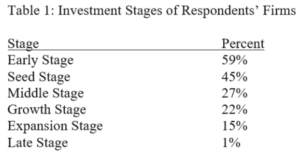
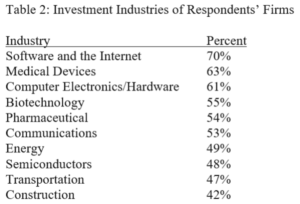
The tables below indicate the different stages of venture capital funding represented by the surveyed firms, as well as the variety of represented industries. The total percentages come out to over 100%, because most firms focused on multiple investment stages and industry areas. It should be noted that the survey questions related only to U.S. patents and only to financing activities in the United States.

Table 1: Investment Stages of Respondents' Firms. Early stage, 59%. Seed stage, 45%. Middle Stage, 27%. Growth Stage, 22%. Expansion stage, 15%. Lat stage, 1%.

Table 2: Investment Industries of Respondents' Firms. Industry to percent. Software and the Internet, 70%. Medical Devices, 63%. Computer Electronics/Hardware, 61%. Biotechnology, 55%. Pharmaceutical, 54%. Communications, 53%. Energy, 49%. Semiconductors, 48%. Transportation, 47%. Construction, 42%.

The Findings

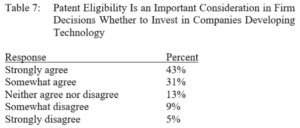
Overwhelmingly, investors reported that patent eligibility is an important consideration for their firms when deciding whether to invest in companies that are developing technology. In total, 74% agreed with this idea, while only 13% disagreed.

Table 7: Patent Eligibility Is an Important Consideration in Firm Decisions Whether to Invest in Companies Developing Technology. Response to percent. Strongly agree, 43%. Somewhat agree, 31%. Neither agree nor disagree, 13%. Somewhat disagree, 9%. Strongly disagree, 5%.

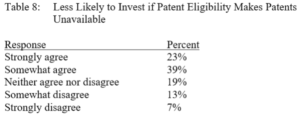
This led to the natural follow-up question: If the laws of patent eligibility make a patent unavailable for a certain technology, would the firm be less likely to invest in companies developing that technology? In response, 62% agreed that their firms would be less likely to invest given the unavailability of patents.

Table 8: Less Likely to Invest if Patent Eligibility Makes Patents Unavailable. Response to percent. Strongly agree, 23%. Somewhat agree, 39%. Neither agree nor disagree, 19%. Somewhat disagree, 13%. Strongly disagree, 7%.

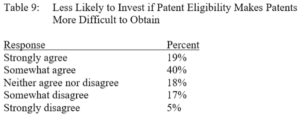
The response changed slightly when the scenario was changed to one where the patent was merely more difficult to obtain. However, there was not a significant change from the response to the previous question, and respondents weighed in at 59% agreement.

Table 9: Less Likely to Invest if Patent Eligibility Makes Patents More Difficult to Obtain. Response to percent. Strongly agree, 19%. Somewhat agree, 40%. Neither agree nor disagree, 18%. Somewhat disagree, 17%. Strongly disagree, 5%.

From the data collected, it appears that investors in the medical device, biotechnology, and pharmaceutical industries tend to value patentability slightly more than investors in the software space. Additionally, early-stage investors seemed to value patent eligibility slightly more than their late-stage counterparts, though there was not a statistically significant difference reported between the different stages of investment. Prof. Taylor theorizes here that a larger sample size might indicate a more obvious trend.

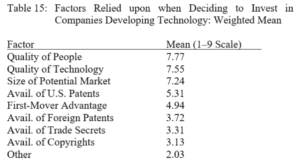
Prof. Taylor notes one interesting statistic: those who were familiar with the Supreme Court’s recent eligibility decisions tended to value patent eligibility higher than those who were not familiar with the cases. This may indicate that the more aware an investor is of the recent opinions, the more they value the impact of those opinions. Prof. Taylor makes sure to note, however, that the data do not preclude the possibility that the more one knows about a subject, the more importance one places on one’s own knowledge of the subject. Additionally, patent eligibility did not appear to be the primary focus for investors. When compared with various other factors typically considered by investment firms, patent eligibility was consistently relegated to a lesser role. It is significant to note that the present survey focused on the availability of patents based only on patent eligibility.

Table 15: Factors Relied upon when Deciding to Invest in Companies Developing Technology: Weighted Mean. Factor to mean (1-9 scale). Quality of People, 7.77. Quality of Technology, 7.55. Size of Potential Market, 7.24. Availability of U.S. Patents, 5.31. First-Mover Advantage, 4.94. Availability of Foreign Patents, 3.72. Availability of Trade Secrets, 3.31. Availability of Copyrights, 3.13. Other, 2.03.

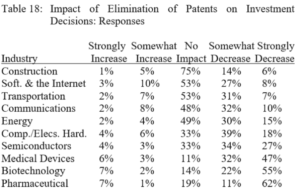
In general, investors indicated that the loss of patent protection would cause them to decrease their investments, though Prof. Taylor finds that this decreased investment would be more pronounced in some industries than others. As shown using weighted averages, the three industries with the greatest reported decrease would be the pharmaceutical, biotechnology, and medical device industries.

Table 18: Impact of Elimination of Patents on Investment Decisions: Responses. Industry to increase or decrease. Construction: Strongly Increase, 1%, Somewhat Increase, 5%, No Impact, 75%, Somewhat Decrease, 14%, or Strongly Decrease, 6%. Software and the Internet: Strongly Increase, 3%, Somewhat Increase, 10%, No Impact, 53%, Somewhat Decrease, 27%, or Strongly Decrease, 8%. Transportation: Strongly Increase, 2%, Somewhat Increase, 7%, No Impact, 53%, Somewhat Decrease, 31%, or Strongly Decrease, 7%. Communications: Strongly Increase, 2%, Somewhat Increase, 8%, No Impact, 48%, Somewhat Decrease, 32%, or Strongly Decrease, 10%. Energy: Strongly Increase, 2%, Somewhat Increase, 4%, No Impact, 49%, Somewhat Decrease, 30%, or Strongly Decrease, 15%. Computer/Electronics Hardware: Strongly Increase, 4%, Somewhat Increase, 6%, No Impact, 33%, Somewhat Decrease, 39%, or Strongly Decrease, 18%. Semiconductors: Strongly Increase, 4%, Somewhat Increase, 3%, No Impact, 33%, Somewhat Decrease, 34%, or Strongly Decrease, 27%. Medical Devices: Strongly Increase, 6%, Somewhat Increase, 3%, No Impact, 11%, Somewhat Decrease, 32%, or Strongly Decrease, 47%. Biotechnology: Strongly Increase, 7%, Somewhat Increase, 2%, No Impact, 14%, Somewhat Decrease, 22%, or Strongly Decrease, 55%. Pharmaceutical: Strongly Increase, 7%, Somewhat Increase, 1%, No Impact, 19%, Somewhat Decrease, 11%, or Strongly Decrease, 62%.

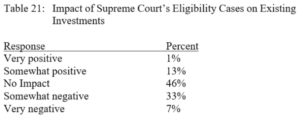
Next, Prof. Taylor explores the impact that the Supreme Court’s decisions have had on investment behaviors. The survey showed that 38% of investors were familiar with at least one of the patent-eligibility cases. About 40% of those knowledgeable investors indicated that the decisions had a negative effect on their firms’ existing investments, compared with 14% who indicated positive effects.

Table 21: Impact of Supreme Court's Eligibility Cases on Existing Investments. Response to percent. Very positive, 1%. Somewhat positive, 13%. No Impact, 46%. Somewhat negative, 33%. Very negative, 7%.

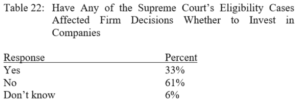
However, Prof. Taylor notes that these numbers represent only the static impact of the Supreme Court cases. Dynamic impact—meaning, the impact on future decision making—is likely the more important statistic. Interestingly, only one-third of investors indicated that the cases would impact their decisions on whether to invest in companies going forward, with no statistically significant difference based on industry or stage of funding.

Table 22: Have Any of the Supreme Court's Eligibility Cases Affected Firm Decisions Whether to Invest in Companies. Yes, 33%. No, 61%. Don't know, 6%.

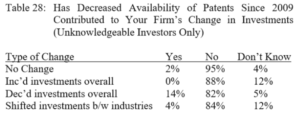
With the numbers above representing investors with knowledge of the patent eligibility cases, it should be no surprise to learn that investors unfamiliar with the Supreme Court cases overwhelmingly responded that the decreased availability of patents had not impacted their firms’ changes in investment behavior.

Table 28: Has Decreased Availability of Patents Since 2009 Contributed to Your Firm's Change in Investments (Unknowledgeable Investors Only). Type of change to reply percentage. No change: Yes, 2%; No, 95%; Don't Know, 4%. Increased investments overall: Yes, 0%; No, 88%; Don't Know, 12%. Decreased investments overall: Yes, 14%; No, 82%; Don't Know, 5%. Shifted investments between industries: Yes, 4%; No, 84%; Don't Know, 12%.

Conclusion

While there were a wide variety of opinions from the many investors regarding the current state of patent eligibility, the general consensus was that the Supreme Court’s decisions have had a negative impact on patentability, leading to a potential decrease in a willingness to invest. This attitude was most prevalent in, but not limited to, the biotechnology and pharmaceutical industries.

As presented in his paper, Prof. Taylor’s survey provides the first empirical data on how the current state of patent eligibility has affected the attitude of investors. Like all surveys, however, it is susceptible to a certain degree of error caused by various unavoidable human characteristics. Even recognizing its limitations, this survey provides useful information that can be used to begin analyzing the question of whether the Supreme Court’s eligibility cases have impacted investment decision making, and it sheds light on an issue about which many experts in the field have become increasingly concerned.

Categories
Biotech Patent Law

Forty Years Since Diamond v. Chakrabarty: Legal Underpinnings and its Impact on the Biotechnology Industry and Society

U.S. Supreme Court buildingCPIP has published a new policy brief celebrating the fortieth anniversary of the Diamond v. Chakrabarty decision, where the Supreme Court in 1980 held that a genetically modified bacteria was patentable subject matter. The brief, entitled Forty Years Since Diamond v. Chakrabarty: Legal Underpinnings and its Impact on the Biotechnology Industry and Society and written by Matthew Jordan, Neil Davey, Maheshkumar P. Joshi, and Raj Davé, is dedicated to the late Dr. Ananda Chakrabarty, a pioneer in the biotechnology world, who passed away in July 2020.

Chakrabarty had a great impact on the biotechnology revolution, ushering in a new era of technological advances that have benefited humankind. Through interviews with Randall Rader, former Chief Judge of the Federal Circuit, and Dr. Chakrabarty himself, as well as case studies on genetically modified seeds, polymerase chain reactions, and monoclonal antibody therapies, the policy brief explores the importance and enduring implications for society of the Chakrabarty decision.

The introduction and conclusion sections are copied below:

***

I. Introduction: The Diamond v. Chakrabarty (1980) Supreme Court Decision

In 1972, Ananda Chakrabarty—a genetic engineer at General Electric—filed a patent application for genetically modified bacteria capable of breaking down crude oil. Dr. Chakrabarty introduced genetic fragments into the Pseudomonas bacterium, altering the bacteria to decompose hydrocarbon components of crude oil. Dr. Chakrabarty intended the bacteria to assist in cleaning up oil spills. The engineered bacteria were especially suited for bioremediation given their resistance to adverse environments and safety as a non-pathogen.

The examiner rejected the application under Section 101 of the Patent Act, which covers patentable subject matter, because living things were not patentable. The Board of Patent Appeals and Interferences (now known as the Patent Trial and Appeal Board) affirmed the examiner’s decision, however, the U.S. Court of Customs and Patent Appeals (now part of the U.S. Court of Appeals for the Federal Circuit) sided with Dr. Chakrabarty. The Court of Customs, in an opinion by Judge Giles Rich, reasoned that only naturally occurring articles, not all living things, were ineligible for patenting. Importantly, the court said, “the fact that microorganisms are alive is a distinction without legal significance” for purposes of the patent law. Then, U.S. Patent and Trademark Office (USPTO) Commissioner Sidney Diamond appealed the case to the Supreme Court.

The Supreme Court of the United States held that Dr. Chakrabarty’s invention consisted of patentable subject matter. Section 101 states: “Whoever invents or discovers any new and useful process, machine, manufacture, or composition of matter, or any new and useful improvement thereof, may obtain a patent therefor, subject to the conditions and requirements of this title.” The Court ruled in a landmark 5-4 decision that Dr. Chakrabarty’s invention was a patentable, manmade, “composition of matter” or “manufacture.” Chief Justice Warren Burger famously quoted a Senate Report that was part of the legislative history for the Patent Act of 1952: patentable subject matter included “anything under the sun that is made by man.”

This decision had immense implications for biotechnology. It resulted in patents for genetically modified seeds, DNA amplification technology, and monoclonal antibody therapy. The rise of biotechnology has impacted many technological fields and society as a whole. The Supreme Court’s distinction between manmade and naturally occurring phenomena was clarified in Mayo v. Prometheus and AMP v. Myriad. The Court found that naturally occurring biological relationships and isolated DNA sequences were not eligible for patenting.

***

V. Conclusion

Diamond v. Chakrabarty revolutionized the biotechnology industry in the United States by incentivizing the advancement of inventions that are beneficial to human life. However, as noted by Judge Randall Rader: “This whole patent eligibility question—which was so clear and well-defined, was practically implementable and understandable, and gave life to our whole biotech industry after Chakrabarty—now has had a heavy cloud cast over it in recent jurisprudence such as Myriad.”

When asked if our legislature should take action to clear up the confusion, Judge Rader stated: “If the statute was the written law that was being interpreted by the Supreme Court, we wouldn’t need legislative change. But the sad truth is that the Supreme Court has created a whole overlay of doctrine that makes the statute almost irrelevant. And now we don’t look at whether there’s a process, a machine, an article of manufacture, or a composition of matter. Instead, we look at whether there’s something more beyond the conventional and the routine and the well-known. We argue over what is something and what is more, and what is an inventive concept. And so in that state of confusion, yes, we’re probably going to need legislation.”

Within the dire context of the COVID-19 pandemic and other countries racing past the United States in biotechnology, it is crucial for Congress to clarify what currently qualifies as patentable subject matter.

***

To read the policy brief, please click here.