Categories
Patents Pharma

Professor Joanna Shepherd Explains Pharmaceutical Product Hopping in New CPIP Policy Brief

pharmaceuticalsCPIP has published a new policy brief by Joanna M. Shepherd, Vice Dean and Thomas Simmons Professor of Law at Emory University School of Law. The brief, entitled The Legal and Industry Framework of Pharmaceutical Product Hopping and Considerations for Future Legislation, discusses the practice of so-called “product hopping,” where a pharmaceutical company turns its focus to newer versions of its existing drugs. The newer versions, which may include extended-release formulations, different dosages, and the like, can be protected by new patents if they independently meet the patentability requirements, including novelty, nonobviousness, and utility. However, these newer versions may not be covered by a state’s automatic substitution laws since there are no generics yet available. Those laws only apply when generic versions are on the market.

Prof. Shepherd explains that the product hopping phenomenon is incentivized by the legal and industry framework in which pharmaceutical companies operate. Indeed, the current system allows generic drug companies to free ride on the extensive research, development, approval, and marketing costs borne by the branded drug companies, and the latter are thus motivated to create new and innovative drugs that will further benefit consumers. Despite these benefits, some suggest that we need legislative changes to rein in product hopping, and some even argue that the practice itself violates the antitrust laws. Prof. Shepherd looks at the existing case law on the antitrust issue—a total of two cases at the federal appellate level—to find points of agreement, and she uses that synthesis to suggest considerations for future legislative efforts to balance the needs of consumers and producers. Finally, Prof. Shepherd warns that any legislation aimed at product hopping should be cautious so as not to ultimately harm consumers, reduce innovation, and increase health care spending.

The Executive Summary and Conclusion are copied below:

***

Executive Summary

Ensuring that Americans can afford health-improving and life-saving drugs should be a top priority for policymakers. However, efforts to reduce drug prices must be made carefully so as not to jeopardize the innovation that creates those critical drugs in the first place.

Recently, in the name of reducing drug prices, the makers of innovative drugs have become targets of antitrust suits alleging that their business practices constitute anticompetitive behavior. One such practice is sometimes called “product hopping.” This is the act of shifting a customer base from an older drug to a newer one with a longer remaining patent life. A generic drug maker is still free to sell the generic version of the older drug once its patent expires, but product hopping prevents the generic drug maker from benefitting from state laws that automatically substitute generic drugs at the pharmacy counter. Because product hopping makes it more difficult for generics to “free ride” on the manufacturers’ efforts, many have argued that the practice is anticompetitive.

Case law in this area is sparse, and there is a troubling uncertainty in the industry about what practices will, and should, trigger an antitrust violation. Current legislative proposals attempt to limit or prohibit the two basic forms of product hopping: the “hard switch,” in which the older drug is pulled from the market and replaced with its newer counterpart; and the “soft switch,” in which the older drug remains for sale, but all marketing efforts are shifted to the new drug.

The purpose of this policy brief is to address broad and vague language within those proposals that run counter to their stated goals and to advocate for clear and reasonable standards for assessing when a business’s activities should be deemed anticompetitive. As discussed further below, language that is too broad in scope could cover normal business practices that should not fall under antitrust law. Vague language would introduce legal uncertainty into the equation and weigh heavily on drug developers’ investment decisions, leading to fewer innovative treatments and higher levels of overall national health care spending.

This brief contains four parts. First, I will discuss the legal and industry framework that incentivizes product hopping. Second, I will discuss the current state of product-hopping case law as laid out in New York v. Actavis and Mylan Pharmaceuticals v. Warner Chilcott. Third, I will present considerations for future product-hopping legislation. The guiding principles for determining anticompetitive practices should be: (1) whether a hard switch eliminates consumer choice with no offsetting consumer benefit; and (2) whether a soft switch includes conduct that significantly interferes with consumer choice to the point at which it is effectively eliminated, with no offsetting consumer benefit. Fourth, I will discuss the potential consequences of legislation that is written too broadly or vaguely.

***

Conclusion

All parties generally agree upon the importance of maintaining choice in the pharmaceutical market. But we must bear in mind that true choice is promoted not only by a competitive marketplace of sellers but also by the continual introduction of new and better treatments. Any new legislation must strike a balance that allows for a free and open market without stifling innovation in medicine. And any new antitrust law should be focused on preventing anticompetitive behavior from all sides, rather than preserving or reinforcing the regulatory advantages to which generic drug makers have grown accustomed. Above all, the law must be clear and unambiguous, so that those who are responsible for bringing innovative medicines to the world are not hampered by the inefficiencies of regulatory uncertainty.

***

To read the policy brief, please click here.

Categories
Copyright

Professor Shyam Balganesh on Understanding Privative Copyright Claims

The following post comes from Liz Velander, a recent graduate of Scalia Law and a Research Assistant at CPIP.

the word "copyright" typed on a typewriterBy Liz Velander

Some argue that modern copyright law is decidedly market-oriented, almost entirely justified in utilitarian terms. By promising authors a set of marketable exclusive rights in their works, copyright is believed to incentivize the production of works of authorship. In his new paper, Privative Copyright, Professor Shyamkrishna Balganesh of the University of Pennsylvania Law School explains that this view produces a clear mismatch when using copyright law to remedy noneconomic harms. This paper was work-shopped at CPIP’s Philosophical Approaches to Intellectual Property research colloquium in 2019 and subsequently published in the Vanderbilt Law Review.

“Privative” copyright claims are infringement actions brought by authors for the unauthorized public dissemination of works that are private, unpublished, and revelatory of an author’s personal identity. They are driven by considerations of authorial autonomy, dignity, and personality rather than monetary value, seeking to redress a particular form of copyright harm that Prof. Balganesh refers to as “disseminative harm.” An example of a privative copyright claim is found in the recent Ninth Circuit case, Monge v. Maya Magazines.

The plaintiffs in the case were a well-known pop music star and her manager, who got married in secret. To maintain the secrecy of the wedding, the couple limited the number of witnesses and took a very limited number of photographs that were intended for the couple’s private use. Through unscrupulous means, the photographs fell into the hands of an individual who sold them to the defendant, a gossip magazine that published them. The district court found for the defendant, concluding that the publisher’s use of the photographs constituted fair use. On appeal, the Ninth Circuit reversed in a rare denial of fair use for a privative claim.

To gain a full understanding of the Ninth Circuit’s opinion in this case, the nature of privative copyright claims in general, and why courts find them troublesome, Prof. Balganesh believes that one must trace the historic evolution of privative copyright claims in Anglo-American copyright law. Modern copyright scholarship is deeply critical of privative copyright claims, believing that the dignitary interests and harms that underlie such claims are best dealt with through privacy law. Prof. Balganesh’s article challenges this dominant view, arguing that privative copyright claims form a legitimate part of the copyright landscape. He demonstrates that protecting an author’s dignitary interest and the underlying commitment to authorial autonomy that motivates these claims have remained important normative goals of copyright law despite the multiple doctrinal variations and updates that the law has gone through over the last three centuries.

Prof. Balganesh explains that in its most basic form, copyright law functions by rendering forms of expressive harm privately actionable. He identifies three types of expressive harm protected by copyright law: (1) appropriative harm, (2) in situ reputational harm, and (3) disseminative harm. Appropriative harm is the primary form of expressive harm that copyright ordinarily centers around, typically resulting from instances of copying. In situ reputational harm originates from the U.S. copyright system’s limited recognition of moral rights protection in the form of the rights of integrity and attribution. A common feature of both rights is they derive from the need to protect an author’s reputation as manifested in the work. The integrity right focuses on protecting against a mutilation or distortion of the work in the recognition that this would impact authorial reputation directly. The attribution right focuses on ensuring that a work is not wrongly attributed to an author, again with the recognition that attributions contrary to the author’s actions and intent to do harm to authorial reputation.

The third category of copyright harm forms the basis of privative copyright claims. It emerges from the mere dissemination or use of a protected work without the creator’s authorization, regardless of the objective utility or value of such actions. The dissemination is harmful not for its economic effects, but instead because of its interference with the author’s unique dignitary interests. In various situations, such as in the Monge case, individuals produce original expression that they intend to keep private or limit to very particular recipients. When fixed in a tangible medium of expression, such as a photograph, the communications become eligible for copyright protection. When such expression is made public, it amounts to a direct infraction of its creator’s personal autonomy.

Prof. Balganesh sees this infraction as two-layered. First, it repudiates the creator’s choice to control whether, how, and when the work is to be shared. Second, it forces the creator to admit to being the author of the work, since elements of the creator’s persona and identity are often apparent on the face of the work. The publication thus forces authorship on the creator, with all its social, legal, and moral implications. Central to disseminative harm is the recognition that the work is personal to its author in a rather distinctive way.

Modern copyright scholarship believes that disseminative harm is best dealt with through privacy law, not copyright law. Prof. Balganesh argues that this approach misunderstands the nature of privative claims in copyright law and the centrality of authorial autonomy that underlies them. He sees it as being drive by three primary concerns: (1) copyright utilitarianism, (2) free speech concerns, and (3) perception that privacy torts are better suited to address dignitary harms.

Prof. Balganesh addresses each of these concerns in turn. First, while copyright law today is often justified exclusively in utilitarian terms, this was not always the case. Privative copyright claims actually predate the utilitarian turn in copyright law. Prof. Balganesh argues that the overt utilitarian turn in copyright law is far from a principled reason to critique the legitimacy of privative copyright claims. To the contrary, normative pluralism has remained a hallmark of the copyright landscape, much like it has for a variety of legal institutions. The logic underlying the functioning of privative copyright claims began to take shape shortly after the passage of the Statute of Anne in 1710. In the three centuries since, they have mutated and adapted to society’s changing concepts of privacy, personal autonomy, and copyright’s coverage of new subject matter.

Second, Prof. Balganesh dismisses the concern that copyright protection for dignitary or privacy interests risks converting authorship into censorship. He explains that copyright has various devices protective of free speech that can come into play in privative claims, the most notable being fair use. Courts use fair use as a stand-in for free speech concerns and balance the fair use factors against the plaintiff’s claims. Given the robustness of these mechanisms, Prof. Balganesh sees no credible free speech concerns with privative copyright claims.

Third, Prof. Balganesh argues that privacy torts are not better suited to protect dignitary interests because the dignitary interests underlying privative copyright claims entail more than just a concern with privacy. They implicate considerations of personality and personal autonomy, in the way of authorial autonomy. Privacy torts, most notably the tort of public disclosure of private facts, focus on representational autonomy and an individual’s ability to control public representations of her persona. They view the denial of such autonomy as emanating from the subject’s choice to keep certain facets of her persona private, and then scrutinize the existence and parameters of that choice rather carefully. The nonconsensual public disclosure of such facts is seen to cast the subject into the public and in turn produce potentially emotional and reputational harm. Privative copyright claims, on the other hand, involve a combination of representational and authorial concerns that an incapable of disaggregation.

With this understanding of privative copyright claims, the Ninth Circuit’s opinion in Monge v. Maya Magazines can be seen in a new light. Recall that the plaintiffs were a celebrity couple who had taken photographs of their secret wedding and the defendant magazine somehow obtained copies of those photographs and published them. The Ninth Circuit’s finding for the plaintiffs demonstrates the difficulty courts have with privative copyright claims and why it is tempting to place them in another legal realm.

The court’s decision was predicated on an analysis of the four fair use factors. Since the fair use doctrine was codified in 1976, courts have grown to place significant reliance on the fourth factor—the potential market harm for the copyrighted work. However, examining the existence (or absence) of market harm for privative copyright claims is an obvious mismatch considering the plaintiff’s work was intended to be kept private. In Monge, the Ninth Circuit refused to acknowledge this mismatch, instead presuming an actual market for the plaintiffs’ photographs because the couple was “in the business of selling images of themselves and had done so in the past.”

The Ninth Circuit’s reasoning is puzzling because, by its own admission, the plaintiffs’ primary (if not exclusive) motivation in retaining the photographs was for their own private use. The photographs were not for sale, they were intended to remain secret. Prof. Balganesh acknowledges that such secrecy has a potential price in that the scarcity renders the information more valuable. But he finds it to be a stretch to presume an actual market for the work.

Prof. Balganesh recommends an alternative approach for courts to use when applying the fair use defense to privative claims. He argues that courts should consider the “dignitary” nature of the work under the second factor, a combination of its being (1) unpublished, (2) private, and (3) embodying expression directly implicating the author’s persona and identity. While this classification should not be dispositive in the overall fair use analysis, it should weigh heavily and influence the interpretation and application of the other factors. The fourth factor, relating to market effect, should be understood as receding in importance once the work is classified as “dignitary” in nature.

Prof. Balganesh’s article makes a strong case for courts to adopt this approach through tracing the historic evolution of privative copyright claims in Anglo-American copyright law. He teases apart the theories behind copyright law and develops a theoretical basis for understanding the workings of privative copyright claims. Privative Copyright is an essential read for a deeper understanding of copyright law.

Categories
CPIP Roundup

CPIP Roundup – December 2, 2020


Greetings from CPIP Executive Director Sean O’Connor

Sean O'Connor

I hope you had an enjoyable, restful Thanksgiving. At CPIP, we’re winding down 2020 while planning our spring and summer events—including biopharma and copyright roundtables, the 2021 WIPO-CPIP Summer School on Intellectual Property, and more.

As usual, our team has been up to many great things. Director of Copyright Research and Policy Sandra Aistars’ Arts & Entertainment Advocacy Clinic co-hosted a virtual clinic with Washington Area Lawyers for the Arts (WALA). The event was a huge success. You can read our write-up here, and a recording of the Rock Creek Kings’ featured performance is available here. Sandra also participated in a November 12 panel hosted by the Law of Intellectual Property (LIP) student organization at the University of Oregon School of Law (home to CPIP Senior Scholar Eric Priest).

I taught my annual workshop on “Public-Private Partnerships–Innovation and Technology Transfer” in the CEIPI-WIPO-INPI Advanced Training Course on Intellectual Property, Technology Transfer and Licensing. I also published an op-ed at The Hill on price controls, explaining why the government cannot seize or bypass pharmaceutical patents.

Our affiliates have also been doing great things as well. Scalia Law Alumna and Arts & Entertainment Advocacy Clinic Adjunct Professor Terrica Carrington and Lateef Mtima of Howard University School of Law and IIPSJ have great quotes in this Billboard article on choreography, copyright, and social justice. CPIP Senior Fellow for Innovation Policy Jonathan Barnett continues to blog at Truth on the Market; you can catch his latest piece here and read his take on how antitrust law can be abused to promote unproductive rent-seeking. Meanwhile Chris Holman, CPIP Senior Fellow for Life Sciences, continues writing for the Biotechnology Law Report, where he serves as Executive Director; his latest article is available here.

Below we highlight new papers from CPIP Edison Fellows Christa Laser (Equitable Defenses in Patent Law), Talha Syed (Owning Knowledge: A Unified Theory of Patent Eligibility), and Tabrez Ebrahim (Artificial Intelligence Inventions & Patent Disclosure).

While 2020’s end-of-year holiday season may well be challenging, I hope you and yours will find a way to share the spirit and renewal of this coming season while looking forward to a successful new year!


Spotlight on Scholarship

a pair of glasses, an apple, and a stack of books

The scholars from our Thomas Edison Innovation Fellowship program continue to publish high quality scholarship and cutting-edge research that promotes the value of intellectual property. Here are some recent publications:

Tabrez Y. Ebrahim, Artificial Intelligence Inventions & Patent Disclosure, 125 Penn. St. L. Rev. 147 (2020)

In his new paper at Penn State Law Review, Artificial Intelligence Inventions & Patent Disclosure, Professor Tabrez Ebrahim of California Western School of Law claims that AI fundamentally challenges disclosure in patent law, which has not kept up with rapid advancements in AI, and seeks to invigorate the goals that patent law’s disclosure function is thought to serve for society. In so doing, Prof. Ebrahim assesses the role that AI plays in the inventive process, how AI can produce AI-generated output (that can be claimed in a patent application), and why it should matter for patent policy and for society. He also introduces a taxonomy comprising AI-based tools and AI-generated output that he maps with social-policy-related considerations, theoretical justifications and normative reasoning concerning disclosure for the use of AI in the inventive process, and proposals for enhancing disclosure and the impact on patent protection and trade secrecy.

To read our blog post summarizing the paper, please click here.

Christa J. Laser, Equitable Defenses in Patent Law, 75 U. Miami L. Rev. 1 (2020)

In patent law, equitable defenses can play an essential role in multi-million-dollar patent infringement cases. Unclean hands, misuse, or estoppel can render a potential verdict unenforceable. Professor Christa Laser of Cleveland-Marshall College of Law dives into the unique and unsettled role of equity in her new paper, Equitable Defenses in Patent Law, which is forthcoming at the University of Miami Law Review. Prof. Laser compares two theories to determine how courts might interpret undefined language governing equitable defenses in patent statutes, and she analyzes whether Congress codified preexisting decisional law or expanded it with the 1952 Patent Act. Finally, Prof. Laser suggests that Congress could delegate its authority to an agency to handle the ever-changing patent landscape.

To read our blog post summarizing the paper, please click here.

Talha Syed, Owning Knowledge: A Unified Theory of Patent Eligibility (forthcoming)

In his new draft paper, Owning Knowledge: A Unified Theory of Patent Eligibility, Professor Talha Syed of Berkeley Law argues that the confusion surrounding patentable subject matter under Section 101 is two-fold. First, it results from our failure to develop a functionality doctrine that can clearly distinguish technological applications of knowledge from other forms of knowledge. Second, he offers a root cause of this failure. There is a distracting preoccupation in patent law with “physicalism,” that is, the notion that a patent is awarded for a thing (tangible or not) rather than for knowledge of that thing. In order to move forward, Prof. Syed states that we must first unwind the physicalist assumptions that are tangled up in our Section 101 analyses. Only then can we develop a functionality doctrine free of those encumbrances.

To read our blog post summarizing the paper, please click here.


Categories
C-IP2 News

#GivingTuesday: A Message from CPIP on Giving Tuesday 2020

CPIP logo

As we enter the holiday season and look ahead to 2021, we hope that you will keep CPIP in mind as you plan your end-of-year giving. Your support is critical to ensuring that CPIP can continue to bring reason and balance to the academic debate on intellectual property (IP) by engaging academics, creators, and innovators in a scholarly dialogue. Through our programs, events, network of scholars, and in-house staff, we have made great strides, but there is more work to be done. CPIP is an academic center and receives neither government funding nor funding from George Mason University, and it is only through the private support of our partners and sponsors that we can fulfill our mission.

To donate to CPIP, please visit: https://cip2.gmu.edu/donate-to-cpip/

You can also support CPIP by:

Your contributions help CPIP:

  • Host conferences, roundtables, fellowship meetings, symposia and colloquia, the WIPO Summer School on Intellectual Property, and many other programs that promote an ongoing dialogue on the importance of IP rights

  • Continue to build and maintain a community of research scholars and innovation industry stakeholders in the U.S.

  • Produce and support the production of a variety of cutting-edge research, scholarly articles, and policy materials that explore the value of IP and contribute to better-informed policy

  • Employ an in-house staff of directors and communications specialists who work tirelessly to plan and execute CPIP programs and events

  • Maintain and grow an international network of scholars, lawyers, and other professionals dedicated to the scholarly analysis of IP

Looking ahead to CPIP’s ninth year of operation, we are proud to be a leading academic voice in the discussion of IP rights and the technological, commercial, and creative innovation they facilitate. We have an exciting lineup of programs and events planned for 2021 as well as research and policy work agendas that will focus on key IP issues. The generosity of our partners and supporters is essential to CPIP’s success, and we thank you in advance for your support.

Categories
Patent Law

Professor Tabrez Ebrahim on Artificial Intelligence Inventions

The following post comes from Associate Professor of Law Tabrez Ebrahim of California Western School of Law in San Diego, California.

a pair of glasses, an apple, and a stack of booksBy Tabrez Ebrahim

Artificial intelligence (AI) is a major concern to the United States Patent and Trademark Office (USPTO), for patent theory and policy, and for society. The USPTO requested comments from stakeholders about AI and released a report titled “Public Views on Artificial Intelligence and Intellectual Property Policy.” Patent law scholars have written about AI’s impact on inventorship and non-obviousness, and they have acknowledged that the patent system is vital for the development and use of AI. However, there is prevailing gap and understudied phenomenon of AI on patent disclosure. The Center for Protection for Intellectual Property (CPIP) supported my research in this vein through the Thomas Edison Innovation Fellowship.

In my new paper, Artificial Intelligence Inventions & Patent Disclosure, I claim that AI fundamentally challenges disclosure in patent law, which has not kept up with rapid advancements in AI, and I seek to invigorate the goals that patent law’s disclosure function is thought to serve for society. In so doing, I assess the role that AI plays in the inventive process, how AI can produce AI-generated output (that can be claimed in a patent application), and why it should matter for patent policy and for society. I introduce a taxonomy comprising AI-based tools and AI-generated output that I map with social-policy-related considerations, theoretical justifications and normative reasoning concerning disclosure for the use of AI in the inventive process, and proposals for enhancing disclosure and the impact on patent protection and trade secrecy.

AI refers to mathematical and statistical inference techniques that identify correlations within datasets to imitate decision making. An AI-based invention can be either: (1) an invention that is produced by AI; (2) an invention that applies AI to other fields; (3) an invention that embodies an advancement in the field of AI; or (4) some combination of the aforementioned. I focus on the first of these concerning the use of AI (what I term an “AI-based tool”) to produce output to be claimed as an invention in a patent application (what I term “AI-generated output”).

The use of AI in patent applications presents capabilities that were not envisioned for the U.S. patent system and allows for inventions based on AI-generated output that appear as if they were invented by a human. Inventors may not disclose the use of AI to the USPTO, but even if they were to do so, the lack of transparency and difficulty in replication with the use of AI presents challenges to the U.S. patent system and for the USPTO.

As a result of the use of AI-based tools in the inventive process, inventions may be fictitious or imaginary, but appear as if they had been created by humans (such as in the physical world) and still meet the enablement and written descriptions requirements. These inventions may be considered as being either imaginary, never-achieved, or unworkable to the inventor, but may appear as if they were created, tested, or made workable to reasonable onlookers or to patent examiners.

The current standard for disclosure in patent law is the same for an invention produced by the use of AI as any invention generated by a human being without the use of AI. However, the use of AI in the inventive process should necessitate a reevaluation of patent law’s disclosure function because: (1) AI can produce a volume of such fictitious or imaginary patent applications (that meet enablement and written descriptions requirements) that would stress the USPTO and the patent system; and (2) advanced AI in the form of deep learning, which is not well understood (due to hidden layers with weights that evolve) may insufficiently describe the making and using of the invention (even with disclosure of diagrams showing a representation of the utilized AI).

Such AI capabilities challenge the current purposes of patent law, and require assessing and answering the following questions for societal reasons: Should patent law embrace the unreal fictitious and imaginary AI-generated output, and if so how can the unreal be detected in patent examination from disclosure of that created by a human? Should inventors be required to disclose the use of AI in the inventive process, and should it matter for society?

Patents are conditioned on inventors describing their inventions, and patent law’s enablement doctrine focuses on the particular result of the invention process. While patent doctrine focuses on the end state and not the tool used in the process of inventing, in contrast, I argue that the use of AI in inventing profoundly and fundamentally challenges disclosure theory in patent law.

AI transforms inventing for two reasons that address the aforementioned reasons for reevaluation of patent law’s disclosure function: (1) The use of an AI-based tool in the invention process can make it appear as if the AI-generated output was produced by a human, when in fact, it was not so; and (2) even if an inventor disclosed the use of an AI-based tool, others may not be able to make or use the invention since the AI-based tool’s operation may not be transparent and replicable. These complexities require enhancing the disclosure requirement, and in so doing, present patent and trade secret considerations for society and for inventors.

The USPTO cannot reasonably expect patent examiners to confirm whether the patent application is for an invention that is fictitious or unexplainable in an era of increasing use of AI-based tools in the inventive process, and heightened disclosure provides a better verification mechanism for society. I argue that enhanced patent disclosure for AI has an important role to play in equilibrating an appropriate level of quid pro quo.

While there are trade-offs to explaining how the applied AI-based tools develop AI-generated output, I argue for: (1) a range of incentive options for enhanced AI patent disclosure, and (2) establishing a data deposit requirement as an alternative disclosure. My article’s theoretical contributions define a framework for subsequent empirical verification of whether an inventor will opt for trade secrecy or patent protection when there is use of AI-based tools in the inventive process, and if so, for which aspects of the invention.

There are a plethora of issues that the patent system and the USPTO should consider as inventors continue to use AI, and consideration should be given to disclosure as AI technology develops and is used even more in the inventive process.

Categories
Copyright

CPIP’s Sandra Aistars and Scalia Law Arts & Entertainment Advocacy Clinic Co-Host Virtual Copyright Event on Arts and the Pandemic

The following post comes from Chris Wolfsen, a recent graduate of Scalia Law and a Research Assistant at CPIP.

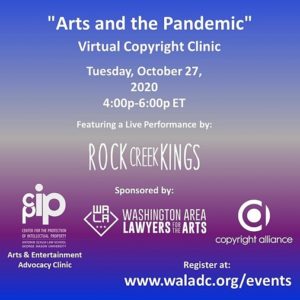
flyer for Arts and the Pandemic eventBy Chris Wolfsen

On October 27, 2020, CPIP Director of Copyright Research and Policy Sandra Aistars and students from her Arts & Entertainment Advocacy Clinic at Scalia Law School co-hosted a virtual event with Washington Area Lawyers for the Arts (WALA) and the Copyright Alliance. This virtual copyright clinic, focused on Arts and the Pandemic, provided information to artists wishing to protect their works as well as educators incorporating creative works into distance learning and museums wishing to make work available during the pandemic.

The event kicked off with a testimonial from the Rock Creek King’s Evan Moses, explaining WALA’s assistance in pairing the band with an attorney who advised them in securing the proper permits and asserting their First Amendment rights to perform outdoors during the COVID-19 quarantine for the Save Our Stages Movement. The band continues to raise awareness of the need for legislation to support local music venues during COVID-19 shutdowns. The Rock Creek Kings are calling on both the D.C. City Council and the U.S. Congress to assist these small businesses until they can reopen safely again.

Professor Aistars then turned the event over so her clinic students could answer questions submitted by attendees, with former clinic student, now adjunct professor, Dr. Stephanie Semler moderating. First was an explanation from David Ward on how artists can copyright their artwork. He explained that artists have a copyright as soon as their work is fixed in a tangible medium, but that registering that copyright with the United States Copyright Office will benefit artists. This registration will allow people seeking to license works to find artists and for artists to recover statutory damages in the case of a successful infringement claim. David explained that there are six categories of protectable works and shared a quick walkthrough of the process on https://copyright.gov/.

Bernard Horowitz then fielded a question on the minds of many artists: should I sign a COVID waiver in the studio or for the live event I participate in? Bernard explained that this question is a moving target—COVID waivers have not yet been litigated and Congress has not acted on the matter. He noted that we can look to current personal injury laws to draw conclusions about what may happen with this type of waiver and went on to explain the sharp distinction between the laws in Maryland and D.C. compared to those in Virginia.

Another topic that has been brought to the forefront during the pandemic is collaboration between artists and teachers. Yumi Oda walked attendees through the concept of fair use—a defense to copyright infringement—explaining that teachers using creative works during a live stream of their lesson can take certain measures to improve the likelihood that they will have a good argument that their use of a work in a classroom setting is a fair use. She explained that fair use is a fact-specific inquiry, but that educational use in a classroom setting is a classic example. Yumi also recommended teachers take additional steps such as protecting the lectures, and the creative works within them, with a password and removing student access at the end of the semester.

In a similar vein, Emily Gunberg discussed how museums are adapting to life in a pandemic. Curators have to consider whether they have the right to display a visual work online, which requires making a reproduction. This is a right that does not automatically attach when a museum acquires the physical work for display within the museum building. Emily noted that some types of online postings are usually acceptable, such as thumbnail images due to their lower resolution and limited use. For general availability to the public, such as a feature in a museum’s virtual tour, curators should revisit licensing agreements to ensure they have permission from rights owners.

Heather Uzer was given a more holistic and open-ended question: is the pandemic a catalyst for reform, or a death knell for independent creators? She emphasized that it is within our capacity to use this moment as an opportunity and as a catalyst for change. Artists’ right to protect their works still remain and there are many resources available to help with that protection. WALA, the Copyright Alliance, and many others are committed to protecting independent creators. David Ward also noted that several legislative efforts have gained attention, and that some record labels are holding special days to acknowledge creator efforts and supplement revenue for broadcasting artists by returning all revenues to performing artists on those days.

The event concluded with a performance by the Rock Creek Kings, live, but socially distanced from Crescendo Studios in Falls Church, Virginia. You can watch the video of their performance here on YouTube. One of the owners of Crescendo Studios, Eddie Fuentes, spoke about the importance of art and music in a time where we cannot be physically connected, and Evan, the lead singer of the band, reinforced the message during the performance This has been a year where people have missed weddings, graduations, funerals, and birthdays. Our communities rely on creators now more than ever to bring us together through shared experiences when we are six feet, or even oceans, apart.

Categories
Patent Law Patent Theory

Rethinking § 101: Professor Talha Syed Takes a Different Look at Subject Matter Eligibility

The following post comes from Colin Kreutzer, a 2E at Scalia Law and a Research Assistant at CPIP.

shelves full of booksBy Colin Kreutzer

When most people think of patentability requirements, they think of whether an invention has been “done before.” Novelty and non-obviousness under 35 U.S.C. §§ 102 and 103 are certainly key hurdles to obtaining a patent. But courts are often tied up over the more fundamental issues presented in § 101. That provision addresses patent eligibility itself—whether an idea, new or not, falls within some class of inventions that qualify for patent protection.

Section 101 of the Patent Act of 1952 says that a patent may be issued to “[w]hoever invents or discovers any new and useful process, machine, manufacture, or composition of matter.” It seems fairly straightforward. But the common law decisions, both pre- and post-1952, are riddled with exceptions and questions that the statute hasn’t resolved on its own. How do we treat intangible notions, such as scientific principles or other abstract ideas? Is a business method a patentable process? What property rights can be granted to an inventor who discovers a fundamental law of nature? And should we treat the realm of pure mathematics as being fundamental to nature itself? As we move deeper into the information age, these questions aren’t getting any simpler.

In a new paper from CPIP’s Thomas Edison Innovation Fellowship program entitled Owning Knowledge: A Unified Theory of Patent Eligibility, Professor Talha Syed of Berkeley Law argues that the confusion surrounding this issue is two-fold. First, it results from our failure to develop a functionality doctrine that can clearly distinguish technological applications of knowledge from other forms of knowledge. Second, he offers a root cause of this failure. There is a distracting preoccupation in patent law with “physicalism,” that is, the notion that a patent is awarded for a thing (tangible or not) rather than for knowledge of that thing.

In order to move forward, Prof. Syed states that we must first unwind the physicalist assumptions that are tangled up in our § 101 analyses. Only then can we develop a functionality doctrine free of those encumbrances. As he puts it, “[r]econstructing eligibility doctrine requires, then, extricating incipient functionality concerns from the physicalist thicket, developing their independent basis, and properly following through on their doctrinal implications.”

On its face, when someone proposes that we fundamentally rethink a subject, it sounds as if they are calling for some kind of seismic shift. But Prof. Syed argues that his proposal merely provides a clearer perspective on a subject that has long needed clarity. Rather than requiring any major statutory reforms or total abandonment of our jurisprudence, he says that the “dephysicalization” of patent eligibility serves to better integrate our existing statutory and common law frameworks.

How We Got Here

The questions mentioned above are not new. To understand the current state of things, Prof. Syed first details some of the cases that led us here, beginning with Neilson v. Harford, Le Roy v. Tatham, Boulton & Watt v. Bull, among others.

Neilson is instructive. It was an 1841 English case that dealt with an improvement to an industrial process. The applicant’s invention involved pre-heating air before it was injected it into an iron furnace. The Court of Exchequer expressed some doubts as to whether this intangible aspect of an industrial process was truly patentable. In the end, it only granted a patent because the inventive principle—that the pre-heated air provides better ignition efficiency than cold air—was embodied in a physical machine designed for that purpose. The patentee “does not merely claim a principle, but a machine embodying a principle.”

Neilson and the others influenced a number of cases in the 20th century American courts. Prof. Syed points to three variants of the general rationale. While a principle on its own is not patent eligible, it becomes so: (1) in an embodied application of the principle, (2) if it is delimited to a specific zone of industry, or (3) in an “inventive” mode of application.

These variants illustrate a schism already appearing by the end of the 19th century as to why an “abstract” idea may be unpatentable. If “abstract” is taken in the dephysicalized sense, then the problem may only be cured by applying the idea in some physical form. Alternatively, it could be abstract in the sense that it is a pure unapplied principle. In this case, patent eligibility may not require a tangible form, but instead some delimitation to a specific industrial zone of applicability. Prof. Syed attributes what came next at least partly on a failure to recognize and fully develop these distinctions.

Principles, in the abstract, were but one concern. The eligibility problem was compounded by similar questions about patent rights over natural phenomena. In the 1948 case of Funk Brothers Seed Co. v. Kalo Inoculant Co., the Supreme Court considered whether a set of naturally occurring bacterial strains—unmodified except by their selective combination—was a patentable invention. They answered “no.” Citing Le Roy, the Funk Bros. Court ruled that “patents cannot issue for the discovery of the phenomena of nature. . . . The qualities of these bacteria, like the heat of the sun, . . . are part of the storehouse of knowledge of all men.” Therefore, an invention based on a natural phenomenon must do more than rely upon “the handiwork of nature” in order to become patentable.

Then the waters got even muddier. At the crossroads of abstract principles and natural phenomena lies the fundamental concept of mathematics itself. In Gottschalk v. Benson, the Court addressed an algorithm for converting signals from one numerical form into a computer-friendly binary form. In Parker v. Flook, it was an algorithm for updating threshold alarm limits while monitoring certain chemical processes. In both cases, the Court held that the claimed invention was not a patentable process, but merely a mathematical formula which belonged to the “basic tools of scientific and technological work.”

However, both cases offered a different manner of distinguishing these abstract concepts from patentable inventions. Benson mentioned, but did not require, that an eligible process should transform a particular article or require a particular machine (much later, the Federal Circuit imposed the “machine-or-transformation test” as the sole test for eligibility, only to have it demoted to “useful tool” by the Supreme Court). Flook, on the other hand, looked for some “inventive” aspect that went beyond the algorithm itself.

The whole story is too convoluted to do it justice here. The strength of these various eligibility bars has fluctuated over the years. But through these cases and more, we arrived at the modern two-part test under Mayo Collab. Svcs v. Prometheus Labs, Ass’n for Molecular Pathology, Inc. v. Myriad Genetics, and Alice Corp. v. CLS Bank.

Quoting Alice, Prof. Syed lays out the test as:

(1) Step 1: First, we ask “whether the claims at issue are directed to” a law of nature, natural phenomenon, or abstract idea.(2) Step 2: If so, “we then ask, ‘what else is there in the claims before us,’” considering “the elements of each claim both individually and ‘as an ordered combination’ to determine whether the additional elements ‘transform the nature of the claim’ into a patent-eligible application.” Step two of this analysis is “a search for an ‘inventive concept.’”

Critique of the Modern Test, and a New Proposal

Prof. Syed cites a fundamental disconnect in this test between its “why” and “how,” that is, why an invention is ineligible at all (claiming “basic building blocks” of scientific and technological work) and how it may become eligible (by containing an “inventive concept in application”). He asks, “[i]f the reason certain spaces of knowledge are ineligible is because they are ‘basic,’ then why doesn’t delimiting the claims to a zone of ‘application’ suffice for eligibility?”

Prof. Syed says that at each stage of our § 101 development, courts have touched on proper functionality issues only to leave them obscured by physicalist notions. He moves to recast the three exceptions as “laws of nature, products of nature, and abstract formulas.” More importantly, he insists that when discussing eligible categories or their exceptions, we preface them with the phrase “knowledge of.” So, knowledge of a law of nature can include discovered knowledge of some natural process. To analyze whether that knowledge should be patent-eligible, we should focus on the functional application of that knowledge. The inventor must go from “knowing that” to “knowing how.”

Prof. Syed uses Neilson as an example to distinguish between understanding (having basic knowledge) and intervening (having applied knowledge). A claim to “[k]nowledge of the principle that heated air promotes ignition better than cold” is not patent eligible. But why? Not because it is an abstract idea, but because it claims the sheer knowledge that some process exists rather than knowledge of how to do something with it. This may not seem like a huge difference from the analysis we have now in the Alice/Mayo test. It isn’t. But it might arguably be a clearer way of looking at things.

Prof. Syed’s version of the Alice framework would ask, at step one, whether the claim seeks to cover knowledge of a law of nature, product of nature, or abstract formula. If so, then step two asks whether the claim delimits the ambit of its coverage to a zone of practical application. Finally, he urges (as others have) that the § 101 analysis be kept separate from analyses of substantive issues under §§ 102 and 103: “claims should be truly evaluated ‘as a whole’ so that, for instance, a claim whose delimited application is obvious, but which also involves a nonobvious basic contribution, should pass matter under § 103 just as easily as one whose delimited application is itself nonobvious.”

Conclusion: Reconstructing § 101

Taking these considerations, Prof. Syed reconstructs § 101 into three patentability requirements for “inventions” or “discoveries” in the “useful arts”:

(1) Such “inventions” or “discoveries” must be conceived in a thoroughly dephysicalized way, as spaces of “knowledge of” a “process, machine, manufacture, or composition of matter.”(2) Such spaces of knowledge must be spaces of “useful”—i.e., applied or functional—knowledge.

(3) Finally, such candidate functional spaces of knowledge still need to satisfy the substantive requirements laid out in the rest of the statute to qualify for protection.

Prof. Syed further recasts the statutory categories of subject matter eligibility. Where the “process, machine, manufacture, or composition of matter” comprises one intangible process category and three tangible product categories, his version is the opposite. There are three distinct process categories and one category for knowledge of physical things:

(1) “Knowledge of” a way of doing something (so-called “functional” claims)(2) “Knowledge of” some thing, its structure, and at least one property (“product” claims)

(3) “Knowledge of” a way of making something (method-of-making process patents)

(4) “Knowledge of” a way of using something (method-of-use process patents)

This reconstruction reflects the two fundamental concepts of Prof. Syed’s paper—physicalism and functionality. In order to see the latter clearly, one must abandon the former. But Prof. Syed says that’s easier said than done: “What gives physicalism its lasting power in patents—what makes the spell linger—is, in fact, precisely functionality: it is precisely because patents properly obtain only in spaces of functional knowledge, or knowing how to do something, that it becomes easy to forget that they nevertheless still only obtain in spaces of functional knowledge, or knowing how to do something.” That could help explain why courts have long struggled with this deceptively complicated subject.

To read the paper, please click here.

Categories
Patent Law

Christa Laser on Patent Law’s Equitable Defenses

The following post comes from Wade Cribbs, a 2L at Scalia Law and a Research Assistant at CPIP.

a pair of glasses, an apple, and a stack of booksBy Wade Cribbs

In patent law, equitable defenses can play an essential role in multi-million-dollar patent infringement cases. Unclean hands, misuse, or estoppel can render a potential verdict unenforceable. CPIP Edison Fellow and Assistant Professor of Law at Cleveland-Marshall College of Law Christa J. Laser dives into the unique and unsettled role of equity in her Edison Fellowship paper, Equitable Defenses in Patent Law, which is forthcoming in the University of Miami Law Review.

Professor Laser compares two theories to determine how courts might interpret undefined language governing equitable defenses in patent statutes, given that the Supreme Court has repeatedly dodged the issue. One interpretive method is a traditional point of view, the faithful agent approach, that advocates for courts to only interpret the statutes’ scope from the legislature’s intent when crafting them. The alternative approach, referred to as dynamic statutory interpretation, suggests that courts should determine what the law ought to be given the vague nature of patent statutes. The unique relationship between patent law and equity and the historically broad language of patent statutes frame the discussion about how courts should interpret equitable patent defenses.

Professor Laser sets the stage by discussing the historical distinction between law and equity before merging in 1938. The distinction in patent law is that most patent claims had been brought in equity since 1870. In the Patent Act of 1870, Congress granted equity courts the ability to award actual damages in addition to equitable remedies, effectively giving equity courts the power of law and equity regarding patents.

This early delegation of patent law to equity courts fits with Congress’s lack of specific rules for patents. Equity has historically been more flexible than law. A common argument is that Congress’s lack of specific rules for patents is to enable a common law approach to patents. Congress establishes the rough outlines of the law while leaving the finer contours for the courts, and flexibility is a necessary trait in establishing these contours. However, even if that was once the case, equity has been constrained to standards that resemble the law. In 1952, Congress amended the Patent Act in an attempt to stabilize the common law approach by codifying it.

The question now is, did Congress codify preexisting decisional law or expand it? Also, what methods should courts take to determine the answer? The confusion and its specific relation to equity arose out of the 1952 amendment removing the specifically delineated equitable defenses established under the 1870 Act and replacing them with a defense of unenforceability. Further confusion arose because Congress eliminated the statement that the listed “defenses may be pleaded in any suit in equity for relief against alleged infringement” and left it to state only that “the following shall be a defense in any action.” While committee notes clarified that unenforceability covered the previously recognized equitable defenses, there was no comment on what “defenses in any action” meant. Previously, all equitable defenses were not understood to bar all claims under both law and equity. For example, estoppel barred claims in law and equity, but laches was limited to actions at law.

Professor Laser proposes three possible interpretations of the “defenses in any action” language. The phrase could mean that the defenses would apply equally in law and equity, that the equitable defenses would only bar claims in equity, or that courts should adopt a case-by-case approach, drawing guidance from prior case law. Professor Laser tosses out the first two alternatives as too stark a change from established law, given the lack of legislative comment. The case-by-case approach is unproblematic when it comes to laches and estoppel because their applications to law and equity claims is well delineated. However, for unclean hands, inequitable conduct, and patent misuse, the case law is much less clear, and the disagreement over statutory interpretation is necessary.

As a case-by-case approach is necessary, Professor Laser outlines the case law before 1952 and the impact the amendment had on unclean hands, inequitable conduct, and patent misuse defenses.

For prior case law on unclean hands, Professor Laser looks at Keystone, Hazel-Atlas, and Precision Instruments. Keystone highlights that unclean hands can serve as a bar to equitable relief when plaintiffs commit acts such as bribery or suppression of evidence. Hazel-Atlas allowed unclean hands to bar a judgment at law in an infringement suit because the plaintiff based both the patent itself and the infringement case upon bribery and fraud. In Precision Instruments, the court dismissed the case because blackmail by the plaintiff was an act related to the cause of action that transgressed equitable principles. The case law before 1952 illustrates that equitable claims are barred when a party commits an unconscionable act related to the cause of action, and legal claims are barred if fraud leads to a legal judgment.

After the 1952 amendment, the Federal Circuit has expanded unclean hands to bar both legal and equitable relief without the related cause of action requirement. In Gilead v. Merck, the Federal Circuit held that unclean hands constituted grounds for summary judgment on both legal and equitable claims where an attorney had given false testimony in support of unethically obtained patent strategy information. Pre-1952 case law did not bar legal relief when the conduct was not inequitable, but in Gilead, the court held that conduct that was unclean hands—but that was not inequitable—still barred legal relief.

Some courts believe that inequitable conduct arose out of the unclean hands doctrine. However, inequitable conduct was a defense against patent claims in the first Patent Act passed in 1790. Inequitable conduct and invalidity overlap heavily. Inequitable conduct requires a deceptive intent with misleading information to render a patent invalid. Invalidity requires no such intent. Previously, the reasoning for pleading inequitable conduct instead of invalidity was that inequitable conduct had infectious invalidity. If a claim was invalid, only that claim was invalid and did not affect any other claim in the patent. However, inequitable conduct in a claim would infect the entire patent making it invalid. Congress removed this distinction in 2011 when it passed the America Invents Act and removed the infectious invalidity result from inequitable conduct. The doctrines is now no longer distinguishable from invalidity.

Patent misuse is improperly using a patent outside of the scope of the patent grant. The Supreme Court, in Continental Paper Bag, held that an unused patent was not a misused patent. On the other hand, in Morton Salt and B.B. Chemical, the Supreme Court found that product tying did qualify as patent misuse, and selling a patented machine cannot be tied to the sale of an unpatented dependent product. Before 1952, patent misuse was only an equitable defense to prevent infringing injunctions. There has not been a patent misuse Supreme Court case since 1952, so how the amendment affected the doctrine has yet to be seen.

The policy arguments supporting a dynamic statutory interpretation are that courts more readily see the impact of policy decisions and therefore are better suited to craft policy. Also, Congress acts too slowly to handle the rapid advancement of the latest technology.

The counterpoint, Professor Laser explains, is that slow and deliberate policymaking is advantageous in patent law. Much of a patent’s value comes from the predictability of patents. A single case changing the landscape of an industry or invalidating hundreds or thousands of patents would ruin faith in the patent industry. Congress is slow because it takes time to gather information in ways that courts cannot. This ability to obtain the necessary knowledge to craft patent legislation is essential in the highly technical application of broad policy. Finally, courts are not policymakers, and judges who are not practiced in crafting policy may prove hesitant or rash in their decisions. While rash decisions have apparent consequences, even inaction will lead to unintentional policy. Judges are accustomed to making decisions based on precedent, not broad policy implications.

Professor Laser closes by suggesting a third strategy. Congress could delegate its authority to an agency to handle the ever-changing patent landscape. This would have the positives of superior access to knowledge and practiced policymakers without Congress’s gridlock and combative lobbying forces. The fact is, until the Supreme Court or Congress provides guidance on how to handle the vague nature of patent statutes, lower courts are left on their own to consider an ever-growing list of factors when determining equity’s impact on patent litigation.

To read Professor Laser’s paper, please click here.

Categories
CPIP Roundup

CPIP Roundup – October 30, 2020


Greetings from CPIP Executive Director Sean O’Connor

Sean O'Connor

With the end of the crazy year of 2020 coming into view, we here at CPIP are striving for a strong finish and already looking forward to meeting 2021 as prepared as anyone can be. Our thoughts are with all of CPIP’s friends, and I’m glad to pass along yet another Roundup full of positive news.

CPIP’s Eighth Annual Fall Conference, 5G at the Nexus of IP, Antitrust, and Technology Leadership, took place via Zoom on October 7-8. Thanks to everyone who made the event such a huge success! If you weren’t able to join us, you can find videos of the sessions here on CPIP’s website, and you can read our blog posts here and here.

In other event-related news, we have posts covering our recent conference, The Evolving Music Ecosystem, now available on both CPIP’s blog and IP Osgoode’s blog, hosted by our friends at York University’s Osgoode Hall Law School in Toronto. Bradfield Biggers, recent Boston College Law School graduate and music fintech entrepreneur at Timshel, and Meghan Carlin, Osgoode Hall law student and Co-President of the Osgoode Entertainment & Sports Law Association. You can check out the CPIP posts, here, here, here, and here, and the IP Osgoode posts here, here, here, and here.

CPIP would like to congratulate Thomas Edison Innovation Fellow Christa Laser on her professorship at Cleveland-Marshall College of Law! We’re excited about this opportunity for Christa to move into the world of academia, and we eagerly look forward to seeing all she has to offer in this space.

Congratulations also to Terrica Carrington of the Copyright Alliance for testifying at the “Copyright and the Internet in 2020” hearing before the House Judiciary Committee on September 30! You can find the written testimony, as well as a video of the hearing, on the Committee’s website. Terrica blogged about the oral argument in Google v. Oracle as well, and she joined the Committee for Justice on October 9 for a virtual panel discussion about the oral argument.

In other notable new from CPIP affiliates, CPIP Senior Scholar Mark Schultz and other experts have participated in a video for the Geneva Network on how IP helps in the battle against COVID-19. CPIP Affiliate Scholar Hina Mehta is speaking on October 30 at a session titled “Intellectual Property and its Commercialization” during Industry Day, an event hosted by George Mason University’s Department of Mechanical Engineering. Also this month, I spoke at the Law & Economics Center’s virtual Symposium on the Economics and Law of Cannabis Markets on October 12, as well as on the “Machine Learning in the Lab and in the Marketplace” panel at the LES 2020 Annual Meeting on October 16.

I’m grateful to the indefatigable CPIP staff for another productive month—especially in these crazy times—and I hope the coming months will allow us to catch our collective breath to prepare for the new year. Please read on for more October news from CPIP, and I wish you an early, happy—and especially safe—Thanksgiving!


CPIP Hosts Eighth Annual Fall Conference on 5G and the Internet of Things

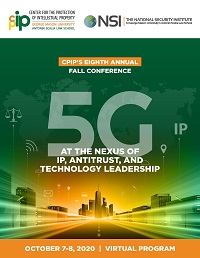
Eighth Annual Fall Conference flyer

On October 7-8, 2020, CPIP hosted its Eighth Annual Fall Conference, 5G at the Nexus of IP, Antitrust, and Technology Leadership, online from Scalia Law in Arlington, Virginia. The conference featured a keynote address by the Honorable Andrei Iancu, Under Secretary of Commerce for Intellectual Property and Director of the USPTO, and it was co-hosted by Scalia Law’s National Security Institute (NSI).

This conference addressed fast-emerging intellectual property (IP), antitrust, and technology leadership issues in the 5G and “Internet of Things” innovation ecosystem. Coverage included standard-essential patents (SEPs) along with established and emerging markets on a regional and global basis. Speakers were drawn from the academic, industry, and policymaking communities, with an emphasis on using objective fact-based analysis to explore points of convergence among legal, economic, and geopolitical perspectives on the IP and regulatory infrastructures that underlie these critical industries.

Our blog posts summarizing the conference are available here and here, and you can watch the conference videos here.


CPIP Welcomes Ken Randall as Next Dean of Scalia Law School

the words "Mason" set up outside on campus with people walking behindGeorge Mason University has announced that Ken Randall will be the next Dean of Antonin Scalia Law School, beginning on December 1, 2020.

CPIP Executive Director Sean O’Connor welcomed the news: “We couldn’t be happier with the selection of Ken Randall as Dean-Elect. He cares deeply about the continued success of CPIP and is no stranger to innovation and commercialization. He and I have already developed a great working relationship, and CPIP endeavors to support his Deanship in any way we can. We also thank Dean Henry Butler for his outstanding leadership and look forward to working with him as a faculty colleague and Executive Director of the Law & Economics Center.”

The Center for the Protection of Intellectual Property congratulates Dean Randall on his appointment and welcomes him to the Scalia Law family. His rigorous academic mind, strong leadership skills, and expertise in online learning bring together the ideal skill set to take our law school to new heights. We very much look forward to working with him in the near future.

To read our announcement, please click here.


Spotlight on Scholarship

a pair of glasses, an apple, and a stack of books

Deepak Hegde, Joan Farre-Mensa, & Alexander Ljungqvist, What Is a Patent Worth? Evidence from the U.S. Patent “Lottery”, 75 J. Finance 639 (2020)

Deepak Hegde of New York University and co-authors Joan Farre-Mensa and Alexander Ljungqvist have published a new paper from our Edison Fellowship program entitled What Is a Patent Worth? Evidence from the U.S. Patent “Lottery” in the Journal of Finance. The paper provides empirical evidence that startups that obtain their first patent have, on average, 55% higher employment growth and 80% higher sales growth five years later. Utilizing a unique dataset drawn on unprecedented access to USPTO internal databases, the study also shows with causal evidence that these startups pursue more—and higher quality—follow-on innovation as the first patent boosts innovation by facilitating their access to funding.

Olena Ivus, Edwin L.-C. Lai, & Ted M. Sichelman, An Economic Model of Patent Exhaustion, 29 J. Econ. & Manag. Strategy 816 (2020)

CPIP Senior Scholar Ted Sichelman of the University of San Diego, along with Olena Ivus and Edwin Lai, have published a new paper in the Journal of Economics & Management Strategy entitled An Economic Model of Patent Exhaustion. The paper, which comes from our Edison Fellowship program, uses a sophisticated economic model to show that, contrary to the Supreme Court’s opinion in Impression Products v. Lexmark, mandatory patent exhaustion can be highly inefficient, particularly when transaction costs are low. The authors show that it is socially optimal for patent owners to be able to opt-out of exhaustion via contract when the social benefits from buyer-specific pricing outweigh the social costs from transaction cost frictions in individualized licensing.

Lauma Muizniece, University Autonomy and Commercialization of Publicly Funded Research: The Case of Latvia, ___ J. Knowl. Econ. ___ (2020)

In this paper from our Edison Fellowship program, Lauma Muizniece of the Investment and Development Agency of Latvia focuses on university autonomy as one of the key variables in commercializing publicly funded research in Latvia. The paper presents a case study using secondary data and interviews to demonstrate that, with greater funding flexibility and experimentation, universities could develop better ways to commercialize their research that are currently hindered by systemic bottlenecks. By taking a more nuanced approach at the research organization level that aligns incentives with opportunities, the paper argues that researchers and those who pursue commercialization of that research would be more successful in their endeavors.


Activities, News, & Events

a lit lightbulb hanging next to unlit bulbs

CPIP Director of Copyright Research and Policy Sandra Aistars and the students in her Arts & Entertainment Advocacy Clinic joined the Washington Area Lawyers for the Arts (WALA) and the Copyright Alliance to co-host a virtual event entitled Arts and the Pandemic to discuss how local venues and artists are affected by the pandemic and to offer legal assistance to individual artists and small businesses. Prof. Aistars has written two recent articles at Law360 about the Google v. Oracle case. The first, RBG’s Legacy Can Guide High Court In Oracle Copyright Case, traverses the late Justice Ginsburg’s love of the arts and copyright legacy and runs through the various legal issues to explain why Google’s position is wrong on the merits. The second, High Court Oracle-Google Copyright War May Benefit Artists, examines how a case that is ostensibly about computer code could have a significant impact on the livelihoods of all artists and authors. Finally, Prof. Aistars spoke at the 2020 National Volunteer Lawyers for the Arts (NVLA) conference, discussing how to protect the arts and the importance of reversing anti-IP biases in academia.

CPIP Senior Fellow for Innovation Policy Jonathan Barnett published an op-ed at The Hill entitled “Unfair Use,” Democracy and the Supreme Court about the imbalance created by the expansion of copyright law’s fair use doctrine in recent years. Prof. Barnett explains how and why the Court can rein in the fair use doctrine in Google v. Oracle, noting that the current fair use “groupthink” dogmatism fails to recognize that platform aggregators improperly rely on the exception to generate billions of dollars annually despite having borne neither the costs nor risks of developing the content. Prof. Barnett also published an essay at Truth on the Market entitled Antitrustifying Contract: Thoughts on Epic Games v. Apple and Apple v. Qualcomm. The essay explains how the Epic v. Apple and Apple v. Qualcomm cases demonstrate “the unproductive rent-seeking outcomes to which antitrust law will inevitably be led if, as is being widely advocated, it is decoupled from its well-established foundation in promoting consumer welfare—and not competitor welfare.”

CPIP Senior Scholar Erika Lietzan has published a new article in the Cato Institute’s Regulation entitled The Evergreening Myth that discusses recent efforts by U.S. policymakers to reduce so-called pharmaceutical “evergreening” by changing the antitrust, intellectual property, and regulatory landscape. Prof. Lietzan explains that claims of evergreening, where drug companies supposedly block competition by improper means, are revealed to be myths upon closer inspection. Indeed, its proponents are making unstated normative claims that blind policymakers from making informed decisions based on rigorous evidence. As Prof. Lietzan concludes, the “term’s meaninglessness makes it impossible for audiences to distinguish among situations that may be different, as a legal, theoretical, or normative matter, and that may call for differing policy solutions,” and this “does a disservice to policymakers and the public.”

CPIP Senior Scholar Kristen Osenga has published a pair of op-eds on how policymakers and regulators are threatening innovation. In an op-ed entitled Price Controls Are Intellectual Property Theft by a Different Name at Townhall, Prof. Osenga discusses a recent executive order that would decrease Medicare payments for many prescription medications to match the lowest price paid in other developed countries. This policy, which she describes as “myopic at best and downright reckless at worst,” fails to consider the devastating impact it would have on medical innovation in the United States—and how it would ultimately hurt patients in the long run. At RealClearMarkets, Prof. Osenga published an op-ed entitled Today’s Federal Trade Commission Is Taking One Giant Leap Backwards that discusses the FTC’s misguided efforts to pit antitrust and patents against each other. As she explains, patent and antitrust law share the same goal of increasing innovation. Prof. Osenga concludes: “Rather than tilting at windmills already lost, it is time for the FTC to move forward and set their focus on real impediments to innovation and competition.”


Categories
Copyright

House Judiciary Committee Hearing Reacts to Copyright Office Report on Efficacy of Section 512

The following post comes from Liz Velander, a recent graduate of Scalia Law and a Research Assistant at CPIP.

U.S. Capitol buildingBy Liz Velander

In late September, the House Judiciary Committee held a hearing entitled Copyright and the Internet in 2020: Reactions to the Copyright Office’s Report on the Efficacy of 17 U.S.C. 512 After Two Decades. As Chairman Jerrold Nadler (D-NY) explained, the hearing sought “perspectives on whether Section 512 is working efficiently and effectively for this new internet landscape.” The hearing was guided by the U.S. Copyright Office’s Section 512 Report, released in May, which concluded that the operation of the Section 512 safe harbor system disfavors copyright owners—contrary to “Congress’ original intended balance.”

The witnesses included: Jeffrey Sedlik, President & CEO, PLUS Coalition; Meredith Rose, Senior Policy Counsel, Public Knowledge; Morgan Grace Kibby, Singer and Songwriter; Jonathan Band, Counsel, Library Copyright Alliance; Matthew Schruers, President, Computer & Communications Industry Association; and Terrica Carrington, Vice President, Legal Policy and Copyright Counsel, Copyright Alliance.

Enacted in 1998 as part of the Digital Millennium Copyright Act (DMCA), Section 512 establishes a system for copyright owners and online service providers (OSPs) to address online infringement, including a “safe harbor” that limits liability for compliant OSPs. To qualify for safe harbor protection, an OSP must fulfill certain requirements, generally consisting of implementing measures to expeditiously address online copyright infringement. Congress sought to create a balance between two goals in enacting Section 512: (1) providing important legal certainty for OSPs so that the internet ecosystem can flourish without the threat of the potentially devastating economic impact of liability for copyright infringement as a result of user activity, and (2) protecting the legitimate interests of authors and other rights owners against the threat of rampant, low-barrier online infringement.

The Copyright Office’s Report determined that the balance Congress originally sought is now “askew.” It found that “despite the advances in legitimate content options and delivery systems, and despite the millions of takedown notices submitted on a daily basis, the scale of online copyright infringement and the lack of effectiveness of Section 512 notices to address that situation, remain significant problems.” The Report did not recommend any wholesale changes to Section 512, but instead identified certain areas that Congress could fine-tune in order to better balance the rights and responsibilities of OSPs and copyright owners. These include eligibility qualifications for the service provider safe harbors, repeat infringer policies, knowledge requirement standards, specificity within takedown notices, non-standard notice requirements, subpoenas, and injunctions.

At the hearing, the six witnesses reacted to the Copyright Office’s Report in dramatically different fashions. Representatives of OSPs disagreed with the Report’s conclusions, testifying that Section 512 is working as Congress intended. Mr. Band from the Library Copyright Alliance referred to Section 512 as a “shining example of enlightened legislation for the public good” that is responsible for the “golden age of content creation and distribution.” Mr. Schruers from the Computer & Communications Industry Association criticized the Report for inadequately reflecting the interests of users and “conspicuously” overlooking the problem of Section 512 misuse. Ms. Rose from Public Knowledge stated “the Office’s analysis performed a familiar sleight-of-hand by presenting user interests as coextensive with those of platforms, effectively erasing free speech concerns from its analysis.”

Representatives of content creators painted an entirely different picture of Section 512’s efficacy. They applauded the Copyright Office for calling attention to areas of imbalance related to Section 512 and to how overly expansive or narrow interpretations of the statute have aided in skewing the balance Congress intended. Mr. Sedlik, a photographer with over 35 years of professional experience and President & CEO of the PLUS Coalition, described how service providers take advantage of his and others’ copyrighted works while hiding behind Section 512’s safe harbors. He explained that, like many other copyright owners, he must spend an exorbitant amount of time searching for infringing materials online and sending takedown notices instead of creating new works.

Ms. Kibby, a singer and songwriter, testified that Section 512 is “undermining creativity, and more alarmingly, quietly undercutting our next generation of artists. It is jeopardizing livelihoods for working class musicians, obliterating healthy monetary velocity in our creative community. It is rewarding unscrupulous services that deal in the unauthorized trade and use of our works. It is fundamentally sabotaging the legitimate online marketplace that we all rely on and that Congress envisioned.” Responding to the argument that notice-and-takedown results in censorship of user-generated content, Ms. Kibby said that Section 512’s “stripping creators of their fundamental rights, their livelihood, and ultimately their creative contributions is the real censorship.”

Ms. Carrington from the Copyright Alliance identified three main problems with Section 512: (1) the ineffective notice-and-takedown process, (2) the effective elimination of the red flag knowledge standard, and (3) ineffective repeat infringer policies. She recommended adjusting the statute to clarify the difference between actual and red flag knowledge, enacting the Copyright Alternative in Small-Claims Enforcement (CASE) Act, and transparently developing effective standard technical measures (STMs).

Members of the Committee recognized the need for reform. Chairman Nadler remarked that the sheer volume of takedown notices being sent does not seem like the hallmark of a system functioning as intended. Some Members first spoke about the importance of copyright law before questioning the panelists. For example, Representative Hank Johnson (D-GA) said “it’s crucial that these creators are able to rely on copyright law protections to make their living. This is even more true in an age where the click of a button can plagiarize a lifetime of work.”

It was heartening to hear the Representatives’ positive response to the concerns of small, individual creators whose livelihoods depend on the commercial viability of their works. It was clear that the Committee is seriously considering the recommendations in the Copyright Office Report and looking for a way to rebalance Section 512 so that it respects what Congress originally intended—a system that respects the rights of authors and artists who face widespread infringement of their rights in the online environment.