By Erika Lietzan, Kevin Madigan, & Mark Schultz
 Earlier this month, a bipartisan group of Senators introduced the Creating and Restoring Equal Access to Equivalent Samples Act (or CREATES Act). The proposed bill is aimed at deterring what the bill’s author, Sen. Patrick Leahy, claimed were “inappropriate delay tactics that are used by some brand-name drug manufacturers to block competition from more affordable generic drugs.” Whether the bill would produce the intended consequences is the subject of some debate, but we thought it important to point out some (hopefully) unintended consequences: The CREATES Act would impose vague standards and draconian remedy provisions to force innovators to surrender their intellectual property rights for the benefit of generic competitors.
The CREATES Act
It’s no surprise that the legislation might generate unintended consequences, as it would add further complexity to an already challenging regulatory scheme for approving drugs.
As a general rule, for a generic drug manufacturer to get permission to market a duplicate of an already approved drug, it usually[1] must have access to samples of the already approved drug. The generic drug company uses these samples in the bioequivalence studies required in its abbreviated new drug application. The same general principle applies to companies developing biosimilar versions of already approved biological medicines; they conduct comparative trials for approval of their abbreviated applications, and these trials generally require samples of the “reference” product. In addition, FDA sometimes[2] requires drug and biologic manufacturers to develop risk evaluation and mitigations strategies (REMS) if safety measures beyond standard labeling are needed to ensure that the product’s benefits outweigh its risks. These REMS can include elements to assure safe use (ETASU)—essentially, a system of use or distribution restrictions—if necessary to mitigate a specific serious risk. A generic or biosimilar manufacturer seeking to distribute its version of a product that is subject to a risk management distribution program must generally develop its own system or negotiate to share the existing system.
The CREATES Act is spurred by concerns that innovators are hampering competition by strategically exploiting these regulatory requirements imposed on their generic and biosimilar competitors. That is, critics contend that innovators are raising barriers that prevent their generic and biosimilar competitors from obtaining samples of the reference drug and from participating in existing distribution programs.
While the FTC and members of Congress have raised these concerns before, the concerns are particularly topical because of the controversy surrounding Turing Pharmaceuticals and its notorious former CEO Martin Shkreli (described by one publication as the most-hated man in America). Turing is a small company that acquired the only license to market the off-patent drug Daraprim and raised the price by over 5000%, meanwhile preventing potential competitors from obtaining samples for use in developing a competing supply. While Turing is a small company marketing an off-patent drug, its actions have been misattributed (through confusion or purposeful obfuscation) to mainstream, R&D-intensive innovative drug companies.
The CREATES Act proposes to prevent strategic exploitation of regulatory requirements by giving generic and biosimilar manufacturers their own strategic advantage in their negotiations with competitors – the threat of a lawsuit. The Act would give these follow–on developers the ability to sue their competitors to obtain samples of any drugs that they wish to use as references in testing for approval of generic and biosimilar versions. Follow–on drug developers could also sue their competitors to be allowed to share in existing distribution systems.
Although the Act contemplates that the parties will negotiate with respect to purchase of samples and sharing of any distribution system already in place, it would decisively shift bargaining power in favor of follow-on competitors. To begin with, it imposes unreasonable deadlines on innovators—for instance, one month to manufacture and provide samples, after which the follow–on applicant may sue. Also, it creates enormous liability exposure. If the plaintiff proves its case, the court will order the innovator to provide “sufficient” quantities of its product for testing and, if applicable, to share its REMS distribution system with its follow–on competitor. Further, the court must award not only reasonable attorney fees and costs, but also a “monetary amount sufficient to deter” the innovator from failing to provide other applicants with sufficient quantities, or failing to share its risk management system, as applicable. The “maximum” award—which will surely be taken as a suggestion at least of the magnitude envisioned—is the total revenue on the product for every day that the innovator failed to provide samples or to agree to share its developed risk management system. It bears no rational relationship to any harm suffered by the follow–on applicant and is functionally punitive.
The CREATES Act Creates Potential Intellectual Property Problems
The CREATES Act raises two significant intellectual property issues. Essentially, it would create a mechanism to force innovators and patent owners to supply their products and intellectual property to their competitors.
First, it would require an intellectual property owner to make its product for the benefit of a competitor. The Act allows a generic or biosimilar applicant to sue for drug samples to use in testing. In many instances, those drugs will still be under patent. While the so-called Bolar provision permits a generic or biosimilar applicant to conduct tests during the patent term, the CREATES Act turns the Bolar shield into a sword by empowering a court to order a company to provide its patented drug to a potential competitor. This, in turn, will require the company to manufacture the drug for that competitor. Whether it makes a small or large supply for the market, it will need to adjust its production to ensure supplies for its competitor as well, and indeed as many competitors as want samples. This conflicts directly with a basic and valued tenet of the patent system in the United States: we do not require a patent owner to practice his or her invention. In short, the CREATES Act directs courts to order patent owners to practice their patents for the benefit of others.
Second, it would require a drug company with intellectual property rights in a REMS distribution system to forego those rights for the benefit of a competitor. The Act allows a generic or biosimilar applicant to sue the innovator in order to use the specific risk management system that the innovator developed. Although current law creates a default rule that generic drug companies and drug innovators should use a single shared system, there is no such default rule for biosimilar companies and biologic innovators. And the default for generic drugs is simply a default; FDA may waive the default if, for instance, some aspect of the system is claimed by a patent or subject to trade secret protection. This bill would authorize the court to order the innovator to share its system, regardless of any unexpired patent or trade secret protection. It short, it permits courts to order intellectual property holders to surrender their intellectual property or face the threat of monetary penalties.
An innovator may have lawful and legitimate reasons for declining to manufacture its patented product for its competitors and for declining to share its patented risk management system with those competitors. Yet, the unreasonable deadlines and punitive liability provisions of the CREATES Act mean that it will have little scope to resist the demands of its competitors. This essentially nullifies the innovator’s intellectual property—which will discourage future investment and innovation in the pharmaceutical industry.
Important IP Rights in Safety Systems: The Example of Celgene
The IP problems unleashed by the CREATES Act are illustrated by their effect on the IP rights and incentives of a company such as the Celgene Corporation (which submitted a statement on the bill to the Senate Judiciary Committee). Celgene is an innovative biopharmaceutical company that focuses on treatments for cancer and immune–inflammatory related diseases in patients with limited treatment options. The company’s first approved drug was Thalomid, initially approved by FDA for leprosy and then approved for its primary indication—multiple myeloma, a particularly pernicious form of blood and bone marrow cancer. The active ingredient of Celgene’s product, thalidomide, is a powerful teratogen, causing severe disfiguring birth defects. It was marketed in other parts of the world in the late 1950s and early 1960s as a treatment for morning sickness in women, and FDA has estimated that more than 10,000 children in 46 countries were born with severe birth defects attributable to thalidomide. As a result of this history and the special risks associated with this life–saving medicine, Celgene developed an extremely detailed and meticulous protocol dedicated to ensure safe distribution, prescription, and use. Essentially, Celgene’s innovative contribution was inventing a safe way to use an otherwise dangerous drug to fight cancer. The company’s special system for managing the risk of thalidomide is formalized at FDA as the “elements to assure safe use” portion of a REMS. It is also subject to patent protection.
The CREATES Act would force companies such as Celgene to share the proprietary elements of their REMS programs. It would give the company the choice: share its patent system or face a lawsuit that might result in catastrophic damages and mandatory sharing anyway. This functionally nullifies the patent. This, in turn, would discourage innovation and investment in the programs. The essence of thalidomide, and other drugs subject to use and distribution restrictions, is that these drugs require special programs. Their benefits do not outweigh their risks, without these special programs in place. If functionally nullifying the innovator’s patent protection means the innovator will not invest in creative solutions to difficult safety risks, then the products that require these solutions cannot be approved—and will never reach patients.
Conclusion
The CREATES Act has been presented as a panacea for the suspect activity of a few bad actors. But while it might force those companies to share their products and safety systems, it would also affect—and penalize—the much larger group of innovators that have legitimate reasons for withholding the fruits of their labors. By imposing unreasonable deadlines for action, failing to consider legitimate explanations for the choices made by innovative drug manufacturers, and imposing draconian penalties, it tramples the intellectual property rights of drug innovators. Yet, this industry is deeply reliant on intellectual property rights; they provide the incentive for research into tomorrow’s cures. The CREATES Act should be laid aside, if Congress truly wants to promote innovation and investment in life-saving medicines for future generations of Americans.
Erika Lietzan is an Associate Professor at University of Missouri School of Law and is participating in CPIP’s 2016-2017 Thomas Edison Innovation Fellowship Program.
[1]In fact, the situation is more complicated than proponents of this bill have stated. In instances where samples of an already-approved drug are unavailable for any reason, FDA has several regulatory options at its disposal. After all, if a brand company withdraws its product from the market, that doesn’t preclude generic companies from seeking approval, even years later. So long as the Reference Listed Drug (RLD) was not withdrawn for safety or efficacy reasons, it can be cited in a generic application. In that situation, one thing FDA can do is designate another generic to be the RLD for bioequivalence testing. The statute says only that the ANDA must demonstrate bioequivalence; it does not expressly require that the generic applicant use the innovator’s product in the testing.
Even if there aren’t other generics, it might be possible to obtain ANDA approval based on a showing of bioavailability and the same therapeutic effect. FDA has repeatedly noted, when finding that a particular RLD was not withdrawn for safety or efficacy reasons, that the agency may approve an ANDA for a generic version of a withdrawn product even if the withdrawn product is not commercially available. These Federal Register notices state that if the RLD is not available for bioequivalence testing, the applicant should contact the FDA’s Office of Generic Drugs to determine what showing would be required to satisfy the approval requirements of the statute.
[2]Despite the controversy around this issue, there are relatively few REMS, and even fewer with ETASU. The FDA maintains a downloadable list on its website, with the ETASU marked. As of this writing (July 2016) there are 75 REMS listed, only 40 of which have ETASU. Of these, 6 already have approved generics that share in an approved risk management system. More than a dozen of the remaining products are still under regulatory exclusivity.
 On July 27, 2017, CPIP Affiliate Scholar and Associate Professor of Law at the University of Missouri–Columbia Erika Lietzan testified before the House Judiciary Committee’s Subcommittee on Regulatory Reform, Commercial and Antitrust Law in a hearing on Antitrust Concerns and the FDA Approval Process. The hearing was an attempt by lawmakers to better understand the sometimes complex pharmaceutical development and approval process and to consider legislative tactics that could help curb regulatory abuses in the drug marketplace. Professor Lietzan’s testimony provides her perspective and recommendations on three aspects of the regulatory paradigm of particular interest to the Committee: citizen petitions, use and distribution restrictions, and FDA’s unapproved drugs initiative.
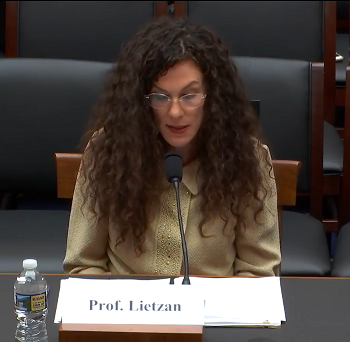 Lietzan explains that there is scant factual evidence of delay in the approval of generic drugs due to petitions, noting that of 175 petitions related to pending applications over a recent eight-year period, only five resulted in delays not necessary to protect the public health. Additionally, while two of the most relied upon studies track denied petitions, neither of them evaluate the strength or contents of the petitions. As Lietzan notes, “[t]he claim that petitions are frequently frivolous appears based on the timing of petitions and denial rate, not the substance, of the petitions.”
 The hardest things are often the most important things. That’s one of the implicit justifications for the intellectual property system. If we want people to do the hard and important work of researching, developing, and commercializing game-changing innovations, then we need to secure the fruits of their labor with property rights.