Description
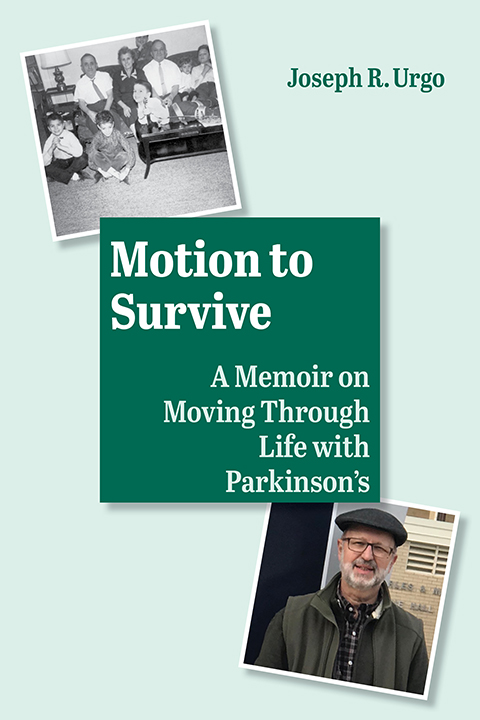
Motion to Survive traces Joseph R. Urgo’s understanding of Parkinson’s disease not simply as a diagnosis, but as a revelation that reshapes the meaning of movement across his entire life. While Parkinson’s is commonly associated with tremors and involuntary movement, Urgo focuses equally on dystonia: the freezing and stiffening of the body that traps motion altogether. Looking backward through this “Parkinsonian lens,” he recognizes a lifelong fear of becoming stuck—emotionally, professionally, and physically. The disease becomes a metaphor through which he reinterprets his past and examines the forces that drove his restless pursuit of change.
Spanning childhood memories and a forty-year academic career at eight institutions, where he served as professor, department chair, dean, provost, and president before retiring to Akron, Ohio, Urgo’s life was defined by continual transition: new campuses, new communities, and constant reinvention.
Through blending memoir, neurological reflection, and professional reckoning, Urgo bravely explores the uneasy relationship between ambition and mortality, learning to view the brain as both adversary and engine, as a force shadowed by self-destruction even as it propelled creativity, risk-taking, and achievement.
Motion to Survive transforms Parkinson’s from passive diagnosis into a way of understanding existence itself and reveals how memory, identity, and movement shape a life lived in constant motion and under increasing awareness of the body’s fragility.
About the author
Joseph R. Urgo is a literary scholar and higher education leader whose work engages major figures in American literature, including William Faulkner and Willa Cather, alongside broader topics in American history and culture. Throughout his career, he advanced a strong commitment to access to higher education, with an emphasis on the value of liberal arts. Urgo has held senior academic leadership positions at institutions across the country, including chair of the English department at the University of Mississippi, dean of faculty at Hamilton College, provost at UNC Asheville, and president of St. Mary’s College of Maryland. After retiring to Akron, Ohio, he returned to service in a series of interim leadership roles, including provost and dean of arts and sciences, while adapting to life with Parkinson’s disease. He lives with his wife, Lesley Dretar Urgo, in Canal Fulton, Ohio.
Praise for Motion to Survive
For some academics, retirement ushers in long golf games and early happy hour. For Joseph R. Urgo, retirement ushered in a Parkinson’s diagnosis and a deep need to interrogate his history through the lens of this “movement disorder.” From his “eighteen-month hospitalization in a mid-century crippled children’s ward” at the age of five through a career notable not only for its success but for its extreme peripatetic nature—it includes eight professional moves—this is a well-written and fascinating study of the brain in motion.
—Beth Ann Fennelly, author of The Irish Goodbye: Micro-Memoirs
Joseph Urgo’s Motion to Survive is a hauntingly multilayered book. Partly an account of crippling disability, partly a literary journey, partly a rags-to-riches American success story, partly a memoir of a peripatetic academic career, this powerful book traces both movements and inhibitions of movement throughout a lifetime. Emotionally moving and vividly portraying the experience of sickness and impairment, Urgo’s book takes its place among the very best in disability writing, from Helen Kellar to Eli Clare.
—Taylor Hagood, author of Faulkner, Writer of Disability
Motion to Survive—a searing and gripping intimate memoir—arrives when nearly one million people live with Parkinson’s Disease in the US and some ninety thousand are diagnosed annually. Author Joseph R. Urgo chronicles life on Parkinson’s “mystical tour bus” in clustered short chapters titled to pique curiosity. Fine-tuned masterly prose delivers Urgo’s hard-won insights woven into the intriguing, poignant back story of a working-class boyhood and life as a husband and father with a distinguished career in the college and university classroom and in administrative leadership. “Parkinson’s brings clarity,” Urgo writes, “as it suggests dividing one’s life into chemical segments,” meaning doses of medicines that alleviate symptoms in the face of elusive cures. Motion to Survive frankly confronts Parkinson’s “brain fog” and brain disorder, but Urgo’s splendid book is the product of a first-rate mind.
—Cecelia Tichi, Gertrude Conaway Vanderbilt Professor of English Emerita, Vanderbilt University
Joseph R. Urgo has written a memoir that transcends autobiography to portray a crucial time in the history of the American academy as experienced by a gifted academic beset with Parkinson’s disease. The early stages of Parkinson’s, unrecognized by Urgo and his family, nonetheless shaped his personality, behavior, and a peripatetic academic career that brought him to leadership positions at a range of public and independent institutions. Urgo’s narrative is at once informative and poignant, analytical and moving, broadly applicable and intensely personal. This book will provide a fascinating read for anyone interested in the intersection of an individual life with the crosscurrents of American higher education in the late twentieth and early twenty-first centuries.
—Terrence MacTaggart, former Chancellor, University of Maine System, Minnesota State University System, University of Wisconsin-Superior
In this fascinating inside narrative and oftentimes mordant dissection of a modern academic career, Joseph R. Urgo charts a restless and disturbing doubleness of alternating ascent and descent that is his own version of a spiritual guide for the perplexed. He retrospectively links his myriad successes and failures to the allegorical conceit of a “movement disorder” that is both physical and psychological, a disease that is also an unease propelling him along many forking paths of teaching and administration in late twentieth century American higher education. In this latter-day pilgrim’s progress, he encounters many sloughs of despond and vanity fairs, but his chief discovery is about the duality of his own self and the duplicity of the mission he initially undertook with such idealism and elan. To those who today nostalgically regard his era as a lost golden age of humanistic progress and abundance, Urgo’s refreshingly candid yet searing self-confessions about the quirks and compromises along the way, augmented by the specter of illness that always stood in his path, sets the balance true about just how dark and slippery and consuming this professional road trip always was and always will be.
—Barton Levi St. Armand, Professor Emeritus of American Civilization and English, Brown University