Description
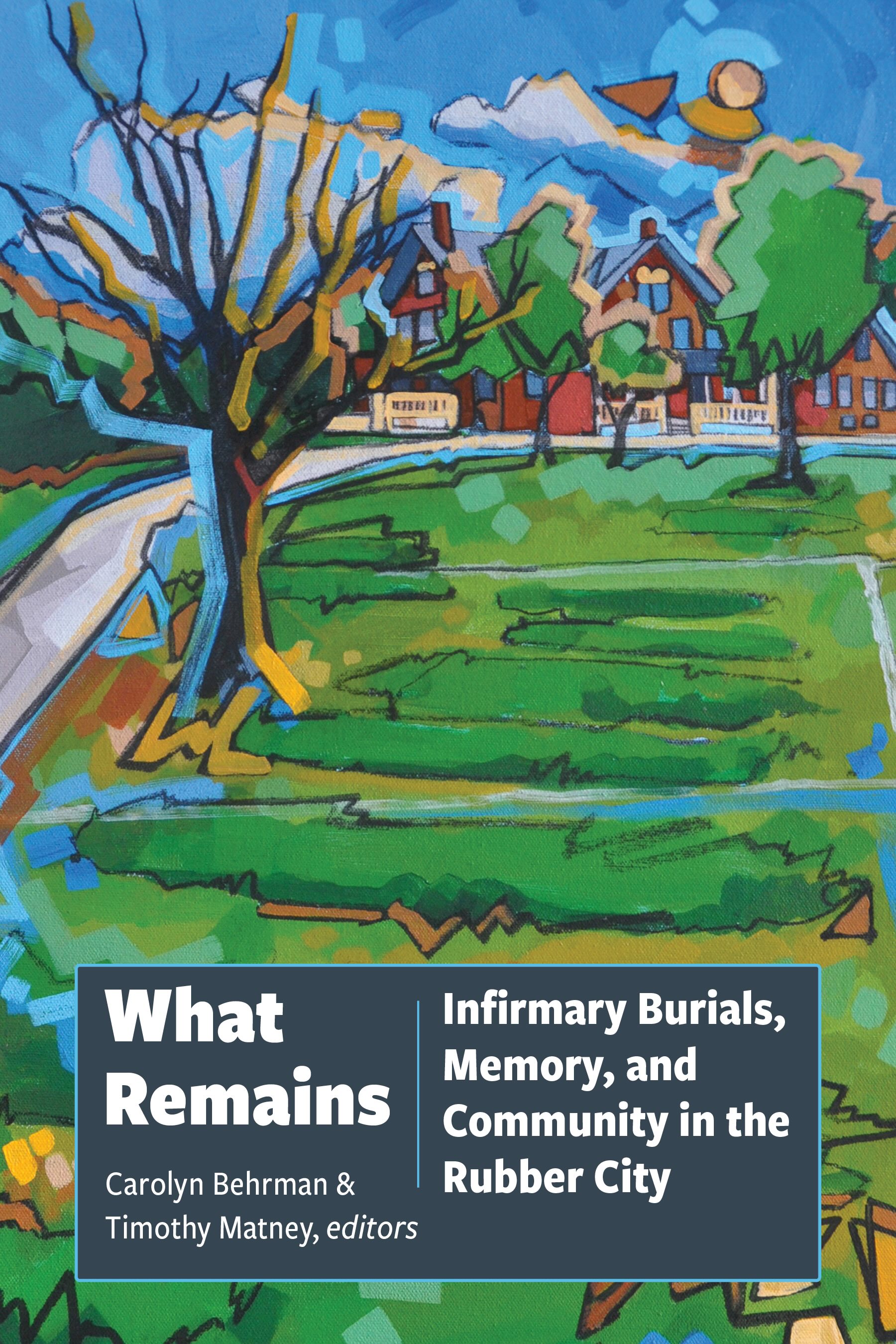
What Remains presents a grassy field with a complicated and fraught history. What is now a suburban park where people play soccer and flag football in the City of Akron, Ohio, was once a Progressive-era county infirmary’s burial ground for people who were poor, infirm, troubled, immigrant, injured, alcoholic, elderly, or otherwise deemed “unemployable” during the late nineteenth and early twentieth centuries. Through community-engaged scholarship, this book uses legal, historical, archaeological, and anthropological lenses to consider what is above and below the grass. What Remains is about memories and stories; how at times we collectively remember, forget, or even invent new pasts through the process of tracing and uncovering our own histories. It is about what is worth remembering, what is better left forgotten, and who gets to decide.
About the editors
Carolyn Behrman has worked in community-based and community-engaged research in Akron for more than twenty years. The work she and her students have done include documenting and addressing food security for elementary school students, analyzing health concerns with resettling refugees, supporting leadership development in the Karen Community of Akron, and addressing social and environmental justice issues with Neighborhood Network and the Families Against City Transfer Stations (FACTS) group. She is a professor emerita of anthropology and former codirector of the EXL Center at the University of Akron.
Timothy Matney is a professor of archaeology at the University of Akron. He has conducted fieldwork in the United States, Europe, and Asia, including over thirty seasons of work in Turkey, Syria, and Iraq. In addition to archaeology, he has taught applied geophysical survey at the University of Akron since 1998. His previous book, Ziyaret Tepe: Exploring the Anatolian Frontier of the Assyrian Empire (2017, Cornucopia Press), coauthored with three collaborators, was winner of the Archaeological Institute of America’s national 2019 Felicia A. Holton Book Award for a popular presentation of archaeology.
Praise for What Remains
For more than a century, something the authors call “a whispering history” lay just beneath the surface of a public space filled with activity and ignorance. More recently, as the mystery of Schneider Park’s abandoned graves has entered the public lore, its questions have multiplied. This ground contains the remains of those least able to answer those questions—the infirm, the impoverished, the immigrants. And therefore this book provides a vital community service, dignifying lost souls and allowing us a better understanding of who they were and, by extension, who we are. If a society is measured by how it regards its most vulnerable members, What Remains contributes importantly not just to Akron’s historical record, but its humanity.
—David Giffels, author of Barnstorming Ohio: To Understand America and The Hard Way on Purpose
This important book investigates a haunting and almost-forgotten chapter of Akron’s history, but its significance extends beyond local history. Its skillful use of historical, legal, demographic, and archaeological methods to create a compelling and nuanced picture of the past serves as an admirable model for future interdisciplinary historical studies. Moreover, it deserves high praise for telling the story of, and giving a voice to, countless thousands of people whose stories and voices had been lost for more than a hundred years.
—Kevin Kern, coauthor of Ohio: A History of the Buckeye State
Every time I drive past Schneider Park, I think of those poor lost souls. This thoughtful book provides interesting information and scholarly analysis from a variety of perspectives. What Remains gives a voice to the voiceless. It will help ensure that those marginalized, neglected residents of the Summit County Infirmary are not forgotten.
—Mark J. Price, Akron Beacon Journal features reporter and local historian
I love my comfortable neighborhood of West Akron and for thirty-eight years, walked the streets of the Sunset View Allotment in solitary thought, tugged by an energetic Welsh Corgi, or hand-in-hand with children and grandchildren. I never asked what more was there to know? “The only thing new in the world is the history you don’t know,” said Harry Truman. The forgotten world beneath the swampy surface of Scheider Park—always the subject of myth but not memory—is revealed by this team of researchers and writers using modern tools of inquiry and investigation. They have created a living scrapbook of memories long forgotten and given voice to people who lived at the margins of Akron society who were silenced for so long. By unearthing hidden truths, the memories of the least of our citizenry have been revived, and we have a deeper understanding of their struggles.
—Dave Lieberth, President, Akron History Center
The story of Schneider Park is a powerful and somber story about the life and death of the most vulnerable citizens in the city of Akron, Ohio. The writers eloquently bring together the elements of the park’s history, and the research is remarkable. The depiction of the challenging and seemingly hopeless lives of individuals housed in an infirmary and subsequently buried at Schneider Park provides a powerful opportunity for readers to connect with the human experience behind these historical events. They also shed light on the socio-economic conditions and healthcare system of the time, but more importantly the need to ensure the life and contributions of each person is acknowledged, respected, and memorialized as a sense of human decency. As Ward 4 representative, I encourage the city government and Summit County Historical Society to study the findings in this story and acknowledge and memorialize these past events as we continue the journey to ensure all people regardless of socio-economic status are recognized as contributors to the elevation of this great city.
—Jan Davis