
 | Computer Modeling and Simulation ASEC Room 535 Dept. of Civil Engineering The University of Akron Akron, OH 44325-3905, U.S.A. Tel: 1-330-972-2683 Email: melissa_smk@yahoo.com |
EDUCATION
Ph.D University of Akron, 2006~
M.S. Dalian University of Technology, Dalian, China, 2006
B.S. Dalian University of Technology, Dalian, China, 2003
RESEARCH
Topic: Computer Simulation of Semiconductor Quantum Dots Growth
Nanoscale quantum dots (QDs) are intensively studied in recent years due to their confined optical and electronic properties with applications in optoelectronics and semiconductor devices. Self-organized growth is a promising way to grow QD islands with uniform size and spatial distribution. We study the growth of self-organized quantum dots in strained semiconductors in the Stranski-Krastanov growth mode using kinetic Monte Carlo (KMC) simulations method.
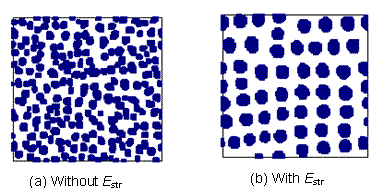
1. Simulation of two-dimensional semiconductor quantum dots growth
We developed a two-dimensional (2D) KMC model, which includes the correct and accurate strain energy due to the lattice misfit eigenstrain. The semiconductor material is assumed to be GaAs (001), and the strain energy is calculated from the half-space Green’s functions. Validate code has been developed using our 2D KMC model. Using this strain modified KMC model, the effect of growth parameters on the QD growth pattern has been studied.
2. Simulation of three-dimensional semiconductor quantum dots growth
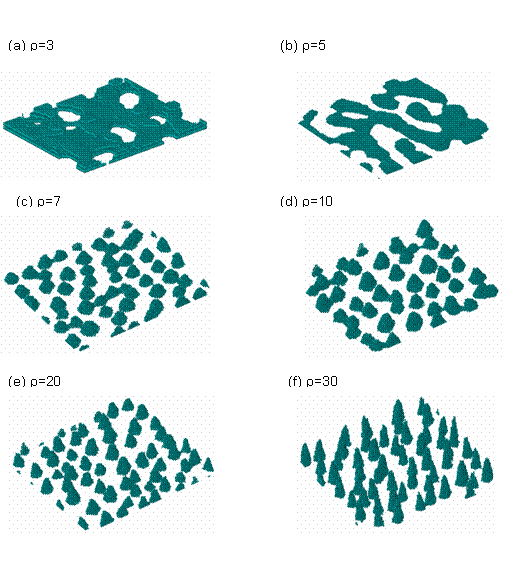
A three-dimensional (3D) KMC model is developed to simulate the growth of self-assembled QD islands. Our multiscale model includes the long-range strain energy contribution from a fast continuum Green’s function calculation and an up/down ratio describing the relative probability for atoms to jump out of the plane of the surface during the growth process. Validate code has been developed using our 3D KMC model. For the model material InAs/GaAs (001), effect of the flux rate and the deposition and interruption times on the island shape and ordering has been studied.
3. Future Work: Develop simulation capability for general group III- IV nitrides
There has been a tremendous increase in interest on gallium nitride (GaN) since 1989 when it was shown by the Nichia group, the possible capabilities obtainable from GaN. Wide-bandgap nitride-based QDs have significantly different properties compared to GaAs-based QD structures. Whereas GaAs and most other Group-III-IV compounds have a cubic crystal structure, GaN and related nitride alloys generally have a hexagonal structure, which leads to strong built-in piezoelectric fields in heterostructures. As a consequence, self-organized GaN/AlN QDs can exhibit a large redshift in the energy of the photoluminescence maximum with interband emission. However, GaN QDs have in many ways displayed unique growth characteristics, which are different from other group III- IV quantum dots systems such as InAs/GaAs. Hence it is proposed here to develop a validate model to study the nucleation process of nitride-based QDs.