
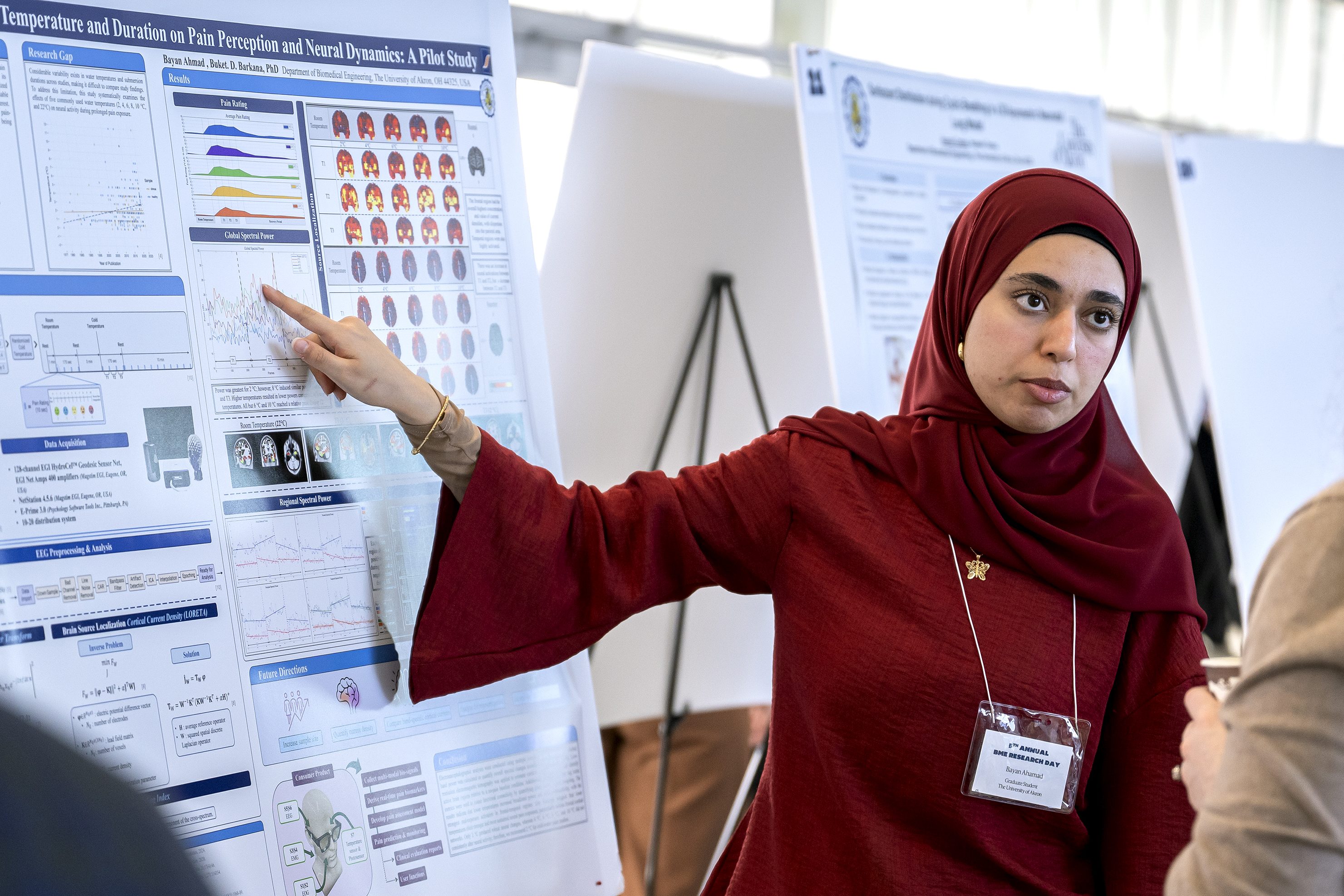
Primary Investigator:
Bayan Ahmad
About The Study
This study investigates the relationship between the brain, pain states, and various mental tasks, using cold water stimulation to induce a controlled pain response. The research aims to support advancements in pain identification as well as neural processing.
Interested in being a participant? Click Here to Sign Up: https://blogs.uakron.edu/barkana-signals-lab/pain-study/
Journal Articles
Pain and the Brain: A Systematic Review of Methods, EEG Biomarkers, Limitations, and Future Directions
By Bayan Ahmad and Buket D. Barkana
Abstract
Background: Pain is prevalent in almost all populations and may often hinder visual, auditory, tactile, olfactory, and taste perception as it alters brain neural processing. The quantitative methods emerging to define pain and assess its effects on neural functions and perception are important. Identifying pain biomarkers is one of the initial stages in developing such models and interventions. The existing literature has explored chronic and experimentally induced pain, leveraging electroencephalograms (EEGs) to identify biomarkers and employing various qualitative and quantitative approaches to measure pain. Objectives: This systematic review examines the methods, participant characteristics, types of pain states, associated pain biomarkers of the brain’s electrical activity, and limitations of current pain studies. The review identifies what experimental methods researchers implement to study human pain states compared to human control pain-free states, as well as the limitations in the current techniques of studying human pain states and future directions for research. Methods: The research questions were formed using the Population, Intervention, Comparison, Outcome (PICO) framework. A literature search was conducted using PubMed, PsycINFO, Embase, the Cochrane Library, IEEE Explore, Medline, Scopus, and Web of Science until December 2024, following the Preferred Reporting Items for Systematic Reviews and Meta-Analysis (PRISMA) guidelines to obtain relevant studies. The inclusion criteria included studies that focused on pain states and EEG data reporting. The exclusion criteria included studies that used only MEG or fMRI neuroimaging techniques and those that did not focus on the evaluation or assessment of neural markers. Bias risk was determined by the Newcastle–Ottawa Scale. Target data were compared between studies to organize the findings among the reported results. Results: The initial search resulted in 592 articles. After exclusions, 24 studies were included in the review, 6 of which focused on chronic pain populations. Experimentally induced pain methods were identified as techniques that centered on tactile perception: thermal, electrical, mechanical, and chemical. Across both chronic and stimulated pain studies, pain was associated with decreased or slowing peak alpha frequency (PAF). In the chronic pain studies, beta power increases were seen with pain intensity. The functional connectivity and pain networks of chronic pain patients differ from those of healthy controls; this includes the processing of experimental pain. Reportedly small sample sizes, participant comorbidities such as neuropsychiatric disorders and peripheral nerve damage, and uncontrolled studies were the common drawbacks of the studies. Standardizing methods and establishing collaborations to collect open-access comprehensive longitudinal data were identified as necessary future directions to generalize neuro markers of pain. Conclusions: This review presents a variety of experimental setups, participant populations, pain stimulation methods, lack of standardized data analysis methods, supporting and contradicting study findings, limitations, and future directions. Comprehensive studies are needed to understand the pain and brain relationship deeper in order to confirm or disregard the existing findings and to generalize biomarkers across chronic and experimentally induced pain studies. This requires the implementation of larger, diverse cohorts in longitudinal study designs, establishment of procedural standards, and creation of repositories. Additional techniques include the utilization of machine learning and analyzing data from long-term wearable EEG systems.
Link: https://doi.org/10.3390/neurolint17040046
Conferences and Poster Presentations
Conference Papers
Ahmad B, Barkana BD. Foundations for Generalizing Cortical Current Density Predictions From High-Density EEG Using Gradient Boosted Decision Trees. 4th International Conference on Artificial Intelligence, Blockchain, and Internet of Things, Central Michigan University (CMU), USA, on September 05 – 06, 2026.
Poster Presentations
Bayan Ahmad, Buket D. Barkana, PhD. EEG cold Pressor Temperature and Duration on Pain Perception and Neural Dynamics: A Pilot Study. UA Biomedical Engineering Research Day, March 6, 2026


Supporting Researchers
Graduate Students: Rachael Amira Brimm
Undergraduate Students: Julia Ehnot
Former Researchers: Jen Hatalla
Supporting Work in Our Lab
ECG and Thermal Pain Recovery: https://blogs.uakron.edu/barkana-signals-lab/ecg-thermal-pain-recovery/