Categories
Copyright

The Changing Nature of Sound Recording Rights

The following post comes from Meghan Carlin, who is in her second year at Osgoode Hall Law School in Toronto, Ontario. In addition to her work with the IPilogue, Meghan is a Fellow with the Innovation Clinic and is Co-President of the Osgoode Entertainment and Sports Law Association. This post first appeared at IPilogue.
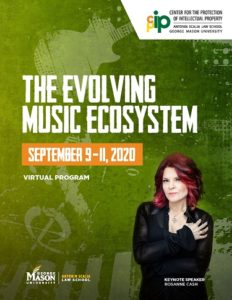
2020 Evolving Music Ecosystem Conference flyerBy Meghan Carlin

The ongoing history of sound recording rights continues to provide a fascinating study in the United States’ copyright regime’s ability to contemplate and absorb new technologies into its framework. The evolution of these rights in America over the last 50 years charts alongside the country’s evolving music industry, crystallizing the importance, and distinctiveness, of music law in relation to the broader copyright regime.

Over the last 20 years, global music industry players have seen traditional revenue streams decrease as the shift towards digital distribution has intensified. In 2018, reported global revenues from recorded music were 25% lower than those reported in 1999 – without adjusting for nearly 20 years of inflation. With the worldwide concert industry grinding to a halt, removing a major source of revenue for performers and copyright owners alike, the effect of COVID-19 on the global music industry has placed a spotlight on moving the conversation on sound recording rights forward.

On September 9th through 11th, 2020, the Center for the Protection of Intellectual Property (CPIP) hosted The Evolving Music Ecosystem conference. Streaming online from George Mason University Antonin Scalia Law School in Arlington, Virginia, day one of the conference saw panelists tackling a number of topics in music law, including the colourful history of sound recording rights in America and their current status under the US copyright regime. The below provides a deeper look at the issues discussed during the Changing Nature of Sound Recording Rights panel on September 9th.

Looking Back: The Music Modernization Act

Revenues from recorded music have grown over the last five years in the US, with the Recording Industry Association of America (RIAA) reporting four years in a row of double-digit growth. In 2019, revenues from recorded music grew 13%, primarily through paid subscription services. Total revenues from streaming alone grew 19.9% in 2019, accounting for almost 80% of all recorded music revenues in the United States.

Consider these statistics against the legislative backdrop that governs the payment of royalties for recorded music. On October 11, 2018, the Orrin G. Hatch-Bob Goodlatte Music Modernization Act (H.R. 1551) (“MMA”) was signed into law by President Donald Trump. The MMA combines three previously introduced bills intended to modernize copyright law as it relates to the music industry.

Title I of the MMA is the Musical Works Modernization Act, which impacts the conversation on sound recording rights in a number of ways. First, Title I changes the standard used by the Copyright Royalty Board (“CRB”) in setting digital royalty rates, bringing the standard used for digital radio stations up to date. Under the old regime, the standard used for setting statutory royalties relied on public interest considerations, preventing the CRB from considering what a licensee might pay as a market rate. Under the MMA, the rates for all compulsory blanket licences are to be determined through a market-based standard, sometimes referred to as a willing buyer/willing seller standard, ideally creating a fairer standard of compensation for the owners of sound recordings.

Further, Title I establishes the Mechanical Licensing Collective (MLC). While the primary role of the MLC is to collect and distribute section 115 mechanical publishing royalties, it has also been tasked with the creation of a Musical Works Database, intended to link sound recordings to their underlying compositions. In theory, the database will provide music users with a one-stop shop for uncovering all potential rightsholders involved in a song, on both the sound recording and the composition side.

Title II of the MMA tackles the grey zone inhabited by pre-1972 recording artists, otherwise known as “legacy artists”. The Classics Protection and Access Act extends the same protections to the digital public performance of pre-1972 sound recordings as those extended to post-1972 recordings. The practical outcome of this legislation? Digital radio stations and streaming services are now responsible for paying royalties for the expansive catalogue of pre-1972 recordings in their repertoires, according to the uniform rate setting standard outlined in Title I.

Title III, The AMP (Allocation for Music Producers) Act, creates a new “letter of direction” process, allowing recording artists to distribute a portion of the royalties collected for a sound recording to the producers, sound engineers or mixers involved in its production. Title III enables SoundExchange, the entity collecting and distributing sound recording royalties under section 114 statutory licenses, to distribute these royalties directly to the producers involved on behalf of recording artists who submit a “letter of direction” outlining their intention to make such a payment.

Simply put, and as it currently stands, the US legislation regarding sound recording rights maintains its focus on digital plays. What about analog?

Looking Forward: AM-FM Act

The AM-FM (Ask Musicians For Music) Act, introduced to Congress in November 2019, is a bi-partisan bill aimed at creating a terrestrial radio (AM/FM) performance right for sound recordings. The AM-FM Act arrives following the Fair Pay for Fair Play Act, introduced in both 2015 and 2017 with the same goal, but which failed to pass.

Supporters of the AM-FM Act describe it as ending a “a decades-long loophole” stemming back to the early days of radio that has allowed AM-FM radio broadcasters to play recorded music on air without obtaining the permission of the recording’s copyright owner, and without paying royalties for the use. In essence, it is argued, terrestrial radio broadcasters are being subsidized by the recording industry and will continue to be until the creation of an AM-FM radio performance right in sound recordings.

The National Association of Broadcasters has come out in opposition of the AM-FM Act, countering with their support of the Local Radio Freedom Act, stating that  “Congress should not impose any new performance fee, tax, royalty, or other charge relating to the public performance of sound recordings on a local radio station for broadcasting sound recordings over the air, or on any business for the public performance of sound recordings on a local radio station broadcast over the air”.

In contemplating the ongoing battle over the creation of a terrestrial broadcast performance right in sound recordings, we’re provided with the opportunity to consider the role of analog radio in a digital era, and to think through the questions of promotion versus consumption that relate to music copyright as a whole.

Today: CUSMA

One argument made by proponents of the AM-FM Act is that while countries with a terrestrial radio performance right for sound recordings collect royalties for American artists whose sound recordings are played outside the US, they are unable to pass on these royalties to US rights holders as there is no domestic royalty scheme. In written comments filed in February 2020 in response to the USTR’s Request for Comments and Notice of Public Hearing Regarding the 2020 Special 301 Review, SoundExchange identified 6 territories which deny full national treatment to American recording artists – UK, France, Australia, Japan, the Netherlands, and Canada.

On July 1, 2020, the Canada-United States-Mexico Agreement (CUSMA) entered into force in Canada, providing full national treatment to sound recordings. Chapter 20 on intellectual property rights states at Article 20.8 that “in respect of all categories of intellectual property covered in this Chapter, each Party shall accord to nationals of another Party treatment no less favorable than it accords to its own nationals with regard to the protection of intellectual property rights”. As explained by panelist and Attorney Eric Schwartz of Mitchell Silberberg & Knupp, Canada’s implementation of its CUSMA obligation to give national treatment to sound recordings is sure to result in new payments to American copyright owners for uses occurring in Canada.

The effect of COVID-19 on the worldwide music industry has put the focus on the copyright regime’s ability to respond to change, both cultural and technological. For those interested in music law, and in the modernization of copyright more generally, the complicated and curious history of sound recording rights provides countless jumping off points for creatively thinking through the issues affecting artists and copyright holders today.
Categories
C-IP2 News Patent Law

CPIP 2020 Fall Conference: Day Two Recap

The following post comes from Wade Cribbs, a 2L at Scalia Law and a Research Assistant at CPIP. This is the second of two posts (see day one recap) summarizing our two-day 5G at the Nexus of IP, Antitrust, and Technology Leadership conference that was held online from George Mason University Antonin Scalia Law School on October 7-8, 2020.

By Wade Cribbs

On October 7-8, 2020, CPIP hosted its Eighth Annual Fall Conference, 5G at the Nexus of IP, Antitrust, and Technology Leadership, online from George Mason University Antonin Scalia Law School in Arlington, Virginia. The conference featured a keynote address by the Honorable Andrei Iancu, and it was co-hosted by Scalia Law’s National Security Institute (NSI).

This conference addressed fast-emerging intellectual property (IP), antitrust, and technology leadership issues in the 5G and “Internet of Things” innovation ecosystem. Coverage included standard-essential patents (SEPs) along with established and emerging markets on a regional and global basis. Speakers were drawn from the academic, industry, and policymaking communities, with an emphasis on using objective fact-based analysis to explore points of convergence among legal, economic, and geopolitical perspectives on the IP and regulatory infrastructures that underlie these critical industries.

SESSION 3: MARKETS WORK: PRIVATE ORDERING MECHANISMS IN PATENT-INTENSIVE MARKETS

The first panel of the day consisted of academics and industry experts discussing the path moving forward for intellectual property licensing and how it relates to 5G technology. CPIP Executive Director Sean O’Conner moderated the panel, directing a conversation on the mechanisms for controlling intellectual property licensing and the conflict between antitrust policy and private-ordering initiatives. Panelists included Prof. Jonathan Barnett of the University of Southern California, Dr. Bowman Heiden of the University of California, Berkeley, David Kappos of Cravath, Swain & Moore, and Luke McLeroy of Avanci.

Prof. Barnett opened the panel with a discussion of the difference between the theoretical models of IP licensing and the actual standard-essential patent market. According to the models, the burden of many standard-essential patents involved in developing a smartphone should cripple the smartphone market. Smartphones should cost thousands of dollars due only to the cost of royalties necessary for production. However, as Prof. Barnett pointed out, smartphones are more available than ever and at every price point. The empirical evidence confirms the theoretical models’ fears are inaccurate as the aggregate royalty burden is in the single digits.

Prof. Barnett went on to illustrate how this empirical evidence is shaping the DOJ Antitrust Division’s view of IP licensing. The fear has shifted from patent holdup, large patent royalties preventing innovation and competition, to a fear of patent holdout. Prof. Barnett explained that patent holdout is becoming common place in the market where a company’s most efficient method of obtaining an IP license is through litigation as opposed to negotiating a competitive licensing fee. Prof. Barnett concluded by suggesting that patent holdout occurs where property rights are not strong and clear. Where injunctive relief is awarded readily and aggressively to license owners, in the United Kingdom and Europe, patent holdout is not a prevalent issue.

Dr. Bowman framed the issue as an interplay between the public and private spheres. For the private sphere to produce, protection of its investment in the form of patents is necessary. The conflict is the public’s access to the private sector’s production is easily frustrated by a large number of standard-essential patents in an industry. Because access to the product is in the interest of the private sphere, the private sphere has solved its own problem. Industries require an agreement from a patent owner to license its patents on terms that are fair, reasonable, and non-discriminatory (FRAND). Without a FRAND agreement, a patent cannot be a standard-essential patent.

Dr. Bowman then examined the implementation of FRANDs in the wireless communication ecosystem. He argued that the inherent vagueness of FRANDs are a necessary feature as it allows for varied and customized solutions. Additionally, the public sphere, or other members of the private sphere, can obtain an advantage through antitrust authorities. However, innovation on the private side is always preferable to antitrust regulations.

Mr. Kappos began by emphasizing the need for balance between innovators and implementers. Current innovation-based standards create enormous consumer surplus, totaling nearly four trillion dollars in the wireless communication industry. He went on to say that innovation-based standards are far superior to previous proprietary, winner-take-all standards that produced limited consumer surplus.

Mr. Kappos further developed Prof. Barnett’s point about the need for injunctive relief to protect innovators. He highlighted that preliminary injunctive relief is available in other IP hubs, such as China and Germany, but that the United States has all but given up on awarding injunctive relief to innovators. In many cases, even when injunctive remedies are available, more is needed to compensate innovators for the lost opportunity, income, and effort. He then added that there needs to be a new recognition in license negotiations. Those who delay or try to avoid paying for licenses should be forced to pay a premium once they finally comply.

Mr. McLeroy discussed the nature of his licensing company Avanci. The company streamlines licensing of cellular standard-essential patents for internet connectivity in commercial products such as cars. It simplifies licensing by compacting all standard-essential licenses, from multiple patent owners, necessary for a product and offering them to companies in the industry at a flat rate. Avanci lowers the transaction costs by removing the time needed to identify the patents necessary and evaluate what the proper fee should be. This reduction in transaction costs allows the innovator to spend money that would have been spent on searching and negotiation back into research and development.

In response to a question, Mr. McLeroy discussed the way that 5G licensing will be administered. One potential method is based on usage. He compared a water meter intermittently transmitting data with autonomous cars constantly interacting with other vehicles and intersection equipment. The licensing fee for the water meter would be much lower than for the autonomous car due to the significantly lower scale of data transfer necessary to operate it.

All panelists agreed that strong and clear property rights in innovation are necessary for a productive global licensing market. Injunctive relief is also a necessary tool that must be made available to those developing innovative standard-essential patents.

SESSION 4: TECHNOLOGY LEADERSHIP IN 5G/IOT MARKETS

The second panel of the day focused on what steps should be taken to protect American leadership in the innovative technology sectors such as 5G networks. Moderator Jamil Jaffer, Founder & Executive Director of the National Security Institute (NSI), led the discussion on how the federal government can best handle the global development of 5G standards and protect American innovation from the competitive threat of China. Panelists included Megan Brown of Wiley Rain, Dr. Jonathan Putnam of Competition Dynamics, the Hon. Randall Rader of the Federal Circuit, and Andy Keiser of Navigators Global.

Dr. Putnam opened the discussion by addressing China’s patent program. Dr. Putnam described a model he created using research and development, gross national product, population, and other national indicators of inventive behavior. He noted that China subsidizes patent applications, resulting in the largest number of patents worldwide. Dr. Putnam addressed whether China has become the world leader in innovative technology. The model shows that while Chinese patent application numbers are dramatically increasing, the quality of those patents are notably lower than the rest of the world.

Dr. Putnam proposed three methods for the United States government to protect domestic interests without following the Chinese model of subsidizing innovators. First, the U.S. should unify its fractured view of antitrust on the global market. Presenting a common understanding of antitrust principles would remove a substantive fracture in U.S. foreign policy that works to China’s advantage. Second, the U.S. should take a more aggressive stance in enforcing fair trade on the world stage. There is systemic theft of foreign patent technology that must be curtailed. Third, in the pharmaceutical industry, private companies can take advantage of basic research conducted by the National Institute for Health. Applying this model to other technological sectors would be beneficial for American innovation as basic research is the foundation for most innovation.

Judge Rader agreed with Dr. Putnam that a large quantity of inferior patents is produced by China. However, Judge Rader distinguished the average patent seeker from the Chinese mega-corporations such as Huawei that produce innovation technology. Chinese mega-corporations are like American innovation leaders such as Qualcomm. Judge Rader explained that China built its platform out of subsidies in the past, but currently individual companies like Huawei devote large percentages of their gross budget to research and development that makes China a competitive innovator. China cannot be dismissed as a competitor built on unfair advantage. Instead, he urged, China must be confronted as an innovative equal that is willing to spend and supply the technology of the future.

Mr. Keiser identified China’s unique control over its market through tariffs, credit, and market manipulation. Unlike any other economy of similar size, its unique control positions China perfectly to advance its interests in innovation. Given that China is the United States’ biggest geopolitical competitor, China poses a serious threat to national security. Mr. Keiser pushed back against Judge Rader’s equal competitor view of China. He cited cases from both the United States and Poland where Huawei was found to have committed espionage and theft of competitors’ patents. Regardless of how China arrived at its current state, he said that Chinese 5G networks are not trustworthy due to consistent exploitation of foreign patents.

Ms. Brown voiced her concerns regarding the impulse to respond to China’s action by nationalizing 5G. She suggested optimizing regulation by removing the fragmented regime currently impeding innovation. The hands-off approach of Congress has facilitated longstanding U.S. leadership in innovation, and unprecedented congressional involvement would only harm American innovators. Ms. Brown framed Mr. Keiser’s point about the trustworthiness of Chinese 5G equipment and networks as a question of government intervention. Assuming these networks cannot be trusted, she asked how much the government should intervene to address the problem. In response to Dr. Putnam’s proposal of government-subsidized basic research, Ms. Brown argued that the focus should be real-world research and development with telecommunication carriers.

Ms. Brown warned that, specifically relating to 5G standard setting, the government must be careful to expend influence in its natural spheres. The 3rd Generation Partnership Project (3GPP) is a private sector, global body that leads the development of standards in 5G technology. As a global private sector organization, the federal government, in the form of the Department of Defense, has no business influencing 3GPP policy. If any government activity is warranted, she continued, it should incentivize more private American businesses to participate in and influence private organizations like 3GPP.

All the panelists agreed that the focus should be on American policy promoting domestic innovation as opposed to overreacting to the imposing threat of China. Foremost on policy makers minds must be preserving and promoting innovation from garage inventors to Qualcomm. However, Mr. Keiser stated that the scale of theft of intellectual property by China is too large to be ignored. Congressional protection in the form of laws such as the CHIPS Act, a bill to incentivize and subsidize research into semiconductors, is necessary.

CLOSING REMARKS

CPIP Executive Director Sean O’Connor and CPIP Deputy Director Joshua Kresh closed out the two-day conference by thanking all of the moderators, panelists, and attendees for making the conference such a huge success. They also thanked CPIP staff members, including Kristina Pietro, Devlin Hartline, and Mary Clare Durel, for working behind the scenes and the generous sponsors of the conference whose financial support made it possible.

Categories
Conferences Patent Law

CPIP 2020 Fall Conference: Day One Recap

The following post comes from Terence Yen, a 4E at Scalia Law and a Research Assistant at CPIP. This is the first of two posts (see day two recap) summarizing our two-day 5G at the Nexus of IP, Antitrust, and Technology Leadership conference that was held online from George Mason University Antonin Scalia Law School on October 7-8, 2020.

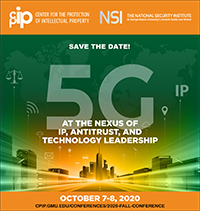
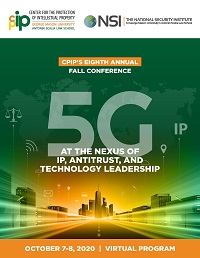
CPIP 2020 Fall Conference flyerBy Terence Yen

On October 7-8, 2020, CPIP hosted its Eighth Annual Fall Conference, 5G at the Nexus of IP, Antitrust, and Technology Leadership, online from George Mason University Antonin Scalia Law School in Arlington, Virginia. The conference featured a keynote address by the Honorable Andrei Iancu, and it was co-hosted by Scalia Law’s National Security Institute (NSI).

This conference addressed fast-emerging intellectual property (IP), antitrust, and technology leadership issues in the 5G and “Internet of Things” innovation ecosystem. Coverage included standard-essential patents (SEPs) along with established and emerging markets on a regional and global basis. Speakers were drawn from the academic, industry, and policymaking communities, with an emphasis on using objective fact-based analysis to explore points of convergence among legal, economic, and geopolitical perspectives on the IP and regulatory infrastructures that underlie these critical industries.

OPENING REMARKS & INTRODUCTIONS

CPIP Executive Director Sean O’Connor opened the conference by welcoming everyone to this year’s event and explaining that the conference was limited to a few hours each day to avoid “Zoom burnout.” Prof. O’Connor discussed the developing technologies of 5G and Internet of Things (IOT), which represents the systems that connect everyday objects and allow them to communicate with each other in real time. This technology increases the capability of a wide variety of industries, including automotives, home appliances, healthcare systems, and more.

CPIP Deputy Director Joshua Kresh then highlighted the various topics that would be covered during the four panel sessions and the keynote address and fireside chat by USPTO Director Andrei Iancu. Mr. Kresh also thanked the CPIP team, including Kristina Pietro, Devlin Hartline, and Mary Clare Durel, and the conference sponsors for making the conference possible.

SESSION 1: USING DATA TO INFORM POLICY: EMPIRICAL EVIDENCE ON SEPS, SSOS AND FRAND ROYALTIES

The first panel focused on the use of data to inform policy, compared with the use of theoretical models for standard-essential patents (SEPs), standard setting organizations (SSOs), and fair reasonable and non-discriminatory (FRAND) commitments. The panelists included Dr. Anne Layne-Farrar of Charles River Associates, Prof. Stephen Haber of Stanford University, and Prof. Daniel Spulber of Northwestern University, and the panel was moderated by Ted Essex of Hogan Lovells.

The panelists discussed how one of the biggest issues in this field is the setting up of royalty rates for industries such as the automotive sector, which utilize 5G and IOT. In the past, economists have warned the public about the looming problem of royalty stacking. Royalty stacking is a theory about industry collapse, wherein market power is exercised excessively and repeatedly. The theory is based on the concept that one monopoly is bad, two monopolies is worse, three monopolies is even worse, and so on. The fundamental concept is that each monopolist sets its price without taking into consideration the prices charged by other monopolists, leading to a situation where, as the number of patent owners increases, the aggregate royalty grows unsustainably and output collapses.

Despite the fears generated by royalty stacking models, however, this issue has not seemed to materialize in the real world. For example, the actual cumulative royalty yield on a smartphone is less than one-twentieth of that predicted by royalty stacking models. The reason we don’t observe this in the real world is that the theory is built on the notion of “one-time” play, meaning the people setting royalties do so independently of each other. As the data shows, this is an inaccurate portrayal of how royalty rates are set up.

The panel then went on to explain that it is important to check theories against data and real results. At the beginning of FRAND litigation, courts worried that implementers were being anticompetitively harmed by high royalty prices. As such, decisions were issued with the policy goal of protecting implementers. Over time, however, we have begun to see more balance from the courts and a higher demand for data prior to the acceptance of theoretical models.

Courts have now recognized that there is a very real problem of people using products without licenses, and that strategic or opportunistic behaviors can happen on either side of the bargaining table. As such, they are now more willing to act as gatekeepers to enforce good faith on both sides, often falling back to comparable licenses as a basic standard.

With this new emphasis on fair play from the courts, most royalty decisions are now being settled through out-of-court negotiations. Evidence shows that practically all SEP licenses are now subject to negotiation. While patent pools are often cited as the main exception, even they generally still have the option of negotiation. Evidence also suggests that SSOs develop standards through consensus decisions that are procompetitive, and most SEP licenses are mostly negotiated and enforced with contract law, making litigation rare. FRAND commitments have generally been found to be clear and effective, and it is believed that excessive regulation and antitrust intervention would impede standardization. Data shows that FRAND commitments encourage the adoption of standards, do not generate market power, and are consistent with invention and innovation.

The increase in negotiation eliminates many predicted outcomes for theories, which makes data even more important. Accurate real-life data informs public policy, and research in this field is shifting towards new techniques for gathering and analyzing big data, as well as increased use of AI and big data.

This trend helps to avoid policy decisions based on guesswork and provides evidence-based analysis helpful to courts and agencies.

KEYNOTE ADDRESS & FIRESIDE CHAT

“IP controls the destiny of virtually every industry.” Andrei Iancu, Under Secretary of Commerce for Intellectual Property and Director of the USPTO, started his keynote address with this bold statement. Advanced digital technologies are transforming virtually every product, manufacturing process, and logistical system, and protecting the IP rights to those technologies is not only a right mentioned in the Constitution, but is the foundation of wealth creation for our nation.

As Director Iancu explained, the advancement of 5G and IOT technology will form the backbone of a new system of autonomous vehicles, smart cities, intelligent appliances, telerobotic surgeries, precision agriculture, and much more. However, our nation faces the reality that the United States is falling behind in the intellectual property arms race.

Twenty years ago, the number of patent applications being filed by Chinese citizens was practically zero. By 2018, however, that number reached almost 1.5 million per year, approximately three times the number of American applications. Chinese applications have increased at an average rate of 26% each year, as opposed to a 2-3% annual increase for the U.S. While some may call into question the quality of these Chinese patent applications, Director Iancu noted that the sheer magnitude indicates that China is at minimum attending diligently to its intellectual property portfolios in areas critical to the next technological revolution. This remarkable trend can in part be attributed to China’s extensive system of government incentives for IP, which include tax incentives, subsidies for patents, and other monetary and nonmonetary rewards. As foreign nations like China continue to outperform the U.S. in amassing a rich depth of technological patents, U.S. companies may end up paying billions in royalties as those patents become increasingly vital to the upcoming technological revolution.

Director Iancu went on the explain that the U.S. must take steps to ensure that American technology is able to keep up with foreign technological development. To do so, we must have a robust system of predictable patent rights to maintain the incentives to innovate. If we are forced to use only technologies that are in the public domain, standards will inevitably be stunted.

Recognizing that private sector inventions are the primary source of SEPs, Director Iancu explained the need for a market-driven licensing system and the role of the government in the transition to 5G. He emphasized that it is the Patent Office’s goal to maintain balance between licensors and licensees, and he ended his presentation with the promise that the “USPTO will be steadfast in ensuring that we have a fair and balanced licensing system driven by the needs of the industry.”

Director Iancu then went on to have a fireside chat with CPIP Executive Director Sean O’Connor, taking questions from the audience at the end.

SESSION 2: IP MEETS ANTITRUST AROUND THE GLOBE: POLICY DEVELOPMENTS IN THE LEGAL TREATMENT OF SEPS AND FRAND

The final session of the day included panelists Maureen Ohlhausen of Baker Botts, Dr. Urška Petrovčič of the Hudson Institute, Prof. Daniel Sokol of the University of Florida, and Prof. John Yun of Scalia Law. The panel was moderated by Prof. Henry Butler, Dean of Scalia Law and Executive Director of the law school’s Law & Economics Center.

The panelists discussed how innovation is crucial to the U.S. economy and how IP has been one of the primary drivers of the economy for the last 60 years. Throughout that time, IP and antitrust law have consistently been found to be complementary fields, as both are aimed at encouraging innovation, industry, and competition.

FRAND issues arise in the context of standards setting, as SDOs commonly adopt patent policies to promote access after a standard is adopted. In tech areas especially, hundreds of patents are often necessary to create a working product. This requires standards for fair and reasonable licensing policies, though there is some dispute as to whether the breach of FRAND commitments is an antitrust concern. Blanket licensing policies can offer higher efficiencies related to reduced transaction costs and patent peace, but the concern is that it may be a form of tying arrangement. However, it should be noted that U.S. antitrust agencies have long acknowledged that blanket licensing does not always raise antitrust concerns.

One issue of contention is the topic of injunctions. The confusions raised on the subject have drawn the attentions of the DOJ and FTC, most recently with their post-Madison approach. The DOJ holds that patent holdup is not an antitrust problem and that SSOs should better protect against holdout to ensure maximum incentives to innovate. It believes that patent owner injunction rights should be protected, not persecuted, and that a unilateral and unconditional refusal to license a valid patent should be per se legal. The FTC agrees with some of that approach, with the opinion that breach of FRAND alone is not an antitrust problem, but both hold-out and hold-up can raise serious concerns.

As a general trend, U.S. courts have begun to move away from the idea that IP owners are very constrained by antitrust and must license. However, the advent of 5G is sure to raise a whole new slew of issues, and the 5G battle will be a very different conflict from what we have seen before. Up until now, many of the most politically connected companies around the world have not played a significant role in this debate. With 5G being the future of IOT, however, many more elements of the supply chain will be involved on this issue, and many previously uninvolved players will want to shake up the case law in their favor.

Thus far, European courts have also moved towards the trend of acknowledging that FRAND compliance may make injunctions more difficult, but there are no rules specifically barring injunctions, so the option remains on the table. European courts have generally put forth the opinion that they want to protect the interests of both implementers and SEP owners, and they are currently less willing to adopt conclusions based on categorical rules or abstract theories, preferring evidence-based analysis instead.

At the center of this multisided issue is SSOs. SSOs balance the interests of two competing groups with different incentives: the innovators and the implementers. By design, SSOs are avoiding cracking down on the issue with bold decisions so as not to disrupt the balance between two sides.

The panelists agreed that, as of right now, nothing is set in stone. Antitrust, especially in combination with IP and contract law, remains in a state of flux. This has led to a lot of uncertainty in investments, which may impact our ability to innovate. Amongst its concluding thoughts on the issue, the panel noted that there are titanic conflicts yet to come, and as far as this field is concerned, “winter is coming.”

Categories
Copyright

Google v. Oracle at the Supreme Court: Copyrightability, Fair Use, and Standard of Review

The following post comes from Chris Wolfsen, a recent graduate of Scalia Law and a Research Assistant at CPIP.

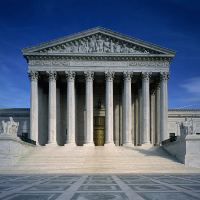
U.S. Supreme Court buildingBy Chris Wolfsen

Grocery store shelves, QWERTY keyboards, and restaurant menus. These are just three of the analogies that Supreme Court justices used to grapple with the complex issues in the long-awaited Google v. Oracle oral argument that was heard last Wednesday, October 7. The case between the two tech companies that has been brewing for over a decade comes down to 11,000 lines of Oracle’s Java code that Google copied, without permission, for use in its well-known Android smartphone platform—a competing product.

Oracle originally filed suit in 2010 against Google in the U.S. District Court for the Northern District of California for both patent and copyright infringement. In 2014, the Federal Circuit ruled that Oracle’s code was copyrightable, and Google appealed to the Supreme Court, only to be denied review. On remand, again in the district court, Google claimed that its use of the Oracle code was fair use—meaning that even if it were an infringing use it should still be allowed by law. In 2016, a jury sided with Google, and Oracle filed a motion to challenge the jury verdict, which was denied. So instead, Oracle appealed the case back up to the Federal Circuit where the court reversed the lower court’s judgment and held that Google’s copying of the code was not fair use and that the copyrightability issue that was resolved in its 2014 decision still applied. In 2019, Google filed its petition for Supreme Court review once again, and finally the time for oral argument arrived.

The main issues for the Court to decide are a review of the Federal Circuit decisions—whether Oracle’s code was copyrightable to begin with and whether Google made fair use of the code. But also, and perhaps most importantly, the Court must decide what standard of review should be used to make a fair use determination. This last question will have a lasting impact far beyond this particular dispute.

Copyrightability

Under the Section 102 of the Copyright Act, software is considered a “literary work” and is afforded legal protection. Oracle would therefore have the right to prevent others from using its code or, as was the case, license the use of its software for others to use. But Google makes an argument under the merger doctrine that the code was never subject to copyright protection. The merger doctrine states that when an idea and its expression are inextricably merged there cannot be any copyright protection for the idea. This doctrine gets right to the heart of copyright law: original expression is protectable; an idea—a method, a system, a way to explain something—is not. Google’s argument is that there is only one way to express Oracle’s code, and therefore the code itself cannot be copyrightable at all. Google repeatedly suggests that to rule otherwise would be imparting protection over a method, which is something reserved for patent law.

The Court, and perhaps the rest of us not well-versed in computer science, struggled with this concept in the context of a very technical set of facts. Google’s counsel, Thomas Goldstein, drew comparisons to the Baker v. Selden Supreme Court case where Selden created a new method of bookkeeping and attempted to assert copyright protection over his ledger forms. Goldstein likened Oracle’s code to those ledgers—innovative and hugely successful, but merely a methodology that does not warrant copyright protection. The justices took turns proposing different hypotheticals to challenge this argument. First was Chief Justice Roberts, “cracking the safe may be the only way to get the money that you want, but that doesn’t mean you can do it,” followed by Justice Thomas’s analogy to a football team’s playbook that Google swiped for its own win. Mr. Goldstein argued back that copyrighting the knowledge itself of how to crack a safe would not be allowed and that Google is not “trying to take someone’s fan base or their football players or anything else.” The justices did not seem convinced by Google’s assertion that Oracle’s method of writing code was the only way to create the function Google wanted for its Android platform.

It is easy to get lost in the technical language of the case, between declaring code and implementing code and shortcut programs. Oracle’s counsel, Joshua Rosenkranz, cut through all those distinctions saying, “code is code,” and he pointed out that no circuit court drew a distinction between the types of code. Congress could have carved out different types of code in its consideration of the Copyright Act, but it expressly chose otherwise. Mr. Rosenkranz also circled back to distinguish Oracle’s code from the accounting ledgers in the Baker v. Selden case, highlighting that Oracle is not trying to prevent others from creating their own programs. “Others are free to write and organize their own prewritten programs however they see fit, as long as they don’t copy ours.” Mr. Rosenkranz underscored, and multiple justices acknowledged, that other competitors like Apple and Microsoft did not resort to pure copying to create their products, and that companies like IBM and SAP paid Oracle to properly license the code. Just because Oracle’s method was the most elegant, and therefore popular, way of expressing the code does not make it the only method of doing so. Mr. Rosenkranz summarized this issue well, saying, “the Copyright Act does not give Google a pass just because it would be expensive to recreate our expression.” 

Fair Use

Even if the code were copyrightable in the first place, Google argues, fair use still justifies its copying of the code. Fair use is an affirmative defense to an accusation of copyright infringement. A person or entity who has plainly copied another’s protected work can argue fair use to justify their taking and subsequent use of the copyrighted material. Congress has enumerated a four-factor test within the Copyright Act for courts to follow when evaluating a fair use claim—a test that the Supreme Court last used 26 years ago in Campbell v. Acuff-Rose Music—weighing the purpose and character of the use, the nature of the original work, the amount and substantiality of the portion used, and the effect of the use on the market value of the original work.

Modern courts, when evaluating the first factor of purpose and character of the infringing use, often focus on whether the use was transformative. Google has used this argument successfully in the past, in Authors Guild v. Google, defending its copying of millions of books for use in its Google Books search engine. The court in that case found that digitizing books for use in an online search database was highly transformative. In this case, Mr. Goldstein tried to make a similar argument that Google wrote an improved version of Oracle’s Java code to be more suitable for use in a smartphone. Mr. Goldstein said that this is “what Congress would want, that is to be able to take the functionality of a computer program, [and] someone else comes along and does it better.” He then stated that computer code only performs one function and therefore can still be considered transformative even if it does nothing different than the original work, only to later argue that the word “transformative” is not used in the Copyright Act and might not even be the correct standard of evaluation in this case.

Google also maintained a policy argument that “reusing software interfaces is critical to modern interoperable computer software,” and that to rule in Oracle’s favor would “upend that world” and make computer programming so inefficient as to have fewer creative computer programs. Justice Kavanaugh pointed out that despite Google and its amici claiming a dire result if the Court should rule for Oracle, in the years since the Supreme Court first denied certiorari, “I’m not aware that the sky has fallen.”

Oracle made a more direct argument based on legal precedent, noting that the Supreme Court had already held in Harper & Row and in Stewart v. Abend that no court had found or upheld a fair use verdict where an infringer copied so much of an original work for use in a competing commercial product, all while retaining the same meaning and purpose as the original work. Mr. Rosenkranz pointed out that Google conceded that every line of code copied serves the same purpose in Google’s Android platform as it did in the original software—there was no alteration or transformation of the original code—and Malcolm Stewart, arguing on behalf of the United States in support of Oracle, echoed that point. Mr. Rosenkranz then cited the Court’s own decision in Campbell, saying that what Google did is the “epitome of commercial superseding use: using a work ‘to get attention or to avoid the drudgery in working up something fresh.’”

Standard of Review

The discussion quickly turned to the standard of review that the Court should use to evaluate fair use—whether the determination must be left up to a jury, like the jury that ruled in Google’s favor previously, or whether it can be made by a court, such as the Federal Circuit that overturned the jury verdict to side with Oracle. Google argued that fair use is determined by “whether the jury could reasonably find fair use,” and that “no previous court ever held that only a court may decide fair use.” Mr. Goldstein argued that giving the decision to a jury is the better choice due to the numerous factors involved in a fair use verdict and that jury instructions exist to give appropriate legal certainty and guidance to the jurors.

Oracle disagreed and argued that de novo, meaning “anew,” is the correct standard to resolve this question. This would allow for a court to make a fair use determination without being bound by the decision of a previous court or verdict. Mr. Rosenkranz again cited Harper & Row: “an appellate court may conclude, as a matter of law, that the challenged use does not qualify as fair use once it has the factual record and resolves all subsidiary factual questions in favor of the fact-finder.” Judicial review provides certainty to a fair use determination that would be lost if left to a lay jury. Mr. Rosenkranz also noted that making fair use a fact-finding mission that only a jury may evaluate would all but preclude summary judgment determinations, which are exclusively judge-made decisions and currently comprise the vast majority of fair use cases.

Conclusion

The stakes in this case are extremely high—if it was not made clear by the number of times the justices and attorneys referenced the sky falling—not only for Oracle and Google and the computer science world at large, but also for any copyright creator or user who will eventually face a fair use determination. Joshua Simmons, co-counsel for Oracle and partner at Kirkland & Ellis, looks forward to the Court’s decision, writing:

Given that Google’s copyrightability argument would make it difficult for any code to be protectable, I am hopeful that the Court will follow the text of the Copyright Act and the intent of Congress that code, like Oracle’s, is protectable. Likewise, I hope that the Court will follow a century of precedent allowing courts to decide as a matter of law that, when the defendant creates a substitute that competes with the original, it simply is not fair use.


People of all industries, from professionals to hobbyists, should take note of last week’s oral argument and what will be an historic decision from the Court.

Categories
Copyright

Nicola Searle on Business Models and Copyright: The Legal Business Model

The following post comes from Dr. Nicola Searle, an economist who specializes in the economics of intellectual property and the creative industries. This post is derived from a paper that Dr. Searle prepared for CPIP’s Sixth Annual Fall Conference.

the word "copyright" typed on a typewriterBy Nicola Searle

The last two decades have made for interesting times in the media business. With rapidly changing technology, the digital era released content from the confines of physical formats and introduced a dazzling array of formats, channels, and other key elements of business models.

Business models describe how an organization creates, delivers, and captures value; business models have become increasingly important for companies to adapt to, and harness the opportunity arising from, the digital ear. In digital media, this transformation has been coupled with changing consumer preferences and delivery mechanisms, leading to increased copyright infringement. Unsurprisingly, copyright is a focal point of regulatory discourses in the digital media industry. A key theme has been the interaction of copyright and business models.

Thanks to support from CPIP, I have developed an in-depth analysis of the copyright-business models narrative in the digital media industry. My research uncovered different viewpoints, types of business models, and the existence of an unacknowledged theme in these debates: the legal business model.

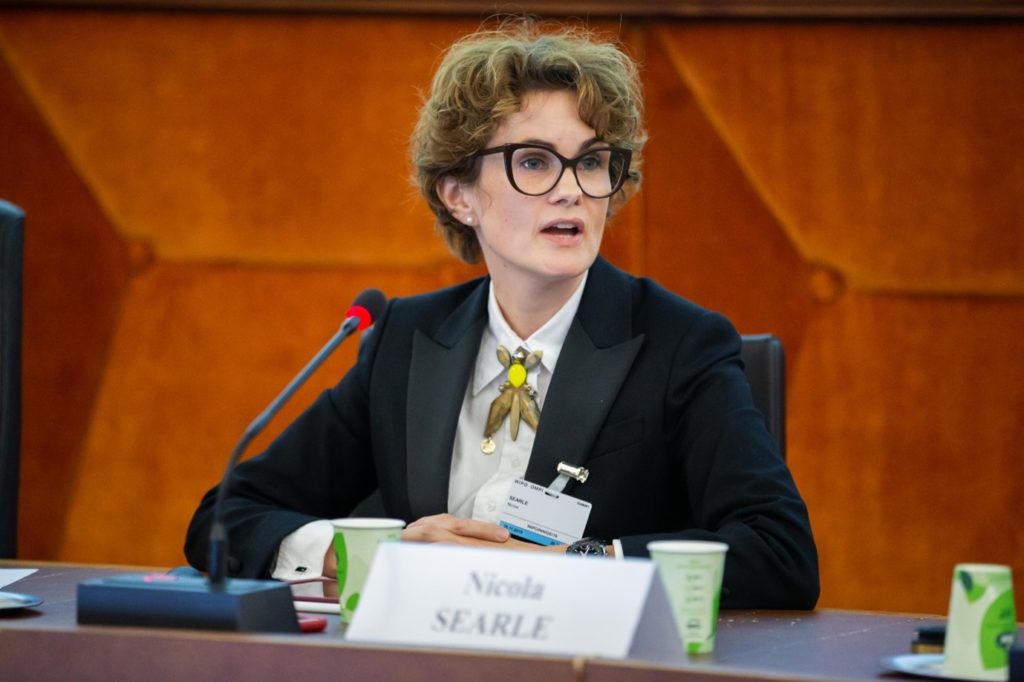
Nicola Searle
Copyright: WIPO. Photo: Pierre Albouy. This work is licensed under a Creative Commons Attribution-NonCommercial-NoDerivs 3.0 IGO License.

Two contrasting perspectives on copyright policy-business models emerge from the research: the first, as in the quote below, where copyright is a fundamental legal tool to support the industry’s business models and the fight against infringement. This view argues that without copyright protection, digital media business models will fail. For example:

Our business is based on a robust copyright framework which allows us to reinvest in the works we produce and licence, anything that could jeopardise it, such as a reduced copyright term or a fair-use system would result in our business model becoming redundant and therefore obsolete.[1]


A second view suggests copyright law restricts business model innovation. This take often cites the wild-west of the early Google business model, and its relatively liberal approach to copyright in the United States, in contrast to more restrictive jurisdictions, such as the UK, where business model innovation has been relatively tame. It is demonstrated by this quote:

Fair use [a copyright exception] may offer benefits for businesses which rely on the reproduction of creative content. To the extent that it offers a broader range of exceptions, it may encourage investment in new business models if firms believe they will neither infringe copyright nor incur licensing costs.[2]


The question then is, does copyright hinder or enable business models in digital media? The answer is that is not the question. This debate is not about business models—it is about the legal business model.

My analysis of over 300 documents from the UK digital media industry identifies a latent concept in these discourses: the legal business model. The discussion is not about business models as such, but as business models viewed via copyright—which I term “the legal business model.”

In a traditional concept of business models, the focus is on value creation through goods or services. In the copyright-business model narrative, the “business model” is actually the legal model shaped and sustained by external legal structures (copyright), where regulations (copyright) create and protect value. It is a subtle difference, but it explains why UK copyright regulations to encourage business model innovation have not been successful and why copyright does not actually feature heavily in the descriptions of business models.

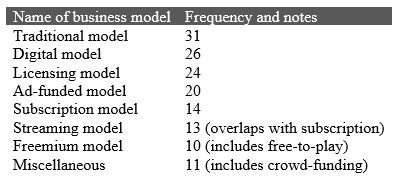
The research identifies various, yet inconsistent, labels for business models, as listed in the table below. The most cited is that of the “traditional model,” namely a model where content is sold directly to the consumer. The “digital model” is very similar—perhaps a digital equivalent of the sales of physical products. Other models talk about delivery and price mechanisms; however, only one business model is directly related to copyright—the licensing model. Only 16% of the business models mentioned in the sample are based on copyright; all the rest are framed instead around elements of the traditional concept of the business model.

Name of business model with frequency and notes. Traditional model, 31. Digital model, 26. Licensing model, 24. Ad-funded model, 20. Subscription model, 14. Streaming model, 13 (overlaps with subscription). Freemium model, 10 (includes free-to-play). Miscellaneous, 11 (includes crowd-funding).

In contrast to the drama and dynamism of the digital era and its copyright narratives, business models in digital media are surprisingly stagnant or resilient, depending on the perspective. The core model has not changed. For example, the CEO of Phonographic Performance Limited (PPL), a sound recording collective society in the UK, stated in 2017:

We have a strong and steadfast business model that forms the foundation for our future progress, and positions PPL well to deal with today’s ever-changing, competitive and complex market.[3]


Other authors, such as Feng Li, have also found relative stability in business models in the sector.[4]

Coupled with a further analysis of the discourse, details available in the paper here, a paradox emerges. While copyright-business models insist on a strong link between the two, in practice the industry’s own framing and use of business models downplay copyright. The legal business model offers an explanation: the narrative is copyright-legal business models, not copyright-business models.

Yet, the stability of the existing business models and structure of the industry are not given. Market power has shifted to large technology platforms and gateways, and tensions have emerged. As streaming services that license-in content, such as Spotify, grow, they become increasingly dependent on external content owners. Services such as Netflix and Prime are now content creators, and content creators themselves are launching their own services, such as Disney+. Platforms have also been criticized, as described in the following quote from UK Music CEO Michael Dugher:

Google’s YouTube is the world’s most popular music platform, yet it deliberately chooses to return a pittance to those whose creativity it has built its multi-billion pound business model on. Google remain the vultures that feed off music creators.[5]


Business models and copyright continue to play a part in both regulatory narratives in the industry and the future of the industry itself. However, discussions thus far have not been a true engagement with copyright and business models in the traditional sense—only with debates over the legal business model. Perhaps the correct question is, should business models adapt to copyright, or should copyright adapt to business models?

To read the paper, please click here.


[1] Alliance for Intellectual Property, Trading Places: The UK’s IP Future, at 60 (2017).

[2] PricewaterhouseCoopers, An Economic Analysis of Copyright, Secondary Copyright and Collective Licensing, at 51 (2011).

[3] Phonographic Performance Limited, Annual Review, at 6 (2017).

[4] See Feng Li, The Digital Transformation of Business Models in the Creative Industries: A Holistic Framework and Emerging Trends, Technovation 92-93 (2020).

[5] See Chris Cooke, Music Industry Comments on Copyright Directive Ruling, Music Business Worldwide (July 5, 2018).

Categories
Copyright

High Court Oracle-Google Copyright War May Benefit Artists

This post first appeared on Law360.

U.S. Supreme Court buildingYou might think that a copyright battle waged between tech behemoths Google LLC and Oracle America Inc. about computer code has little to do with the concerns of songwriters, authors, photographers, graphic artists, photo journalists and filmmakers. You would be wrong. These groups all filed amicus briefs with the U.S. Supreme Court in Google v. Oracle, argued on Wednesday Oct. 7.

Google v. Oracle is a long-running copyright dispute in which Google admits that, pressed for time, and wanting to compete with Oracle, it copied more than 11,000 lines of Oracle’s Java software code, as well as the organizational structure of the software program.

In doing so, Google avoided the research and development costs of authorship and even the licensing obligations to make its products interoperate with other Java products those using the code legally took on. Google then began competing with Oracle — earning billions of dollars in revenue using the code and structure it had copied.[1]

Google claims that either the portions of the code it took were not copyrightable or that Google’s use is a fair use.[2] It and its amici — many of whom would prefer reduced intellectual property protections for software to fuel their business models — deploy terms like “permissionless innovation” and “efficient infringement” as a public relations strategy.

However, the Copyright Act is clear that software is copyrightable as a literary work — with no carveouts for particular types of code — and that fair use is a defense to copyright infringement intended to excuse limited uses of works, especially for noncommercial purposes, where the use does not compete with the original work.[3]

That is why Google lost in the U.S. Court of Appeals for the Federal Circuit, where U.S. Circuit Judge Kathleen O’Malley opined “[t]here is nothing fair about taking a copyrighted work verbatim and using it for the same purpose and function as the original in a competing platform.”

The First Transformative Use Case at the Supreme Court in a Generation

The Supreme Court has not revisited the transformative use test articulated in Campbell v. Acuff-Rose Music Inc. in 26 years. That case added a new gloss on the first fair use factor — the purpose or nature of the use — courts consider when analyzing a fair use defense.

Artist advocates believe that some lower courts have improperly expanded transformative use over time so that it now includes uses that should be licensed, resulting in losses in income to creators.

Today it is not unusual for defendants to assert arguments that a given use is transformative even if it does not add new expression, meaning or purpose to a work, as Campbell required. It is common to hear policy arguments used to justify the need to copy the creative work of another for the sake of efficiency, or because it will reduce the cost of a product. Notable copyright scholars have even observed that transformative use is becoming a conclusory label that means all things to all people.[4]

Although cloaked in terminology related to software code, all of the familiar transformative use debates were present in Wednesday’s oral arguments in Google v. Oracle.

Google’s counsel, Thomas Goldstein, repeatedly resorted to the public policy arguments of efficiency and cost that rankle artists. At various points Goldstein was questioned by Chief Justice John Roberts and Justices Clarence Thomas, Elena Kagan, Neil Gorsuch and Brett Kavanaugh regarding why Oracle should be penalized for developing a “particularly elegant or efficient or successful or highly adopted solution in the marketplace.”

Goldstein ultimately replied that it would “upend the world” if later competitors were unable to copy popular computer code that programmers had become accustomed to using and “make the creation of innovative computer programs less efficient.”[5]

Google likewise argued that its use of Oracle’s code was transformative because it used the code on a mobile platform rather than a desktop. This argument was refuted by Deputy Solicitor General Malcolm Stewart, who noted that Google copied the portions of Oracle’s code that were used in the smart phone environment, so it did not transform anything.

Moreover, for app developers to have confidence that their programs would trigger the same functionality they had triggered in Java previously, the code had to perform exactly the same function it had always performed.

Hence, Google has not and could not do anything transformative in that sense either. To analogize to a motion picture that has only been released in theaters, he explained if one were to obtain a print of that film and instead stream it on a digital platform, no court would excuse that as a transformative fair use.[6]

Why the Standard of Review Matters

What might seem like an arcane civil procedure dispute over the proper standard of review for a fair use decision may well be the most important issue for artists in Google v. Oracle because it could determine whether cases in which fair use is asserted can be decided by a judge as a matter of law or instead require a trial and determination by a jury.

Google, which has routinely requested that fair use be decided by courts as a matter of law, has raised an argument through its amici that fair use is a question that must always go to the jury.

To put into perspective what this would mean for artists: Because copyright is a body of federal law that preempts state law, it must be tried in federal courts. Most individuals and small businesses cannot afford to bring or defend against even simple infringement actions in federal court. The American Intellectual Property Law Association has estimated that the mean cost of fully litigating a copyright infringement lawsuit is $397,000. Adding a jury trial requirement to these already astronomical costs would put justice ever further out of reach for the majority of the creative community.

Requiring a jury trial on fair use is outside the norm. As counsel for Oracle Joshua Rosenkranz noted, “Professor [Barton] Beebe has identified over 100 fair use cases decided by courts on summary judgment in a 30 year time span. Google could identify only five cases that went to a jury in a similar 30 year span.”[7]

Additionally, fair use is a defense on which both the public and creators depend and that requires stability and predictability so that individuals may make legal and commercial decisions with some certainty that they are not exposing themselves to undue risk. Google often makes these very arguments itself. To leave fair use determinations wholly to juries would undermine that stability and make innovation more dangerous and licensing more challenging.

What Artists Are Watching

Some amicus briefs filed by artist advocates invited the court to take this opportunity to clarify and rein in what they view are overly expansive fair use decisions since Campbell.[8]

Others express worry that

Google has used its unprecedented online footprint to dictate the terms of the market for creative works. By tying together a set of limited exceptions and exclusions within the U.S. Copyright Act and analogous laws in other countries, and then advocating for the radical expansion of those exceptions, Google has amplified its own market power to the great detriment of copyright owners.The more amorphous and unreasonably expansive the analysis and application of the fair use doctrine, the harder it becomes to establish the value of the copyrighted work during licensing negotiations that are the lifeblood of the creative ecosystem.[9]

Dale Cendali, co-counsel for Oracle, is optimistic after Wednesday’s argument and wrote to me in an email:

We are hoping that the Court will uphold the copyrightability of software and protect the incentive to create that the Constitution provides to all creators — big and small. We also are hoping the Court will agree it is fundamentally not fair use to use a work for the same purpose as the original for commercial gain. Moreover, fair use requires a complicated legal analysis that makes it suited to determination by a court as a matter of law — as has been the history of deciding fair use on summary judgment — as opposed to the often unpredictable and frequently unaffordable process of a jury trial.


Conclusion

Artists have much reason for optimism. The weight of the law and the diversity of amici arrayed against Google’s view of copyright is mighty. Beyond the wide variety of independent artists groups mentioned, amici aligned with Oracle also included:

  • The U.S. government, which has aligned with Oracle under the administrations of both former President Barack Obama and President Donald Trump;
  • Members of Congress who enacted the provisions of law in question, confirming that they intended to fully protect software without any carveouts or loopholes and that subsequent Congresses have only strengthened those protections;[10]
  • A member of Commission on New Technological Uses of Copyrighted Works, or CONTU, the special commission convened by Congress to advise it in the late 1970s on whether and how to protect software — confirming that software is protectable as a literary work and that CONTU considered and rejected the arguments Google raises in this litigation;[11]
  • The former Register of Copyrights Ralph Oman, who served during the time period that protections for software were enacted by Congress and whose role was to advise Congress on copyright matters as it drafted and implemented legislation — noting that Google’s arguments “fly in the face of long-standing principles of copyright law codified in the Copyright Act, which Congress extended to software in 1980 when it amended the Copyright Act explicitly to encompass computer programs”;[12] and
  • A variety of software and technology companies that depend on copyright protection to facilitate their participation in standards development as well as startup investment and innovation.

There is reason for optimism for all innovators and creators, as Rosenkranz summed up for the court:

The software industry rose to world dominance since the 1980s because of copyright protection, not unlicensed copying. And … the sky hasn’t fallen. [The] six years since the court of appeals’ first decision have brought new bursts of innovation and interoperability. In that time frame, we’ve seen the explosion of interoperability, cloud computing, 5G, machine learning, and autonomous vehicles.


Cases like Google v. Oracle illustrate how important copyright protections are to all authors in safeguarding the excruciating investment they make in taking their work from “the passable to the masterful.”[13]


[1] Brief of Respondent Oracle America Inc., Google v. Oracle, https://www.supremecourt.gov/DocketPDF/18/18-956/132891/20200212180251262_200208a%20Resp%20Brief%20for%20efiling.pdf.

[2] Brief of Petitioner Google LLC, https://www.supremecourt.gov/DocketPDF/18/18-956/127663/20200106172508533_18-956%20ts.pdf.

[3] 17 U.S.C. section 107.

[4] Brief of Amici Curiae Ten Creators’ Rights Organizations In Support of Respondent (Ten Creators Brief), https://www.supremecourt.gov/DocketPDF/18/18-956/133394/20200219112343394_18-956%20Amici%20Curiae.pdf.

[5] Transcript of Oral Argument, https://www.supremecourt.gov/oral_arguments/argument_transcripts/2020/18-956_kifl.pdf.

[6] Id.

[7] Id.

[8] Ten Creators Brief.

[9] Brief of Amici Curiae Helienne Lindvall, David Lowery, Blake Morgan and the Songwriters Guild of America in Support of Respondent, https://www.supremecourt.gov/DocketPDF/18/18-956/133298/20200218155210566_18-956%20bsac%20Helienne%20Lindvall%20et%20al–PDFA.pdf.

[10] Brief of Former Congressmen as Amici Curiae in Support of Respondent, https://www.supremecourt.gov/DocketPDF/18/18-956/133486/20200219145736673_18-956%20bsac%20Former%20Congressmen.pdf.

[11] Brief of Amicus Curiae Professor and Former CONTU Member Arthur R. Miller In Support of Respondent, https://www.supremecourt.gov/DocketPDF/18/18-956/133407/20200219120149951_18-956bsacProfessorAndFormerContuMemberArthurRMiller.pdf.

[12] Brief Amicus Curiae of Ralph Oman, https://www.supremecourt.gov/DocketPDF/18/18-956/133418/20200219122526620_2020-02-19%20No.%2018-956%20Oman%20amicus%20brief%20supporting%20respondent.pdf.

[13] Joshua Rosenkranz, counsel to Oracle in closing to the court “who will invest the excrutiating time it takes to refine code from the passable to the masterful if all of it can be stolen?”

Categories
Patent Licensing

LeadershIP 2020: Injunctive Relief in Standard-Essential Patent Cases

The following post comes from Colin Kreutzer, a 2E at Scalia Law and a Research Assistant at CPIP.

a hand holding a phone with holograms hovering above the screenBy Colin Kreutzer

The LeadershIP conference is dedicated to promoting an open dialogue on global issues surrounding innovation, intellectual property, and antitrust policy. On September 10th, LeadershIP kicked off its 2020 series of virtual events with a panel discussion featuring three government agency leaders: PTO Director Andrei Iancu, NIST Director Walter Copan, and Assistant Attorney General Makan Delrahim of the DOJ’s Antitrust Division.

Moderator David Kappos, a former PTO Director and current partner at Cravath, Swaine & Moore LLP, led a discussion about the role of standard-essential patents (SEPs) in modern industry and the legal effect that an SEP designation has on patent owners. The main topic of discussion was the importance of retaining the right to injunctive relief against infringers. The panelists had released a joint statement on this subject last year, following some unwelcome court decisions and what they viewed as misinterpretations of an earlier statement from 2013. View the video of the panel discussion here.

SEPs and F/RAND

The adoption of industry-wide technical standards helps industries to thrive by promoting efficiency and interoperability among competitors. A group that authors such standards is known as a standards developing organization (SDO), and it can include representatives from governments, private companies, and universities all over the world. For example, mobile communications standards such as 4G broadband technology are developed by the ITU, a group within the United Nations.

Developing a complex technical framework necessarily involves the use of many patented technologies. When the use of a certain patented technology is essential for adhering to the industry standard, it is known as a standard-essential patent.

Since owning an SEP can give the patent owner leverage over an entire industry, SDOs often require an agreement from patent owners before electing to use their technology in the standard. To be included, owners must commit to licensing their invention to all interested parties on terms that are fair, reasonable, and non-discriminatory (FRAND). Some forms of this agreement omit the word “fair,” leaving only “RAND.” They can be collectively referred to as F/RAND commitments.

Holdup and Holdout

The combination of public standards and private property rights can create perverse incentives for both patent owners and technology implementers alike. Once a company is bound to an industry standard, a patent owner may refuse to honor its F/RAND commitment and demand licensing fees that are grossly disproportionate to the patent’s actual value. A practice like this is known as “holdup.” But the presence of F/RAND agreements can encourage the licensee to practice “holdout” as well. In that case, a company will simply use the technology without paying any fees, ostensibly because the owner would not agree to fair and reasonable terms. Holdup and holdout can both weaken standard-setting efforts by breeding distrust and discouraging participation.

The panelists talked about the chain of events that they feel resulted in too much emphasis on preventing holdup at the expense of giving holdout a green light.

The 2013 and 2019 Letters

In 2013, the PTO and DOJ released a joint policy statement on the issue of appropriate legal remedies for SEP owners. The statement said it may not always be proper seek an injunction in a district court or to ban importation of products using an exclusion order at the International Trade Commission. Citing “an effort to reduce . . . opportunistic conduct” and the need to “provide assurances to implementers of the standard that the patented technologies will be available,” the letter suggested that a voluntary F/RAND commitment may imply that “money damages, rather than injunctive or exclusionary relief, is the appropriate remedy for infringement in certain circumstances.” The letter indicated that, at least under certain circumstances, no remedies should be available that would halt the actual flow of products or impede the implementation of a technical standard. Instead, the SEP owners could expect only monetary judgments that would be decided after the fact.

In the years following this statement, several court decisions were handed down denying injunctive relief in SEP infringement cases. In Apple v. Motorola for example, the N.D. Illinois court reasoned that when an SEP owner commits to licensing its patent to everyone, the dispute narrows to one of price: “[b]y committing to license its patents on FRAND terms, Motorola committed to license the [patent] to anyone willing to pay a FRAND royalty and thus implicitly acknowledged that a royalty is adequate compensation.” On appeal, the Federal Circuit objected to this rationale as a per se rule, but it upheld the denial of injunctive relief all the same.

The agencies became concerned that an entirely different legal standard was being applied when the patent in question was encumbered by a F/RAND commitment. So in 2019 the USPTO and DOJ, now joined by the NIST, released a new statement. In this one, they sought to clarify that, while F/RAND commitments should be considered as a factor, they “need not act as a bar” to injunctive or exclusionary orders. The three agency heads were unified on the importance of keeping these remedies available.

Andrei Iancu, Director, USPTO

Director Iancu talked about the critical role that innovation plays in the United States economy and the need to be vigilant in our protection of IP. Inventors must be certain that their protections are reliable, whether regarding infringement, remedies, march-in rights, or any other current issue. He discussed the various measures the Office is taking to improve our IP system. This includes COVID-response actions, such as fee deferral for small entities and the switch to an all-electronic filing system.

For an IP system to be robust, it must be founded on sound policy considerations. In this vein, Director Iancu discussed various PTO policies. Recent changes at the PTAB are designed to ensure a balance between patent owners and petitioners. The Office has issued new guidance on § 101 issues to provide greater clarity on what constitutes patentable subject matter. The PTO’s chief economist reported that “uncertainty” has decreased by 44% following this new guidance. And, of course, the joint policy statement is a step toward restoring all available remedies.

On the main topic, Director Iancu kept it simple: SEPs are patents. He emphasized that injunctive relief truly goes to the heart of the property rights conferred by a patent, as the right to exclude is explicitly provided in our Constitution. He rejected the notion that a special set of rules should apply when a F/RAND commitment is involved, and he warned about what would happen if there were: “One of the fundamental principles here is that if you have categorical rules, whether in fact or as perceived, then you create a system that leads to perverse incentives and bad outcomes.” There will be far less incentive to negotiate a license agreement up front when infringers “know categorically that they will not be enjoined.”

Walter Copan, Director, NIST

Director Copan discussed the various roles that NIST play in our economy and in promoting innovation, including: advanced 5G communications, standards leadership and cooperation with the private sector, cybersecurity, biotech innovation and protection, and manufacturing and supply chain security.

His most important objective at NIST is strengthening America’s competitiveness in the world. A strong IP system is the “bedrock” of this position and SEPs figure in prominently. The U.S. share of worldwide IP is on the decline while that of China is growing. One avenue that China is using to assert itself on the world stage is through China Standards 2035, a 15-year plan to become the leader in standards development for next generation technology. Copan and others made a case for the desired SEP remedies as part of an effort to maintain or improve the United States’ global standing on issues of IP and standards development. He said that our international partners are starting to see “the value and power of injunctive relief” to discourage infringement at will.

He also emphasized the same core ideas as the other panelists: SEPs are patents, and they are entitled to the same remedies as any other patent. Rather than favoring one of holdup or holdout over the other, we should focus on encouraging good-faith negotiation.

As a patent owner himself, he has been through a number of injunctive processes and knows first-hand that this form of relief is a “key part in the suite of remedies” available. He expressed excitement about the new policy statement and the international momentum that accompanies it, but he cautioned that this effort “is a journey” and there is a long way to go.

Makan Delrahim, Assistant Attorney General, USDOJ Antitrust Division

Assistant Attorney General Delrahim described the issues in the context of his New Madison approach to IP and antitrust policy, and the four core principles that form the basis of the New Madison approach.

First, patent holdup is not an antitrust issue. The DOJ has long recognized that SDOs are procompetitive institutions, and that the interoperability they provide is a major benefit to consumers. However, that does not mean that SEP holdup is an inherently anticompetitive practice, or that antitrust law is the appropriate forum in which to settle such disputes. He described as “radical” the idea that a patent owner could be accused of an antitrust violation simply for reneging on F/RAND obligations, and that contract law would be far more appropriate.

Second, SDOs shouldn’t be used as “vehicles” by which either implementers or patent owners gain advantages over each other. Instead SDO policies should strive for a balance which maximizes the incentives for innovators to innovate and for implementers to implement. “Negotiating in the shadow of dubious antitrust liability is not only unnecessary, it dramatically shifts the bargaining power between patent holders and implementers in a way that distorts the incentives for real competition on the merits.”

Third, as discussed above, the fundamental right conferred by a patent is the right to exclude. Courts should be very hesitant to take that right away. Doing so can effectively create a compulsory licensing regime, which has been largely disfavored in the U.S. for decades.

Finally, at least from an antitrust perspective, the refusal to license a patent should not be considered per se legal. This will allow F/RAND negotiations to take place “in the shadows of contract law” without the threat of treble damages under the Sherman Act, and thus without “skewing the negotiations in favor of an implementer.”

Conclusion

In closing, the panelists were unified in their views as laid out in the joint policy statement. They were optimistic about the direction in which the law is headed, both in the U.S. as well as with international partners such as Germany and the U.K. And they looked forward to continuing the full restoration of a critical remedy for owners of standard-essential patents.

Categories
Scalia Law

CPIP Welcomes Ken Randall as Next Dean of Scalia Law School

the word "Mason" set up outdoors on campus with people walking behindGeorge Mason University has announced that Ken Randall will be the next Dean of Antonin Scalia Law School, beginning on December 1, 2020.

CPIP Executive Director Sean O’Connor welcomed the news: “We couldn’t be happier with the selection of Ken Randall as Dean-Elect. He cares deeply about the continued success of CPIP and is no stranger to innovation and commercialization. He and I have already developed a great working relationship, and CPIP endeavors to support his Deanship in any way we can. We also thank Dean Henry Butler for his outstanding leadership and look forward to working with him as a faculty colleague and Executive Director of the Law & Economics Center.”

Dean Randall has a proven track record as an effective administrator and innovator. He served as the Dean of the University of Alabama School of Law for twenty years, taking the school from 96th to 21st place in the U.S. News & World Report law school rankings. The school likewise rose to 7th place as the best public law school under his watch. Dean Randall is also the President and Founder of iLaw, a market leader in legal distance learning that has partnered with 30 graduate programs and worked alongside 25% of the accredited law schools.

Dean Randall is an accomplished scholar. He holds four law degrees: a J.S.D. and LL.M. from Columbia Law School, an LL.M. from Yale Law School, and a J.D. from Hofstra Law School, where he served as editor-in-chief of the Hofstra Law Review. He has authored a book on international law that was published by the Duke University Press, and his law review articles have appeared in many top journals.

The Center for the Protection of Intellectual Property congratulates Dean Randall on his appointment and welcomes him to the Scalia Law family. His rigorous academic mind, strong leadership skills, and expertise in online learning bring together the ideal skill set to take our law school to new heights. We very much look forward to working with him in the near future.

Categories
CPIP Roundup

CPIP Roundup – September 30, 2020


Greetings from CPIP Executive Director Sean O’ConnorSean O'Connor

As we move through our busy fall season here at CPIP, we are grateful for the efforts of everyone in the George Mason University community keeping us safe and healthy. We are fortunate that in these highly uncertain times, we are still able to focus on what we do best: bringing you the research, impact policy pieces, and programming that you have come to expect.

In the copyright sphere, we were gratified by the success of our postponed—and ultimately virtual—conference, The Evolving Music Ecosystem. Highlighted by an informative and moving fireside chat between singer, songwriter, and author Rosanne Cash and CPIP’s Sandra Aistars, the conference also featured seven panels of academics, industry specialists, and artists who provided invaluable insight into copyright law and the music business, especially in light of 2020’s challenges to the industry. Thank you to all who participated and attended! Videos of the keynote address and panel presentations can be watched here.

CPIP also congratulates Shira Perlmutter on her appointment to Register of Copyrights and Director of the U.S. Copyright Office by Librarian of Congress Carla Hayden. We very much look forward to Ms. Perlmutter’s continued positive impact on the copyright community in her new role.

In the patent sphere, CPIP Senior Fellow for Innovation Policy Jonathan Barnett led our roundtable, Measuring the Value of Patent Licensing. Leading legal scholars, economists, and industry representatives focused on the data collection and methodological approaches to quantifying the full economic benefits of commercializing new innovation through patent licensing models.

Congratulations to CPIP Senior Scholar Erika Lietzan on becoming the William H. Pittman Professor of Law & Timothy J. Heinsz Professor of Law at University of Missouri School of Law and for being named a “Best Lawyer in America” for 2020! We are proud of the many accomplishments of our Scholars!

In the coming month, we are excited to host our Eighth Annual Fall Conference on October 7-8. We are partnering with the National Security Institute (NSI) at Scalia Law School to focus on 5G at the Nexus of IP, Antitrust, and Technology Leadership. We hope you’ll be able to join us! You can see the conference program, confirmed speakers, and register for the virtual event here.

Last, but certainly not least, we are proud of the academic and policy publications of our Scholars, Fellows, and other affiliates. Keep reading to learn about work by Sandra Aistars, Jonathan Barnett, Stuart N. Brotman, Ross E. Davies, H. Tomás Gómez-Arostegui, Devlin Hartline, Chris Holman, Erika Lietzan, and Kristen Osenga.


CPIP Eighth Annual Fall Conference with USPTO Director Andrei Iancu on October 7-8

2021 5G Conference image

CPIP’s Eighth Annual Fall Conference will be hosted virtually from George Mason University Antonin Scalia Law School in Arlington, Virginia, on October 7-8, 2020. The theme this year is 5G at the Nexus of IP, Antitrust, and Technology Leadership. The conference is being co-hosted by the National Security Institute (NSI), and it features a keynote address by USPTO Director Andrei Iancu.

This conference addresses fast-emerging intellectual property (IP), antitrust, and technology leadership issues in the 5G and “Internet of Things” innovation ecosystem. Coverage includes standard-essential patents (SEPs) along with established and emerging markets on a regional and global basis. Speakers are drawn from the academic, industry, and policymaking communities, with an emphasis on using objective fact-based analysis to explore points of convergence among legal, economic, and geopolitical perspectives on the IP and regulatory infrastructures that underlie these critical industries.

Registration closes on Monday, October 5, 2020, at Noon ET, so please register soon! We have 4 hours of Virginia CLE credit pending!

To visit our conference website and to register, please click here.


CPIP Hosts Academic Roundtable on Patent Licensing Valuation

hand under lightbulbs drawn on a blackboard

On September 17, 2020, CPIP hosted an academic roundtable entitled Measuring the Value of Patent Licensing online from George Mason University Antonin Scalia Law School in Arlington, Virginia. The roundtable, which was moderated by CPIP Senior Fellow for Innovation Policy Jonathan Barnett, included leading scholars, economists, and industry representatives.

The sessions focused on the existing methodologies developed to measure IP transactions, the insights achieved so far using those methodologies, and the possibilities for developing more precise methodologies to measure licensing and related transactional activities in the IP marketplace. They also examined the mechanics of IP licensing and transactional markets, how IP transactions generate social value, and the extent to which existing IP legal regimes may impede IP markets.


The Evolving Music Ecosystem Conference with Rosanne Cash

Rosanne Cash

On September 9-11, 2020, CPIP hosted The Evolving Music Ecosystem conference online from George Mason University Antonin Scalia Law School in Arlington, Virginia. The conference featured a keynote address by singer, songwriter, and author Rosanne Cash, and coverage included news articles at Billboard and Mason News. CPIP Senior Scholars Sandra Aistars, Sean O’Connor, and Mark Schultz also participated in the event. We’ve posted a synopsis of each day of the conference here, here, and here.

This unique conference continued a dialogue on the music ecosystem begun by CPIP Executive Director Sean O’Connor while at the University of Washington School of Law in Seattle. In its inaugural year in the D.C. area, the conference aimed to bring together musicians, music fans, lawyers, artist advocates, business leaders, government policymakers, and anyone interested in supporting thriving music ecosystems in the U.S. and beyond.

To visit our conference website and to watch the videos, please click here.


Spotlight on Scholarship

a pair of glasses, an apple, and a stack of books

Tomás Gómez-Arostegui & Sean Bottomley, The Traditional Burdens for Final Injunctions in Patent Cases C.1789 and Some Modern Implications, 71 Case W. Res. L. Rev. ___ (forthcoming 2020)

CPIP Edison Fellow Tomás Gómez-Arostegui of Lewis & Clark Law School and co-author Sean Bottomley have published a draft of their law review article that will be published in the Case Western Reserve Law Review. The article takes an historical look at the first two permanent injunction factors from eBay v. MercExchange, namely, irreparable injury and inadequate legal remedies. The article concludes that equitable principles dictate that the Federal Circuit should recognize that: “(1) an injury it seeks to redress with a final injunction is future infringement itself, not just follow-on harms caused by future infringement; (2) it can presume future infringement from past infringement; (3) it can presume that legal remedies are inadequate to remedy future infringement; and (4) it need not require a plaintiff to show that alternative equitable remedies, like ongoing royalties, would inadequately redress future infringement.”

To read the article, please click here.

Stuart N. Brotman, Intersecting Points in Parallel Lines: Toward Better Harmonization of Copyright Law and Communications Law Through Statutory and Institutional Balance, 26 Rich. J.L. & Tech., no. 3, 1 (2020)

The Richmond Journal of Law and Technology (JOLT) has just published a new article by Professor Stuart Brotman, the inaugural Howard Distinguished Endowed Professor of Media Management and Law and Beaman Professor of Journalism and Electronic Media at the University of Tennessee, Knoxville. The article was supported by a Leonardo da Vinci Fellowship Research Grant from CPIP and the research assistance of recent Scalia Law graduate Samantha Levin. The article traverses the history and development of copyright and communications law, which have historically followed separate paths, and offers potential ways that they can be harmonized to match the current realities of the media marketplace.

To read the article, please click here.


Activities, News, & Events

a lit lightbulb hanging next to unlit bulbs

CPIP Director of Copyright Research and Policy Sandra Aistars has written an article at Law360 (also available on the CPIP blog) about Justice Ginsburg’s copyright legacy, especially as it will affect the impending Google v. Oracle decision. Prof. Aistars has also published her latest Copyright Notebook series post, The Importance of Artists’ Agency, on the CPIP blog. Additionally, the Arts & Entertainment Law Clinic—directed by Prof. Aistars—has continued its academic partnership with the U.S. Copyright Office for the fifth year. This semester, they are supporting the Office’s public meetings to investigate standard technical measures (STMs) that could be adopted to aid and identify copyrighted works and to potentially reduce infringement on digital platforms as envisioned in Section 512(i) of the DMCA. Prof. Aistars and the Clinic students will also co-host an online copyright clinic with WALA and the Copyright Alliance that will feature a live performance by the Rock Creek Kings.

CPIP has published a new policy brief by Professor Ross E. Davies entitled Ebb and Flow in Safe Harbors: Some Exemplary Experiences Under One Old Statute and One New. Prof. Davies teaches administrative law, civil procedure, comparative criminal law, contracts, employment discrimination, legal history, legal profession, and torts at George Mason University Antonin Scalia Law School in Arlington, Virginia, and the policy brief is the product of our two Safe Harbors and Private Ordering in the Creative Industries research symposia that were held in 2019. In the policy brief, Prof. Davies compares and contrasts two seemingly unrelated statutory provisions that are often referred to as “safe harbors”—despite that term not appearing in either statute: the National Labor Relations Act (NLRA) as codified in Title 29, and the Online Copyright Infringement Liability Limitation Act (OCILLA)—otherwise known as Title II of the Digital Millennium Copyright Act (DMCA)—as codified in Title 17.

CPIP Scholars have participated in several speaking engagements this past month. CPIP Senior Fellow of Innovation Policy Jonathan Barnett spoke at the Innovation Alliance’s Recognizing the Growing Economic Impact of Patent Licensing webinar. CPIP Senior Fellow for Life Sciences Chris Holman participated in the Regnier Institute for Entrepreneurship and Innovation Kansas City Region’s Bio-Medical and Healthcare Technology Entrepreneurship Certificate Program. CPIP Senior Scholar Erika Lietzan spoke at IPWatchdog’s The Race for a Coronavirus Vaccine: The Intersection of Science and IP Policy webinar. CPIP Senior Scholar Kristen Osenga presented a draft paper at the Gray Center’s Public Health: Regulation, Innovation, and Preparation research roundtable. And CPIP Director of Communications Devlin Hartline participated in the Music Biz Entertainment & Technology Law Conference.

CPIP Scholars have also written op-eds defending the importance of robust patent protection, particularly for biopharmaceutical inventions in light of the COVID-19 pandemic. At the Huntsville Item, CPIP Senior Fellow for Life Sciences Chris Holman argues that the seizure of patents will only hamper the development of a vaccine to combat the coronavirus: “Eliminating intellectual property protections would not only reduce incentives to develop coronavirus treatments as quickly as possible; they will also destroy the domestic industrial base that could be the key to stopping the next pandemic.” Likewise, CPIP Senior Scholar Kristen Osenga argues at the Nashua Telegraph that taxpayers are getting a great deal with biomedical research: “When new treatments are successful, drug companies make money because we, through insurance, buy those drugs to keep us, or make us, healthy. The government then taxes those profits and invests some of that tax money into new research. Far from ‘paying twice,’ we are getting a great bargain from government spending on basic research.”


Categories
Conferences Copyright

The Evolving Music Ecosystem Conference: Day Three Recap

The following post comes from Bradfield Biggers, a graduate of Boston College Law School and Founder & CEO of Timshel Inc., a music fintech company that provides data-driven cashflow solutions to musical artists in Los Angeles, California. This is the third of three posts (see day one recap and day two recap) summarizing our three-day The Evolving Music Ecosystem conference that was held online from George Mason University Antonin Scalia Law School on September 9-11, 2020.

Rosanne CashBy Bradfield Biggers

On September 9-11, 2020, the Center for the Protection of Intellectual Property (CPIP) hosted The Evolving Music Ecosystem conference online from George Mason University Antonin Scalia Law School in Arlington, Virginia. The conference featured a keynote address by singer, songwriter, and author Rosanne Cash.

This unique conference continued a dialogue on the music ecosystem begun by CPIP Executive Director Sean O’Connor while at the University of Washington School of Law in Seattle. In its inaugural year in the D.C. area, the conference aimed to bring together musicians, music fans, lawyers, artist advocates, business leaders, government policymakers, and anyone interested in supporting thriving music ecosystems in the U.S. and beyond.

SESSION 5: THE POWER OF DATA OWNERSHIP & ANALYTICS

Access to consumer data and the ability to process and respond to it is perhaps the most valuable component of our digital global ecosystems—no matter the industry. In the music business, collecting and analyzing data about listeners and their habits is occurring on a massive scale, and it’s informing the development of new business models and platforms. But questions of ownership and data sharing loom large, as musicians increasingly realize the value of knowing more about their fans. This panel discussed the current state of data collection and analytics in the music industry and explored ways that big data can foster creative ecosystems for all stakeholders. The panel was moderated by Prof. Sean Pager of Michigan State University College of Law.

Prof. Serona Elton from the University of Miami Frost School of Music kicked off the panel by describing the various places where artist data is aggregated, such as Spotify for Artists, Apple Music for Artists, Soundcharts, and collective management organizations (CMOs). Prof. Elton emphasized that while the number of data sources and quantity of data is extraordinary, the quality of data and specificity of the sources vary drastically. Moreover, while that data is accessible to everyone, the utility and granularity of the data will vary depending on who you are and how you want to use it.

Joshua Friedlander from the Recording Industry Association of America (RIAA) then described the history of data tracking in the music industry. Data analytics became prominent in the 1990s when the RIAA was tracking roughly a billion point-of-sale transactions for recorded music annually. Nevertheless, those billion transactions have been dwarfed by the 1.5 trillion datapoints the RIAA now tracks annually in the U.S. alone. Moreover, where the data of the 1990s merely tracked when and where a record was sold, music industry data today is infinitely more complex. The music data we collect now includes the demographics of the consumer, how long they consumed the song, how often they consume it, and many more analytics that continue past the point of sale or download. As a result, record labels and marketing plans are so intricately related to data that few will approve a marketing campaign without data-backed guidance. Finally, Mr. Friedlander advised artists to retain only representatives who understand and use music data. Without looking at this data to understand the disposition of fans, contemporary artists will have a more difficult time achieving success in this data-driven music business.

Prof. Jake Linford from Florida University School of Law followed Mr. Friedlander’s discussion of the endless potential of artist data with a critical discussion of the safety and usefulness of current data collection and analytics efforts. Prof. Linford agrees that this extraordinarily granular data has unlimited potential, but he also thinks that not all aspects of its potential are positive. For example, the data technology companies collecting from your online consumption habits may be able to help artists and record labels understand what style of music is likely to create the next big pop song. Nevertheless, such data collection can also reveal potentially sensitive information about users, such as political affiliation and sexual orientation. Prof. Linford went on to discuss how this data can also allow AI-driven robots to create compositions without human intervention. While many are excited about the prospect of robot artists, this does create an interesting philosophical debate of what constitutes a creator.

Prof. Tonya Evans then led the panel into a discussion of disintermediation in the music industry. Prof. Evans explained how too many gatekeeper intermediaries in music needlessly create friction. She recommended that blockchain can streamline music distribution and remove many of these costly friction points, which would leave more money for artists. However, despite the promise of modern internet technologies, she recognized that the effectiveness of streamlining music distribution with current blockchain technology is curbed by the pervasiveness of piracy. Prof. Evans then suggested that a solution to music piracy—which could pave the way for efficient music licensing—could be through a disaggregated, decentralized network of blockchain payment and smart contracts. She anticipates that this sort of technological framework could provide the certainty and trust that music stakeholders need to distribute music securely and efficiently.

Finally, Will Page, the former Chief Economist of Spotify, began his presentation by rehashing and analyzing some of the main points made by the prior panelists. Particularly, he found blockchain to be a less capable solution in the music industry because of the issue of conflicting song metadata. Instead, he suggested the creation of a global repertoire database that would provide needed clarity in the music rights environment that regularly misattributes—or outright fails to attribute—artists to particular songs. Mr. Page later suggested that a country’s best solution to straightening out its broken song attribution status quo would be to create a natural monopoly to act as a central copyright depositor to coordinate with licensees. He then went on to stress the importance of music’s big data conversation, which he suggested should drive music innovation over longstanding industry customs. For example, the music industry continues to rely on country-level data for identifying fans because of longstanding touring customs, rather than the city-level data we have access to that is vastly superior due to its granularity.

SESSION 6: ARTIST MANAGEMENT & THE BUSINESS OF MUSIC

In today’s music business, when artists can act as their own producers, promoters, booking agents, managers, etc., is there still a need for traditional representation? What is the role of an artist manager? How has it evolved as the internet and interconnectivity have grown? This panel, moderated by Prof. Robert Heverly of Albany Law School, brought together artists, managers, lawyers, and venue owners to discuss the constant evolution of artist representation and the business of music.

Prof. Olufunmilayo Arewa from Temple University Beasley School of Law opened the panel by explaining how marginalized groups have been short-changed by record agreements in the past. Prof. Arewa described the financial discrimination and general injustice that has been felt by African American musicians for generations. For example, African American R&B artists between the 1960s and 1980s received royalty contract rates worth 20-60% of what were considered standard rates. Moreover, she noted that an additional consequence of failing to compensate African Americans and other groups fairly is that they cannot receive union sponsored health insurance. Finally, Prof. Arewa highlighted that considering the Black Lives Matter movement, there have been various proposals on how to make amends for past royalty rate inequities.

Attorney Lita Rosario carried on Prof. Arewa’s conversation about the injustices felt by marginalized groups by discussing her personal experience litigating unfair royalty agreements on behalf of African American artists. She then outlined her work in striking the down the “sharecropping” agreements between artists and record labels in favor of joint venture arrangements. Ms. Rosario noted that in the traditional sharecropping model, an artist’s royalties must recoup the recording costs before she is given any share of her royalties. In her proposed joint venture agreement, the artist would instead begin to earn royalties on the day the album breaks even. Also, Ms. Rosario noted, while it is a positive that major record labels have committed around $225 million to promote anti-racism, this gives little solace to those who continue to suffer from the chains of inequitable contracts.

Simon Tam of the award-winning band The Slants then brought home the conversation about systemic racism and marginalization in the music industry by speaking about his personal experience navigating injustice. He recalled an incident when a record executive offered his band a substantial record deal, so long as they replaced their Asian lead singer for a white person. The executive said this was because “Asians don’t sell.” Mr. Tam confronted the executive about the racism and walked out on the deal. Since then Mr. Tam and his band have leveraged online independent distribution platforms to release their music, which has allowed them to create a successful career without label involvement. However, he explained that artists who forgo record label agreements will generally need to find the right group of representatives to champion their careers. The music industry is full of complex arrangements and niches, which is extremely difficult to navigate on one’s own.

Ralph Jaccodine, who is an artist manager and a professor at the Berklee College of Music, then rounded out the panel by providing the perspectives of the record label and artist manager. Prof. Jaccodine emphasized that modern artists can no longer confine their activities just to creating music. Prof. Jaccodine believes that artists need to be able to wear a bunch of different hats in the music industry so they can delegate aspects of their business to effective representatives. Artists need to educate themselves about their business and understand how activities from concert promoting to publishing function so that they can hire the right representatives to drive their careers. Without a knowledge of their business, artists can be taken advantage of and will not know if a particular manager or agent is worth hiring. Prof. Jaccodine encourages artists that they don’t need record labels to be successful—just knowledge and a good team.

SESSION 7: SUPPORTING ARTISTS & COMMUNITIES

Recognition of and support for local artists and musicians is vital to the preservation of creative and culturally diverse communities. Whether full-time professional musicians or part-time hobbyists, creative individuals’ contributions to their communities are invaluable and difficult to measure. But like many who make a living through artistic endeavors, musicians often struggle to find steady work and lack the benefits that many of us take for granted. Musicians also often encounter mental health and substance abuse issues at a greater rate than non-artists. This panel discussed ways a vibrant music scene can benefit a community, ways that communities can give back, and resources available to musicians in need. The panel was moderated by John Good of the Washington Area Lawyers for the Arts.

Prof. Ying Zhen of Wesleyan College kicked off the panel by discussing her 2018 survey concerning the wellbeing of modern musical artists. This survey was an in-depth, multidimensional study involving 1,000 artists who identified as full-time musicians with sustainable careers and those who were transitioning into such careers. From this data, Prof. Zhen and her team were able to uncover interesting information about the modern working artist. For instance, Prof. Zhen identified that the median income from music for these artists was $35,000 per year, the median artist has around 3.5 different music income streams, and that one-third of their yearly income came from non-music sources. And while much of her research concerned the financial wellbeing of artists, Prof. Zhen also collected data on their general wellbeing. Unfortunately, this research tended to show that artists found the financial instability of music challenging, drug usage by artists in this survey was higher than the national average, and that 76% of women in music reported experiencing sexual harassment. Although these figures did not paint the rosiest portrait of artist wellbeing, Prof. Zhen hopes this survey will bring about social and financial change by educating artists and policymakers on the everyday struggles of artists.

Jennifer Leff from MusiCares then followed Prof. Zhen’s presentation by discussing the resources that MusiCares, one of the largest artist resource organizations in the world, offers to artists. Specifically, Ms. Leff spoke about MusiCare’s grant program that helps artists who are struggling financially due to the global COVID-19 crisis. To qualify for this program, artists must have five years of music industry experience or be able to show proof of six commercially released tracks. Qualifying artists can request small-quantity grants to pay personal expenses, such as rent, medical care, and other necessities. So far, MusiCare’s grant program has supported over 18,000 artists during the COVID-19 pandemic and distributed $20 million in grant relief. In addition to this grant program, Ms. Leff spoke about how MusiCares looks out for the broader music community by offering educational seminars ranging from money management and tax tips for musicians to addiction and recover information.

Yudu Gray Jr., the co-founder of House Studio, then transitioned the panel from discussing overarching artist support organizations to how artists are handling the state of the music industry today. Through his music production company, House Studio, Mr. Gray has not only helped artists create masterful music productions, but he also concedes that he has helped artists with the “boring stuff” such as LLC registrations and accounting practices. However, this more holistic approach to providing foundational artistic and business services has allowed his artists to achieve global notoriety, as in the case of the Gramm–winning artist Logic. Mr. Gray then discussed his firsthand account of watching artists he works with struggle to pay rent and access other necessities because of the COVID-19 global pandemic. He sees that technology and the music industry are trying to pivot to stay alive, which ends up leaving individual artists behind. Recognizing this inequity, Mr. Gray began to look for ways to help artists get money to finance their projects. This search resulted in House Studio connecting with technology companies like Apple and Amazon to help artists’ projects get funded. For example, Mr. Gray spoke generally of an upcoming project where artists could pitch music video ideas to an undisclosed technology company that would fund the project without demanding rights. The only catch is that the content the technology company funded would be exclusive on its platform for a period of time.

Erik Philbrook from the performing rights organization American Society of Composers, Authors and Publishers (ASCAP) rounded off the panel by providing artists with tips on how they can get compensated for their work. First, Mr. Philbrook emphasized that artists need to register their music properly so that ASCAP and other royalty distributors can identify and compensate artists for their works. Second, he noted that many artists are not collecting their full amount of performance royalties because they only register with performing rights organizations as writers. Mr. Philbrook explained that unless an artist has a relationship with a publisher, the artist herself needs to register as both a writer and publisher with her performing rights organization so that she can receive all of the performance royalties she is due. Finally, Mr. Philbrook wanted to publicize that ASCAP also supports artists with educational materials, seminars, and conferences to teach artists on how to navigate the nuances of the music industry.

CLOSING REMARKS

CPIP Executive Director Sean O’Connor closed the conference by expressing how pleased he was with how smoothly the conference operated and thanking everyone involved in making this conference possible. Prof. O’Connor provided special thanks to the CPIP team, including Prof. Sandra Aistars, Prof. Devlin Hartline, CPIP Deputy Director Joshua Kresh, Kristina Pietro, and Mary Clare Durel, for their phenomenal work behind the scenes. Additionally, Prof. O’Connor acknowledged the financial and general support of the conference’s sponsors, in particular the Recording Industry Association of America (RIAA) and Mitchell Silberberg & Knupp LLP.

Prof. O’Connor then invited artists, academics, and anyone else to join CPIP next year in a follow-up conference that he anticipates will be themed “Rebuilding the Music Ecosystem.”