Categories
Communications

C-IP2 2022 Winter Progress Report (September-November 2022)

Greetings from C-IP2 Faculty Director Seán O’Connor

With warmest wishes for the holiday season, we present our last report of 2022. This has been the year in which many of our programs were held in person again. We are grateful to our community for supporting the transition back to in-person events.

This Winter 2022 Progress Report covers Center and affiliate news and publications from September through November. Over that time, we hosted our 2022 Annual Fall Conference in person at the newly rebranded “Mason Square” (formerly the Arlington Campus), where we also held the second meeting of our 2022-2023 Thomas Edison Innovation Law and Policy Fellowship. Additionally, C-IP2 co-hosted and helped to sponsor the inaugural National Vaccine Law Conference, and we are proud to highlight that our own Professor Sandra Aistars gave the 2022 Christopher A Meyer Memorial Lecture for The Copyright Society of the USA!

We’re grateful to all our Advisory Board, scholars, fellows, donors, and supporters for all their help with C-IP2’s efforts to further the scholarly discussion around IP and innovation.

We look forward to seeing you again in the New Year!


Holiday Cheer and Highlights of the Year

Holiday Greeting: We wish you the very best this holiday season and a Happy New Year for 2023!


Photo opportunities—one of the reasons we’re thrilled to be back to in-person events at last!
Here are a few of our favorites from 2022:

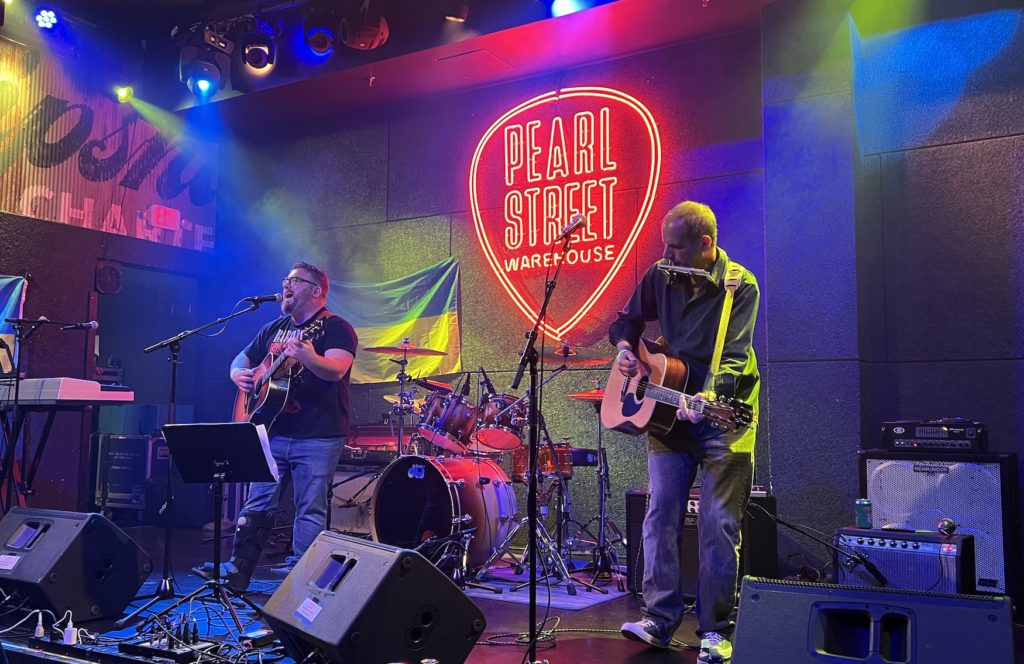
Seán O'Connor and Jon Knight rock out on the Pearl Street Warehouse stage under blue and yellow lights and in front the the Ukrainian flagOn May 5, C-IP2 Faculty Director  Seán O’Connor (right) performed vocals, guitar, and harmonica with Jon Knight (left) as an acoustic rock duo under the name Buzzard Point Caucus for Law Rocks Washington D.C. for Ukraine, a special charity event hosted in Washington, D.C. by annual charity event Law Rocks.
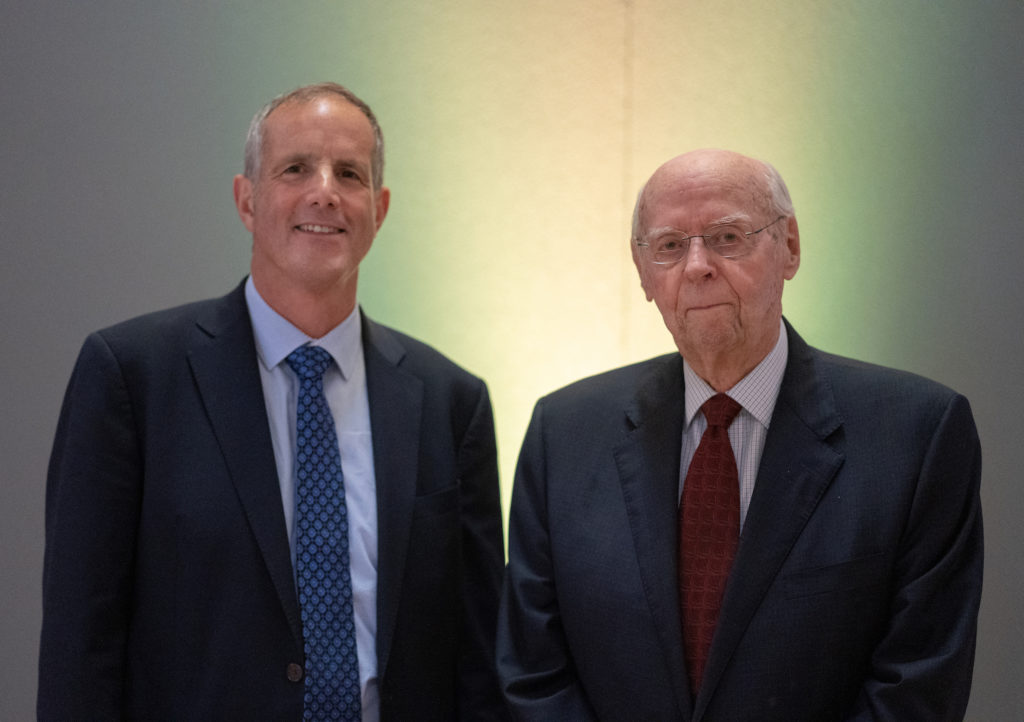
Professor Sean O'Connor and the Honorable John F. Witherspoon pose for a picture together at the 2022 Fall Conference receptionThe Hon. John F. Witherspoon (right), Professor and Director Emeritus of the Intellectual Property Program, honored C-IP2 with his presence and a few words at the reception for the 2022 Annual Fall Conference in September. The reception was held in recognition of Prof. Witherspoon’s service to George Mason’s law students and the IP program over the years. Here he poses for a picture with C-IP2 Faculty Director Seán O’Connor. / Photo credit: Dennis Le
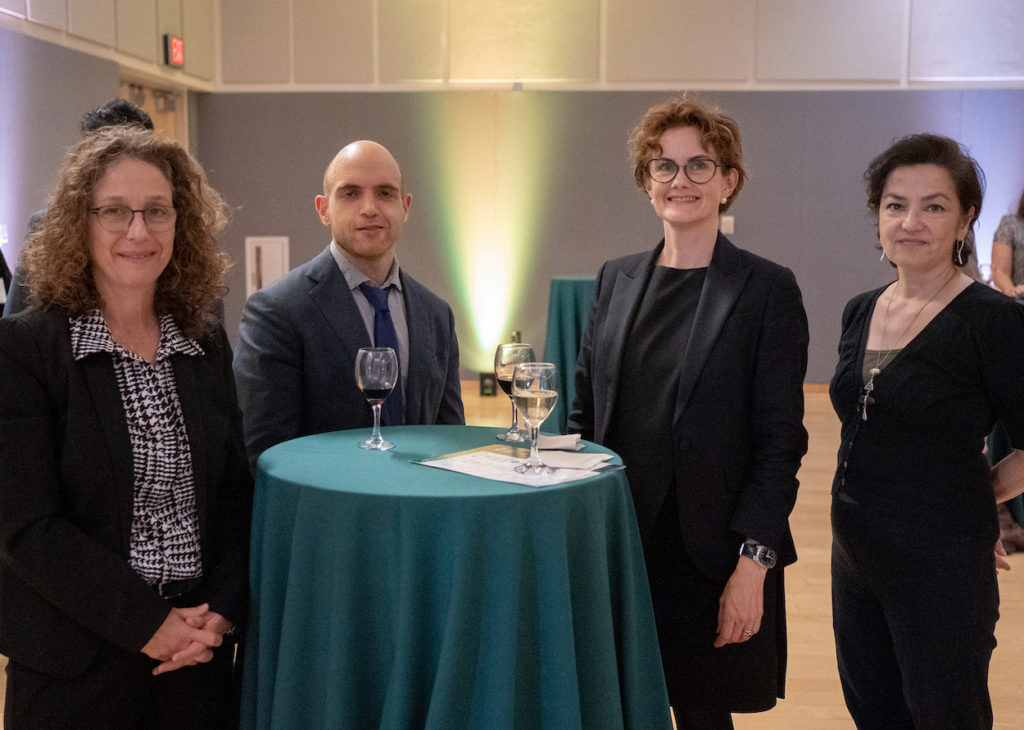
Professor Orit Fischman-Afori, Joshua Kresh, Dr. Nicola Searle, and Professor Emily Michiko Morris pose for a picture at the Fall Conference receptionProfessor Orit Fischman-Afori, C-IP2 Managing Director Joshua Kresh, Dr. Nicola Searle, and Professor Emily Michiko Morris pose together for a photo at the Fall Conference reception. / Photo credit: Dennis Le
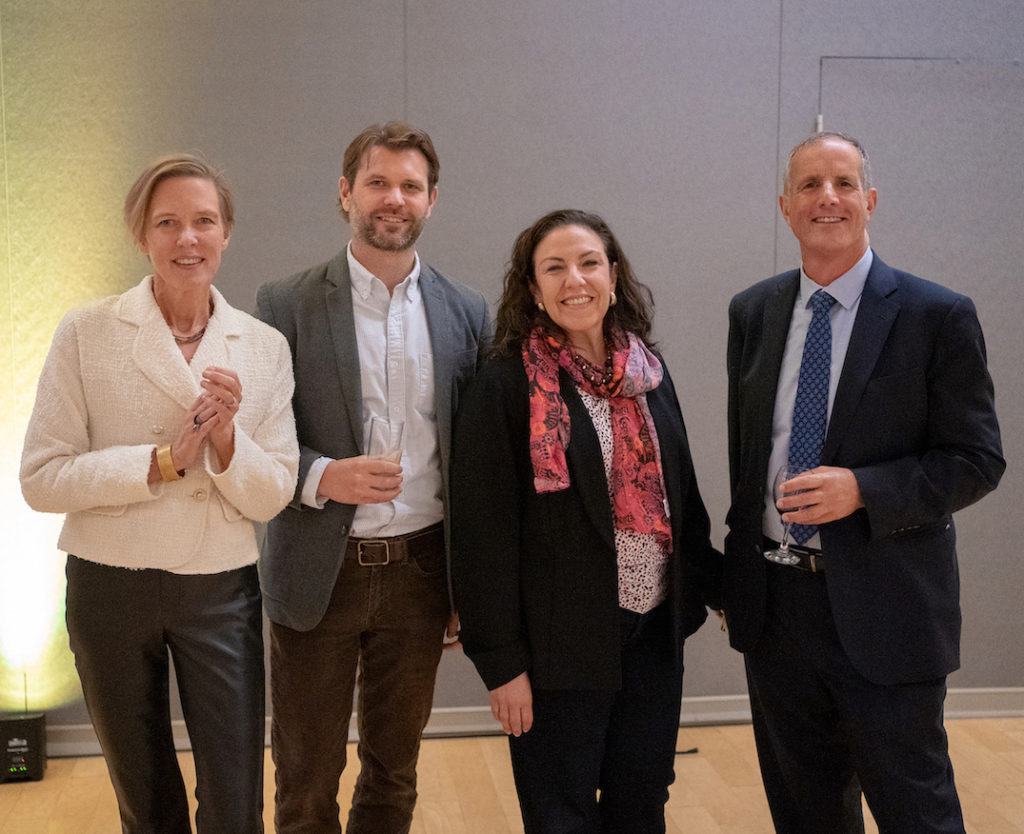
Sandra Aistars, Kevin Madigan, Victoria Sheckler, Seán O'Connor pose for a photo at the Fall Conference receptionSenior Fellow for Copyright Research Sandra Aistars; Kevin Madigan, Copyright Alliance VP, Legal Policy and Copyright Counsel and former center Deputy Director; Stephanie Semler, Supervising Attorney with the Mason Arts and Entertainment Advocacy Clinic and C-IP2 Practitioner in Residence; and C-IP2 Faculty Director Seán O’Connor pose for a picture at the Fall Conference reception. / Photo credit: Dennis Le
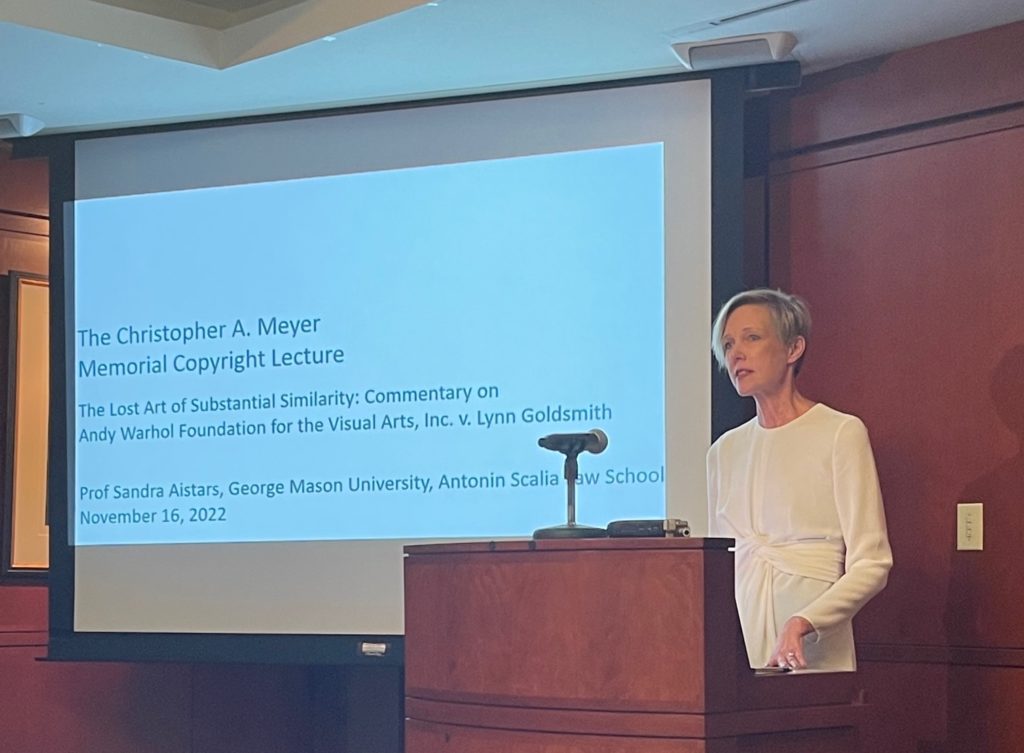
Sandra Aistars opens her 2022 Meyer Memorial Lecture at the podium in front of her slide presentationSenior Fellow for Copyright Research Sandra Aistars gives the 2022 Christopher A. Meyer Memorial Lecture at the George Washington Law School on November 16. / Photo credit: Claudia B. Delgado


C-IP2 Hosted & Co-Hosted Events

Thomas Edison Innovation Law and Policy Fellowship
On September 15-16, C-IP2 hosted the second meeting of the 2022-2023 Thomas Edison Innovation Law and Policy Fellowship. This meeting was devoted to the Edison Fellows’ presenting their draft works in progress that they researched and drafted over the summer months of 2022. Each Edison Fellow received extensive feedback during presentation sessions devoted to each draft work in progress, including specific commentary from the Distinguished Commentators. 

Vaccine Law Conference
On September 15-16, C-IP2 co-hosted and helped to sponsor the inaugural National Vaccine Law Conference at Mason Square in Arlington, VA. C-IP2 Jurist in Residence Judge Susan G. Braden served on the conference board and spoke in a breakout session entitled “Vaccine Injury Compensation Inside the NVICP.” The conference was covered in a DCBar blog post and was advertised on the Scalia Law events website.

Annual Fall Conference
On September 22-23, C-IP2 held our 2022 Annual Fall Conference, IP on the Wane: Examining the Impacts as IP Rights Are Reduced, in person at Mason Square with the Global Antitrust Institute (GAI) and the National Security Institute (NSI) as this year’s co-hosts. The conference featured a Keynote Lunch with virtual remarks from Thom Tillis, Senator for North Carolina; seven panels of experts covering several types of IP, as well as antitrust and national security; and a Special Closing Reception in recognition of the Honorable John F. Witherspoon, who is a member of C-IP2’s Advisory Board, a Professor, and Director Emeritus of Scalia Law’s Intellectual Property Program, which he ran for many years. C-IP2 was also pleased to feature the Seventh Annual Law Rocks Washington DC—a musical fundraiser for capital-area nonprofits by bands of local legal professionals—on the official conference program. The conference was recorded, and the sessions can be viewed on the conference website and C-IP2’s YouTube channel. The conference was approved for 9.5 hours of VA CLE.


News and Speaking Engagements

Dmitry Karshtedt headshotC-IP2 joins the IP community in mourning the sudden loss of George Washington Law School Professor and C-IP2 Scholar Dmitry Karshtedt. Dmitry was a talented IP scholar and a great teacher and friend to many. Below are a few posts commemorating Dmitry and his life and work.

    • On October 31, was commemorated by Jason Rantanen in a Patently-O post, “Dmitry Karshtedt”
    • On October 31, was mentioned by Scott Graham in a Law360 post, “Dead in Mid-40s: Law Professor Mourned as ‘Brilliant Scholar,’ ‘Nicest Guy in the World”
    • On November 1, was eulogized by Irina Manta in Reason Magazine’s The Volokh Conspiracy in a post entitled “In Memoriam: Dmitry Karshtedt (1977-2022)”
    • On November 14, was remembered by Caitlin Kitson in a GW Hatchet post, “Law professor and intellectual property law scholar dies at 45”

Scholarship Program Announcement: The Scalia Law Alumni September Newsletter announced, “Professor and Director Emeritus John F. Witherspoon Establishes ‘The Witherspoon Scholars Program.’ The Program will provide funding for the next 15 years, primarily to students with financial need and those interested in intellectual property, including patent law. The first Witherspoon Scholars will be announced in fall 2023.”

Good alumni news for the IP Program: Two Scalia Law IP graduates, Dawn-Marie Bey and Lucy J. Wheatley, made the Virginia Lawyers Weekly list of “Virginia’s Go To Lawyers for Intellectual Property Law.”

In its first in-person extramural tournament since March 2020, Scalia Law’s Moot Court Board won first place at the Billings, Exum & Frye National Moot Court Competition at Elon University School of Law. The Team beat 35 other teams to take top honors in arguments before North Carolina state and federal judges. They will compete in the ABA National Appellate Advocacy Contest later this winter and next spring.

2021-2022 Edison Fellow Dr. John Liddicoat had his Fellowship paper, Repositioning Generic Drugs: Empirical Findings and Policy Implications, published in the International Review of Intellectual Property and Competition Law. The paper was co-authored with Kathleen Liddell, Jonathan Darrow, Mateo Aboy, Matthew Jordan, Cristina Crespo & Timo Minssen.

Dr. Lili Yang, recipient of a Leonardo da Vinci Fellowship Research Grant, was published along with co-author Professor Jyh-An Lee in the Duke Law and Technology Review with the paper Viagra Did Not Work, but Michael Jordan Still Made It: Trademark Policy Toward the Translation of Foreign Marks in China.

On November 9, C-IP2 was mentioned in Scalia Law’s Capital Notes email digest edition on “Research: Raising Questions, Finding Answers” for the forthcoming book 5G and Beyond: Intellectual Property and Competition Policy in the Internet of Things (Cambridge University Press), a volume co-edited by C-IP2 Senior Fellow for Innovation Policy & Senior Scholar Jonathan M. Barnett and Faculty Director Seán M. O’Connor and featuring chapters by expert contributors, a number of whom spoke at C-IP2’s December 2021 academic conference on Intellectual Property and Innovation Policy for 5G and the Internet of Things, which initiated the book project. 

Along with Professor Adam Mossoff, C-IP2 Senior Fellow for Innovation Policy and Senior Scholar Professor Jonathan Barnett wrote and signed a November 30 Letter to Assistant Attorney General Jonathan Kanter on SEPs and Patent Pools. The letter was signed by 28 former judges and government officials, legal academics, and economists, including C-IP2 Advisory Board Member the Hon. Paul Michel; Senior Scholars Professor Kristina M. L. Acri, Professor Justin (Gus) Hurwitz, and Dean Kristen Osenga; and Scholar Dr. Bowman Heiden.

Faculty Director Seán M. O’Connor penned the op-ed Is the era of tech bros and techno-libertarianism over? in The Hill.

* * *

We are honored and delighted to welcome to our team of C-IP2 affiliates the following academics and legal professionals whom we admire and with whom we look forward to working!

    • Senior Scholars: Professor Joseph Fishman, Dr. Kristina M. L. Acri née Lybecker, Professor Michael Mireles, Professor Michael Risch, Professor James Y. Stern
    • Practitioner in Residence: Dale Lazar

Dr. Kristina M. L. Acri, née Lybecker (C-IP2 Senior Scholar; John L. Knight Chair of Economics and Professor of Economics, Colorado College)

    • In October, joined C-IP2 as a Senior Scholar
    • Signed a November 30 letter (co-authored by Professors Jonathan Barnett and Adam Mossoff) to Assistant Attorney General Jonathan Kanter on SEPs and Patent Pools

Sandra Aistars (C-IP2 Senior Fellow for Copyright Research and Policy & Senior Scholar; Founding Director, Arts & Entertainment Advocacy Clinic; Clinical Professor of Law, George Mason University Antonin Scalia Law School)

    • Was cited in a September 7 article on how “Librarians and Lawmakers Want Greater Access to E-Books” by Caitlin Dewey (Stateline.org) for Governing: The Future of States and Localities
    • On September 23, moderated the panel “Copyright Under Pressure – What Phase Are We In?” at C-IP2’s Annual Fall Conference (a recording of the panel is available on YouTube, and a write-up on the panel can be found on C-IP2’s blog)
    • On October 25, joined the Copyright Society-sponsored virtual panel “Art Law: Warhol Foundation v. Goldsmith.” The other panelists were Professor Pamela Samuelson, Professor Jessica Litman, Jordana Rubel, and Professor Emily Behzadi, and the panel was moderated by musician and graduating RWU Lawstudent Jeffrey Prystowsky. This was the most attended CSUSA panel discussion to date, with over 620 pre-registrants. (A recording of the panel is available on YouTube.)
    • On October 28, spoke as a panelist for “Plenary Session 2: Andy Warhol Foundation for the Visual Arts v. Goldsmith Amici” at IIPSJ’s Mosaic IP Law and Policy Roundtable Conference
    • On November 15, Mason’s Arts & Entertainment Advocacy Clinic, which is led by Professor Aistars, collaborated with Washington Area Lawyers for the Arts (WALA) for a Legal Workshop & Clinic: Copyright in the Metaverse
    • On November 16, gave the 2022 Christopher A. Meyer Memorial Lectureat The George Washington University Law School in Washington, D.C. A recording of the lecture is available on CSUSA’s website (login in to view; you can sign up for a free account here). Click here to learn more about this prestigious lecture series, and click here to read about Professor Aistars’s 2022 lecture.
    • Directed student participation in a November 3rd online education session for Own Your Dance, a non-profit organization for choreographers 

Jonathan Barnett (C-IP2 Senior Fellow for Innovation Policy & Senior Scholar; Torrey H. Webb Professor of Law, USC Gould School of Law)

    • On September 16, presented on “Illusions of Dominance: Revisiting the Market Power Assumption in Platform Ecosystems” at the Market Structure Roundtable hosted by the International Center for Law & Economics
    • On September 23, moderated the panel “How Weak Patent Rights Distort Innovation Markets” at C-IP2’s Annual Fall Conference (a recording of the panel is available on YouTube)
    • With Professor Adam Mossoff, co-authored and signed a November 30 Letter to Assistant Attorney General Jonathan Kanter on SEPs and Patent Pools
    • Mentioned in IP Watchdog’s November 30 post “Patent Experts Urge Kanter to Reject Calls to Scrap Avanci Business Review Letter”

Chief Judge Susan G. Braden (Court of Federal Claims (Ret.); C-IP2 Jurist in Residence)

    • On September 9, attended the Federal Circuit Judicial Conference
    • On September 12-13, attended the IPWatchdog LIVE 2022 Conference in Dallas, Texas, and spoke on the September 13 panel “Injunctions and Relief in Patent Proceedings at the International Trade Commission”
    • On September 15-16, attended the Inaugural National Vaccine Law Conference and spoke on the September 15 panel “The Vaccine Court: Overview and Function”
    • On September 21, attended a Board Meeting for AI and software firm LegalSifter, Inc.
    • On September 22, attended a public meeting of USPTO Private Patent Advisory Committee
    • On October 13-14, attended and participated in ALI Advisor’s Meeting on Restatement of the Law, Copyright, in Philadelphia
    • On October 18, attended and participated in the USPTO Private Patent Advisory Committee Meeting re: 2022 Annual Report
    • On October 25-26, attended the IPWatchdog Conference on Life Science IP Developments and spoke as a panelist for “Can Price Fixing and Antitrust Liability Control Drug Prices?”
    • On October 27, took part in a FedArb planning Session on the EU Unitary Patent System
    • On October 27, spoke as a panelist on the Bayh-Dole Coalition webinar entitled “The Three-Pronged Attack on U.S. Innovation and Intellectual Property”
    • Joined the Advisory Council for the Bayh-Dole Coalition
    • The 2022 USPTO Private Patent Advisory Committee Annual Report was forwarded to President Biden on November 1. (Judge Braden was the author of the IT/AI Chapters. See https://patentsgazette.uspto.gov/week47/OG/2022PPACAnnualReport.pdf.)
    • On November 4, attended the U.S. District Court Event for former Chief Judges Thomas F. Hogan and Royce C. Lamberth
    • On November 9, attended Board of Directors Meeting for LegalSifter, Inc.
    • On November 15, attended the United Inventor Association Board of Directors Meeting
    • On November 16, attended the Supreme Court Historical Society Dinner at DACOR Bacon House
    • On November 21, participated in the Administrative Conference of the United States Meeting with Academic Advisors for the Small Patent Claims Court Study requested by Congress
    • Was quoted and recognized in IP Watchdog’s November 23 article “What IP Stakeholders are Giving Thanks for in 2022”
    • On November 27-28, attended Board of Directors Meeting for LegalSifter, Inc.

Daniel R. Cahoy (C-IP2 Senior Scholar; Robert G. and Caroline Schwartz Professor, The Pennsylvania State University’s Smeal College of Business; Research Director, Center for the Business of Sustainability)

Terrica Carrington (C-IP2 Practitioner in Residence; VP, Legal Policy and Copyright Counsel, Copyright Alliance)

    • Has been selected to receive the 2022 Inspiration Award from the IPO Education Foundation (IPOEF) at the December 9, 2022, IPO Education Foundation Awards even in Washington, D.C. (PR Newswire | Copyright Alliance)
    • On September 22- 23, attended C-IP2’s Annual Fall Conference
    • Throughout October, gave presentations on the Copyright Claims Board, the Copyright Alliance Small Claims Opt-Out Protection (SCOOP) Program, and the Copyright Alliance Initiative to Promote Diversity in Copyright (IPDC program) for several organizations:
      • October 5 – Women in Film and Video
      • October 13 – as part of the USPTO’s program on “Building an E-Commerce Presence, Session 9: Protecting Your Business: IP and the Indian Arts and Crafts Act”
      • October 19 – National Volunteer Lawyers for the Arts Retreat
      • October 20 – The ABA Copyright Litigation Committee
    • Attended the Meyer Lecture at George Washington Law School on November 16

Theo Cheng (C-IP2 Practitioner in Residence; Arbitrator and Mediator, ADR Office of Theo Cheng LLC; Adjunct Professor, New York Law School)

    • On September 8, spoke on the panel “Diversity, Equity & Inclusion in FINRA Arbitrations” as part of the Practicing Law Institute’s 2022 Securities Arbitration Program in New York City
    • On September 17, spoke on the panel “Options for Preventing, Managing and Resolving Healthcare Disputes” as part of the ABA’s 2022 Physicians Legal Issues: Healthcare Delivery & Innovation Conference that was held in Chicago
    • On September 20, spoke on the panel “Getting to Maybe: The Intersection of ADR and Adult Learning” as part of the ADR Skills Program Series sponsored by New York Law School
    • On September 21, was a panelist on the ABA Litigation Section’s webinar “Roundtable 2: Everything You Wanted to Know About Arbitration (But Were Afraid To Ask) – Exchange of Information and Discovery Issues”
    • On September 28, was a panelist on the program “Conducting an Arbitration,” which was sponsored by the Columbian Lawyers Association of the First Department in New York
    • On September 30, conducted an arbitration training program for members of the New York Law School Dispute Resolution Team
    • On October 8, was a panelist on a segment entitled “Let’s Talk Settlement: The Ins and Outs of Resolving Your Case at the Negotiating Table,” which was part of the Asian American Bar Association of New York’s Fall Conference at Fordham University School of Law. More details here.
    • On October 11, visited Professor Elayne Greenberg’s class “Mediation: Representing Clients” at St. John’s University School of Law to discuss practice points and answer questions about mediation practice
    • On October 19, was a panelist on a segment entitled “Sustainable Solutions to DEI Challenges in ADR,” which was part of the Minority Corporate Counsel Association’s Pathways to Diversity Conference at the Marriott Marquis Hotel in New York City. More details here.
    • On October 19, was also a co-presenter on mediator’s proposals at the American Arbitration Association’s Midwest Arbitrators Roundtable
    • On October 20, was a panelist on a segment entitled “The Mediator’s Toolbox: Practical and Ethical Considerations on Breaking Impasse,” which was part of the New York State Bar Association Dispute Resolution Section’s Fall Meeting at the American Arbitration Association’s midtown offices in New York City. More details here.
    • On October 27, was a co-presenter on a segment entitled “The Culturally Competent Mediator: Standards, Microaggressions & Cultural Context,” which was part of the New Jersey Association of Professional Mediators’ “Improving Mediation Outcomes Through Cultural Competency” program that was presented to Maryland court personnel
    • In November 2022, his latest Resolution Alley column, entitled “Considering ADR for Trusts and Estates Disputes,” was published in the New York State Bar Association Entertainment, Arts & Sports Law Journal. Resolution Alley is a regular column Mr. Cheng writes that addresses the use of ADR in the entertainment, arts, and sports industries. (The piece can be read here on LinkedIn)
    • On November 1, was a guest lecturer in the Arts & Entertainment Law Clinic at the University of Detroit Mercy School of Law where he discussed alternative dispute resolution and, in particular, the out-of-court resolution of copyright disputes
    • On November 5, was a featured speaker at the 29th Annual Conference of the New Jersey Association of Professional Mediators. The title of his talk was “Becoming a Master Mediator: The Path to Excellence.”
    • On November 11, was a panelist on a program sponsored by the Silicon Valley Arbitration and Mediation Center entitled “Should Technology Cases Have Special Arbitration Rules?”
    • On November 13, was a panelist on a program sponsored by the American Arbitration Association as part of its Diverse Student ADR Summit entitled “Perspectives From the Trenches – Part 3: ADR Professionals.” 

Eric Claeys (C-IP2 Senior Fellow for Scholarly Initiatives & Senior Scholar; Professor of Law, George Mason University Antonin Scalia Law School)

Lolita Darden (C-IP2 Scholar; Visiting Associate Clinical Professor and Director, Intellectual Property and Technology Clinic, The George Washington University Law School)

    • On October 28, spoke as a panelist for a discussion about Andy Warhol Foundation for the Visual Arts v. Goldsmith Amici and as a moderator for the panel “Traditions or Traps? Patent Inventor Access under Review” at IIPSJ’s Mosaic IP Law and Policy Roundtable Conference
    • On November 18, gave a presentation on Rectifying Missed Opportunities: Expanding the Diversity in Innovation Pledge to Law Firms and Law Schools at the 2022 Santa Clara University Law School Innovator Diversity Pilots Conference 

Gregory Dolin (C-IP2 Senior Scholar; Associate Professor of Law, University of Baltimore School of Law)

    • On September 11, was mentioned in a Patently-O post by Professor Dennis Crouch entitled “Laser v. Dolin: Estoppel and the Billion Dollar Question of Whether an IPR Petition is filed “during” the IPR”
    • On September 22, spoke on the panel “How Well Does the Antitrust Approach Fit the Biopharmaceutical Space?” at C-IP2’s Annual Fall Conference (a recording of the panel is available on YouTube)

John F. Duffy (C-IP2 Senior Scholar; Samuel H. McCoy II Professor of Law and Paul G. Mahoney Research Professor of Law, University of Virginia School of Law)

Tabrez Ebrahim (C-IP2 Scholar; Associate Professor, California Western School of Law)

Jon M. Garon (C-IP2 Senior Scholar; Professor of Law and Director of the Intellectual Property, Cybersecurity, and Technology Law program, Nova Southeastern University Shepard Broad College of Law)

David Grossman (C-IP2 Practitioner in Residence; Senior Director of Technology Transfer & Industry Collaboration, Office of Technology Transfer, George Mason University)

Joseph Fishman (C-IP2 Senior Scholar; Professor of Law, Vanderbilt University Law School)

    • In November, joined C-IP2 as a Senior Scholar

Dr. Bowman Heiden (C-IP2 Scholar; Co-Director, Center for Intellectual Property (CIP), University of Gothenburg, Visiting Professor, University of California, Berkeley)

    • On September 27, participated in Sisvel’s webinar, “New Wi-Fi 6 Patent Pool & LIFT Royalty Payment Structure”
    • On September 30, spoke as a panelist on a LESI Patent & Technology Licensing Committee and 4iP Council webinar entitled “Connected Cars: New Challenges and Opportunities” (a recording of the panel is also available on YouTube)
    • In October, spoke at PatSnap’s Annual Innovation Conference, Frontier 2022
    • On October 14, was quoted by 4iP Council for #worldstandardsday

Christopher Holman (C-IP2 Senior Fellow for Life Sciences & Senior Scholar; Professor of Law, University of Missouri-Kansas City School of Law)

    • Published a piece in Patently-O on November 11 entitled “After Granting Certiorari In Enablement Case, Supreme Court Declines Opportunity To Address Written Description”

Camilla A. Hrdy (C-IP2 Scholar; Professor of Intellectual Property Law, University of Akron School of Law)

Justin (Gus) Hurwitz (C-IP2 Senior Scholar; Professor of Law, The Menard Director of the Nebraska Governance and Technology Center and the Co-Director of the Space, Cyber, and Telecommunications Law Program, University of Nebraska-Lincoln College of Law)

    • Featured as a guest speaker on Episode 421, “Congressional Session of the Living Dead,” of The Cyberlaw Podcast (a September 12 write-up of the episode by Stewart Baker is available at Reason)
    • Featured as a guest speaker on Episode 424, “Big Tech’s Chickens Coming Home to Roost,” of The Cyberlaw Podcast (an October 4 write-up of the episode by Stewart Baker is available at Reason and on the LawFare blog)
    • On October 14, spoke at a conference on The Administration of Antitrust: The FTC and the Rule of Law, hosted by the Boyden Gray Center and co-hosted by the Global Antitrust Institute
    • Featured in the November 23 podcast episode “The FTC’s Litigation: In Court and In-House,” hosted by Gray Matters
    • Signed a November 30 (co-authored by Professors Jonathan Barnett and Adam Mossoff) to Letter to Assistant Attorney General Jonathan Kanter on SEPs and Patent Pools

Hon. Prof. F. Scott Kieff (C-IP2 Senior Scholar; Fred C. Stevenson Research Professor, The George Washington University Law School)

    • Was quoted in GW’s Hatchet November 14 article “Law professor and intellectual property law scholar dies at 45”
    • Was quoted in IP Watchdog’s November 17 article “Advice from the SEP Masters: Rely on the Data, Engage with Courts and Regulators, Be Wary of Calls for Special Tribunals” 

Joshua Kresh (C-IP2 Managing Director)

Dale Lazar (C-IP2 Practitioner in Residence; Director, Patent Program, Innovation Law Clinic)

    • Joined C-IP2 as a Practitioner in Residence
    • Works with clients and students as Director of the Patent Program for the Innovation Law Clinic of George Mason University Antonin Scalia Law School
    • Participated in the planning committee for the 18th Annual Advanced Patent Law Institute co-hosted by The University of Texas School of Law and George Mason University Antonin Scalia Law School

Dr. John Liddicoat (C-IP2 Scholar; Senior Research Associate and Affiliated Lecturer, Faculty of Law, University of Cambridge)

    • Co-organized and spoke on “Designing Empirical Studies in Law” at the European Policy on Intellectual Property (EPIP) PhD Workshop 2022, which was held September 14-16 (Faculty of Law, University of Cambridge, Cambridge, UK)
    • Co-organized and presented “Repositioning Generic Drugs: Empirical Findings and Policy Implications” and “Has the EU Incentive for Drug Repurposing been Effective? An Empirical Analysis” in the September 16 CeBIL Symposium 2022 on Intellectual Property & Drug Repurposing: New Frontiers(Newnham College, University of Cambridge, Cambridge, UK)
    • In October, was invited to a Roundtable hosted by ‘Repurposing of Medicines 4All’, a new European Platform for Medicines Repurposing, funded by the European Commission. The focus of the roundtable was on the Platform’s philosophy, vision, mission, and operational principles.
    • 2021-2022 Edison Fellowship paper, Repositioning Generic Drugs: Empirical Findings and Policy Implications, was published in the International Review of Intellectual Property and Competition Law

Erika Lietzan (C-IP2 Senior Scholar; William H. Pittman Professor of Law & Timothy J. Heinsz Professor of Law, University of Missouri School of Law)

    • Was a contributor in The Oxford Handbook of Comparative Health Law (eds. David Orentlicher and Tamara K. Hervey), published September 28
    • Was quoted in the Medical Xpress November 3 article “Are drug companies the villain? New study questions claims of ‘evergreening”

Daryl Lim (C-IP2 Senior Scholar; H. Laddie Montague Jr. Chair in Law; Associate Dean for Research and Innovation; Founding Director, Intellectual Property Law and Innovation Initiative; and co-hire, Institute for Computational and Data Sciences, Penn State University)

    • In October 22, was mentioned in Penn State Dickinson Law article “Professor Daryl Lim Publishes Article In Indiana University Mauer School of Law’s IP Theory Journal” (Professor Lim’s article is entitled Life after Google v. Oracle: Three Reflections on a Theme)
    • In November, moderated the panel “Cybersecurity and Data Security: What Every Lawyer Should Know,” hosted by Penn State Dickinson Law

Irina D. Manta (C-IP2 Senior Scholar; Professor of Law, Hofstra University School of Law)

    • On October 19, took part in a virtual conversation about “Engendering Trust in Election Outcomes,” which was hosted by Elon University School of Law

Hina Mehta (C-IP2 Practitioner in Residence; Director, Office of Technology Transfer, George Mason University)

    • In 2022, was recognized by the AmeriCorps and the Office of the U.S. President with a Presidential Lifetime Achievement Award for volunteer service, signed by President Biden 

Michael Mireles (C-IP2 Senior Scholar; Professor of Law and Director, Intellectual Property Certificate Concentration, University of the Pacific McGeorge School of Law)

    • In September, joined C-IP2 as a Senior Scholar
    • On September 22- 23, attended C-IP2’s Annual Fall Conference

Emily Michiko Morris (C-IP2 Senior for Life Sciences and Scholar; C-IP2 2021-2022 Edison Fellow; David L. Brennan Endowed Chair, Associate Professor, and Associate Director of the Center for Intellectual Property Law & Technology, University of Akron School of Law)

    • On September 23, moderated the panel “How Well Does the Antitrust Approach Fit the Biopharmaceutical Space?” at C-IP2’s Annual Fall Conference (a recording of the panel is available on YouTube)
    • Was quoted in a September 27 in Bloomberg Law article “Gray Areas in Patent Review Denials Catch Agency Director’s Eye” by Kelcee Griffis
    • Wrote an October 14 letter to the U.S. Congress’s Senate Judiciary Committee and Subcommittee on Intellectual Property in favor of the Patent Eligibility Restoration Act of 2022

Lateef Mtima (C-IP2 Senior Scholar; Professor of Law, Howard University School of Law; Founder and Director, Institute for Intellectual Property and Social Justice (IIPSJ))

Loren Mulraine (C-IP2 Senior Scholar; Professor of Law, Director of Music and Entertainment Law Studies, Belmont University – College of Law)

    • On December 12, gave a presentation on film and television tax incentives at a CLE event for the Nashville Bar Association year end Entertainment and Sports CLE program 

Christopher M. Newman (C-IP2 Scholar; Associate Professor of Law, George Mason University Antonin Scalia Law School)

Seán M. O’Connor (C-IP2 Faculty Director; Faculty Director, Innovation Law Clinic; Professor of Law, George Mason University Antonin Scalia Law School)

    • Presided over C-IP2’s Annual Fall Conference on September 22-23 and gave remarks during the September 23 conference reception in recognition of the Honorable John F. Witherspoon
    • On October 13, moderated the panel on “Global Tech Trends: Africa, China, Europe, Latin America and Russia” at the Fifth Annual International IP Summit, which was hosted at Boston College Law by Ropes & Gray
    • On October 17, gave a lecture entitled “What Does it Mean to Own Virtual Things?: Non-Fungible Tokens (NFTs), Video Games, and the Metaverse” at Mason Korea as part of the Mason Korea Distinguished Lecture Series
    • On November 15, delivered a virtual lecture—entitled “Determining the Composition: Songwriting, Music Copyright and Technology”—to National Chengchi University (NCCU) in Taiwan as part of an academic course of Media and Entertainment Law in the Digital Age

Kristen Jakobsen Osenga (C-IP2 Senior Scholar; Associate Dean of Academic Affairs, Austin E. Owen Research Scholar and Professor of Law, University of Richmond School of Law)

    • Signed a November 30 (co-authored by Professors Jonathan Barnett and Adam Mossoff) to Letter to Assistant Attorney General Jonathan Kanter on SEPs and Patent Pools

Yogesh Pai (C-IP2 Scholar; Assistant Professor, National Law University Delhi (NLUD); Co-Director, Centre for Innovation, Intellectual Property and Competition at NLUD)

    • On October 27, was mentioned in Livelaw News Networks’ post “IJIEL Blog: Call for Submissions On A Rolling Basis”

Michael Risch (C-IP2 Senior Scholar; Vice Dean and Professor of Law, Villanova University Charles Widger School of Law)

    • Professor Risch’s 2011 George Mason Law Review article, A Surprisingly Useful Requirement, was cited in a September 9 Patently-O article on “Utility and Eligibility” by Professor Dennis Crouch
    • Served as a Distinguished Commentator during the second meeting of the 2022-2023 Thomas Edison Innovation Law and Policy Fellowship on September 15-16
    • Was quoted in the October 11 Insurance Journal article “Uber Executive/s Conviction Puts Spotlight on Secrecy About Hacking” by Jack Gillum; the article was also syndicated by Bloomberg
    • In October, gave a presentation entitled “Worse than Human?” as part of the Villanova University Falvey Library Speaker Series

Alexandra Jane Roberts (C-IP2 Senior Fellow for Trademarks; Professor of Law and Media, Northeastern University School of Law)

    • In September, served as a commentator for Professor Sarah Burstein’s paper “Uncreative Designs” as part of Northeastern University School of Law’s 2022-2023 Faculty Colloquia Series
    • Was quoted extensively in the September 13 Yahoo!/Sportico article entitled “Luka Dončić Embroiled in Unusual Trademark Dispute With His Mother” by Michael McCann
    • Participated as a commentator at the Suffolk Law IP Center’s Fourth Annual Intellectual Property & Innovation Conference at Suffolk University Law School on September 30-October 1
    • Was quoted in an October 4 Digiday article about Kim Kardashian and the SEC
    • Was quoted in the Daily Dot in an October 13 article by Grace Stanley entitled “Bethenny Frankel sends TikTok creator Meredith Lynch a cease and desist, sparking debate”
    • On October 20, have a presentation on “The Poetics of Trademark Law” as part of the University of New Hampshire Franklin Pierce School of Law’s IP Speaker Series
    • Presented “Multi-Level Lies” at UNH Law’s 2022 Annual Academic IP Roundtable on October 20-21
    • Was quoted in an October 20 Washington Post article by Ben Brasch entitled “Barilla customers sue because ‘Italy’s #1 Brand of Pasta’ is made in U.S.”
    • Was quoted by Grace Stanley in an October 5 Daily Dot article as well as in a post in its newsletter, Passionfruit, for a piece entitled “TikToker says her video was used in Refy Beauty ad without her permission, sparking debate”
    • Was quoted in The Fashion Law on Kanye West and morals clauses
    • Was quoted in VOA Learning English on how students should use Twitter
    • Was quoted in Law360 on the class action lawsuit against FTX and celebrity endorsers
    • Was quoted in ReutersABA Journal, and Bloomberg on potential litigation over blue-check impersonation on Twitter
    • Was referenced as a source in a Washington Post article about a false advertising lawsuit against Barilla for marketing itself as “Italy’s #1 Pasta Brand”
    • Gave a talk in the music department of Northeastern’s College of Arts, Media & Design

Keith Robinson (C-IP2 Senior Scholar; Professor of Law, Wake Forest University School of Law)

Zvi S. Rosen (C-IP2 Scholar; Assistant Professor of Law, Southern Illinois University School of Law)

    • On October 12, presented his article Examining Copyright (forthcoming) as part of the George Washington University Law School Speaker Series
    • Also on October 12, hosted the webinar “Courthouse Steps Oral Argument: Andy Warhol Foundation for the Visual Arts, Inc. V. Goldsmith

Mark F. Schultz (C-IP2 Senior Scholar; Goodyear Tire & Rubber Company Chair in Intellectual Property Law, University of Akron School of Law; Director, Center for Intellectual Property Law and Technology)

Amy Semet (C-IP2 Scholar; Associate Professor, University at Buffalo School of Law)

    • Participated in the Suffolk Law IP Center’s Fourth Annual Intellectual Property & Innovation Conference at Suffolk University Law School on September 30-October 1

Dr. Stephanie M. Semler (C-IP2 Practitioner in Residence; Adjunct Professor, George Mason University, Antonin Scalia Law School; Supervising Attorney, Arts & Entertainment Advocacy Clinic)

Ted Sichelman (C-IP2 Senior Scholar; Professor of Law, University of San Diego School of Law; Director, Center for Intellectual Property Law & Markets; Founder & Director, Center for Computation, Mathematics, and the Law; Founder & Director, Technology Entrepreneurship and Intellectual Property Clinic)

Eric M. Solovy (C-IP2 Practitioner in Residence; Partner, Sidley Austin LLP)

    • On September 11, presented at the 2022 AIPPI World Congress in San Francisco, CA on the panel “Pharma I: IP and COVID-19 – Two Years Later”
    • In late October, represented the Sidley Emerging Enterprises Pro Bono Program at the International Trade Centre’s (ITC) SheTrades and UPS Women Exporters Programme: “Working together with Mexico’s Secretaría de Economía, UPS, Mercado Libre, and the ITC, we provided hands-on training to Mexican women-led small businesses on essential topics for accessing new markets. My presentation focused on the importance of IP rights, the USMCA, and overall export strategy.” – via LinkedIn

James Y. Stern (C-IP2 Senior Scholar; Professor of Law, William & Mary Law School)

    • In October, joined C-IP2 as a Senior Scholar

Toshiko Takenaka (C-IP2 Scholar; Washington Research Foundation/W. Hunter Simpson Professor of Technology Law, University of Washington School of Law)

    • On November 3, spoke at IAM Live: AI IP Europe 2022
    • On November 7, participated in Université Toulouse 1 Capitole’s conference Rethinking the Impact of Artificial Intelligence on Patent Law

Saurabh Vishnubhakat (C-IP2 Senior Scholar; Professor of Law, Yeshiva University Benjamin N. Cardozo School of Law)

    • On October 19, joined a conversation with other new faculty at Cardozo Law as part of the Intellectual Property & Information Law Fall 2022 Speaker Series
    • In November, spoke at UNH Franklin Pierce School of Law’s 2022/2023 Intellectual Property (IP) Speaker Series
    • On November 9, moderated a fireside chat with Katherine E. Lewis (Partner and Director of Innovative Ventures, Meister Seelig & Fein LLP) at Cardozo Law as part of the Intellectual Property & Information Law Fall 2022 Speaker Series

Scholarship & Other Writings

Mary Catherine Amerine, The fragility of freelancing: The impact of copyright law on modern journalism, in The Subjects of Literary and Artistic Copyright (eds. Enrico Bonadio and Cristiana Sappa) (Edward Elgar 2022)

Jonathan M. Barnett, The case against the FTC, The Hill (October 3, 2022)

Jonathan M. Barnett, The End of Reason at the FTC, Truth on the Market (November 14, 2022)

Jonathan M. Barnett, How patents facilitate market entry and promote competition, IAM (06 July 2022)

Jonathan Barnett, Illusions of Dominance?: Revisiting the Market Power Assumption in Platform Ecosystems (October 26, 2022). USC CLASS Research Paper No. CLASS22-29, USC Law Legal Studies Paper No. 22-29

Jonathan M. Barnett, Taking Cost-Benefit Analysis Seriously in Consumer-Data Regulation, Truth on the Market (September 12, 2022)

Daniel R. Cahoy, Trademark’s Grip Over Sustainability (March 15, 2022). University of Colorado Law Review, Vol. 94, No. 4, Forthcoming

Theo Cheng, “Considering ADR for Trusts and Estates Disputes,” 33 New York State Bar Association Entertainment, Arts & Sports Law Journal 3: 12-14 (2022) [viewable here on LinkedIn]

Cala Coffman, C-IP2 2022 Fall Conference Panel Discusses Copyright Under Pressure, C-IP2 Blog (October 26, 2022)

Thomas D. Grant & F. S. Kieff, Appointing Arbitrators: Tenure, Public Confidence, and a Middle Road for ISDS Reform, 43 MICH. J. INT’L L. 171 (2022). Available at: https://repository.law.umich.edu/mjil/vol43/iss1/5

Steve Harris, Suzanne Harrison, and Bowman Heiden, How European countries compare on gender diversity in inventorship, IAM (September 15, 2022)

Chris Holman, “After Granting Certiorari In Enablement Case, Supreme Court Declines Opportunity To Address Written Description,” Patently-O (November 11, 2022)

Camilla Hrdy, Gersen & Hempill: What’s in a Bottle?, Written Description (October 21, 2022)

Camilla Hrdy, Morten Follow-Up: What Do Federal Agencies’ Enabling Statues Say About Their Power to Disclose Trade Secrets?, Written Description (September 6, 2022)

Camilla Hrdy, The Value in Secrecy, Fordham Law Review (November 1, 2022)

Camilla Alexandra Hrdy and Daniel Harris Brean, The Patent Law Origins of Science Fiction (December 1, 2022)

Gus Hurwitz, FTC Could Soon Face High Court Reprimand, Real Clear Policy (October 11, 2022)

Jyh-An Lee and Lili Yang, Viagra Did Not Work, but Michael Jordan Still Made It: Trademark Policy Toward the Translation of Foreign Marks in China (September 6, 2022). Duke Law & Technology Review, Vol. 20, No. 1, 2022, The Chinese University of Hong Kong Faculty of Law Research Paper No. 2022-36

Johnathon Liddicoat, Kathleen Liddell, Jonathan Darrow, et al. Repositioning Generic Drugs: Empirical Findings and Policy Implications, IIC (2022)

Erika Lietzan and Kristina M.L. Acri née Lybecker and Evan Weidner, The Case of the Missing Device Patents, or: Why Device Patents Matter (September 19, 2022). Fordham Intellectual Property, Media & Entertainment Law Journal, Vol. 33, Forthcoming, University of Missouri School of Law Legal Studies Research Paper, Forthcoming

Erika Lietzan and Kristina M.L. Acri née Lybecker, Solutions Still Searching for a Problem: A Call for Relevant Data to Support “Evergreening” Allegations (September 26, 2022). Fordham Intellectual Property, Media & Entertainment Law Journal, Vol. 33

Daryl Lim (2022) “Life After Google v. Oracle: Three Reflections on a Theme,” IP Theory: Vol. 12: Iss. 1, Article 3.

Irina Manta, In Memoriam: Dmitry Karshtedt (1977-2022), The Volokh Conspiracy (November 1, 2022)

Loren E. Mulraine, Unintended Repercussions: Copyright Termination and the Punitive Effect of 17 U.S.C. §203(a)(3) on the Rights of Creators, 22 UIC Rev. Intell. Prop. L. 23 (2022)

Seán M. O’Connor, Is the era of tech bros and techno-libertarianism over?, The Hill (November 14, 2022)

Kristen Osenga, Column: Are “patent thickets” to blame for high drug prices?, Richmond Times Dispatch (November 30, 2022)

Michael Risch, From Patents to Secrets (September 29, 2022). Research Handbook On Empirical Studies In Intellectual Property Law (Edward Elgar Publishing, Estelle Derclaye ed. Forthcoming 2022)

Zvi Rosen, What’s at Stake in Andy Warhol Foundation for the Visual Arts, Inc. V. Goldsmith, FedSoc Blog (October 4, 2022)

Saurabh Vishnubhakat and Dave Fagundes, The Coming Copyright Judge Crisis (September 12, 2022). New York University Law Review Online, Vol. 98, Forthcoming

Mark Schultz and Philip Stevens, Five reasons the TRIPS waiver should not be expanded to covid therapeutics, Geneva Network (October 5, 2022)


Categories
Patents Pharma

Policy Brief: The TRIPS Waiver for COVID-19 Vaccines, and Its Potential Expansion: Assessing the Impact on Global IP Protection and Public Health

This policy brief, including the following “Introduction and Executive Summary,” comes from Eric M. Solovy.

CLICK HERE to read the brief in full.

Overlaid images of pills, a gloved hand of someone expecting a pill, and an eyedropperIntroduction and Executive Summary

On June 17, 2022, in the early morning hours of the final day of the World Trade Organization’s (“WTO”) 12th Ministerial Conference, the Members of the WTO adopted a waiver of the Agreement on Trade Related Aspects of Intellectual Property Rights (“the TRIPS Agreement”), commonly known as the “TRIPS Waiver for COVID-19 Vaccines” or the “TRIPS Waiver.”[1]  The TRIPS Waiver, with its primary focus on compulsory licensing of patents (i.e., licensing without the authorization of the patent owner) that are “required for the production and supply of COVID-19 vaccines,” reflected a compromise position among WTO Members.[2]  The initial proposal advanced by India and South Africa, on October 2, 2020, would have gone much further, authorizing WTO Members to waive the substantive and enforcement-related provisions of the TRIPS Agreement not only for patents but also for copyrights, industrial designs, trade secrets, and test data protection; moreover, the original proposal would have gone far beyond COVID-19 vaccines, to cover intellectual property (“IP”) “in relation to prevention, containment or treatment of COVID-19.”[3]

The debate over the TRIPS Waiver began at a time when the development of the first COVID-19 vaccines was already nearing completion.  To wit, the Pfizer-BioNTech COVID-19 Vaccine received emergency use authorization from the U.S. Food & Drug Administration (“FDA”) on December 11, 2020 – i.e., just two months after India and South Africa had submitted their original TRIPS waiver proposal.[4]  Yet, at the same time that certain countries began attacking IP rights as an obstacle to addressing the pandemic, it was already well understood that the rapid development of COVID-19 vaccines, therapeutics, and diagnostics would not have been possible but for the billions of dollars in private investments, over the course of many years, in technologies that were incentivized by strong IP protection.[5]  It is no coincidence that the first COVID-19 vaccines were developed in industrialized countries that offer strong IP protection – protection that provided the incentives necessary for private investors to take the huge risks required when researching revolutionary technologies.[6]

For example, although mRNA was discovered in 1961, it took many years of research, at huge expense and great risk, to create the mRNA-based technology used in COVID-19 vaccines.[7]  BioNTech’s Dr. Sahin and Dr. Tureci, a married couple, had been working on mRNA technology for more than 25 years, without any successful commercial applications prior to developing their COVID-19 vaccine.[8]  To take another example, before going public in 2018 with its mRNA technology, Moderna had raised USD 2.6 billion in investments and partnership funding, along with USD 600 million raised in an IPO.[9]  At the time of its IPO, Moderna was spending hundreds of millions of dollars a year, reporting in September 2018 that it “had an accumulated deficit of $865.2 million.”[10]  This scale of private investment in a venture as risky as these ground-breaking new technologies would simply have been impossible but for the upside potential offered by the promise of IP rights over any resulting therapeutics or vaccines and, in turn, the potential to recoup returns on those investments.  Further, the assurance that IP rights would be honored and, where necessary, enforced, in multiple countries enabled the creators of vaccines to enter into voluntary licensing agreements with enterprises around the world for the manufacture and distribution of the vaccines, making them rapidly available throughout the world.[11]

Since the inception of the TRIPS Agreement nearly thirty years ago, there have been voices calling for its dilution.  The ongoing COVID-19 pandemic amplified some of these voices.  Ignoring the role of IP in the creation of COVID-19 vaccines (and diagnostic and therapeutic products), many governments bought into the narrative claims that protection of IP rights obstructs access to important vaccines and therapeutic products.  In making this argument, they conveniently put to the side the multitude of trade, regulatory and logistical barriers that clearly prevented vaccines from quickly going into arms in a number of developing countries.[12]  At the same time, some have argued that certain countries viewed the pandemic, and a TRIPS waiver in particular, as a strategic opportunity to get access to next generation technologies that would provide benefits to their domestic economies long after the COVID-19 pandemic ends.[13]

Upon the announcement and public release of the terms of the TRIPS Waiver, the reactions were, not surprisingly, mixed.  They were generally aligned with the long-term views of international IP rights that had been consistently expressed by countries, activists, and industry since the inception of the TRIPS Agreement.

For those countries and activists that have long advocated against IP protection for pharmaceutical products, they characterized the TRIPS Waiver as a compromise that did not go far enough but that nevertheless served to validate (in their view) that they had been right all along about the relationship between IP protection and global health.  For example, Médecins Sans Frontières (“MSF”) expressed disappointment that the scope of the TRIPS Waiver was not as broad as the original proposal but then went on to question whether patent protection is ever appropriate for pharmaceutical products, calling “on governments to take concrete steps to rethink and reform the biomedical innovation system to ensure that lifesaving medical tools are developed, produced and supplied equitably where monopoly-based and market-driven principles are not a barrier to access.”[14]

For those who, in record time, created and produced the revolutionary vaccines, diagnostics, and therapeutics that have enabled families and businesses around the world to begin returning to normal, the TRIPS Waiver was understood as a threat to IP rights, to the incentives they create, and ultimately, to innovation itself.  As the U.S. Chamber of Commerce stated in advocating against a TRIPS waiver:

Waiving intellectual property rights would only hobble the innovation that is critical to improving lives and raising living standards globally.  If enacted, this move would set an unfortunate precedent and may limit innovative companies’ ability to devote unprecedented resources to quickly discover and deliver solutions for the next global crisis, be it pandemic, food security, or climate-related.[15]

There are currently calls for a further expansion of this waiver, both in terms of duration and product scope.  As explained below, any expansion of the waiver could deal an additional blow to incentives to biopharmaceutical innovation, which would, in turn, compromise our ability to deal with future public health emergencies (as well as possible future variants of COVID-19).

When WTO Members gather in Geneva, Switzerland, to decide, pursuant to the direction in paragraph 8 of the TRIPS Waiver, whether the waiver should be “extend[ed] to cover the production and supply of COVID-19 diagnostics and therapeutics,” it is important to take a step back from the public rhetoric and evaluate the TRIPS Waiver in view of its actual text, as well as the text of the provisions of the TRIPS Agreement that it waives and/or purports to “clarify.”

In Part II, below, this paper briefly discusses the evolution of global IP protection and why a multilateral treaty such as the TRIPS Agreement is absolutely essential to incentivizing R&D in an increasingly globalized economy.  Part III then offers a summary of the legal content of the TRIPS Waiver.  Part IV places the TRIPS Waiver into its proper context in the WTO system, explaining the legal nature of a waiver as a matter of WTO law.

Next, in Part V, I turn to the potential impact of the TRIPS Waiver.  After first noting that no WTO Member has given notice of an intent to make use of the TRIPS Waiver since its inception over five months ago, I explain (in Part V(A)) that, by creating uncertainty as to the value of pharmaceutical patents, the TRIPS Waiver may serve to decrease the incentives to innovation created by the patent system, to the detriment of global public health.  Part V(B) highlights how, in contrast to the mechanism set out in Article 31bis of the TRIPS Agreement, the failure to include tracking, tracing, and detailed transparency requirements in the TRIPS Waiver could lead to diversion of vaccines, which would be counterproductive to the stated intent of the TRIPS Waiver.

Part V(C) considers the potential harm that may arise if WTO Members rely on one of the so-called “existing good practices,” as referenced by the TRIPS Waiver, for determining remuneration to a patent owner whose patent is compulsorily licensed.  In Part V(D), I consider the potential impact of the provision of the TRIPS Waiver addressing regulatory data protection, a type of IP right distinct from patents which provides important incentives to bring new pharmaceutical technologies to market.  Part V(E) considers the public debate, particularly in the United States, surrounding the possible impact of the TRIPS Waiver on the global competitiveness of certain WTO Members.

Finally, Part VI considers how the proposed expansion of the product scope of the TRIPS Waiver to COVID-19 diagnostics and therapeutics (as not yet defined) could serve to create uncertainty for a much larger group of patent owners and, in turn, further reduce incentives for innovation, to the detriment of global public health.  It would do so at a time when R&D is rapidly progressing in preparation for new variants of COVID-19 and ultimately for the next pandemic.

CLICK HERE to read the brief in full.


[1] See Ministerial Decision on the TRIPS Agreement, WTO Doc. WT/MIN(22)/30 (Jun. 22, 2022), available at: https://docs.wto.org/dol2fe/Pages/SS/directdoc.aspx?filename=q:/WT/MIN22/30.pdf&Open=True (“TRIPS Waiver”).

[2] Id. at ¶ 1.

[3] TRIPS Council, Communication to the TRIPS Council from India and South Africa, Waiver from Certain Provisions of the TRIPS Agreement for the Prevention, Containment and Treatment of COVID-19, Annex at ¶ 1, WTO Doc. IP/C/W/669 (October 2, 2020).

[4] Press Release, U.S. Food & Drug Admin., FDA Approves First COVID-19 Vaccine(Aug. 23, 2021), available at https://www.fda.gov/news-events/press-announcements/fda-approves-first-covid-19-vaccine#:~:text=The%20first%20EUA%2C%20issued%20Dec,trial%20of%20thousands%20of%20individuals.

[5] Eric M. Solovy, The Doha Declaration at Twenty: Interpretation, Implementation, and Lessons Learned on the Relationship Between the TRIPS Agreement and Global Health, 42 Nw J. Int’l L. & Bus. 253 (2022), at 289-296, available at https://jilb.law.northwestern.edu/issues/?vol=vol%2042%20-%20issue%202.

[6] See Bojan Pancevski & Jared Hopkins, How Pfizer Partner BioNTech Became a Leader in Coronavirus Vaccine Race, Wall Street Journal (Oct. 22, 2020), https://www.wsj.com/articles/how-pfizer-partner-biontech-became-a-leader-in-coronavirus-vaccine-race-11603359015.

[7] See Elie Dolgin, The Tangled History of mRNA Vaccines, Nature (Sept. 14, 2021), https://www.nature.com/articles/d41586-021-02483-w.

[8] See Pancevski & Hopkins, supra note 6; see also David Gelles, The Husband-and-Wife Team Behind the Leading Vaccine to Solve Covid-19, New York Times (Nov. 10, 2020), https://www.nytimes.com/2020/11/10/business/biontech-covid-vaccine.html.

[9] See Moderna, Inc., U.S. Securities and Exchange Commission filing (Amendment No. 1 to Form S-1 Registration Statement), November 28, 2018, at i, 1.

[10] Id. at 20.

[11] See, e.g., Guilherme Cintra, Is an extension of the TRIPS waiver needed for COVID-19 tools?, Global Health Matters, IFPMA (Oct. 15, 2022), available at https://www.ifpma.org/global-health-matters/is-an-extension-of-the-trips-waiver-needed-for-covid-19-tools/; see also COVID-19 vaccines and treatments output continues apace, IFPMA (Apr. 13, 2022), available at https://www.ifpma.org/resource-centre/covid-19-vaccines-and-treatments-output-continues-apace-as-health-systems-and-last-mile-hurdles-remain-collective-stumbling-blocks/ (“The COVID-19 vaccine manufacturing scale-up has seen 372 partnerships forged, of which 88% (329) include technology transfer or fill & finish. 51 manufacturing and production agreements were made in developing countries (LICs and LMICs).”).

[12] See Indicative List of Trade-Related Bottlenecks and Trade-Facilitating Measures on Critical Products to Combat COVID-19, WTO Information Note (July 20, 2021), available at  https://www.wto.org/english/tratop_e/covid19_e/bottlenecks_report_e.pdf.

[13] See Shayerah I. Akhtar, Cong. Rsch. Serv., R47231, World Trade Organization: “TRIPS Waiver” for COVID-19 Vaccines (2022), at 13.

[14] Lack of a real IP waiver on COVID-19 tools is a disappointing failure for people, Médecins Sans Frontières (Jun. 17, 2022), available at https://www.msf.org/lack-real-ip-waiver-covid-19-tools-disappointing-failure-people (asserting that “we are disappointed that a true intellectual property waiver, proposed in October 2020 covering all COVID-19 medical tools and including all countries, could not be agreed upon, even during a pandemic that has claimed more than 15 million people’s lives.”).

[15] Press Release, U.S. Chamber of Commerce, Proposal at WTO to Waive Intellectual Property Would Set Harmful Precedent (Jun. 15, 2022), available at https://www.uschamber.com/intellectual-property/proposal-at-wto-to-waive-intellectual-property-would-set-harmful-precedent; see also, e.g., Press Release, PhRMA, PhRMA Statement on the TRIPS Waiver Agreement (Jun. 17, 2022), available at https://phrma.org/resource-center/Topics/Trade/PhRMA-Statement-on-the-TRIPS-Waiver-Agreement (stating that the COVID-19 TRIPS Waiver “undermine[s] the very intellectual property rights that enabled hundreds of collaborations to produce the COVID-19 vaccines on a global scale.”).

Categories
Conferences Copyright

C-IP2 2022 Fall Conference Panel Discusses Copyright Under Pressure

The following post comes from Cala Coffman, a 2L at Scalia Law and Research Assistant at C-IP2.

At the recent C-IP2 conference entitled IP on the Wane: IP on the Wane: Examining the Impacts as IP Rights Are Reduced, one panel discussed the current state of copyright law, the pressures it has come under in recent years, and their differing perspectives on how the digital world is shaping copyright. Topics of discussion included enforcement techniques, trends in fair use, and the impact of evolving technology on copyright.

Panelists were Clark Asay (Professor of Law at Brigham Young University J. Reuben Clark Law School), Orit Fischman-Afori (Professor of Law at The Haim Striks School of Law, College of Management Academic Studies (COLMAN)), Terry Hart (General Counsel, Association of American Publishers (AAP)), and Karyn A. Temple (Senior Executive Vice President & Global General Counsel, (Motion Picture Association)), and the session was moderated by Sandra Aistars (Clinical Professor, George Mason University, Antonin Scalia Law School; Senior Fellow for Copyright Research and Policy; and Senior Scholar at C-IP2).

Professor Fischman opened the panel by proposing a reconsideration of criminal enforcement for copyright claims. After reviewing current avenues for civil copyright enforcement, including the newly established Copyright Claims Board in the Copyright Office, Digital Millennium Copyright Act, and civil enforcement in federal court including the opportunity for statutory damages, Professor Fischman suggested that criminal copyright enforcement actions seem to be on the decline and should not be a focus of enforcement efforts. Rather, greater attention should be devoted to civil enforcement. Recently, the U.S. Sentencing Commission reported that criminal Copyright and Trademark cases have dropped from 475 cases in 2015 to 137 cases in 2021.

Over the past two decades, several enforcement mechanisms have been introduced to address the challenges authors face enforcing their copyrights in the digital world. These include the Digital Millennium Copyright Act in 1998, the Digital Theft Deterrence Act of 1999, and the Copyright Alternatives in Small-Claims Enforcement Act of 2020, which improved access to enforcement for small creators by creating a new administrative forum with simplified proceedings in the Copyright Office. Small copyright claims can be pursued there with or without the assistance of counsel. While these civil enforcement mechanisms are effective, they have not been without criticism.

Ultimately, Professor Fischman argued that the combination of civil and criminal enforcement frameworks creates a powerful enforcement mechanism for author’s rights. As we consider the current state of IP rights, criminal enforcement is becoming less meaningful overall, in her opinion.

Next, Professor Asay presented three recent empirical studies examining trends in copyright litigation.

The first study indexed fair use cases from 1991 to 2017. In this study, Professor Asay examines the scope of fair use analysis in copyright infringement cases and finds a “steady progression of both appellate and district courts adopting the transformative use paradigm, with modern courts relying on it nearly ninety percent of the time.” The study finds that at the Federal Circuit Court level, in cases where transformative use was asserted, 48% were found to be transformative, and 91% of transformative uses were found to be fair use. Professor Asay states that “fair use is copyright law’s most important defense to claims of copyright infringement,” but as courts increasingly apply transformative use doctrine, he finds that “it is, in fact, eating the world of fair use.”

The second study Professor Asay presented analyzed over 1000 court opinions from between 1978 and 2020 that used a substantial similarity analysis. In this study, Professor Asay finds first that courts rely on opinions from the Second and Ninth circuits “more than any other source in interpreting and applying the substantial similarity standard.” The study also breaks down trends within the two-step substantial similarity analysis. On the first step, Professor Asay finds that “courts mostly decide this first prong . . . as a matter of whether defendant’s had access to the plaintiff’s work, and they mostly favor plaintiffs.” On the second step, he finds “significant heterogeneity” in analyzing improper appropriation of a plaintiff’s work. He states that “no dominant means exist for resolving this question” and “the data also suggest that one of the keys to winning, for either defendants or plaintiffs, is the extent to which the court engages with and discusses copyright limitations.”

The third study, which is forthcoming, examines DMCA Section 1201 litigation. DMCA Section 1201 prohibits attempts to circumvent technological measures used to control access to a copyrighted work.17 U.S.C. § 1201. This study encompasses 205 cases and 209 opinions, and Professor Asay said during the panel that “the most interesting finding in this study is that there’s not much section 1201 litigation.” Although the DMCA has been in force for nearly twenty-five years, less than one appellate decision is made per year on average. The study also finds that “the most litigated subject matter” (over every other subject matter the study coded for) is software.

Ms. Temple discussed how new technologies, techniques, and distribution methods are constantly requiring courts to re-evaluate how authorship rights function in a digital landscape. She likewise commented on the challenges courts seem to face in appropriately drawing distinctions between derivative uses of copyrighted works that should require a license from the author, and transformative uses that are permissible under the affirmative defense of fair use.

Ms. Temple cited the numerous briefs in Andy Warhol Foundation for the Visual Arts, Inc. v. Goldsmith (including the Motion Picture Association’s) that note that the transformative use test is becoming the sole criteria courts use to determine fair use. Indeed, the MPA’s brief cited to Professor Asay’s study on transformative use (Is Transformative Use Eating the World?) to support the petitioner’s assertion that “in practice, the transformativeness inquiry is virtually always dispositive of the fair use question.” In closing, Ms. Temple stated that although we may be “waning” in how courts see fair use, Warhol presents a chance to correct the fair use analysis and steer it away from infringing on the derivative work rights of authors.

Finally, Mr. Hart presented on potential threats to authorship rights and the concomitant harms to consumer interests in the e-book arena. Mr. Hart’s perspective was that as businesses, copyright industries legitimately have profit-motivated goals, but happily, their ability to meet these goals is directly tied to the “ultimate goal” of promoting science and the useful arts and thus is beneficial to society as a whole. Mr. Hart stated that “the good news, if we think copyright [protections are] waxing, is that . . . the legal framework both in the United States and internationally recognizes [the] principles” that allow copyright owners to take advantage of and divide their exclusive rights. However, digitization may pose a threat to the ability to license rights as the copyright owner desires, as digital copying and transmission greatly increases risk of infringement of e-books.

The e-book market is unique, according to Mr. Hart, in that authors may be particularly vulnerable to digital threats when “digital copies are completely indistinguishable from the originals, and so they would be competing directly with the copyright owner’s primary markets.” Furthermore, he stated that “threats to the ability of copyright owners . . . to pursue rational choices in how they market and distribute their works can be just as harmful as straight up piracy.”

Mr. Hart characterized the e-book market as a thriving, sustainable economy. E-books have been popular for over a decade now, and there are a “variety of licensing models [available] . . . that continue to evolve to meet both the needs of publishers and libraries.” Mr. Hart stated, “the evidence shows that this is a well-functioning market.” He said that “Overdrive, which is the largest e-book aggregator, reported that in 2021 there was over half a billion check-outs of library e-books worldwide, and the pricing is, in my view, fair and sustainable.” Additionally, Mr. Hart said, “Overdrive also reported . . .  that the average cost per title for libraries declined in 2021, and libraries have been able to significantly grow their e-book collections . . . with collection budgets that, when you’ve adjusted for inflation, have essentially been flat the entire time.”

One of the major threats to authorship rights in the e-book market, in Mr. Hart’s view, is the rise of Controlled Digital Lending (CDL). While this theory is currently being litigated in Hachette Book Group v. Internet Archive, Mr. Hart posits that we are only a few steps from a full-blown digital first-sale doctrine, which could have widespread harms throughout copyright for many types of authors. Many amicus briefs in the Internet Archive case have identified this potential harm, as well. According to Hart, the Copyright Alliance brief, for example, stated that a ruling in favor of CDL would have extremely widespread economic harms for authors.

The second threat Mr. Hart identified comes from recent propositions at the state level that would introduce compulsory licenses for e-books. These proposed laws would outlaw limitations on e-book licenses offered to libraries and allow states to dictate what states believe are “reasonable” pricing for e-book licenses. A flaw in both the arguments for CDL and for compulsory e-book licensing, as Mr. Hart sees it, is that both approaches treat the mere exercise of a copyright owner’s exclusive right as unfair and, if accepted, would be dangerous encroachments on authorship rights.

Ultimately, while the panelists identified significant concerns in the existing copyright regime, they were hopeful about the future of authorship rights, reflecting that even if the protections for copyright law had “waned” in certain respects in recent years, and certain rights remain in peril, there are opportunities for education as courts confront the significant changes that accompany an increasingly digital landscape.

Categories
Uncategorized

C-IP2 2022 Fall Progress Report (June-August 2022)

Sean O'ConnorGreetings from C-IP2 Faculty Director Seán O’Connor

As our fall season of programming is underway, we are pleased to report on summer (June-August) programming and scholarship at C-IP2. Here are some highlights:

    • Fifth annual exclusive WIPO-U.S. Summer School on Intellectual Property virtually hosted about fifty students from around the world, taught by renowned experts from the academy and industry
    • Fourteen new Senior Scholars and Scholars (several of whom are former CPIP/C-IP2 Edison Fellows)
    • Professor Alexandra Roberts of Northeastern University joins in our new position of Senior Fellow for Trademarks
    • Three amicus briefs in major IP cases drafted and filed by C-IP2 staff and affiliates

We also organized the 2022-2023 Thomas Edison Innovation Law and Policy Fellowship and C-IP2’s 2022 Annual Fall Conference during this period—both of which were successfully held in person and will be included in next quarter’s Progress Report. Finally, please note that our 2023-2024 Thomas Edison Innovation Law & Policy Fellowship Call for Applications was posted last week; details can be viewed here.


C-IP2 Hosted & Co-Hosted Events

Academic Program
From June 6-17, C-IP2 hosted the prestigious WIPO-U.S. Summer School on Intellectual Property for the fifth year. The virtual Summer School included 50 students representing 19 countries including Azerbaijan, Brazil, Canada, China, Columbia, Ethiopia, Hungary, India, Indonesia, Japan, Nigeria, Peru, Philippines, Republic of Korea, Romania, South Africa, the United States of America, Ukraine, and Vietnam. Among the instructors this year were C-IP2 directors Sean O’Connor and Joshua Kresh; C-IP2 Senior Fellows Sandra Aistars, Jonathan Barnett, and Emily Michiko Morris; and several C-IP2 Affiliates: David Grossman, Steve Jamar, Lateef Mtima, Kristen Osenga, Eric Priest, and Mark Schultz. The Summer School was also taught by retired judges: the Honorable Judge Paul Michel (Ret.), U.S. Court of Appeals for the Federal Circuit, and the Chief Judge Susan Braden (Ret.), and by speakers from such government organizations as the U.S. Patent and Trademark Office and the U.S. Copyright Office.


News and Speaking Engagements

The Institute for Digital Innovation (IDIA)—which has partnered with the Innovation Law Clinic, founded by C-IP2 Faculty Director Seán O’Connor—was mentioned in a June 14 Free Lance Star article by Michael Martz (Richmond Times-Dispatch).

This summer, we were honored and delighted to welcome to our team of C-IP2 affiliates a number of academics we admire and with whom we look forward to working!

    • Senior Fellow for Trademarks: Professor Alexandra Jane Roberts
    • Senior Scholars: Professor Daniel Cahoy, Professor Justin (Gus) Hurwitz, Professor Steven Jamar, Professor Adam MacLeod, Professor Lateef Mtima, Professor Michael Risch, Professor Keith Robinson, Professor Brenda Simon, and Professor Saurabh Vishnubhakat
    • Scholars: Professor Lolita Darden, Dr. Charles Delmotte, Professor Gerardo Con Díaz, Professor Laura Ford, Professor Zvi Rosen

C-IP2 was mentioned on Newswire’s article “National Vaccine Law Conference to Discuss & Debate Legal Aspects of Vaccines & Immunization in Virginia September 15-16″ as a co-host and partner of the conference.

C-IP2 Scholar Lolita Darden & Senior Scholar Lateef Mtima served as Additional Counsel for the following amicus brief: The Andy Warhol Foundation for the Visual Arts, Inc., v. Lynn Goldsmith and Lynn Goldsmith, Ltd., Brief of Amici Curiae Institute for Intellectual Property and Social Justice and Intellectual-Property Professors in Support of Respondent (U.S. August 15, 2022). The brief was also signed by Faculty Director Sean O’Connor, Senior Scholar Steven Jamar, and Edison Distinguished Commentator Justin Hughes.

C-IP2 Managing Director Joshua Kresh and Senior Fellow for Life Sciences and Scholar Emily Michiko Morris organized and signed following brief: Novartis Pharmaceuticals Corporation v. Accord Healthcare Inc., etc.Brief of Amici Curiae Intellectual Property Law Professors in Support of Novartis Pharmaceuticals Corporation’s Petition for Panel and En Banc Rehearing (U.S. August 4, 2022). The brief was also signed by Senior Scholars Kristen Osenga, Mark Schultz, and Ted Sichelman.

C-IP2 Senior Fellow for Copyright Research and Policy and Senior Scholar Sandra Aistars organized and signed the following brief: Hachette Book Group, Inc., HarperCollins Publishers LLC, John Wiley & Sons, Inc., and Penguin Random House LLC, Brief of Amici Curiae Professors and Scholars of Copyright Law in Support of Plaintiffs and in Opposition to Internet Archive (U.S. August 5, 2022). The brief was also signed by Faculty Director Sean O’Connor; Managing Director Joshua Kresh; Senior Fellow for Innovation Policy & Senior Scholar Jonathan Barnett; Senior Scholars Jon Garon, Eric Priest, and Mark Schultz; and Scholars Christopher Newman and Zvi Rosen.

C-IP2 Senior Fellow for Life Sciences Emily Michiko Morris has provided an analysis of Senator Tillis’s Patent Eligibility Restoration Act of 2022 bill, an important amendment to § 101 that would create valuable certainty in an area that has been murky for more than a decade.

Sandra Aistars (C-IP2 Senior Fellow for Copyright Research and Policy & Senior Scholar; Founding Director, Arts & Entertainment Advocacy Clinic; Clinical Professor of Law, George Mason University Antonin Scalia Law School)

    • On June 13, taught “Fundamentals of Copyright” and moderated the panel “Copyright in the Creative Industries” during the virtual WIPO-U.S. Summer School on Intellectual Property, hosted by C-IP2
    • On June 14, spoke with Suzanne Wilson, General Counsel and Associate Register of Copyrights at the U.S. Copyright Office, in a Fireside Chat as part of the WIPO-U.S. Summer School on IP
    • On June 21, participated in a virtual Copyright Claims Board Roundtable event
    • Organized and signed Brief of Amici Curiae Professors and Scholars of Copyright Law in Support of Plaintiffs and in Opposition to Internet Archive (U.S. August 5, 2022)

Jonathan Barnett (C-IP2 Senior Fellow for Innovation Policy & Senior Scholar; Torrey H. Webb Professor of Law, USC Gould School of Law)

    • On June 6, taught “Overview and Economics of Intellectual Property” at the virtual WIPO-U.S. Summer School on Intellectual Property, hosted by C-IP2
    • On June 15, spoke on the virtual panel “The U.S. Innovation System in a Changing World,” which was co-hosted by C-IP2 and the Smithsonian’s Lemelson Center for the Study of Invention and Innovation
    • On June 22, spoke on “How Patents Drive Innovation and Growth: Insights from the Route 128 Tech Ecosystem” at a virtual Legislative Committee event hosted by the Boston Patent Law Association
    • On June 27, spoke on “Regulatory Rents: An Agency-Cost Analysis of the FTC Rulemaking Initiative” at a symposium on the Rulemaking Authority of the Federal Trade Commission in Washington, D.C.
    • Signed Brief of Amici Curiae Professors and Scholars of Copyright Law in Support of Plaintiffs and in Opposition to Internet Archive (U.S. August 5, 2022)
    • On August 15, appeared on Information Technology and Innovation Foundation’s podcast Innovation Files in the episode “What Happens to the Economy When Patent Protections Are Weakened, With Jonathan Barnett”
    • On August 18, was mentioned in a CBR (Comic Book Resources) article “Warner Bros. Discovery’s Batgirl Cancellation Raises Antitrust Concerns, Warns Law Professor”

Chief Judge Susan G. Braden (Court of Federal Claims (Ret.); C-IP2 Jurist in Residence)

    • On June 3, attended USPTO Public Patent Advisory Committee (PPAC) Meeting with Undersecretary of Commerce for Intellectual Property and Director USPTO
    • On June 7, co-taught “Enforcing Rights: U.S. Patent Litigation” with Joshua Kresh at the virtual WIPO-U.S. Summer School on Intellectual Property, hosted by C-IP2
    • On June 9, attended United Inventors Association Board of Director Meeting
    • On June 13, attended USPTO PPAC Meeting with Chief Policy Officer and Director for International Affairs and Director of Government Affairs and Oversight and attended PPAC Executive Meeting on Patent Quality
    • On June 14, attended Public Session of USPTO PPAC and Meeting with USPTO’s Chief Information Officer
    • On June 15-18, attended Federal Circuit Bar Association Meeting in Sea Island, Georgia
    • On June 29, attended inaugural AI & Emerging Technology Partnership Meeting
    • On July 28, met with the USPTO CIO regarding the agenda for the August 9 public USPTO PPAC Meeting
    • On July 26, taught Civil Trial Litigation and Management (Including Patent Infringement Cases) to Community Court of Justice (ECOWAS), International Law Institute, Georgetown
    • On July 31, hosted a dinner party for the Ambassador to the United States from Niger to discuss IP law and enforcement in Niger
    • On August 1, attended a PPAC Executive Meeting
    • On August 4, ABA IP Section Council Dinner, Chicago
    • On August 5, PPAC Finance Subcommittee Meeting
    • On August 8, attended a PPAC Executive Meeting
    • On August 9, attended a PPAC Public Meeting (Presenter IT/AI Subcommittee)

Daniel R. Cahoy (C-IP2 Senior Scholar; Robert G. and Caroline Schwartz Professor, The Pennsylvania State University’s Smeal College of Business; Research Director, Center for the Business of Sustainability)

    • In August, joined C-IP2 as a Senior Scholar

Terrica Carrington (C-IP2 Practitioner in Residence; VP, Legal Policy and Copyright Counsel, Copyright Alliance)

    • On June 16, participated in a discussion hosted by the Recording Academy/GRAMMY Advocacy, entitled “What You Need To Know About The Copyright Claims Board”
    • On June 30, spoke on a panel hosted by the Hudson Institute, entitled “What the Copyright Claims Board Means for Creators” (a recording of the panel is available here)
    • On July 12, spoke on a panel hosted by the Authors Guild on the “Copyright Claims Board: What Authors & Agents Should Know” (recording available here)

Theo Cheng (C-IP2 Practitioner in Residence; Arbitrator and Mediator, ADR Office of Theo Cheng LLC; Adjunct Professor, New York Law School)

    • On June 1-3, served on the faculty of the 15th Annual ABA Arbitration Training Institute at Loyola University Chicago School of Law
    • In June, was invited by the College of Commercial Arbitratorsto join the College as a Fellow: “Established in 2001, the CCA is the world’s most prestigious ADR professional organization, defining and promoting the highest standards of arbitrator ethics, standards of conduct, and best practices. The CCA is an invitation-only organization that provides a meaningful contribution to the profession, the public, the legal sector, and to the businesses that implement commercial arbitration as a means of dispute resolution. The Fellows of the CCA are the elite within the profession. They have the professional training, judgment, and years of experience to undertake the most complex and difficult commercial arbitration assignments.”
    • Between June 1-3, 2022, served on the faculty of the ABA’s Arbitration Practice Development Program & 15th Annual Arbitration Training Institute, which was held at Loyola University Chicago School of Law. Specifically, Mr. Cheng spoke on programs relating to developing an arbitration practice, initiating arbitration proceedings, conducting preliminary hearings, and arbitration award-writing and post-award issues. Agenda at this link.
    • On June 23, 2022, spoke at the meeting of the Regional CCA Fellows Meeting on the topic of “Managing Virtual Hearing Exhibits”
    • On June 29, 2022, was a speaker on a panel hosted by Consolidated Edison entitled “Negotiating a Settlement in Mediation”
    • In July, Mr. Cheng’s latest column in his Resolution Alleyseries was published in the New York State Bar Association’s Entertainment, Arts & Sports Law Journal entitled, “‘The Slap’ and Emotions in Conflicts and Disputes.”
    • On July 13, 2022, gave a presentation to the ABA Dispute Resolution Section’s Mediation Committee entitled “A Refreshed Way to Deliver the Mediator’s Proposal”
    • On July 13, 2022, also participated in two panel programs that were a part of the New York State Bar Association’s Comprehensive Commercial Arbitration Training For Arbitrators And Counsel. The first panel addressed “Arbitration Ethics,” and the second panel addressed “Perspectives on Practice Development in the Arbitration World.” Program details at this link.
    • On July 19, 2022, was a co-speaker on a program presented to the New York State Office of the Attorney General entitled “Using Alternative Dispute Resolution to Address Intellectual Property Rights in the Employment Context”
    • On July 27, 2022, was a panelist on a program sponsored by the ABA Dispute Resolution Section’s ADR Practice Management, Business and Skills Development Committee entitled “Captivating Conversations that Connect and Convert: Best Practices for Marketing Your ADR Practice Online.” More details at this link.
    • On August 2, 2022, gave a presentation to the Asian Pacific American Lawyers Association of New Jersey on “The Roles and Responsibilities of a Nonprofit Board and its Members”
    • On August 26, 2022, gave an orientation to arbitration presentation to the New York Law School Dispute Resolution Team, and will be giving a longer training session to the team on September 30th

Eric Claeys (C-IP2 Senior Fellow for Scholarly Initiatives & Senior Scholar; Professor of Law, George Mason University Antonin Scalia Law School)

    • On August 29, was mentioned on the American Law Institute’s website as being a speaker at the upcoming 19th Annual Brigham-Kanner Property Rights Conference on September 29-30

Lolita Darden (C-IP2 Scholar; Visiting Associate Clinical Professor; Director of Intellectual Property and Technology Clinic, The George Washington University Law School)

Dr. Charles Delmotte (C-IP2 Scholar; Assistant Professor, Michigan State University College of Law; Affiliate Fellow, New York University School of Law Classical Liberal Institute)

    • In July, joined C-IP2 as a Scholar
    • In August, was interviewed for the Detroit Legal News article “NYU tax scholar joins faculty at Michigan State law school”

Gerardo Con Diaz (C-IP2 Scholar; Associate Professor, Science and Technology Studies, UC Davis College of Letters and Science

    • In July, joined C-IP2 as a Scholar

Tabrez Ebrahim (C-IP2 Scholar; Associate Professor of Law, Lewis & Clark Law School)

    • Participated as a discussant at the University of Houston Law Center’s Institute for Intellectual Property & Information Law’s National Conference
    • Co-organized a June 17 Symposium on Data in Cyber-Physical Systems, for the Center for Legal & Court Technology at William & Mary
    • On July 22, participated in a workshop for Digital Platforms as Enabling Access & Delivery of Legal Services during the virtual First Annual Olivas Writing Institute
    • On July 31, presented on Quantum Standards Development Organizations and their Patent Policies during a panel on “Intellectual Property and Web3” as part of the 2022 Southeastern Association of Law Schools (SEALS) Conference in Miramar Beach, Florida
    • In August, spoke on “Quantum Standards Development Organizations and their Patent Policies” at the 19th Annual IP Scholars Conference (IPSC), Stanford Law School, and at the Junior IP Scholars Association (JIPSA), Univ. of California, Berkeley School of Law

Laura Ford (C-IP2 Scholar; Associate Professor of Law, Faulkner University’s Thomas Goode Jones School of Law)

    • In July, joined C-IP2 as a Scholar

Jon M. Garon (C-IP2 Senior Scholar; Professor of Law and Director of the Intellectual Property, Cybersecurity, and Technology Law program, Nova Southeastern University Shepard Broad College of Law)

    • Participated in the University of New Hampshire Franklin Pierce Law School, Intellectual Property Summer Institute, creating and teaching a new course entitled “Regulatory and Contractual Aspects of Web3 and the Metaverse”
    • In July, offered an all-day intellectual property training program for Blue Ridge University entitled Understanding Intellectual Property for the Emerging Business
    • In July and August, presented and moderated a series of panels at the Southeastern Association of Law Schools, including the following:
      • Intellectual Property, NFTs, and Collective Creation
      • Rethinking the Scholarship Submission Process and the Role for Law School Scholarship
      • Workshop on Advancement: Effective Development and Management of Advisory Boards
      • Workshop on Online Education: Online & Hybrid Learning Pedagogy Best Practices and Standards Development
      • Workshop on Online Education: The Changing Online Landscape
      • Constitutional Law Workshop: Is the U.S. Democratic System in Trouble?
      • Workshop on Online Education: Lessons from the Research on Online Legal Education
      • Is Section 230 Unconstitutional? Should it be modified?
    • Signed Brief of Amici Curiae Professors and Scholars of Copyright Law in Support of Plaintiffs and in Opposition to Internet Archive (U.S. August 5, 2022)

David Grossman (C-IP2 Practitioner in Residence; Senior Director of Technology Transfer & Industry Collaboration, Office of Technology Transfer, George Mason University)

    • On June 9, taught a Simulation Exercise on “Transfer of Technology and Licensing” at the virtual WIPO-U.S. Summer School on Intellectual Property, hosted by C-IP2

Dr. Bowman Heiden (C-IP2 Scholar; Co-Director, Center for Intellectual Property (CIP), University of Gothenburg, Visiting Professor, University of California, Berkeley)

Christopher Holman (C-IP2 Senior Fellow for Life Sciences & Senior Scholar; Professor of Law, University of Missouri-Kansas City School of Law)

    • On July 29, was mentioned in a Patently-O blog post, “The Sound of Silence and the Inherency Doctrine for Written Description”
    • On August 9, was mentioned in the Patently-O post, “Novartis En Banc and Amicus Support”
    • On August 25, was mentioned in the Patently-O post, “Decisions by the Court as an Institution; or by the Judge as a Human?”

Camilla A. Hrdy (C-IP2 Scholar; Professor of Intellectual Property Law, University of Akron School of Law)

    • Congratulations to Camilla Hrdy, who—as of August 2022—is now Professor of Intellectual Property Law at the University of Akron School of Law!

Justin (Gus) Hurwitz (C-IP2 Senior Scholar; Professor of Law, The Menard Director of the Nebraska Governance and Technology Center and the Co-Director of the Space, Cyber, and Telecommunications Law Program, University of Nebraska-Lincoln College of Law)

    • Joined C-IP2 as a Senior Scholar in July 2022

Steven D. Jamar (C-IP2 Senior Scholar; Associate Director, Institute for Intellectual Property and Social Justice (IIPSJ); Professor Emeritus, Howard University School of Law)

Hon. Prof. F. Scott Kieff (C-IP2 Senior Scholar; Fred C. Stevenson Research Professor, The George Washington University Law School)

    • In June 23, was mentioned in a Harvard Law School Forum on Corporate Governance post “Proposal on Climate-Related Disclosures for Investors”
    • On July 19, was mentioned in the Blog of the European Journal of International Law’s post “ISDS reform and air guitar: A response to Grant and Kieff”
    • On July 31, was mentioned in the Blog of the European Journal of International Law’s post “Two Weeks in Review, 18 July – 31 July”

Joshua Kresh (C-IP2 Managing Director)

Dr. John Liddicoat (C-IP2 Scholar; Senior Research Associate and Affiliated Lecturer, Faculty of Law, University of Cambridge)

    • On June 10, gave a presentation entitled ‘Repositioning Generic Drugs: Empirical Realities’ at the Munich Summer Institute (Bavarian Academy of Sciences and Humanities, Munich, Germany)
    • On June 20, gave a presentation entitled ‘Our repurposing story’ at the CeBIL Retreat at the University of Copenhagen in Denmark
    • With colleagues, was cited and quoted in the USPTO’s Report to Congress entitled “Patent eligible subject matter: Public views on the current jurisprudence in the United States”

Erika Lietzan (C-IP2 Senior Scholar; William H. Pittman Professor of Law & Timothy J. Heinsz Professor of Law, University of Missouri School of Law)

    • On June 15, spoke on the panel “Top Cases in Food and Drug Law” at the Food and Drug Law Institute’s 2022 Annual Conference in Washington, D.C.
    • In August 2022, released the fifth edition of the book Food and Drug Law with co-authors Peter Barton Hutt, Richard A. Merrill, Lewis A. Grossman, Nathan Cortez, and Patricia J. Zettler.

Daryl Lim (C-IP2 Senior Scholar; H. Laddie Montague Jr. Chair in Law; Associate Dean for Research and Innovation; Founding Director, Intellectual Property Law and Innovation Initiative; and co-hire, Institute for Computational and Data Sciences, Penn State Dickinson Law)

    • Congratulations to Professor Lim, who has accepted a new position at The Pennsylvania State University’s Dickinson Law School!
    • Spoke at the Artificial Intelligence and Intellectual Property Rights Conference, which was hosted in Switzerland from June 9-11 by the Swiss Federal Institute of Intellectual Property (IPI) and the University of Zurich Center for Intellectual Property and Competition Law (CIPCO)
    • Spoke on “IP and Tech: Is Past Prologue?” and served as a panelist for “Future Policy at the United States Patent and Trademark Office – Transformation or Status Quo” at the 37th marcus evans IP Law Summit, which was held from June 26-28 in Chicago, Illinois
    • Spoke on “Semiconductor M&A and IP Protection under the Epidemic” at the 2022 Jiwei Semiconductor Summit, which was held from July 15-16 in Xiamen, China 

Adam MacLeod (C-IP2 Senior Scholar; Professor of Law, Faulkner University, Thomas Goode Jones School of Law; Research Fellow, Center for Religion, Culture, and Democracy)

    • Joined C-IP2 as a Senior Scholar in July 2022

Emily Michiko Morris (C-IP2 Senior for Life Sciences and Scholar; C-IP2 2021-2022 Edison Fellow; David L. Brennan Endowed Chair, Associate Professor, and Associate Director of the Center for Intellectual Property Law & Technology, University of Akron School of Law)

Lateef Mtima (C-IP2 Senior Scholar; Professor of Law, Howard University School of Law; Founder and Director, Institute for Intellectual Property and Social Justice (IIPSJ))

Christopher M. Newman (C-IP2 Scholar; Associate Professor of Law, George Mason University Antonin Scalia Law School)

Seán M. O’Connor (C-IP2 Faculty Director; Faculty Advisor, Innovation Law Clinic; Professor of Law, George Mason University Antonin Scalia Law School)

Kristen Jakobsen Osenga (C-IP2 Senior Scholar; Austin E. Owen Research Scholar and Professor of Law, University of Richmond School of Law)

Eric Priest (C-IP2 Senior Scholar; Associate Professor, University of Oregon School of Law)

Michael Risch (C-IP2 Senior Scholar; Vice Dean and Professor of Law, Villanova University Charles Widger School of Law)

    • Joined C-IP2 as a Senior Scholar in July 2022
    • On August 11, spoke on “Growth of Trade Secrets in Patent Cases” at the IP Scholars Conference at Stanford Law School

Alexandra Jane Roberts (C-IP2 Senior Fellow for Trademarks; Professor of Law and Media, School of Law and Department of Music, College of Arts, Media and Design (CAMD), Northeastern University)

    • Joined C-IP2 as Senior Fellow for Trademarks in August 2022
    • Was quoted in the August 3 Protocol article “What’s in a name? If the name is Meta, a lawsuit.” by Issie Lapowsky
    • Was quoted in the August 24 Fast Company article “Is that shirt a Gucci . . . or a Cuggl?” by Elizabeth Segran
    • Was quoted in the August 30 Bloomberg Law article “Trump’s ‘Truth Social’ Trademark Loss More Detour Than Roadblock” by Riddhi Setty

W. Keith Robinson (C-IP2 Senior Scholar; Professor of Law, Wake Forest University School of Law)

    • Joined C-IP2 as a Senior Scholar in July 2022
    • Organized and moderated a July 31 panel on IP and Web 3 at the 2022 SEALS conference
    • On August 5, was quoted in the Raleigh News & Observer paper on a patent infringement case

Zvi S. Rosen (C-IP2 Scholar; Assistant Professor of Law, Southern Illinois University School of Law)

Mark F. Schultz (C-IP2 Senior Scholar; Goodyear Tire & Rubber Company Chair in Intellectual Property Law, University of Akron School of Law; Director, Center for Intellectual Property Law and Technology)

Amy Semet (C-IP2 Scholar; Associate Professor, University at Buffalo School of Law)

    • In July, presented an article on immigration at the Global Meeting on Law and Society in Lisbon, Portugal
    • The week of August 8, presented own Edison Fellowship article at the Junior IP Scholars Conference at Berkeley Law, and presented an article on an empirical examination of patent law and venue at the 2022 Intellectual Property Scholars Conference at Stanford Law
    • Is participating on the consultative group to the Administrative Conference of the United States (ACUS) for the project they are undertaking on the U.S. Patent Small Claims Court

Ted Sichelman (C-IP2 Senior Scholar; Professor of Law, University of San Diego School of Law; Director, Center for Intellectual Property Law & Markets; Founder & Director, Center for Computation, Mathematics, and the Law; Founder & Director, Technology Entrepreneurship and Intellectual Property Clinic)

Brenda Simon (C-IP2 Senior Scholar; Professor of Law, California Western School of Law)

    • Joined C-IP2 as a Senior Scholar in July 2022
    • In August, was appointed the “ProFlowers Professor of Internet Studies” at California Western School of Law

Saurabh Vishnubhakat (C-IP2 Senior Scholar; Professor of Law and Director, Intellectual Property and Innovation Law Program, Yeshiva University Benjamin N. Cardozo School of Law)

    • Joined C-IP2 as a Senior Scholar in July 2022

Scholarship & Other Writings

Jonathan M. Barnett, Antitrust populism would shift US from free market to managed economy, The Hill (June 15, 2022)

Jonathan Barnett, Antitrust Populism Would Shift Us From Market to Managed, Real Clear Markets (June 16, 2022)

Jonathan Barnett, Market Drops Show Tech Antitrust Reform Isn’t Needed, Law360 (August 5, 2022)

Jonathan M. Barnett, How patents facilitate market entry and promote competition, IAM (July 6, 2022)

Jonathan Barnett, Intellectual Property and Transactional Choice: Rethinking the IP/Antitrust Dichotomy, CPI Antitrust Chronicle (July 2022)

Jonathan Barnett, “Regulatory Rents: An Agency-Cost Analysis of the FTC Rulemaking Initiative,” in Rulemaking Authority of the Federal Trade Commission (ed. Daniel Crane, Concurrences 2022)

Jonathan Barnett and David J. Teece, Is the West Giving Away the Game?, Network Law Review (July 21, 2022)

Gustav Brismark and Bowman Heiden, Licensing 2.0: How to Incentivise around the Prisoner’s Dilemma in SEP Licensing (July 22, 2022) [published by IAM on July 20, 2022 (link)]

Charles Delmotte and Daniel Nientiedt (2022). “Classical Liberalism: Market-Supporting Institutions and Public Goods Funded by Limited Taxation.” In Political Philosophy and Taxation, R.F. van Brederode (ed). Springer, Singapore.

Bowman Heiden and Caroline Pamp, Textiles For The Extreme (EPO tech transfer case study published in Les Nouvelles, June 2022)

Bowman Heiden and Thomas Bereuter, Licensing-Based Business Models (article in Les Nouvelles, June 2022)

Bowman Heiden and Lew Zaretzki, Why it’s time to create transparency around 5G SEPs, IAM (29 June 2022)

Chris Holman, Federal Circuit Flips “Negative Claim Limitation” Decision after Change in Panel Composition, Patently-O (June 23, 2022)

Kristen Osenga, Our National Security Depends on SEP Policy, LeadershIP (June 14, 2022)

Yogesh Pai and Prashant Reddy T, The TRIPs waiver and India: A misadventure and a compromise in Geneva by the government, Scroll.in (June 29, 2022)

Philip Stevens and Mark Schultz, Building a Predictable, Stable Patent System in Brazil, Geneva Network (June 20, 2022)

Prashant Reddy T. and Yogesh Pai, Crime and copyright infringement, The Hindu (June 8, 2022)

Thomas D. Grant and F. Scott Kieff, Chinese courts are deciding key patent cases — the US and its allies should be wary, The Hill (July 28, 2022)

Chris Holman, CareDx v. Natera: Some Further Thoughts on the Patent Eligibility of Molecular Diagnostics, Patently-O (July 20, 2022)

Peter Barton Hutt, Richard A. Merrill, Lewis A. Grossman, Nathan Cortez, Erika Fisher Lietzan, and Patricia J. Zettler, Food and Drug Law, 5th ed. (Foundation Press 2022)

F. Scott Kieff and Thomas Grant, UK Rulings Give Chinese Courts Wide Powers in IP Disputes, Law360 (August 12, 2022)

Adam MacLeod, Vested Patents and Equal Justice (July 21, 2022). Catholic University Law Review, Forthcoming

Irina Manta, Announcing “Strangers on the Internet” Podcast, The Volokh Conspiracy (August 3, 2022)

Irina Manta and Cassandra Burke Robertson, Constitutional Citizenship in the U.S. Territories, LawFare (July 27, 2022)

Emily Michiko Morris, A Response to ‘Another Legislative Attempt to Revive Gene Patenting,’ Harvard Law Petrie-Flom Center (August 26, 2022)

Kristen Osenga, Friendly Fire: How the Biden Administration’s Innovation Policy Is Undermining U.S. National Security (July 13, 2022). CPI Antitrust Chronicle (July 2022) (SSRN | CPI)

Jack Ring, FTC Chair and Commissioners Weigh in on SEP Litigation at the ITC, C-IP2 Blog (August 24, 2022)

Jack Ring, Philips and Thales’ Standard Essential Patent Fight at the Federal Circuit, District Court, and ITC, C-IP2 Blog (August 18, 2022)

Alexandra J. Roberts, A Poetics of Trademark Law (March 31, 2022). Berkeley Technology Law Journal, Vol. 38, No. 1, 2023

Brenda M. Simon, Preserving the Fruits of Labor: Impediments to University Inventor Mobility (May 17, 2021). Tennessee Law Review, Forthcoming

Brenda M. Simon, Using Artificial Intelligence in the Law Review Submissions Process (May 19, 2022). UC Davis Law Review, Forthcoming

Tuan Tran, From Great Ideas to Global Impact – A Talk with Andrew Byrnes, C-IP2 Blog (July 28, 2022)

Shine (Sean) Tu and Paul R. Gugliuzza and Amy Semet, Overqualified and Underrepresented: Gender Inequality in Pharmaceutical Patent Law (November 3, 2021). Brigham Young University Law Review, Vol. 48, forthcoming, Temple University Legal Studies Research Paper No. 2021-44, WVU College of Law Research Paper No. 2022-001


Categories
Copyright Uncategorized

C-IP2 Statement Commemorating Marybeth Peters

C-IP2 is saddened by the death of former Register of Copyrights Marybeth Peters — an accomplished and inspiring copyright lawyer who led the U.S. Copyright Office from 1994-2010. Register Peters began her love affair with copyright on Valentines Day of 1966 with her appointment as a music examiner in the former Music Section of the Examining Division. She held numerous positions at all levels in the Copyright Office, ultimately culminating with her role as Register. 

Register Peters’ contributions to the law are enshrined in the Copyright Act, the Digital Millennium Copyright Act, and the numerous regulations implementing them. Her wise counsel will live on in untold hours of advice rendered to Members of Congress, various administration officials, and the many authors, practitioners and scholars who make their careers in the copyright world.  

Those scholars and practitioners include scholars at C-IP2 who remember Marybeth with thanks for her gifts of mentorship, her passion for knowledge and learning, and the kindness she showed us as we also pursue our love of creativity and innovation.  

Categories
FTC Patent Law Patents

FTC Chair and Commissioners Weigh in on SEP Litigation at the ITC

The following post comes from Jack Ring, a rising 2L at Scalia Law and a Research Assistant at C-IP2.

a gavel lying on a table in front of booksI. INTRODUCTION

In a previous blog post, we discussed the dispute surrounding standard essential patents (SEPs) between Philips and Thales. That dispute included an investigation before the United States International Trade Commission (ITC).[1] As part of that investigation, Chair Lina Khan and Commissioner Rebecca Slaughter of the Federal Trade Commission (FTC) submitted a public interest statement to the ITC (Public Interest Statement or Statement).[2] Commissioner Christine Wilson responded to the Statement in a speech at the “IP & Antitrust: Hot Issues” Conference Organized by Concurrences Review (Response or Remarks).[3]

These competing statements by FTC commissioners illustrate a point of contention regarding SEP policy. The Public Interest Statement, submitted by Chair Khan and Commissioner Slaughter, took a policy stance that an exclusion order against an SEP implementer unfairly favors the SEP holder. Meanwhile, Commissioner Wilson’s Response countered that this policy instead tips the balance heavily in favor of implementers, which in her opinion could stifle SEP-holder innovation. This dichotomy of policy goals underlays some of the decisions discussed in the previous blog post about the Philips v. Thales appeal. There, Chief Judge Colm Connolly of the United States District Court for the District of Delaware avoided making policy in his decision, explicitly reserving that for a higher court.[4] The ITC’s Commission opinion in the ITC Investigation took no position on many issues, potentially to avoid tackling these tough issues.[5] And finally, the Federal Circuit affirmed Chief Judge Connolly’s order on the narrowest grounds, likewise sidestepping the policy concerns debated in the Public Interest Statement and Response.[6]

Additionally, as Commissioner Wilson’s Remarks note, Apple and Ericsson are now involved in SEP litigation spanning U.S. courts, international courts, and the ITC.[7] This will once again provide ample opportunity for multiple jurisdictions, including the ITC, to weigh these policy and public interest concerns.

II. CHAIR KHAN AND COMMISSIONER SLAUGHTER’S PUBLIC INTEREST STATEMENT

Chair Khan and Commission Slaughter’s Statement advanced a broad policy argument through the lens of an “increasing[] concern that SEP holders . . .  are seeking exclusionary orders . . . for the purpose of gaining leverage.” Through that lens, the Public Interest Statement sought to answer the question, “Is it in the public interest to issue an ITC exclusion order based on a standard essential patent (SEP) where a United States district court has been asked to determine fair, reasonable, and non-discriminatory (FRAND) licensing terms?” Answering its own posed question, the Statement urged the ITC to consider the statutory public interest factors[8] with particular attention to the impact an exclusion order obtained by a SEP owner against an SEP implementer would have on competition and consumers in the United States.

Chair Khan and Commissioner Slaughter’s concern focuses heavily on misconduct—hold-up—by SEP owners. Hold-up refers to an SEP holder’s demand for a royalty rate in excess of a FRAND rate after an implementer is locked into the standard. Alternatively, hold-out refers to an implementer’s bad faith delaying of constructive licensing negotiations or unilaterally rejecting of a license.

The Public Interest Statement argues that an SEP owner seeking an exclusion order of SEPs at the ITC perpetuates an imbalance in bargaining power. Chair Khan and Commissioner Slaughter recognize that opportunism may arise from either side, but they view an exclusion order as granting unfair leverage for an SEP holder. This one-sided view was discussed by Commissioner Wilson in her Response and will be discussed below.

The Public Interest Statement further recognized the ITC’s enforcement role in intellectual property rights and the ITC’s view on that enforcement in footnote twelve. However, Chair Khan and Commissioner Slaughter argue that SEPs present different issues than other patents. In their opinion, a royalty negotiation under threat of an exclusion order tips the scale in favor of the SEP owner, who made a FRAND commitment—a commitment that may have helped them get the standardization in the first place. In their view, the exclusion of firms that are willing and able to take FRAND licenses discourages investment in standard driven products and technology.

Additionally, hidden in the first footnote, the Statement declined to address whether “seeking an exclusion order for FRAND-encumbered SEPs would violate Section 5 of the Federal Trade Commission Act.” Section 5 of the FTC act covers unfair acts and practices. If the FTC began enforcing Section 5 against SEP owners seeking exclusion orders in the ITC, that would have some of the most drastic short-term changes in SEP policy. Whether that short-term policy change would stand up to judicial review or be the best policy for cultivating innovation remains to be seen.

The Public Interest Statement ultimately moves on to a larger policy rejecting exclusion orders—the only remedy available from the ITC—whenever a court has been asked to set FRAND terms and can make SEP holders whole. (“As a general matter, exclusionary relief is incongruent and against the public interest where a court has been asked to resolve FRAND terms and can make the SEP holder whole.”) In closing, the Public Interest Statement urges the ITC to take its advice that “under no circumstances should Section 337 remedies . . . take effect” until a court asked to resolve the FRAND rate has rendered its decision.

III. COMMISSIONER WILSON’S RESPONSE

Shortly after Chair Khan and Commissioner Slaughter filed their Statement, Commissioner Wilson of the FTC responded with her own critiques. Her Response recognized the same issues but approached those issues from a balancing standpoint. The Response advocated for weighing the rights of SEP holders and implementers and considering both short- and long-term goals.

Commissioner Wilson expressed concern that Chair Khan and Commissioner Slaughter only view hold-up as an antitrust issue. (“In other words, the actions of SEP holders may be unlawful under the antitrust laws, but the actions of patent implementers are immune from scrutiny under those same laws.”) Commissioner Wilson’s Remarks generally pushed the FTC to embrace a balanced approach that favors neither innovators nor implementers but instead focused on incentivizing competition and innovation.

Responding directly to the Public Interest Statement’s call for the ITC to reject exclusion orders where a court has been asked to set FRAND rates, Commissioner Wilson reasoned that the ITC’s public interest analysis already accounts for this type of analysis. Quoting an article from former ITC commissioner and chair Deanna Tanner Okun, the Response explained that the ITC’s public interest factors and process allow allegedly infringing parties the opportunity to argue the SEP holder violated its commitments to the standard setting organization[9] (the point being, why set a blanket prohibition on exclusion orders when the ITC’s processes already account for considering multiple factors in its public interest analysis?).

Commissioner Wilson’s Remarks also touched on the Apple and Ericsson SEP litigation presently occurring in multiple venues, including the ITC. Those proceedings offer another chance for the ITC to consider the Statement and Response’s policy arguments. However, as Commissioner Wilson flagged, unlike in the Philips proceedings, Apple has not committed to accepting the District Court’s FRAND rate. Apple’s non-commitment could be evidence of hold-out, which Commissioner Wilson specifically raised in her Remarks. This change in the fact pattern from the Philips/Thales dispute illustrates how complex and fact-specific SEP proceedings can be.

At bottom, the Response is concerned that the Public Interest Statement’s proposal would tip the balance in favor of SEP implementers when—in Commissioner Wilson’s view—there should be no thumb on the scale. The Response expressed concern with adoption of a one-size-fits-all approach of denying exclusion orders at the ITC whenever a court has been asked to set a FRAND rate. Rather, she posits that the ITC’s public interest factors anticipated complex litigations like those discussed above. Therefore, by the time a case has reached the final stages at the ITC, the Commission or administrative law judge has the necessary information to evaluate the public interest.

IV. TAKEAWAYS

These two policy proposals from FTC commissioners illustrate the complexity of the SEP policy debate, particularly regarding exclusion orders at the ITC. Moving forward, the Apple and Ericsson disputes in multiple courts including the ITC will provide another opportunity for multiple forums to grapple with these competing policies.


[1] Certain UMTS & LTE Cellular Communications Modules & Products Containing the Same, Inv. No. 337-TA-1240 (USITC).

[2] Written Submission on the Public Interest of Federal Trade Commission Chair Lina M. Khan and Commissioner Rebecca Kelly Slaughter, in the Matter of Certain UMTS and LTE Cellular Communication Modules and Products Containing the Same, Inv. No. 337-TA-1240 (USITC May 16, 2022),

https://www.ftc.gov/system/files/ftc_gov/pdf/Written_Submission_on_the_Public_Interest_if_Chair_Khan_and_Co mmissioner_Slaughter_to_ITC.pdf.

[3] Christine Wilson, Comm’r, Fed. Trade Comm’n, Remarks at “IP & Antitrust: Hot Issues” Conference Organized by Concurrences Review (June 8, 2022), https://www.ftc.gov/system/files/ftc_gov/pdf/Wilson-SEPs-speech_FINAL-06-13-2022.pdf.

[4] Koninklijke Philips N.V. v. Thales DIS AIS USA LLC, C.A. 20-1713 (D. Del. May 21, 2021).

[5] Certain UMTS & LTE Cellular Communications Modules & Products Containing the Same, Inv. No. 337-TA-1240, Comm’n Notice (USITC July 6, 2022) (EDIS No. 774681).

[6] Koninklijke Philips N.V. v. Thales DIS AIS USA LLC, No. 2021-2106 (Fed. Cir. July 13, 2022).

[7] Certain Mobile Telephones, Tablet Computers With Cellular Connectivity, & Smart Watches With Cellular Connectivity, Components Thereof, & Products Containing the Same, Inv. No. 337-TA-1299 (USITC).

[8] 19 U.S.C. §§ 1337(d)(1), (f)(1).

[9] Deanna Tanner Okun, Policy Shift Against SEP Rights Poses Risks for U.S. Innovation and Undermines Mandate of the ITC, IPWATCHDOG (May 18, 2022), https://www.ipwatchdog.com/2022/05/18/policy-shift-sep-rights-poses­risks-u-s-innovation-undermines-mandate-itc/id=149116/.

Categories
FTC ITC Patents

Philips and Thales’ Standard Essential Patent Fight at the Federal Circuit, District Court, and ITC

The following post comes from Jack Ring, a rising 2L at Scalia Law and a Research Assistant at C-IP2. Click here for a related post.

a gavel on a desk in front of booksI. INTRODUCTION

On July 13, 2022, the Federal Circuit affirmed the denial of Thales DIS AIS Deutschland GMBH’s (Thales) motion to enjoin Koninklijke Philips N.V. (Philips) from proceeding in a parallel investigation against Thales at the United States International Trade Commission (ITC).[1] This dispute, stemming from SEP licensing negotiations dating back to 2015, seemed poised to be a vehicle to set SEP policy. It offered an opportunity for the District Court and the Federal Circuit to prevent a party from seeking an exclusion order from the ITC when a court was asked to set FRAND rates. It further offered the ITC the opportunity to apply its public interest factors broadly to the same ends. However, all three courts that heard this dispute sidestepped the policy debate.

On the same day in 2020, Philips brought a district court case in Delaware[2] and an ITC investigation[3] against Thales asserting the same four essential patents. In response, Thales moved for a preliminary injunction to prevent Philips from proceeding at the ITC. Thales claimed inter alia that the ITC investigation was causing irreparable harm to its business by disrupting business and deterring customers. Chief Judge Colm F. Connolly, presiding in Delaware, denied Thales’ preliminary injunction, reasoning that Thales’ claims failed to illustrate irreparable harm.

While Thales’ motion sought to enjoin Philips, granting the preliminary injunction would have effectively stripped the ITC of its jurisdiction. This would have been at odds with the ITC’s statutory scheme. As Chief Judge Connolly acknowledged during his ruling on the motion, Congress authorized patentees to pursue ITC and district court proceedings on parallel tracks. Chief Judge Connolly noted the potential policy issues with granting SEP owners exclusion orders, but he reasoned that he was not the one who should make policy, instead deferring to Congress or a higher court.

On appeal, the Federal Circuit agreed, ruling that Thales failed to present evidence of a likelihood of irreparable harm beyond conclusory customer concerns. The Federal Circuit’s opinion came just seven days after the ITC’s final determination finding no violation of Section 337 and multiple claims of the Asserted Patents invalid.

This appeal and the ITC investigation seemed poised to tackle those big policy issues Chief Judge Connolly declined to answer. However, the subsequent rulings avoided any policy decisions. The Federal Circuit’s narrow holding did not discuss any policy issues, solely focusing on the lack of irreparable harm. The ITC’s finding of no violation meant it needed not consider the statutory public interest factors. The Commission’s prior request for public interest statements request garnered a statement from Chair Lina Khan and Commissioner Rebecca Slaughter of the Federal Trade Commission (FTC), which lobbied the ITC to deny relief to any Complainants asserting patents that are subject to FRAND-setting litigation in other forums.

II. DISTRICT COURT ACTION

Philips brought two district court cases in Delaware and an ITC investigation against Thales and three of its customers on December 17, 2020.[4] The ITC investigation, Inv. No. 337-TA-1240 (the “ITC investigation”) and one of the Delaware cases, C.A. No. 20-1713 (the “District Court Action”) shared the same asserted patents, which Philips claimed are essential. Those patents are U.S. Patent Nos. 7,944,935, 7,554,943, 8,199,711, and 7,831,271 (collectively, the “Asserted Patents”). The second district court case brought by Philips asserted six additional, non-essential patents, against the same parties, C.A. No. 20-1709[5].

Philips’ complaint sought declaratory judgment setting worldwide FRAND licensing terms and alleged infringement of the Asserted Patents. Thales counterclaimed, alleging breach of contract of Philips’ contractual duties to the European Telecommunication Standards Institute (ETSI)[6] and seeking declaratory judgment setting FRAND terms.[7] Contemporaneous with its answer, on March 5, 2021, Thales filed a motion for a preliminary injunction to enjoin Philips from pursuing the ITC investigation. Thales claimed the ITC action divested the district court of its authority and was an attempt to extract a supra-FRAND royalty rate.

Thales argued it was likely to succeed on its breach of contract claim in addition to its declaratory judgment claim because both parties requested the same relief, a FRAND rate determination by the court. On irreparable harm, Thales claimed imminent risk of losing market share, customers, sales, and business opportunity, as well as business disruption, as a result of Philips’ seeking an ITC exclusion order. Thales clarified that the irreparable harm was “the uncertainty and the cloud hanging over our head from now until [the ITC rules].”

At the preliminary injunction hearing in May 2021,[8] Chief Judge Connolly, ruling from the bench, denied Thales’ motion. Chief Judge Connolly found the irreparable harm evidence conclusory and that litigating on parallel tracks in the ITC and District Court did not constitute irreparable harm. Chief Judge Connolly also ruled that Thales had not established likelihood of success. Following denial of the preliminary injunction on May 21, 2021, Thales noticed an appeal to the Federal Circuit on June 21, 2021. The Delaware Action was stayed and administratively closed on August 20, 2021, pending resolution of the ITC investigation.

III. ITC INVESTIGATION

While Thales and Philips litigated in Delaware, the ITC investigation proceeded at full pace. As discussed above, Philips filed its complaint at the ITC on December 17, 2020, the same day as the District Court Action. The complaint asserted the same four patents against Thales and the same three customers plus Telit Wireless Solutions, Inc. and Telit Communications PLC.[9] The Commission instituted the investigation on January 19, 2021.[10]

Following an evidentiary hearing in October 2021, Administrative Law Judge David Shaw found no violation in the Final Initial Determination (ID) on April 1, 2022. In addition to finding no violation, ALJ Shaw found multiple claims of the Asserted Patents invalid. On July 6, 2022, the Commission released a Notice of Determination reviewing certain findings, taking no position on many findings, and affirming portions of the ID. The Commission maintained the finding of no violation, and adopted only the following other findings:

(1) the asserted claims of the ’935 patent, the ’711 patent, the ’943 patent, and the ’271 patent are not infringed; (2) Philips did not satisfy the technical prong of the domestic industry requirement with respect to any of the four asserted patents; (3) claim 9 of the ’711 patent and claim 12 of the ’943 patent are invalid as indefinite; and (4) the asserted claims of the ’271 patent are invalid as indefinite and for lack of written description.

As part of its review, the Commission requested public interest statements from the public. One submission, from Chair Khan and Commissioner Slaughter of the FTC urged the ITC to utilize its Public Interest statute to deny relief to any Complainants asserting patents that are subject to FRAND-setting litigation in other forums.[11] In light of the finding of no violation, the Commission did not need to consider the effect of the proposed remedy on the public interest as required by statute.[12]

IV. APPEAL AT THE FEDERAL CIRCUIT

On July 13, 2022, one week after the ITC released its Final Notice, the Federal Circuit affirmed the District Court’s denial of Thales’ preliminary injunction and awarded costs to Philips. Chief Judge Kimberly Moore’s opinion focused exclusively on Thales’ failure to show it was likely to suffer irreparable harm from Philips’ ITC action. Like Chief Judge Connolly, Chief Judge Moore found the evidence presented conclusory. Thales did not meet its burden because it failed to present evidence that it lost customers, had customers delay purchase, or struggled to acquire new business because of the ongoing ITC proceedings. Rather, the ITC investigation caused customers to voice concerns or express doubt. The Court reasoned that “This type of speculative harm does not justify the rare and extraordinary relief of a preliminary injunction.”

V. TAKEAWAYS

While this dispute seemed prepared to make policy waves in the SEP space, there will be future cases that give rise to similar issues. Even now, Apple and Ericsson are litigating SEPs at the ITC and in District Court.[13] That dispute may reach some of the policy questions raised in this case and specifically in Chair Khan and Commissioner Slaughter’s Public Interest Statement from this investigation.


[1] Koninklijke Philips N.V. v. Thales DIS AIS USA LLC, No. 2021-2106 (Fed. Cir. July 13, 2022).

[2] Koninklijke Philips N.V. v. Thales DIS AIS USA LLC, C.A. 20-1713 (D. Del.).

[3] Certain UMTS & LTE Cellular Communications Modules & Products Containing the Same, Inv. No. 337-TA-1240 (USITC).

[4] The customers include CalAmp Corp., Xirgo Technologies, LLC, and Laird Connectivity, Inc.

[5] Koninklijke Philips N.V. v. Thales DIS AIS USA LLC, C.A. 20-1713 (D. Del.).

[6] Both Philips and Thales are members of ETSI, a standard setting organization for digital cellular communications.

[7] Thales USA answered separately on April 5th and did not include counterclaims. Thales USA moved to be severed and dismissed as misjoined party under Fed. R. Civ. P. 21 on April 5, 2021.

[8] The transcript of the May 21, 2021, hearing can be found attached to Philips’ Opening Brief to the Federal Circuit.

[9] Philips also asserted the four essential patents against Telit in Delaware District Court, Koninklijke Philips N.V. v Telit Wireless Sols., Inc., C.A. 20-1711 (CFC) (D. Del.).

[10] 86 FR 7305 (Jan. 19, 2021).

[11] https://www.ftc.gov/system/files/ftc_gov/pdf/Written_Submission_on_the_Public_Interest_if_Chair_Khan_and_
Commissioner_Slaughter_to_ITC.pdf.

[12] 19 U.S.C. §§ 1337(d)(1), (f)(1).

[13] Certain Mobile Telephones, Tablet Computers With Cellular Connectivity, & Smart Watches With Cellular Connectivity, Components Thereof, & Products Containing Same, Inv. No. 1299 (USITC); Ericsson Inc. v. Apple, Inc., C.A. 6:22-cv-60 (W.D. Tex.).

Categories
Uncategorized

From Great Ideas to Global Impact – A Talk with Andrew Byrnes

The following post comes from Tuan Tran, a rising 3L at Scalia Law and a Research Assistant at C-IP2.

2022 Andrew Byrnes event flyer
Click on image for full-size PDF flyer.

Small ideas can lead to big changes, which in turn can make a significant impact on the world, but—as technology executive, attorney, and investor Andrew Byrnes knows well—this is no easy task.

On May 4, 2022, Mr. Byrnes gave a talk co-hosted by the Center for Intellectual Property x Innovation Policy (C-IP2) at George Mason University, Antonin Scalia Law School, and Business for a Better World Center, School of Business, George Mason University. With his background and experiences in both the legal and technology industries, Mr. Byrnes shared his knowledge about how just a single idea can be transformed to make a great impact on society. His talk focused on two main points: how ideas are developed, and the framework he has used to implement and transform those ideas into something impactful.

According to Mr. Byrnes, the first step is “finding the idea.” There are three principles involved in the process: be curious, look at intersections, and be passionate. The first principle is to be open to the possibility of having a great idea that can either address a challenge or take advantage of an opportunity. It is important to listen and be observant, because the more one talks with new people about new topics in different contexts, the more one will be likely to come up with interesting and powerful new ideas. One of the key things to keep in mind is to not waste time looking for a perfect idea, because a big idea is usually not presented initially in its complete form. Instead, it is usually presented as smaller ideas that are eventually brought together. Second, “looking at intersections between disciplines and industries” means to be curious and examine known things and combine them “in ways that they haven’t been combined before.” For example, with patents, “most inventions are combinations of known elements.” The third principle stands out as the most important one: being passionate about the pursuit of the idea. Without passion, it is extremely difficult to go from that great idea to real-world impact.

Mr. Byrnes has laid out a framework that involves the most crucial aspects of how to accomplish the goal of transforming ideas into impactful innovation. The framework has “five pillars” in a “hub-and-spoke” formation: legal clearance, intellectual property (IP) protection, market validation, operationalization, and user adoption. As Mr. Byrnes explained, “The reason why I have this hub-and-spoke model is it’s not remotely linear. You . . .  have to do all of these things in sequence and at once, and once you’ve gone through all of them, you have to go back and do them all again, because the world is dynamic, your idea is dynamic, and the operationalization of the idea will require you to . . .  adjust over time.” Following is the discussion of the five pillars.

Legal Clearance

This pillar begins by “evaluating the existing law.” It is essential to understand the related law and how it could impact what will be done with the ideas, including any legal barriers that prevent the implementation of an idea. When as is common the law is unclear, there are two choices, both with costs and opportunities. Putting a hold on the idea can help avoid potential legal problems, but that might result in being left behind when the competitors decide to engage in similar markets or to produce similar products. It may be difficult to enter the market later. On the other hand, proceeding with the idea when the law is unclear might be costly later after the regulators or courts say that the implementer cannot do what they have been doing. Therefore, a company needs legal advice to understand all aspects of the related law before implementing any ideas so that the company can come up with the most suitable strategy. Lawyers are a helpful source, and—for any startups in the Northern Virginia area—so is the Innovation Law Clinic at George Mason University Antonin Scalia Law School.

IP

Mr. Byrnes pointed out that there are “many facets” involved in IP, the second pillar. Important forms of IP for protecting one’s inventions and businesses are patents and trademarks. In short, a patent is “the grant of a property right to an inventor by the government” that can “exclude anyone [else] from making, selling, or using the invention for a [specific] period of time.” Not every idea or invention can be patented, because there are some legal requirements for patent protection; trade secrets may be able to provide protection where patents cannot. However, where applicable, patent protection can be valuable for limiting competition during the life of the patent, raising the valuation of a company, and potentially for licensing purposes. When it comes to patent protection, filing as soon as possible is important because the first inventor to file a patent application will have priority. Also, it is advisable to keep documentation and to have written agreements with employees and collaborators, if any, to ensure the ownership of our idea. Trademarks are also important. A great idea may not succeed if the consumers or clients cannot find the product or service or associate it with your company. Ideally, select a trademark “that is as strong as possible” at an early stage to ensure maximum brand protection.

Market Validation

After legal clearance and protecting IP, the third pillar is market validation. Even “a legal and protected idea” is not impactful when people do not need it. As mentioned earlier, the world changes at a fast pace, so what people needed in the past might not be what they find important in the present. Thus, to build a sustainable business from great ideas, it is vital to “(re)visit demand,” “assess the model,” and “engage prospects directly.” When revisiting demand, implementers should ask themselves whether their ideas are solving any problems or providing solutions to “pain point[s]” they envisioned at the beginning or some other problems they have developed over time. In terms of economics, business models should be assessed for their sustainability. Obtain feedback from clients and consumers using a variety of methods, both traditional, e.g., customer surveys, and creative. For example, Arctop utilizes neuroscience technology to develop an app that can evaluate a user’s experience with a product based on the user’s brain activity. This method can be a better representation of customer satisfaction than what is available through a rating system or survey.

Operationalization

As Mr. Byrnes says, it is exciting to confirm that people still love and want our ideas, “but we actually have to get it done.” The operationalization area or fourth pillar is the “get-stuff-done” (the “GSD”) stage. There are three main tasks involved in this stage: “building the right GSD team, . . . focusing on execution, and then prioritizing efficiency and viability.” Building the GSD team is the most important task. Mr. Byrnes lists being emotionally intelligent, curious, diverse in perspective, synergy-seeking, resilient, and confident as important characteristics for team members. The more people in the team who have these characteristics, the more effectively and efficiently the team members can collaborate to accomplish mutual goals. Second, “ideas alone are not good enough”; the focus needs to be on execution. Avoid “mak[ing] the perfect enemy of the good.” For example, a team may wait to act if their vision of the ways things will occur is not realized, but the result may be that, “if you wait that long, … the world’s going to pass you by.” Therefore, implementers need to be confident in the team they have built and the accomplishments they have achieved in earlier stages. As Mr. Byrnes states, “be biased to action, and that’s most likely the best risk-minimizing approach.” In addition, “prioritizing efficiency and viability” is crucial. By “spend[ing] no more money than you’re making,” the team does not “hav[e] to seek as much outside investment and engagement over time.”

User Adoption

The last pillar of the framework is about conveying to the world what you are doing. To be successful at this stage, Mr. Byrnes states, it is important to have “widespread visibility,” “a compelling narrative,” and “third-party validation.” There are several tools to help in achieving widespread visibility: “earned media,” paid advertisements, or “owned” media, such as social media. Although all of these tools helping reach as many customers as possible, the most suitable tool should be chosen carefully depending on the situation. The tools are most useful only when there is a compelling narrative to deliver to the target audience. It takes effort to come up with a unique narrative, but in general, a compelling narrative should convey a key benefit of the products directly and concisely. Finally, products and services will garner more trust and credibility when potential customers see others whom they know and trust approving or using those products or services. Thus, start-up companies are highly encouraged to seek third-party validation, whether from other companies, non-profit organizations, governments, or others.

A small idea can make significant impact on society, but the path from forming an idea to making the impact is challenging. Many companies have struggled to make impactful innovations because of the lack of relevant knowledge and experiences. During the talk, Mr. Byrnes pointed out several unique problems and a sophisticated framework of five pillars to overcome those problems. Although following the five-pillars model might not guarantee success, it significantly improves any company’s chances of creating impactful innovations quickly and effectively.

Categories
Uncategorized

C-IP2 2022 Summer Progress Report (March-May 2022)

Sean O'ConnorGreetings from C-IP2 Faculty Director Sean O’Connor

As we embark upon the Independence Day holiday weekend and contemplate the profound changes in our nation, we are gratified to report that C-IP2 has stayed the course and continues to deliver on our mission with a rich offering of programs from March through May of this year. We launched the eighth iteration of the Thomas Edison Innovation Law and Policy Fellowship in March and welcomed our 2022-2023 cohort of Fellows in the Digital Innovation Pilot Space at Mason Square (formerly Arlington Campus). April was marked by a fireside chat between GRAMMY Award-winning composer Maria Schneider and C-IP2 Senior Fellow for Copyright Research and Policy and Senior Scholar Sandra Aistars; a World IP Day webinar co-hosted with ITIF, Geneva Network, the Hudson Institute, Property Rights Alliance, and the U.S. Chamber of Commerce; and an academic roundtable, Ensuring Diversity and Inclusivity in Copyright, held in person in California. In May, C-IP2 also hosted a talk by technology executive, attorney, and investor Andrew Byrnes and completed preparations for the virtual 2022 WIPO-U.S. Summer School on Intellectual Property, which ran for the first two weeks in June and will feature in our next report.

Taken together, all of our programs and publications show why we are now a Top 20 IP Program in US News. We’re looking forward to many more excellent events and scholarship within the coming months! In the meantime, I wish you a great summer and the best of health.


Celebrating One Year as C-IP2!

C-IP2 logo

This July 1, our center celebrates a year since our name change from “CPIP” to the Center for Intellectual Property x Innovation Policy (C-IP2, also: C-IP2)!

We’re still adjusting to saying “the Center for Intellectual Property by Innovation Policy” and “sip-squared”—but it’s catching on!

Most importantly, though, we’re excited to see how the name change has and continues to facilitate our center’s mission to “produc[e] research, education, and service at the intersection of IP and innovation policy to better understand and shape the means of innovation as a positive force for good.” We are excited that the name change has already broadened our reach and impact and allowed us to invite a number of scholars, speakers, and commentators whom we were eager to collaborate with but with whom we had not worked previously. This widening of our circle of collaborators was both the right thing to do on its own and likely contributed to our new Top 20 status in the latest U.S. News IP specialty rankings.


C-IP2 Hosted & Co-Hosted Events

Thomas Edison Innovation Law and Policy Fellowship
On March 24-25, C-IP2 hosted the first in person meeting of the 2022-2023 Thomas Edison Innovation Law and Policy Fellowship. The Edison Fellowship, now in its eighth iteration, is a year-long non-resident fellowship program that brings together a group of scholars to develop research papers on intellectual property law and policy. The 2022-2023 Distinguished Commentators include Professors John Duffy, Justin Hughes, Zorina Khan, Michael Risch, and Mark Schultz, and this year’s Fellows include Prof. Sandra Aistars, Mary Catherine Amerine, Jeffrey Depp, Melissa Eckhause, Dr. Ani Harutyanyan, William Matcham, Dr. Jonathan Putnam, Kirk Sigmon, Carolina Torres-Sarmiento, and Yao Zhou. The program is led by Prof. Eric Claeys, Prof. Sean O’Connor, and Joshua Kresh. This year’s paper topics include fair use and remastering copyrighted material, cross-country analysis of intellectual property rights, standards and green technology, public-private collaboration and IP rights, copyright and public art, image licensing in the digital age, antitrust and SEPs, and a critique of the Andy Warhol Foundation decision.

Fireside Chat
On April 14, C-IP2 and George Mason University’s Arts Management Program co-hosted a fireside chat, Beyond the Notes with Maria Schneider – A Conversation about Respecting Artist Rights, with GRAMMY Award-winning composer Maria Schneider and Prof. Sandra Aistars as part of Ms. Schneider’s activities as an Artist-in-Residence with Mason’s Center for the Arts. You can read about the event on C-IP2’s blog.

Webinar
On April 26, C-IP2 co-hosted a World IP Day webinar with Information Technology & Innovation Foundation (ITIF), Geneva Network, Hudson Institute, Property Rights Alliance, and the U.S. Chamber of Commerce entitled IP Stories: Innovating for a Better Future in which a panel of young professionals across a variety of IP-intensive sectors spoke about IP in their industries. A recording of the panel is available here. (The event was also mentioned on the website Songpreneurs.)

Academic Roundtable
On April 28-29, C-IP2 hosted an academic copyright roundtable in Oceanside, California, that focused on Ensuring Diversity and Inclusivity in Copyright. The event was led by Prof. Sandra Aistars, who was joined by a group of academics and industry professionals to examine historical critiques of access to the copyright system, to think proactively about how to address such critiques in a way that will ensure a robust copyright regime, and to discuss how to improve access to IP protections for all rights holders.

Visiting Speaker Event
On May 4, C-IP2 hosted an in-person talk with technology executive, attorney, and investor Andrew Byrnes entitled “From Great Ideas to Global Impact: A Talk with Andrew Byrne.” Mr. Byrnes discussed the path from developing innovative ideas to achieving broad impact, including key legal issues and business imperatives. Leveraging experiences from his decades-long career in the private and public sectors working alongside innovators and entrepreneurs, Byrnes offered insights on leadership, building high-functioning teams, engaging policymakers, and other critical stakeholders, and navigating existing and emerging regulatory regimes and challenges. (Event also mentioned in the Center for Innovation and Entrepreneurship’s Summer Semester 2022 Newsletter)


News and Speaking Engagements

We are pleased to welcome and announce the academics who have joined C-IP2 over the course of March through May 2022 as Scholars: Dr. Bowman Heiden and Professor Toshiko Takenaka.

Dr. Bowman Heiden, along with co-authors Drs. Rudd Peters and Igor Nikolic, posted their book chapter “Designing SEP Licensing Negotiation Groups to Reduce Patent Holdout in 5G/IoT Markets,” which is part of the upcoming book project 5G and Beyond: Intellectual Property and Competition Policy in the Internet of Things, co-edited by Professors Jonathan Barnett and Sean O’Connor.

The virtual 7th Annual Advanced Patent Law Institute was co-hosted by George Mason University Antonin Scalia Law School and the University of Texas School of Law on March 15-17, 2022. Included among the planning committee and speakers were C-IP2 Advisory Board Members the Hon. Paul Michel and Mr. David J. Kappos; Senior Scholar Prof, John F. Duffy; and Scholar Prof. Dmitry Karshtedt.

Several C-IP2 affiliates—including the Hon. Paul Michel (ret.), Prof. Chris Holman, Prof. Erika Lietzan, and Prof. Kristen Osenga—signed a March 17 letter to U.S. Secretary of Health and Human Services the Honorable Xavier Becerra regarding the Bayh-Dole Act.

IP at Scalia Law – In the new U.S. News Rankings, Antonin Scalia Law School’s Intellectual Property subject area is now ranked as a Top 20 IP program.

Mason Gold – C-IP2 congratulates George Mason University on its 50th birthday, which the university celebrated on Thursday, April 7!

Changes to Mason in Arlington, Virginia, home of Antonin Scalia Law School – On April 6, the groundbreaking ceremony was held for Fuse at Mason Square (formerly the Arlington Campus). Read more about Mason’s future plans in Arlington at Virginia Business and ARLnow.


Sandra Aistars (C-IP2 Senior Fellow for Copyright Research and Policy & Senior Scholar; Founding Director, Arts & Entertainment Advocacy Clinic; Clinical Professor of Law, George Mason University Antonin Scalia Law School)

    • From March 24-25, participated as a Fellow during the initial meeting of the 2022-2023 Thomas Edison Innovation Law and Policy Fellowship
    • On March 30, participated as a panelist for the webinar “My AI Wrote This; Can I Get a Copyright?,” which was hosted by ACT | The App Association (to learn more and to view a recording of the panel, please click here)
    • From March 31-April 1, served as a paper commentator for the Law & Economics Center’s Research Roundtable, The Data-Competition Interface
    • Organized and hosted an online discussion with Dr. Ryan Abbott, Attorney of Record for the claimant seeking to register A Recent Entrance to Paradise, the visual artwork of an AI, unassisted by a human, for copyright protection with the United States Copyright Office, examining the legal and policy implications of the Office’s refusal to register on March 17, 2022. A recording of the event can be found here, and please also see this C-IP2 blog post by Prof. Aistars about the event.
    • Organized and supervised clinic student participation in a virtual April 12 event entitled Protest and Political Art: What Does the Law Allow? Co-hosted by the Arts & Entertainment Advocacy Clinic and Washington Area Lawyers for the Arts (WALA), the event featured photographer and documentarian Michele McMahon and included an audience Q&A. The students presented legal information concerning copyright, right of publicity, privacy, and other related issues implicated by covering protest marches and licensing images for commercial use.
    • Organized and participated in the April 14 fireside chat with GRAMMY Award-winning composer Maria Schneider
    • On April 22, spoke on a panel at the Fordham 29th Annual IP Conference
    • Organized and participated in a roundtable on Ensuring Diversity and Inclusivity in Copyright, which C-IP2 hosted in California from April 28-29
    • On May 9, attended the Association of American Publishers (AAP) 2022 Annual General Meeting

Jonathan Barnett (C-IP2 Senior Fellow for Innovation Policy & Senior Scholar; Torrey H. Webb Professor of Law, USC Gould School of Law)

    • Was co-lead author with Prof. Adam Mossoff for regulatory submission Response to Call for Views on Standard-Essential Patents and Innovation, which was submitted to United Kingdom Intellectual Property Office on March 1
    • On April 5, spoke on the panel “Competition and Intellectual Property: How to Create a Diverse Innovation Ecosystem?” at LeadershIP 2022 in Washington, D.C.
    • Was quoted in an April 7 IPWatchdog article by Eileen McDermott entitled “O’Malley, Kappos, Michel and Other Experts Debate How Anti-IP Narratives are Threatening U.S. National Security”
    • On April 21, spoke at EUI Florence School of Regulation Standard Essential Patents: The Evolving Framework conference
    • On May 9, with Prof. Adam Mossoff, submitted a comment to the EU Commission regarding SEPs. The signees included by C-IP2 Faculty Director Sean O’Connor; C-IP2 Board of Advisors members Bowman Heiden, the Honorable Andrei Iancu, the Honorable David Kappos, the Honorable Judge Paul Michel, and the Honorable Judge Randall Rader; C-IP2 Senior Scholar Kristen Osenga; and Scalia Law professors the Honorable Joshua Wright and John Yun. (Click here to read the comments; click here to read the related May 17 IPWatchdog post by Steve Brachmann.)

Chief Judge Susan G. Braden (Court of Federal Claims (Ret.); C-IP2 Jurist in Residence)

    • From March 9-10, participated in the USPTO Patent Advisory Committee Public Meeting
    • Participated in the Leahy Institute of Advanced Patent Studies, the 77th Annual Conference by the Naples Roundtable, which was held online from March 16-18
    • On April 5, attended the ABA-IPL Section Leadership Dinner
    • On April 26, attended the AI Committee Meeting, Administrative Conference of the United States

Terrica Carrington (C-IP2 Practitioner in Residence; VP, Legal Policy and Copyright Counsel, Copyright Alliance)

Theo Cheng (C-IP2 Practitioner in Residence; Arbitrator and Mediator, ADR Office of Theo Cheng LLC; Adjunct Professor, New York Law School)

    • In March 2022, latest Resolution Alley column, entitled “Handling Seemingly Irreconcilable Expert Opinions,” was published in the New York State Bar Association Entertainment, Arts & Sports Law Journal (Resolution Alley is a regular column Mr. Cheng writes that addresses the use of ADR in the entertainment, arts, and sports industries)
    • On March 2, gave a presentation to the Allegheny County Bar Association ADR Committee on “Key Issues and Considerations for Conducting Remote Mediations”
    • On March 9, gave a presentation to the American Arbitration Association’s West Coast Roundtable entitled “Do You Know When and How an Arbitrator Can Issue a Third-Party Discovery Subpoena?”
    • On March 14, was a panelist on a program entitled “ADR Ethics and Inclusion – How We Can Do Better,” which was sponsored by the New York State Bar Association Commercial and Federal Litigation Section
    • On March 28, gave a guest lecture in Joan Stearns Johnsen’s Mediation Advocacy class at the University of Florida Levin College of Law
    • On March 28, served as a facilitator for a Commercial and Employment Law Practice Group (for mediators) sponsored by the Association of Conflict Resolution of Greater New York
    • On April 18 and April 28, 2022, trained a group of mediators on “Remote Mediation Using Zoom” and “Ethics Issues and Standards of Conduct” for the New Jersey Institute for Continuing Legal Education
    • On April 19, 2022, gave a guest lecture in Norman Feit’s Commercial Litigation Drafting and Mediation class at Fordham University School of Law
    • On May 3, gave a presentation to the ABA Section of Dispute Resolution’s Early Dispute Resolution Committee on “A New Way to Deliver the Mediator’s Proposal”
    • On May 18, participated in a panel presentation given at the New Jersey State Bar Association’s Annual Meeting in Atlantic City entitled “Practical Tips to Enhance the Mediation Process” (click here for more information)
    • On May 19, spoke on a panel hosted by the International Institute for Conflict Prevention and Resolution entitled “When to Consider Mediation and How to Identify Opportunities for Settlement” (click here for more information)
    • On May 24, spoke on a virtual program hosted by the New York City Bar Association entitled “Adding Mediating to Your Career: How to Get Started in 2022”

Eric Claeys (C-IP2 Senior Fellow for Scholarly Initiatives & Senior Scholar; Professor of Law, George Mason University Antonin Scalia Law School)

    • From March 24-25, participated in the initial meeting of the 2022-2023 Thomas Edison Innovation Law and Policy Fellowship

John F. Duffy (C-IP2 Senior Scholar; Samuel H. McCoy II Professor of Law and Paul G. Mahoney Research Professor of Law, University of Virginia School of Law)

    • Served as a speaker and on the planning committee for the 7th Annual Advanced Patent Law Institute, which was co-hosted virtually by George Mason University Antonin Scalia Law School and the University of Texas School of Law on March 15-17
    • From March 24-25, served as a Distinguished Commentator during the initial meeting of the 2022-2023 Thomas Edison Innovation Law and Policy Fellowship

Tabrez Ebrahim (C-IP2 Scholar; Associate Professor, California Western School of Law)

    • On April 22, spoke on a panel on “Technology, Regulation, and Economic Development” at the State Level Issues in Technology, Regulation, and Economic Development conference, which was hosted by the Nebraska Governance and Technology Center
    • In May, became a Visiting Scholar at University of Texas at Austin McCombs School of Business 

Jon M. Garon (C-IP2 Senior Scholar; Professor of Law and Director of the Intellectual Property, Cybersecurity, and Technology Law program, Nova Southeastern University Shepard Broad College of Law)

    • In March, served as a panelist for the Dean’s Roundtable, Master of Jurisprudence Consortium Conference, University of Arizona
    • On March 25, presented “AI Goes to War: From Alexa to Terminator – How to Assure Corporate Accountability for Algorithmic and Autonomous Machine Atrocities in Cyberwarfare” at the Law Review Symposium on Artificial Intelligence and the Law at the Northern Kentucky University Salmon P. Chase College of Law
    • On April 26, presented on “Cyberfog: The use of AI, Bots, and Synthetic Media in International Conflicts and Terrorism” at the 62nd CICA International Conference on Security, Threads for Peace and Security: Asia vs West, at Universidad Nebrija, Madrid Spain
    • Was mentioned in an April 29 MENAFN article entitled “UNH Franklin Pierce School Of Law Hosts Intellectual Property Summer Institute (IPSI)”

Dr. Bowman Heiden (C-IP2 Scholar; Co-Director, Center for Intellectual Property (CIP), University of Gothenburg, Visiting Professor, University of California, Berkeley)

    • Joined C-IP2 as a Scholar in March 2022
    • On April 21, spoke at EUI Florence School of Regulation Standard Essential Patents: The Evolving Framework conference

Christopher Holman (C-IP2 Senior Fellow for Life Sciences & Senior Scholar; Professor of Law, University of Missouri-Kansas City School of Law)

    • Signed a March 17 letter to U.S. Secretary of Health and Human Services the Honorable Xavier Becerra regarding the Bayh-Dole Act
    • Was featured in the April 6 Patently-O post “Welcome Prof. Chris Holman”

Camilla A. Hrdy (C-IP2 Scholar; Research Professor in Intellectual Property Law, University of Akron School of Law)

    • Was mentioned in a March 4 IPWatchdog post entitled “Referencing Science Fiction: An Ode to (Slightly) Livening Up Patents” by Trenton Morton, as well as in a March 4 article in The Shepherd of the Hills Gazette entitled “An Ode To (Slightly) Livening Up Patents” by Sammy Edwards

Dmitry Karshtedt (C-IP2 Scholar; Associate Professor of Law, The George Washington University Law School)

    • From March 11-28, taught a U.S. patent law course for associates and technical advisors at Licks Attorneys, a law firm in Rio de Janeiro, Brazil
    • Served as a speaker and on the planning committee for the 7th Annual Advanced Patent Law Institute, which was co-hosted virtually by George Mason University Antonin Scalia Law School and the University of Texas School of Law on March 15-17, 2022; on March 15, participated in the written description panel at the Institute
    • On March 18, presented in-progress paper on Adversarial Patents and Pharmaceutical Examination at Universidad do Estado do Rio De Janeiro
    • Mentioned in a March 18 article on Bloomberg Law by Samantha Handler entitled “Biogen’s Rehearing Denial Lays New Hurdles for Pharma Patents”
    • On March 29, spoke on comparative patent law issues at Universidad del Salvador in Buenos Aires
    • On April 12, organized and participated in a panel of Court of Federal Claims judges at the Giles Rich Inn of Court meeting in Washington, D.C.
    • On April 29, spoke on a panel at Stanford Law School during the Use Your Discretion: Changing Standards PTAB conference

Hon. Prof. F. Scott Kieff (C-IP2 Senior Scholar; Fred C. Stevenson Research Professor, The George Washington University Law School)

    • Participated in an April 8 Federalist Society teleforum on Securing Innovation: How Patent Law Shapes U.S. National and Economic Security 

Joshua Kresh (C-IP2 Managing Director)

    • Participated in the March 24-25 initial meeting of the 2022-2023 Thomas Edison Innovation Law and Policy Fellowship
    • On April 4, attended LeadershIP 2022 in Washington, D.C.
    • Participated in a roundtable on Ensuring Diversity and Inclusivity in Copyright, which C-IP2 hosted in California from April 28-29
    • On May 5, joined PhRMA in attending the National Inventors Hall of Fame annual induction event
    • On May 17-19, coordinated a session at the AIPLA Spring Meeting in New Orleans, LA

Dr. John Liddicoat (C-IP2 Scholar; Senior Research Associate and Affiliated Lecturer, Faculty of Law, University of Cambridge)

    • On April 7, gave a presentation on “Repositioning generic drugs: empirical realities” at the Innovation Policy Colloquium organized by Professors Rochelle Dreyfuss and Katherine Strandburg at New York University School of Law
    • On April 8, gave a presentation on “A future for generic drug repurposing” at The evolution of the public health and biomedical innovation, organized by the Cambridge University Science and Policy Exchange (CUSPE)
    • On April 25, gave a presentation on “Repositioning for rare diseases: Too much, too little or just right?” at a webinar organized by the Nordic Intellectual Property Law Review
    • On April 28, hosted a talk by Rochelle Dreyfuss on “ISDS and Intellectual Property in 2020 – Protecting Public Health in the Age of Pandemics” at a CIPIL Evening Seminar, organized by the Centre for Intellectual Property and Information Law, University of Cambridge (for a recording of Prof. Dreyfuss’s talk, please click here) 

Erika Lietzan (C-IP2 Senior Scholar; William H. Pittman Professor of Law & Timothy J. Heinsz Professor of Law, University of Missouri School of Law)

    • Signed a March 17 letter to U.S. Secretary of Health and Human Services the Honorable Xavier Becerra regarding the Bayh-Dole Act
    • Participated in an April 15 Hudson Institute virtual panel on “Drug Patents and Evidence-Based Policymaking in Patent Law”

Daryl Lim (C-IP2 Senior Scholar; Professor of Law and the Director of the Center for Intellectual Property (IP), Information & Privacy Law, University of Illinois Chicago School of Law)

    • Served as moderator for “Beyond Geopolitics – Contending with US-China Intellectual Property Relations for Fair Gains” at the 36th Marcus Evans IP Law Summit on March 27-29, 2022, in New Orleans, Louisiana
    • Served a moderator and co-convener with George Washington University Law School for Music Copyright Infringement: Global Perspectives Virtual Conference on March 18, 2022
    • Participated as a discussant at a virtual roundtable on “Blockchain + Antitrust: The Decentralization Formula” hosted by the Classical Liberal Institute at the NYU School of Law on March 11, 2022
    • On March 10, participated virtually as a panelist on “Digital Health Data, Privacy, and Antitrust” for a symposium co-hosted by the DePaul University College of Law Mary and Michael Jaharis Health Law Institute and Center for Intellectual Property Law & Information Technology

Emily Michiko Morris (C-IP2 Senior for Life Sciences and Scholar; C-IP2 2021-2022 Edison Fellow; David L. Brennan Endowed Chair, Associate Professor, and Associate Director of the Center for Intellectual Property Law & Technology, University of Akron School of Law)

    • Participated in a roundtable on Ensuring Diversity and Inclusivity in Copyright, which C-IP2 hosted in California from April 28-29

Loren Mulraine (C-IP2 Senior Scholar; Professor of Law, Director of Music and Entertainment Law Studies, Belmont University – College of Law)

    • Participated in a roundtable on Ensuring Diversity and Inclusivity in Copyright, which C-IP2 hosted in California from April 28-29

Christopher M. Newman (C-IP2 Scholar; Associate Professor of Law, George Mason University Antonin Scalia Law School)

    • On May 6, participated in a roundtable on “Challenges and Opportunities in the Creative Industries: The Good, the Bad, & the Ugly” hosted by Hudson Institute
    • On May 18, the American Law Institute adopted Prof, Newman’s restatement draft (click here for more details; click here to watch Prof. Newman discussing his project in 2020)

Sean M. O’Connor (C-IP2 Faculty Director; Faculty Director, Innovation Law Clinic; Professor of Law, George Mason University Antonin Scalia Law School)

    • On March 11, delivered a lecture on NFTs at the DX ARTS program at the University of Washington
    • From March 24-25, participated in the initial meeting of the 2022-2023 Thomas Edison Innovation Law and Policy Fellowship
    • On April 1, spoke at a University of Oregon symposium regarding his new book project, The Means of Innovation: Creation, Control, and a New Method+ology, summarizing arguments that innovation can be better understood when classed into three categories of art, science, and law, each used in an older, broader sense. In turn, these contain nested sets of methods ranging in degrees of abstraction from concepts or dispositions down to specific algorithmic methods.
    • On April 7, taught a session on “Government Policy over Public Funds in Supporting Innovations” as part of the WIPO-WTO Advanced Course on Topical IP Policy Issues, which ran from March 28-April 8
    • Cited in an April 13 post on Patently-O on “The Corporation as an Inventive Artificial Intelligence” by Dennis Crouch
    • On April 21, presented “In the Court of TikTok: Are Fan Mashups That Call Out Copying Changing Music Writing Credits?”, a project with Mary Catherine Amerine (Shearman & Sterling, and current Edison Fellow) during a panel at the Emily C. & John E. Hansen Intellectual Property Institute’s 29th Annual IP Conference
    • Participated in a roundtable on Ensuring Diversity and Inclusivity in Copyright, which C-IP2 hosted in California from April 28-29
    • In May, participated with Lateef Mtima (Howard University School of Law; IIPSJ) and Lita Rosario, Esq. (WYZ Girl Entertainment Consulting) in a virtual panel on IP and social justice hosted by the Practicing Law Institute
    • On May 5, performed vocal, guitar, and harmonica with Jon Knight as an acoustic rock duo under the name Buzzard Point Caucus for Law Rocks Washington D.C. for Ukraine, a special charity event hosted in Washington, D.C. by annual charity event Law Rocks
    • In May, served as a speaker and group moderator for the WIPO Advanced Training Course on Intellectual Property (IP), Technology Transfer and Licensing for Caribbean Countries, organized by the World Intellectual Property Organization (WIPO). Moderated sessions were on the themes “From Public Research to Private Initiative (Private Public Partnership),” “Cooperation between Intellectual Property Offices (IPOs) and Technology Transfer Offices (TTOs),” “How to create and Fund Technology Clusters,” and “Understanding and Drafting University IP Policies covering Faculty, Staff, and students.”

Kristen Jakobsen Osenga (C-IP2 Senior Scholar; Austin E. Owen Research Scholar and Professor of Law, University of Richmond School of Law)

    • Signed a March 17 letter to U.S. Secretary of Health and Human Services the Honorable Xavier Becerra regarding the Bayh-Dole Act
    • Signed an amicus brief in the case Epic Games, Inc. v. Apple Inc.
    • On April 6, spoke on a panel on “Agency Approaches to the Antitrust-Intellectual Property Interface Under the Biden Administration” at the 2022 ABA-IPL Section Annual Meeting
    • On April 6, was cited by in a MLex article by Khushita Vasant: “[Jennifer] Dixton was responding to comments by Kristen Osenga of the University of Richmond that a new draft policy statement concerning SEPs to promote good-faith licensing negotiations is tilted in favor of patent users as it prohibited patentholders from seeking injunctions. The draft also addresses the scope of remedies available to patentholders that have agreed to license their SEPs on fair, reasonable and non-discriminatory, or Frand, terms”
    • On April 20, gave the 2022 Gene and Katy Simonds Lectureship in Democracy lecture entitled “The Intersection of Antitrust and IP: Stay in your lane!” at Southern Illinois University School of Law
    • On April 20, spoke on a virtual panel, Understanding Draft Standard-Patent Policy, which was hosted by the Hudson Institute
    • Participated in the UNH Franklin Pierce School of Law’s April 24-26 Spring Summit, “Exploring Intersections,” on FRAND and SEP issues, and joined on the World IP Day panel on IP and innovation (click here to view a recording of the panel)

Eric Priest (C-IP2 Senior Scholar; Associate Professor, University of Oregon School of Law)

Mark F. Schultz (C-IP2 Senior Scholar; Goodyear Tire & Rubber Company Chair in Intellectual Property Law, University of Akron School of Law; Director, Center for Intellectual Property Law and Technology)

    • On March 2, spoke on a webinar hosted by Geneva Network on “The role of intellectual property rights in preparing for future pandemics”
    • From March 24-25, served as a Distinguished Commentator during the initial meeting of the 2022-2023 Thomas Edison Innovation Law and Policy Fellowship
    • Organized and spoke at the March 28 University of Akron School of Law’s 24th Annual Symposium on Intellectual Property Law and Policy
    • Participated in a roundtable on Ensuring Diversity and Inclusivity in Copyright, which C-IP2 hosted in California from April 28-29

Amy Semet (C-IP2 Scholar; Associate Professor, University at Buffalo School of Law)

    • On April 1, presented her 2021-2022 Edison Fellowship article, An Empirical Look at the Patent Trial and Appeal Board, at the annual PATCON seminar at Boston College Law School
    • Presented a new article on “An Empirical Analysis of Patent Law and Venue” at the Benjamin N. Cardozo School of Law’s May 19-20 Seventh Annual Civil Procedure workshop for all civil procedure professors
    • Was quoted in the May 25 Bloomberg Law article “Patent Small Claims Pitch, Long Dormant, Revived by Agency” by Riddhi Setty

Stephanie M. Semler (C-IP2 Practitioner in Residence; Adjunct Professor, George Mason University, Antonin Scalia Law School; Associate Attorney, Venable LLP; Supervising Attorney, Arts & Entertainment Advocacy Clinic)

Toshiko Takenaka (C-IP2 Scholar; Washington Research Foundation/W. Hunter Simpson Professor of Technology Law, University of Washington School of Law)

    • Joined C-IP2 as a Scholar in April 2022

Scholarship & Other Writings

Mateo Aboy, Kathleen Liddell, Matthew Jordan, Cristina Crespo, and Johnathon Liddicoat, European patent protection for medical uses of known products and drug repurposing (2022) 40 Nature Biotechnology 465

Sandra Aistars, Paradise Rejected: A Conversation about AI and Authorship with Dr. Ryan Abbott, C-IP2 Blog (March 23, 2022)*
*Includes an April 6, 2022, response to Dr. Ryan Abbot by David Newhoff, “In Opposition to Copyright Protection for AI Works”

Jonathan M. Barnett, The Economic Case Against Licensing Negotiating Groups in the Internet of Things, Journal of Antitrust Enforcement (2022)

Jonathan M. Barnett, The “License as Tax” Fallacy, 28 Michigan Technology Law Review 197 (2022)

Jonathan M. Barnett, The Market Challenge to Populist Antitrust, Truth on the Market (May 17, 2022)

Jonathan Barnett, Regulatory Rents: An Agency-Cost Analysis of the FTC Rulemaking Initiative (March 28, 2022). Forthcoming in FTC’s Rulemaking Authority (Concurrences 2022)

Jon M. Garon, Legal Implications of a Ubiquitous Metaverse and a Web3 Future (January 3, 2022)

Jon M. Garon, Parenting for the Digital Generation – The Parent’s Guide to Digital Education and the Online Environment (Rowman & Littlefield 2022)

Jon M. Garon, Towards a Conceptual Framework of Entertainment Law for the Twenty-First Century, 102 J. Pat. & Trademark Off. Soc’y 203 (2022)

Thomas Grant & Scott Kieff, Attorneys Can Promote Trade, Security Amid Global Conflict, Law360 (April 13, 2022)

Chris Holman, The Definiteness Implications of Using “Examples” to Define Claim Terms, Patently-O (April 7, 2022)

Chris Holman, Induced Infringement and the Section 286 Statute of Limitations, Patently-O (April 10, 2022)

Scott Kieff and Thomas Grant, The ITC’s Crucial Role in Countering Russia’s Aggression, Law360 (March 18, 2022)

Scott Kieff & Thomas D. Grant, It’s time for America’s trade umpire to cry foul against Russia’s aggression, The Hill (March 19, 2022)

Daryl Lim, AI, Equality, and the IP Gap, Southern Methodist University Law Review (Forthcoming 2022)

Daryl Lim, Antitrust’s AI Revolution, Tennessee Law Review (Forthcoming 2022)

Daryl Lim, Confusion, Simplified, Berkeley Technology Law Journal (Forthcoming 2022)

Daryl Lim, Trademark Confusion Revealed: An Empirical Analysis, 71 American University Law Review 1285 (2022)

Jennifer Mascott and John Fitzgerald Duffy, Executive Decisions After Arthrex (March 10, 2022). Supreme Court Review, Forthcoming, George Mason Legal Studies Research Paper No. LS 22-10

Xuan-Thao Nguyen, Danielle M. Conway, Lateef Mtima, Willajeanne F. McLean, and Emily Michiko Morris, Transnational Intellectual Property Law (West Acad. Publ’g 2d ed. 2022)

Kristen Jakobsen Osenga (2022) “Efficient” Infringement and Other Lies, Seton Hall Law Review: Vol. 52: Issue 4, Article 4

Kristen Osenga, Protecting Our Nation’s Back Doors: Improving Patent Policy for National Security, Hudson Institute (May 16, 2022)

Kristen Osenga, Two Lies and the Truth About the 2021 Draft SEP Licensing Policy, RealClear Policy (May 18, 2022)

Sean A. Pager & Eric Priest, The Chinese Copyright Dream, 49 Pepperdine Law Review 733 (2022)

Yogesh Pai and Prashant Reddy T, View: The vaccine patent waiver wavers, The Economic Times (March 20, 2022)

Ruud Peters, Igor Nikolic, and Bowman Heiden, “Designing SEP Licensing Negotiation Groups to Reduce Patent Holdout in 5G/IoT Markets” (March 1, 2022). Forthcoming in 5G and Beyond: Intellectual Property and Competition Policy in the Internet of Things (eds. Jonathan M. Barnett and Sean M. O’Connor, Cambridge University Press 2022)

Eric Priest, An Entrepreneurship Theory of Copyright, 36 Berkeley Technology Law Journal 737 (2022)

Molly Stech, Co-Authorship Between Photographers and Portrait Subjects (Jan 1, 2022). Vanderbilt Journal of Entertainment & Technology Law, Vol. 25, 2022

Molly Stech, Photography, Portrait Subjects, and Copyright Law, C-IP2 Blog (March 14, 2022)

Sabren H. Wahdan, Recap of the Supreme Court’s Unicolors, Inc. v. H&M Hennes & Mauritz, L.P., C-IP2 Blog (March 15, 2022)

Categories
Uncategorized

Comment of 25 Law Professors, Economists, and Former U.S. Government Officials in Response to EU Commission Call for Evidence on Standard-Essential Patents

Led by Prof. Adam Mossoff and C-IP2 Senior Fellow and Senior Scholar Prof. Jonathan M. Barnett, twenty-five law professors, economists, and former United States Government officials—including C-IP2 Advisory Board members the Honorable Andrei Iancu, the Honorable David J. Kappos, the Honorable Paul Michel, and the Honorable Randall R. Rader; Faculty Director Prof. Sean M. O’Connor; Senior Scholar Prof. Kristen Osenga; and Scholar Dr. Bowman Heiden—submitted a letter in response to a “call for evidence” on the licensing, litigation, and remedies of standard-essential patents (SEPs). The response discusses core functions of SEPs in the wireless ecosystem, the lack of evidence of Patent Holdup and Royalty Stacking, assumptions about SEPs and Market Power, the importance of the potential for injunctive relief even for FRAND, levels of licensing, and SEP licensing in SME markets. The letter is available here on SSRN.