National Science Foundation: Salary & Wages Policy

The NSF recently released the PAPPG 20-1, which applies to proposals submitted or due, or awards made, on or after June 1, 2020. Section IIC2g(i) includes the following language for Senior Personnel & Wages:

“NSF regards research as one of the normal functions of faculty members at institutions of higher education. Compensation for time normally spent on research within the term of appointment is deemed to be included within the faculty member’s regular organizational salary.”

“As a general policy, NSF limits the salary compensation requested in the proposal budget for senior personnel to no more than two months of their regular salary in any one year. (See Exhibit II-3 for the definitions of Senior Personnel.) It is the organization’s responsibility to define and consistently apply the term “year”, and to specify this definition in the budget justification. This limit includes salary compensation received from all NSF-funded grants. This effort must be documented in accordance with 2 CFR § 200, Subpart E, including 2 CFR § 200.430(i). If anticipated, any compensation for such personnel in excess of two months must be disclosed in the proposal budget, justified in the budget justification, and must be specifically approved by NSF in the award notice budget.16

Please note that any proposals submitted or due, or awards made, prior to June 1, 2020 will still be subject to the policies and procedures established in the PAPPG 19-1.

Department of Transportation: Competitive Academic Agreement Program (CAAP)

The US Department of Transportation has published a CAAP grant opportunity under CFDA 20.703 – Interagency Hazardous Materials Public Section Training and Planning Grants associated with the Department’s Pipeline and Hazardous Materials Safety Administration (PHMSA).

Section 12 of the Pipeline Safety Improvement Act of 2002 (Pub. L. No. 107-355) mandates that DOT and other designated federal agencies must “carry out a program of research, development, demonstration and standardization to ensure the integrity of pipeline facilities.”

Specifically, PHMSA’s Pipeline Safety R&D Program’s mission is to sponsor R&D projects focused on providing near-term solutions that will improve the safety, reduce the environmental impact, and enhance the reliability of the Nation’s pipeline transportation system. The goals and objectives of the CAAP initiative, as discussed below, directly support both this mission and the congressional mandate.

The CAAP initiative is intended to spur innovation by enabling academic research focused on high technical risk and high payoff solutions for many pipeline safety challenges. It will potentially deliver solutions that can be handed off to PHMSA’s core research program for demonstration and deployment. The goal is to validate proof of concept for a thesis or theory along a logical path towards commercialization.

The pipeline industry and federal/state regulators are experiencing low numbers of entry-level applicants for engineering or technically focused positions. Consequently, another goal of the CAAP initiative is to expose undergraduate and graduate research students to subject matter that is common to pipeline safety challenges, encourage them to participate in these subjects, and illustrate how their engineering or technical disciplines are highly needed in the pipeline field. The ultimate benefit would be to cultivate new talent in all aspects of the pipeline industry.

New Funding Opportunity: Department of Defense National Defense Education Program

The Department of Defense (DoD) recently published the RFP for the National Defense Education Program (NDEP) for Science, Technology, Engineering, and Mathematics (STEM) Education, Outreach, and Workforce Initiative Programs, Fiscal Year 2020.

DOD seeks innovative applications on mechanisms to implement STEM education, outreach, and/or workforce initiative programs, here onto will be referred as STEM activities. The Department intends to award multiple grants, subject to the availability of funds. Each individual award will be up to a maximum of $3,000,000, for a period of up to three years. Applications for larger amounts may be considered on a case-by-case basis.

The Federal STEM Strategy states, “The pace of innovation is accelerating globally, and with it the competition for scientific and technical talent. Now more than ever the innovation capacity of the United States—and its prosperity and security—depends on an effective and inclusive STEM education ecosystem”. In addition, the National Defense Strategy has called for the Department of Defense to make significant investments in science and technology modernization priority areas to meet key capability and capacity needs. 

DoD is the largest employer of scientists and engineers in the United States. Therefore, the Department must maintain a robust pipeline of STEM talent by investing in pre-kindergarten through undergraduate STEM activities to ensure the DoD has enduring access to the best and brightest talent. The NDEP enables the DoD to cultivate and access high-quality STEM personnel vital to national defense now and in the future. This solicitation seeks innovative approaches to support DoD STEM education, outreach, and workforce development that aligns with DoD and Federal STEM Strategic Plans.

New Funding Opportunity: Research and Evaluation on School Safety

This solicitation seeks applications for funding to study the root causes of school violence and evaluate the effectiveness of projects funded by the Bureau of Justice Assistance (BJA) or by the Office of Community Oriented Policing Services (COPS) under the STOP School Violence Act. NIJ anticipates that at least $2 million will be available to support this solicitation, with the potential for additional funding from the Bureau of Justice Assistance (BJA). For more information and to download the RFP click HERE.

The solicitation seeks applications for funding to conduct research to

  1. Examine the root causes of school violence.
  2. Evaluate the effectiveness of the approaches to stopping school violence found in the Bureau of Justice Assistance (BJA) and the Office of Community Oriented Policing Services FY 2018 or FY 2019 STOP School Violence Act solicitations.
  3. Research on the perspectives of STOP School Violence Act solicitations.

NIH: Searching for Funding Just Got a Little Easier

What’s new with the NIH Guide for Grants and Contracts? In addition to faster, more precise search results, a few key filtering features have been updated.

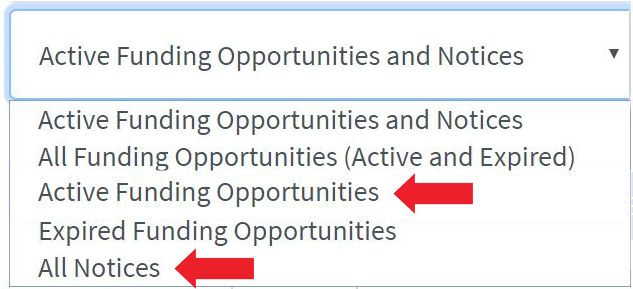
Notices of Special Interest (NOSIs) are displayed in the results when searching either “Funding Opportunities” or “Notices.”

screenshot of search filters showing options to search all funding opportunities, all notices, etc.

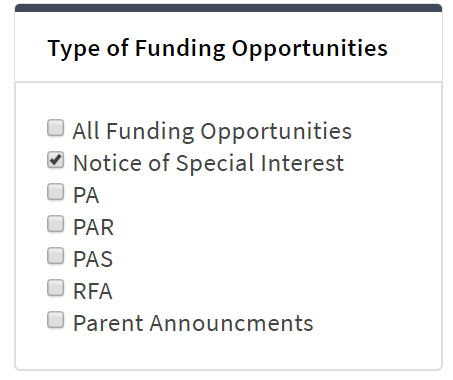
The “Type of Funding Opportunities” filter now includes “Notice of Special Interest.”

Screenshot of Guide Search NOSI filter

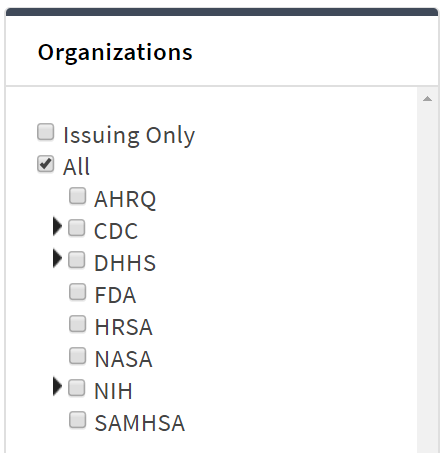
Quickly find notices by organization.

Screenshot of organization filter

NIH publishes funding opportunities and notices in the NIH Guide daily and recaps the week’s postings every Friday afternoon via a Weekly NIH Funding Opportunities and Notices email to the NIH Guide LISTSERV. Subscribe to receive the NIH weekly updates or to follow them on Twitter today!