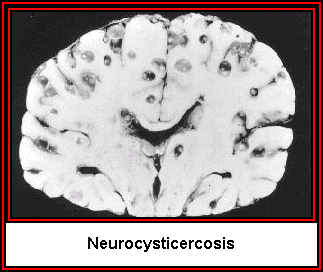
Parasitology is essentially the study of animals who eat their “prey” (termed “hosts”) from the inside out! We talk about microscopic parasites (malaria, hemoflagellates, ameba, etc.) to larger parasites (tapeworms, flukes, nematodes, etc.). There are more parasitic species than any other type of species (e.g., predators, herbivores, etc.), and thus this is an important area to understand as a biologist!
In this course, there are two major emphases. First, we concentrate on the medically-oriented aspects of humans being parasitized. For this aspect of the course, we concentrate on human parasites (and some parasites of domestic animals), discussing how someone becomes parasitized, what the parasite does to the person (i.e., its pathology), how to stop transmission and how to cure a patient. Understanding of the life cycles of these parasites is also emphasized.
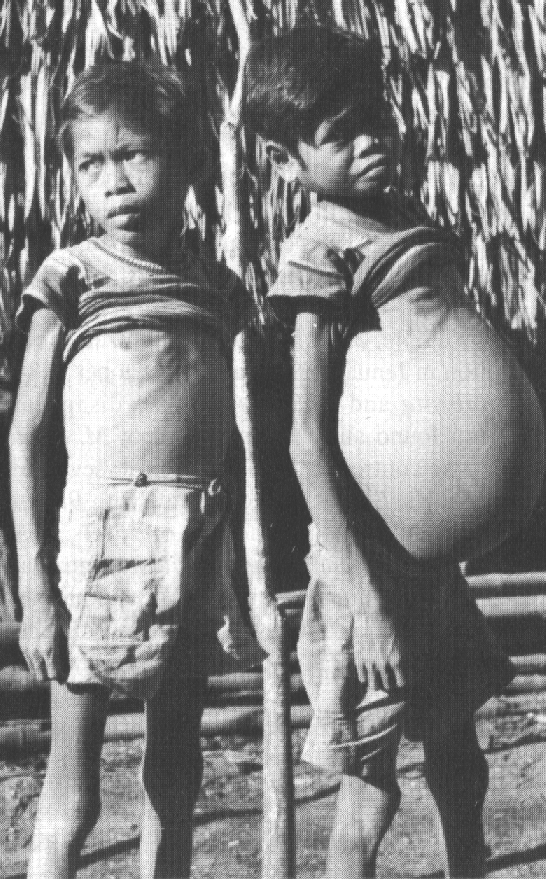
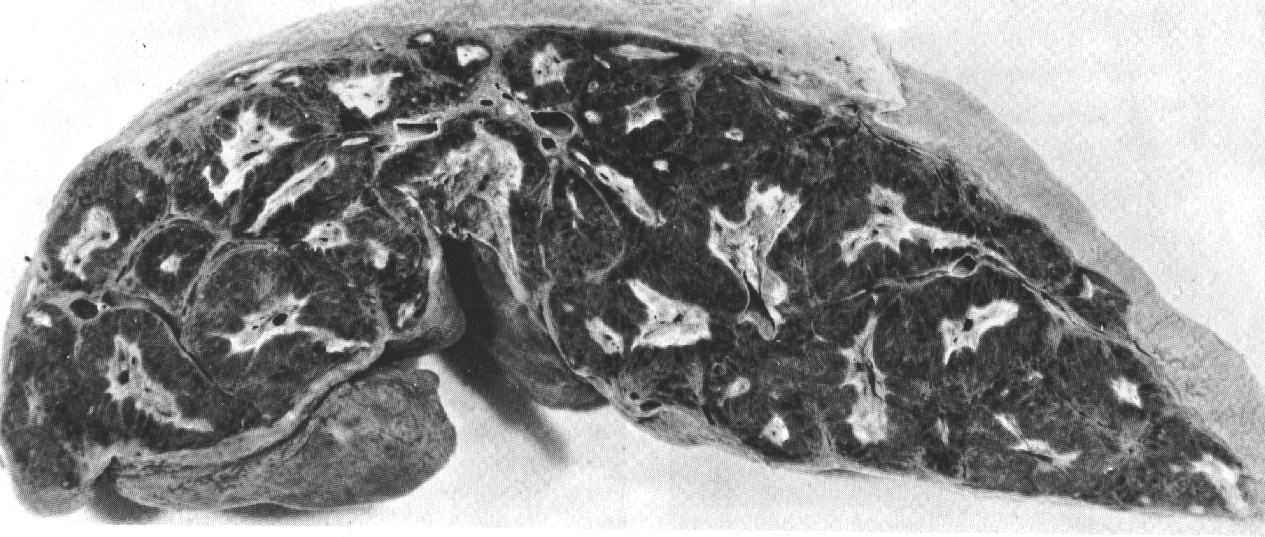
The other emphases we discuss are the important evolutionary and ecological aspects of parasite/host relationships. Coevolution of the host and the parasite is discussed in terms of the “coevolutionary arms race” between the host’s immune system and the parasite’s mechanisms to avoid detection or elimination by the host. We discuss some of the more interesting evolutionary developments of the non-human parasites to “round out” the study of parasitism and to note the interesting evolutionary developments in organisms that have specialized on a parasitic lifestyle.
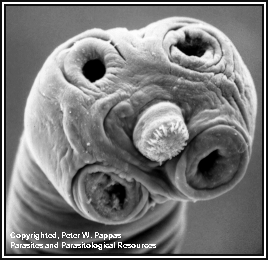
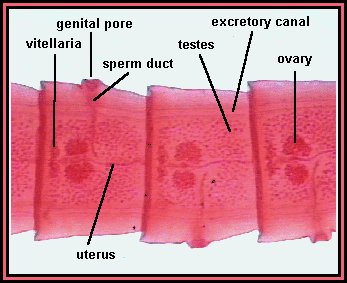
Overall, this online course outlines the single most prolific type of niche for the animal kingdom, and should appeal to both our Biomedical Science students interested in going on to medical school (or other medically-oriented careers) as well as to our general Biology students just interested in interesting critters!
Introductory Lecture –
Sample of first lecture, which outlines subject matter covered in this course
Online Course Description
This is a fully asynchronous online course. We will cover the basic biology, pathology, and epidemiology of important human parasites. The course is divided into two parts: protozoan and worm parasites. In both sections we will discuss the basics of host/parasite interactions, as well as the medical affects of parasitism on humans.
Learning Objectives
- Recall the life cycles and basic biology of the human endoparasites, including the important vectors of parasitic diseases
- Describe the transmission of human parasites and the methods used to interrupt the transmission of these diseases
- Describe the pathological effects of parasites on their human hosts
- Outline the ecology and evolution of parasitism as a way of making a living
- Use pathological symptoms and other evidence to diagnose a parasitic infection
Grading of the course will be as follows: Weekly homework = 40% total; Weekly essays = 40% total; Weekly diagnoses = 20% total. Final grades are based on a “modified” percentage basis (i.e., a partial curve).
Free Textbook: Foundations of Parasitology,” L. S. Roberts and John Janovy, 9th Edition. Textbook will be provided online
NOTE: Your textbook is free and supplied to you in a pdf format on Brightspace!
Other useful Parasitology texts are as follows:
General texts
- Cheng, T. C. General Parasitology
- Marquard and Demaree. Parasitology
- Noble and Noble. Parasitology.
Clinically-oriented texts
- Brooks, T. J. Essentials of Medical Parasitology
- Brown, H. W. and Belding. Basic Clinical Parasitology
- Belding. Textbook of Clinical Parasitology
- Faust, Russel and Jung. Clinical Parasitology
Veterinary texts
- Georgi. Parasitology for Veterinarians
- Soulsby, E. J. L. Helminths, Arthropods, and Protozoa of Domesticated Animals