AkronLawJobs No. 12591: Summer internship with opportunities to work one-on-one with attorneys on active projects in Summer 2021 involving research and writing in the areas of Estate Planning and Administration, Farming and Small Business advising, Contracts, Administrative Law. Interns actively participate in client meetings (virtual during the Pandemic) and court appearances. Our firm maintains a team environment with attorneys and staff with extensive experience. Internships serve as mutually beneficial opportunities to provide interns with practical hands-on experience and provide attorneys with additional support. Day-to-day tasks include research, attending meetings with clients and court appearances, preparation and revision of documents, processing documents for electronic matters and compiling documents for clients retention, general filing, reviewing, organizing and indexing files and assisting with other projects as needed, such as presentation materials. Office business hours are 8:30 – 4:00, when open to the public and internship hours are 8:00 – 5:00 with 1 hour unpaid lunch. Alternate schedules may be available as needed.
Desired Class Level(s): 1L, 2L, 3L
Compensation Details: Hourly $15.00 – $20.00
How To Apply: Send your resume and cover letter to Attorney Elizabeth Krieder Wright at EKWright@BroehlLawOffice.com.
Deadline: May 25, 2021
Category: General Announcements
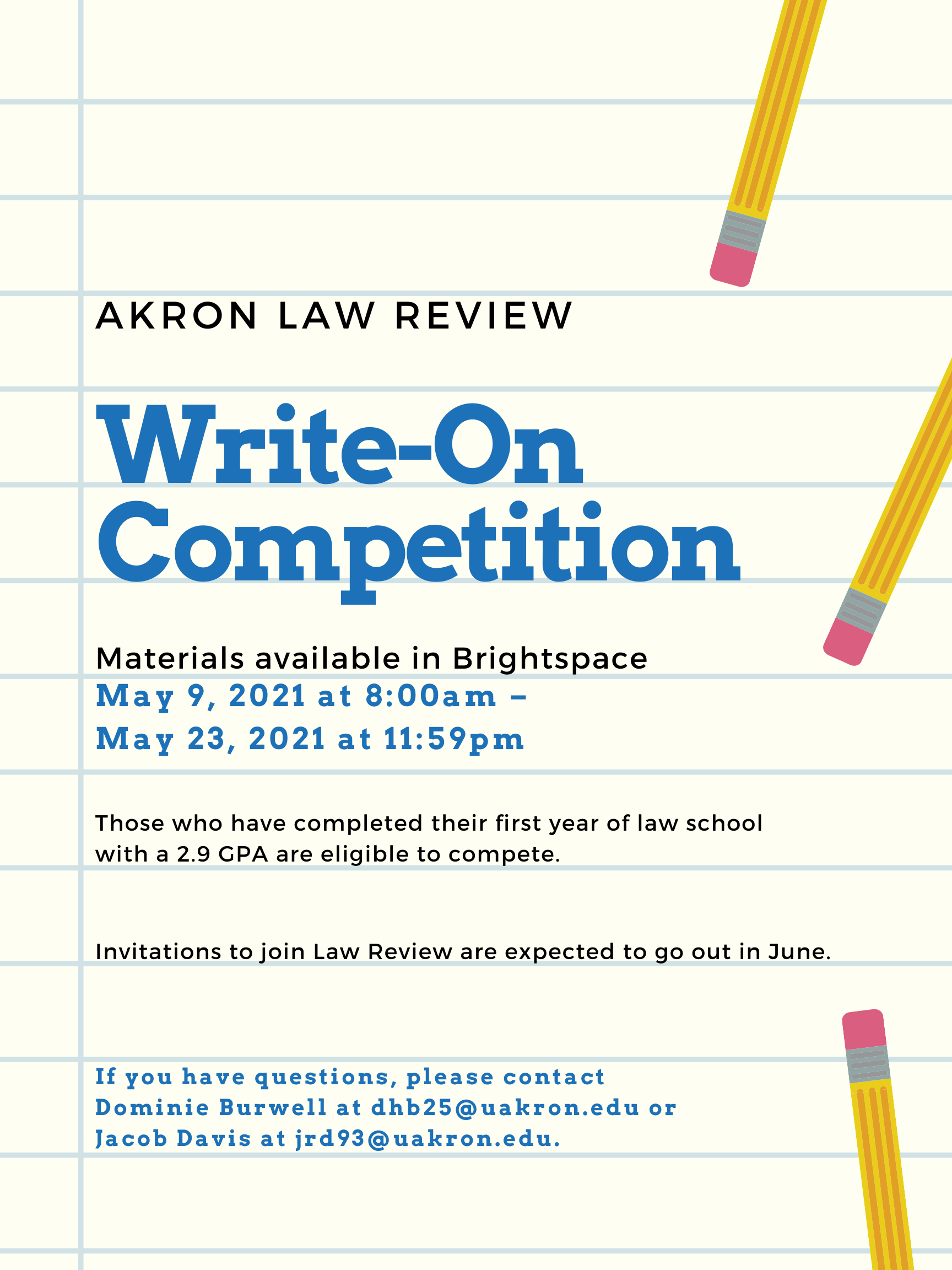
Law Review Write-On Competition
The Akron Law Review Write-On Competition will run from May 9, 2021 at 8:00am – May 23, 2021 at 11:59pm. All competition materials will be available on Brightspace under the Law School Student Resources page starting May 9th.
Those who have completed their first year of law school with a 2.9 GPA are eligible to compete.
Invitations to join Law Review are expected to go out in June.
If selected to be on Law Review, students will go through two mornings of summer training (dates to be determined by the administration) and will be enrolled in the fall Legal Drafting course on Wednesdays from 6:30-8:30pm.
If you have questions, please contact Dominie Burwell at dhb25@uakron.edu or Jacob Davis at jrd93@uakron.edu.
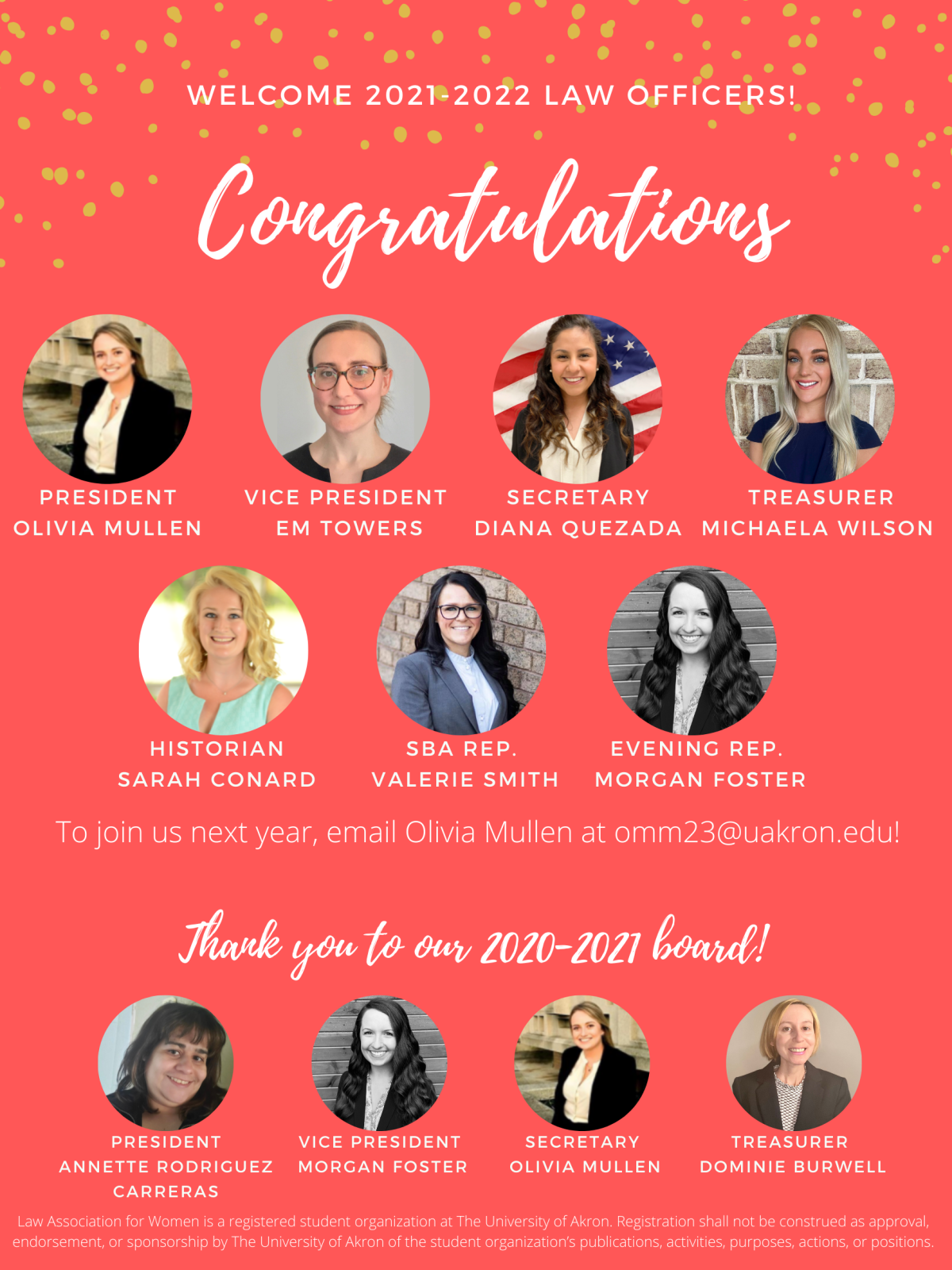
Law Association for Women’s 2021-2022 Board
Law Association for Women has concluded another successful year of sisterhood through networking, volunteerism and fundraising, and educational and members events. This year alone, we raised over $1,900 for the Akron-Canton Regional Foodbank, featured 6 guest speakers, and hosted multiple volunteer events and member meetings.
Congratulations to next year’s board: Olivia Mullen – President, Em Towers – Vice President, Diana Quezada – Secretary, Michaela Wilson – Treasurer, Sarah Conard – Historian, Valerie Smith – SBA Rep., and Morgan Foster – Evening Rep.
Thank you to our current board for their hard work: Annette Rodriguez Carreras – President, Morgan Foster – Vice President, Olivia Mullen – Secretary, and Dominie Burwell – Treasurer.
To join us next year, email Olivia Mullen at omm23@uakron.edu!
Law Association for Women’s 2021-2022 Board
Law Association for Women has concluded another successful year of sisterhood through networking, volunteerism and fundraising, and educational and members events. This year alone, we raised over $1,900 for the Akron-Canton Regional Foodbank, featured 6 guest speakers, and hosted multiple volunteer events and member meetings.
Congratulations to next year’s board: Olivia Mullen – President, Em Towers – Vice President, Diana Quezada – Secretary, Michaela Wilson – Treasurer, Sarah Conard – Historian, Valerie Smith – SBA Rep., and Morgan Foster – Evening Rep.
Thank you to our current board for their hard work: Annette Rodriguez Carreras – President, Morgan Foster – Vice President, Olivia Mullen – Secretary, and Dominie Burwell – Treasurer.
To join us next year, email Olivia Mullen at omm23@uakron.edu!
Consider Digital Forensics with Professor Gentithes this summer
When the modern revolution in digital data collection meets time-honored constitutional traditions and long-established evidentiary rules, how will our courts adjust? Find out in Professor Gentithes’s Digital Forensics course this summer. The course will introduce students to the constitutional parameters and evidentiary limitations that apply to the introduction of digital evidence in both civil and criminal courtrooms. It will also examine emerging topics in the creation and collection of digital evidence, including smart devices for individual use, social media technologies, and data aggregation and analytical methods employed by government bodies and technology giants. Learn to make sense of the data deluge while preserving individual privacy in Digital Forensics!